

 2715 Reads
 16 mins



India’s solar capacity has already crossed 150 GW as of March 2026. The PM Surya Ghar Muft Bijli Yojana subsidy scheme alone has solarized over 30 lakh rooftops. The biggest reason homeowners are going solar is that grid power keeps getting more expensive.
Electricity tariffs in India rise by 3-6% annually. When you install the best solar panels that meet all your home energy needs, your bill drops by at least 90%. Over 25 years, which is the lifespan of a high-quality solar panel, that saves tens of lakhs of rupees.
The key, however, is to install only the best solar panels in India for homes. Wondering how to decide which module is best among the available solar panel variety in India? If that’s been on your mind, too, this guide is a goldmine of answers.
It covers all the factors you should consider to ensure you choose the right solar panel for your needs, why carefully choosing solar panels is so important, and the best panel technology for generating maximum solar electricity.
Why is it so Important to choose the Right Solar Panels in India?
It’s extremely important to choose the right solar panel for your home because the panel you install in 2026 will sit on your roof at least until 2051, as solar panels have a lifespan of 25+ years. The wrong choice can lock in 2.5 decades of underperformance or serious failure of investment.
Here’s why choosing solar panels is such an important thing from a financial point of view:
- Your 25-year ROI hinges on this one decision: A premium panel degrades by ~0.45% a year. A cheap one, on the other hand, can lose 1.5% or more. The lower the panel’s degradation rate, the higher the output will be over the years.
- Indian heat punishes weak panels: Rooftop temperatures can cross 50°C in summer. Panels with a poor temperature coefficient can lose significant output daily.
- Wrong panels will render you ineligible for the subsidy: The PM Surya Ghar Muft Bijli Yojana – the solar subsidy scheme makes homeowners eligible for financial assistance of up to Rs. 78,000 for systems with a capacity of 3 kW or higher. However, this assistance is only for ALMM-approved and DCR-compliant panels.
- Warranties are only as good as the brand: A 25-year solar panel warranty means nothing if the manufacturer exits the market in year 8. That’s why it’s crucial to choose panels only from the best solar panel brands that honor their commitments.
- Payback periods vary by years, not months: Premium TOPCon panels will pay back for themselves in 3 to 5 years. Older modules, on the other hand, have longer payback periods because their output is lower.
Types of Solar Panels in India that You Can Choose From
Here are the different types of solar panels in India that make sense under different scenarios:
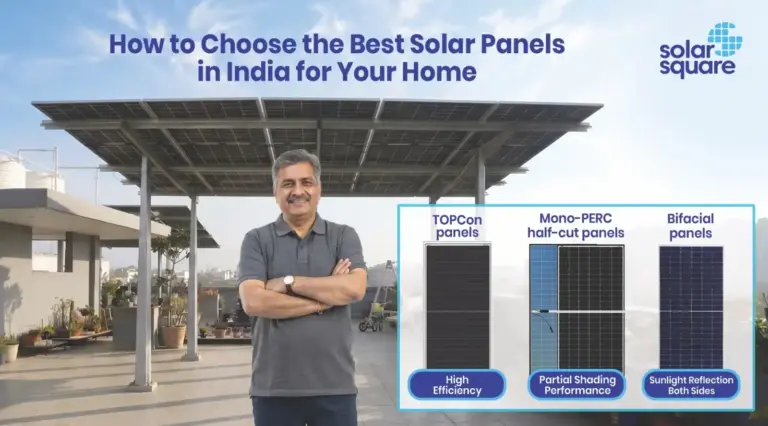
- Mono-PERC half-cut solar panels: With an efficiency of up to 22.5%, these are the best solar panels in India for rooftops where partial shading from water tanks, parapets, or neighboring buildings is a problem.
- TOPCon solar panels: With efficiency up to 26% and a temperature coefficient of -0.30%/°C, these are the best solar panels in India for regions where rooftops cross 50°C in summer.
- Bifacial solar panels: With up to 20% extra generation from rear-side sunlight, these are the best solar panels in India for RCC rooftops where reflected light can hit the back of the module.
10 Factors That’ll Help You Choose the Best Solar Panels in India for Your Needs
Choosing solar panels in India is not a one-size-fits-all decision. The right solar panel for a Bengaluru flat with a 200 sq ft shadow-prone terrace is wrong for a Jaipur bungalow with an 800 sq ft open rooftop and 48°C summers. Specifications alone do not tell you which one is the best solar panel based on your needs.
So, we’ve made a list of 10 factors that, when considered together, will help you pick the best solar panel based on your roof condition, climate, and budget.
#1. Efficiency Rating of the Solar Panel
The efficiency rating tells you how much of the sunlight hitting a solar panel actually gets converted into electricity. For instance, a 22% efficient panel converts 22% of the sun’s energy striking its surface into usable power. The rest is lost as heat or reflection.
Efficiency matters because higher efficiency means more power per square foot of roof. If your rooftop is small, a high-efficiency module means fewer panels to mount and fewer cables to run, resulting in a faster payback per square foot.
Here’s a glimpse of the efficiency rating of different types of solar panels:
- Polycrystalline solar panels: 15-17%. Due to lower efficiency, these modules are obsolete in India.
- Mono-PERC half-cut solar panels: Up to 22.5%
- TOPCon solar panels: 25-26%
#2. Temperature Coefficient of the Solar Panel
The temperature coefficient tells you how much power a panel loses for every degree Celsius above 25°C. Every solar panel is rated at 25°C in lab conditions, but Indian rooftops exceed 50°C in summer. That means real-world output is almost always lower than the specification sheet promises.
Therefore, always choose a solar panel with a lower temperature coefficient so it loses less efficiency as temperatures rise.
#3. Product and Performance Warranty on the solar panel
Solar panels come with two separate warranties.
- The product warranty: It covers manufacturing defects like frame damage or junction box failure, and runs 10 to 15 years.
- The performance warranty: It guarantees how much power the panel will still produce after 25 years, usually 80% to 85% of its original output.
Always check both warranties before buying, and pick a panel that promises at least a 12-year product warranty and 80% output at year 25.
#4. Reputation & After-Sales Support of the Brand/Manufacturer
A 25-year warranty means nothing if the brand you choose is no longer around to honor it. Many smaller solar brands in India have shut down over the years, leaving customers stranded with no service or replacements. The brand you choose today has to still be operating in 2051 to back its promises.
Therefore, always choose well-known solar panel manufacturers like Premier Energies, that have the scale, service network, and stability to support your installation for decades.
#5. Certifications & Quality Standards that are Most Critical to Check
In India, the most important certifications and quality standards to look for are BIS certification, MNRE approval, ALMM listing, and IEC compliance.
For homeowners claiming the PM Surya Ghar subsidy, the panel must also be DCR-compliant, meaning the cells and modules must be made in India.
#6. Your Budget
Solar panel prices in India vary from city to city and from installation to installation, depending on the type of panel. And installing the cheapest option is not a wise choice, as such panels almost always have a high temperature coefficient and a low efficiency rating.
Budgeting for solar panels should be done from the perspective of long-term ROI. For instance, even if a TOPCon solar panel or Mono-perc half-cut bifacial panel costs slightly more upfront, it will generate higher output for 25 years, resulting in a higher ROI than low-efficiency solar panels.
#7. Shadow-free Area Available on Your Roof
Solar panels generate electricity when direct sunlight hits them. Even a small shadow from a water tank, a parapet wall, or a tree can sharply reduce a panel’s output. Thus, you need a shadow-free roof area, ideally between 9 AM and 3 PM, when solar generation is at its peak.
Every 1 kW of solar capacity needs ~80-100 sq ft of shadow-free space. Therefore, always measure your usable rooftop area carefully and choose half-cut cell panels if your roof has any unavoidable shading.
#8. Wattage Rating of the Solar Panel
Solar panel wattage tells you how much power a single panel produces under standard conditions. In 2026, residential solar panels for homes range from 400W to 600W. A higher wattage means fewer panels are needed for the same system size, reducing the need for mounting hardware, cabling, and installation labor.
At the same time, higher-wattage panels are physically bigger and may not fit well on irregular or obstructed rooftops. Therefore, always match the wattage to your roof’s shape and size, and pick 540W-580W TOPCon panels wherever possible.
#9. Climatic Conditions and Pollution Levels in Your City
Heat and pollution reduce panel output, humidity and salt air damage panel construction, and dust blocks sunlight from reaching the cells. That’s why a panel that works perfectly in Pune may fail early in Chennai or struggle to generate electricity in Delhi.
Therefore, always pick a panel built for your local climate. TOPCon and mono-PERC half-cut panels are usually designed to remain intact under all weather conditions. Hence, they’re quite popular among homeowners.
#10. Degradation Rate & Lifespan of the Solar Panel
Every solar panel loses a small percentage of its output every year. This is called degradation, and it is unavoidable.
A standard panel degrades at 0.50% to 0.80% per year, while a premium TOPCon panel degrades at ~0.45%. Over 25 years, this difference adds up to lakhs of rupees in lost generation.
The lower the degradation rate of the panel, the more electricity it will produce as it ages. Therefore, always choose a solar panel with a low annual degradation rate to maximize your solar savings.
How Do the Best Solar Panels in India Work?
Solar panels convert sunlight into electricity through the photovoltaic effect. Photons are energy particles present in sunlight. When sunlight falls on solar cells (building blocks of solar panels), photons transfer their energy to electrons within the cells.
The energized electrons leave their positions and begin to flow in a single direction, producing direct current (DC) electricity.
TOPCon vs Mono-PERC Half-Cut Modules: Which Technology is Better?
TOPCon panels are built on N-type silicon, while Mono-PERC half-cut panels are built on P-type silicon. The difference comes down to how each silicon wafer is doped during manufacturing.
- P-type silicon is made by adding a small amount of boron to pure silicon. This creates a shortage of electrons, which gives the silicon a positive charge.
- N-type silicon is made by adding a small amount of phosphorus to pure silicon. This creates extra electrons, which gives the silicon a negative charge.
N-type silicon is purer, more resistant to light-induced degradation, and better at handling heat. As a result, TOPCon panels outperform Mono-PERC half-cut panels in efficiency rating.
Here’s a side-by-side comparison of both types:
| Feature | Mono-PERC Solar Panels | TOPCon Solar Panels |
| Material used | P-type monocrystalline silicon | N-type silicon |
| How does it work? | It features a rear passivation layer that reflects unused light back into the cell. At the same time, it decreases surface recombination of these charged carriers. | It features an ultra-thin tunnel oxide layer and a polysilicon layer on the rear side. This enhanced passivation makes TOPCon more efficient than Mono-PERC panels. |
| Bifacial gain | ~70% | ~85% |
| Efficiency | Up to 22.5% | Up to 26% |
| High temperature performance | Good | Exceptional |
| Plant degradation rate |
|
|
Why Choose SolarSquare to Install Rooftop Solar at Your Homes?
SolarSquare is India’s #1 home solar company, as listed on the PM Surya Ghar Muft Bijli Yojana – National Portal for rooftop solar. We’ve installed ~170 MW+ (1,70,000 kWp) of solar capacity across 40,000+ homes in India as of April 2026.
Choosing SolarSquare comes with multiple benefits:
- We offer a savings guarantee with a money-back promise. If your rooftop solar system underperforms, we reimburse you at Rs. 8 per unit for the shortfall.
- We offer 5 years* of after-sales maintenance support with monthly visits.
- Our solar mounts are designed to withstand winds of up to 170 km/hr.
*Please note that since June 2026, we offer only TopCon panels in Uttar Pradesh and Nagpur, backed by 4-Year Good Zero Savings Guarantee with money-Back promise. All other terms and benefits of the GoodZero plan remain the same.
For all other states except Uttar Pradesh and Nagpur, our 5-Year Good Zero Savings Guarantee with money-Back promise continues to be available as of now.
As our product offerings (technology) and savings guarantee terms may evolve over time, please connect with your assigned Solar Consultant or schedule a FREE solar consultation with us for the latest information on available panel technologies and guarantee coverage.
If you want to check how much money you can save over 25 years by installing the best solar panels in your city, use SolarSquare’s free solar savings calculator.
Forecast your savings with solar on your investment on the SolarSquare’s plant
Calculate your savings

Conclusion
The best solar panel is neither the cheapest one nor the one with the highest wattage. The best solar panels in India are the ones that offer a combination of:
- High efficiency, so you generate more power from limited roof space.
- Long-term durability, so the panel survives extreme weather conditions.
- A strong warranty that covers both product and performance.
- A brand that will last for as long as the panel does to honor the warranty.
Given the growing solar panel variety, it’s very common for homeowners to get confused. If you still have doubts about rooftop solar installation, you can book a free solar consultation call with SolarSquare.
FAQs
Which solar panel is best for home use in India?
Mono-PERC half-cut bifacial solar panels and TOPCon solar panels are the best two modules in India for homes. They have a high efficiency rating and a lower temperature coefficient, making them a financially sound choice in the long run, as they deliver higher output even as they age.
Which is better, TOPCon or bifacial panels?
TOPCon and bifacial are not competing options, so they cannot be compared directly. TOPCon is a cell technology that defines how a solar cell is built, while bifacial is a panel design that determines whether the panel generates power from one or both sides. A panel can be TOPCon and bifacial at the same time.
Which is better, P-type or N-type solar panels?
N-type solar panels are superior to P-type solar panels because they use purer silicon, handle heat better, and degrade slower. N-type TOPCon panels offer higher efficiency of up to 26% and lower annual degradation rate of ~0.45%. Moreover, N-type panels generate more electricity over their lifetime, making them the smarter choice for most Indian homes.
Which solar panel is better, mono or bifacial?
Bifacial solar panels are usually better when the rooftop they’re being installed on top of is reflective. They can capture sunlight on the front and reflected light on the back, boosting output by 10-20%.
How long do solar panels last in India?
High-quality tier-1 solar panels last for 25 years. When well maintained throughout their life, they continue to generate power at 80% efficiency even after 25 years.


 Previous Article
 13 min


![10 kW Solar Panel Price in India [With and Without a Subsidy]](https://cdn.solarsquare.in/blog/wp-content/uploads/2025/07/18165650/10-KW-solar-panel-300x167.webp)