

 535 Reads
 18 mins


Nagpur summers are among the hottest in India, with temperatures reaching ~46°C. While solar panels need sunlight to generate electricity, very high temperatures can reduce their efficiency.
Solar panels are tested at a standard cell temperature of 25°C. Every 1°C increase in cell temperature above 25°C reduces solar panel output by 0.3-0.5% . Since panels installed on a rooftop can become much hotter than the surrounding air, the drop in generation during peak summer afternoons is noticeable.
So, does this mean solar panels are unsuitable for Nagpur summers? Absolutely not! The amount of power lost depends on the type of panel you choose and how the system is installed.
| To ensure Nagpur heat doesn’t render solar unfit for your roof, choose TOPCon (Tunnel Oxide Passivated Contact) or mono-PERC (Monocrystalline Passivated Emitter and Rear Cell) panels with a temperature coefficient close to -0.30%/°C, install them on an elevated structure with proper airflow, and keep the inverter shaded and ventilated. When you choose the right panel technology and installation design, the heat stops eating into your savings. |
In this guide, we explain how heat affects solar panel efficiency, how hot panels can get on a rooftop in Nagpur during summer, whether the efficiency loss due to heat is permanent, and what you can do to keep generation high throughout the summer. With the right panels and installation, you can continue producing reliable solar power and reduce your electricity bills by up to 90%.
Why Does Heat Lower Solar Panel Efficiency?
Solar panels are rated at a standard cell temperature of 25°C. When the cells heat up, their voltage drops. Since a panel’s power output depends on both voltage and current, the fall in voltage reduces the total electricity produced. This is why a panel can receive strong sunlight but still generate less solar electricity than its rated capacity on a very hot afternoon.
The exact loss depends on the panel’s temperature coefficient of Pmax, which is mentioned on its datasheet.
For example, a coefficient of -0.40% per °C means the panel loses 0.40% of its rated output for every 1°C rise in cell temperature above 25°C.
So, if the panel temperature reaches 65°C, it is 40°C above the standard rating temperature. In that case, the output loss would be 16% (40 × 0.40%).
However, the good news is that heat does not damage the panel during normal operation. It only reduces its power output until the panel cools down.
How Hot Solar Panels Actually Get in Nagpur?
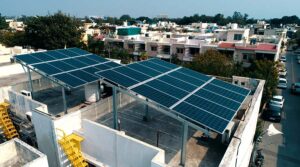
Rooftop solar panels in Nagpur can reach a cell temperature of 60°C to 70°C during peak summer afternoons, even when the outside temperature is 46°C. This happens because the dark solar cells and glass absorb heat, making the panels ~15°C to 25°C hotter than the surrounding air.
- At a cell temperature of 60°C to 70°C, the panel is 35°C to 45°C above its standard rating temperature of 25°C.
- With an output loss of around 0.3% to 0.5% for every 1°C rise, the panel may generate roughly 10% to 22% less power during the hottest hours of the day.
This is where high-efficiency solar panels with a lower temperature coefficient perform better. They lose less power in extreme heat and continue generating more electricity even when rooftop temperatures are at their highest.
How to Keep Solar Panels Efficient in Nagpur During Summers?
Nagpur’s extreme heat can reduce solar panel output, but the right choices can keep this loss under control. Choosing panels that perform well at high temperatures, allowing enough airflow beneath them, and keeping them clean can help your system generate more electricity throughout the summer.
Here are 10 of the most effective ways to protect solar panel efficiency during Nagpur’s hottest months.
#1. Choose the Right Panel Technology for High-Temperature Performance
The most important step is to choose a panel that loses less power as it gets hotter. Solar panels are rated at a cell temperature of 25°C, but panels on a Nagpur rooftop can become much hotter during 46°C summer afternoons.
Once the cell temperature rises above 25°C, the panel’s output starts falling. The rate of this loss is shown by its temperature coefficient of Pmax.
For example, a panel with a coefficient of -0.40%/°C loses more power in heat than one rated at -0.29%/°C. The value closer to zero is better because it means the panel loses less output at high temperatures.
Always check this figure on the panel datasheet before buying.
These are the two solar panel technologies well suited to Nagpur’s hot climate:
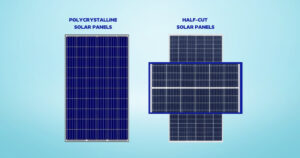
- Mono PERC half-cut bifacial panels: The half-cut cell design splits each cell in two, which lowers internal resistance and lets the panel run slightly cooler and more efficiently in strong sunlight. The bifacial rear surface captures reflected light from the roof, increasing output on long summer days.
- TOPCon panels: TOPCon panels use N-type cells and have a better temperature coefficient than P-type panels. This means they lose less power in extreme heat. They also tend to degrade more slowly over time, helping maintain generation for longer.
Whichever technology you choose, compare the exact temperature coefficient of Pmax rather than relying solely on the panel type or brand name.
#2. Compare Panels by Temperature Coefficient, Not Just Wattage
A 550W panel is not always better than a 535W panel for Nagpur. If the 550W panel loses more power in high temperatures, the difference in actual generation may become much smaller during hot summer afternoons.
The wattage printed on a solar panel is measured at a standard cell temperature of 25°C. But in Nagpur, rooftop panels operate far above this temperature. That is why you should compare the full datasheet rather than choosing a panel based solely on its wattage.
Always ask these questions before saying yes to a panel in Nagpur:
- What is the temperature coefficient of Pmax? A lower negative value means less power lost per degree of heat.
- What is the NOCT (Nominal Operating Cell Temperature) or NMOT (NMOT stands for Nominal Module Operating Temperature) value? This tells you the panel’s expected operating temperature under realistic conditions, not lab conditions.
- Is the panel P-type or N-type? N-type cells usually handle heat and degradation better.
- Is it mono PERC, TOPCon, HJT, or bifacial? The technology decides both efficiency and heat behavior.
- What is the year-one degradation and annual degradation? A lower degradation rate means the panel holds its output longer.
- Is the model eligible under current residential rooftop solar requirements? Make sure the model meets the current requirements for residential rooftop solar, especially if you plan to claim the PM Surya Ghar Muft Bijli Yojana subsidy. This can also help protect solar panel warranty and installation claims.
#3. Use an Elevated Mounting Structure That Allows Heat to Escape
Solar panels absorb heat from both the sun and the roof below. In Nagpur, concrete rooftops can become extremely hot during summer. If panels are installed too close to the roof, hot air gets trapped beneath them, raising their operating temperature.
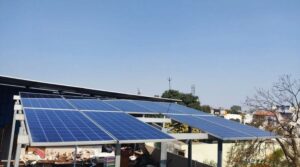
An elevated mounting structure provides enough clearance for air to flow beneath the panels. This airflow helps carry heat away, keeps the panels cooler, and reduces power output loss.
The extra height also makes it easier to clean the panels and carry out maintenance throughout the year.
#4. Design the Tilt and Direction for Both Sunlight and Heat Control
The tilt and direction of solar panels affect both electricity generation and maintenance. In Nagpur, panels should be installed at an angle that captures good sunlight year-round while also allowing dust and water to slide off.
- Panels installed too flat collect more dust and dirt.
- This layer blocks sunlight and reduces generation, especially during dry summer months.
A proper tilt also helps rainwater and cleaning water to drain away instead of leaving dirty patches on the surface. When the panels face the right direction and are installed at a suitable angle, they stay cleaner and generate more electricity.
#5. Prevent Partial Shading Because Heat and Shade Together Create Bigger Losses
Even a small shadow can reduce the output of several solar panels because panels are often connected in strings. Shadows from water tanks, parapet walls, dish antennas, or tree branches can therefore cause a much bigger loss than expected.
Partial shading can also place extra stress on shaded cells when the rest of the panel receives strong sunlight, leading to solar panel defects such as hotspots.
To prevent this:
- Check shadows before installation: The installer should study how shadows move across the roof in the morning, afternoon, and evening before deciding the panel layout.
- Keep panels away from tall objects: Avoid placing panels behind water tanks, walls, trees, or other structures that can cast shadows during peak generation hours.
#6. Keep Panels Clean Without Creating Thermal Shock
Dust, bird droppings, and pollution can build up quickly on solar panels during Nagpur’s dry summer months. This layer blocks sunlight from reaching the cells and reduces electricity generation.
Regular cleaning helps, but the timing matters.
- Solar panels can become extremely hot in the afternoon.
- Pouring cold water on their glass surface suddenly creates thermal stress.
- Over time, this increases the risk of micro-cracks or damage.
Panels should ideally be cleaned early in the morning or late in the evening, when the surface is cooler. Avoid using harsh brushes, abrasive materials, or high-pressure water, as these can damage the glass.
#7. Keep the Inverter Cool
A solar inverter can also lose performance in extreme heat. When it gets too hot, the inverter automatically reduces the power it processes to protect internal components. This is known as derating.
On a 46°C afternoon in Nagpur, an inverter installed in direct sunlight or inside a closed space can heat up quickly and reduce output during peak generation hours.
To avoid this:
- Install the inverter in a shaded and well-ventilated area
- Protect it from direct afternoon sun
- Have enough empty space around it for air to circulate
Here’s an example of a temperature derating curve.
For every 1°C increase in ambient temperature, the inverter limits the peak power by 3-4%.
What actually happens during higher ambient temperatures (e.g. at Tamb = 45°C):
- Tmod (module temperature) will be 25-30°C higher than Tamb, Tmod = 70°C
- Temperature loss in solar panels = -0.34% x (70-25) = 15.5%
- Best case output by solar panels = 2.4 kW (15.5% Temperature loss and 10% other system losses)
- Inverter will decrease max power by 5°C x 4%/°C = 20%
- So, the 3 kW inverter will be limited to = 3 x (1-20%) = 2.4 kW
#8. Use UV-Resistant Wiring, Connectors, and DC Components
Nagpur’s strong summer sun can damage ordinary cables and connectors over time. Cracked insulation, loose connections, or overheated joints can reduce power output and create safety risks.
Since the DC side of a solar system carries high voltage, all outdoor components should be designed for heat, sunlight, and rooftop conditions.
Ask your installer to use:
- Solar-grade DC cables: These solar wires are designed to carry direct current safely in outdoor conditions.
- UV-resistant cable insulation: This protects cables from cracking or becoming brittle under constant sunlight.
- Compatible MC4 solar connectors: Properly fitted MC4 connectors reduce the risk of loose joints, overheating, and power loss.
- Safe cable routing: Cables should be kept away from sharp edges and properly secured in conduit trays to prevent damage.
- Correct earthing and lightning protection: These help protect the system during faults and summer storms.
- Certified DCDB (Direct Current Distribution Box) and ACDB (Alternating Current Distribution Box) units: These protection boxes help safely and reliably manage faults.
- Professional crimping and testing: Every connection should be crimped correctly and tested before the system is handed over.
#9. Track Summer Generation Through Monitoring, Not Guesswork
Solar generation naturally drops during very hot summer afternoons, but not every drop in output is due to heat. Without proper monitoring, a real fault can go unnoticed for days or even weeks.
A solar monitoring system lets you track your PV system’s daily and hourly generation. This makes it easier to determine whether the drop is due to high temperature or a sign of a problem that requires a solar inspection.
Watch for signs such as:
- A sudden fall in generation across the entire day
- Repeated inverter warnings or error messages
- Low output even after a clear and sunny morning
- A noticeable drop compared with similar days
Regular monitoring helps you identify problems early and get them checked before they cause a larger loss in generation.
#10. Choose an Experienced Installer Who Designs Solar for Nagpur’s Heat
Even the best solar panels will not perform well if the system is poorly designed or installed. The installer decides the panel height, tilt, airflow, shading layout, inverter location, and wiring quality, all of which directly affect generation during Nagpur’s extreme summers.
This is where experience matters.
SolarSquare is the #1 home solar installation company in Nagpur, with 35128 kWp of rooftop solar installed across 9126 homes in the city as of 01 September 2026, according to the PM Surya Ghar Muft Bijli Yojana National Portal for Rooftop Solar.
We have designed and installed thousands of PV systems under the same heat, rooftop, dust, and weather conditions you face. This experience helps us ensure that panels are mounted with proper airflow, placed away from shade, and supported by an inverter and electrical design capable of handling peak summer temperatures.
The best part?
We back our installations with a generation guarantee promise.
- Our experts predict how many units your system should generate.
- If the actual generation falls short, we reimburse you ₹8 per lost unit.
Installation Tips to Reduce Heat-Related Losses in Nagpur
Choosing the right solar panels is only half the job. The way the system is installed also affects how much heat builds up and how well it performs during Nagpur’s summer.
A heat-aware installation should:
- Leave enough space below the panels: A proper air gap allows hot air to escape from underneath the modules and helps keep them cooler.
- Use the right tilt and direction: The correct angle improves annual generation and allows dust, rainwater, and cleaning water to slide off more easily.
- Maintain space between panel rows: Enough distance between rows improves airflow and prevents one row from casting shadows on another.
- Install the inverter in a shaded, well-ventilated area: Keeping the inverter away from direct sunlight reduces overheating and lowers the risk of derating.
- Design cables and strings for high temperatures: Correct cable sizes, string lengths, and heat-rated components help prevent electrical losses, overheating, and faults.
Does Heat Damage Solar Panels Permanently?
No, summer heat does not permanently damage solar panels. The drop in efficiency during a hot afternoon is temporary, and generation improves again as the panels cool in the evening and the following morning.
The only exception is hotspots. These can form when a cell is repeatedly affected by heavy shading, dirt, or a manufacturing defect. Over time, the affected area can become unusually hot, causing lasting damage to that part of the panel.
- A hot climate by itself does not directly shorten the life of a solar panel.
- Simply operating through Nagpur’s summer does not cause permanent damage or long-term loss in generation.
This is why proper shading analysis, regular cleaning, and good-quality panels are important. Prevent hotspots, and Nagpur’s heat should not leave any permanent effect on your panels or their performance.
Real Numbers: What Nagpur’s Heat Actually Costs You Per Year
The estimate below is based on a 3.24 kWp solar panel system installed by SolarSquare, paired with a 3 kW inverter. It assumes an electricity rate of ₹15 per kWh.
The month-by-month impact is shown below.
| Month | Generation From a 3.24 kW System | Value of Generation Lost to Heat | Net Electricity Bill Savings @ ₹15 per kWh |
| January | 365 units | 17 units | ₹5,480 |
| February | 384 units | 26 units | ₹5,760 |
| March | 462 units | 43 units | ₹6,930 |
| April | 468 units | 54 units | ₹7,020 |
| May | 468 units | 57 units | ₹7,020 |
| June | 352 units | 31 units | ₹5,280 |
| July | 264 units | 15 units | ₹3,970 |
| August | 274 units | 14 units | ₹4,110 |
| September | 326 units | 21 units | ₹4,900 |
| October | 401 units | 27 units | ₹6,020 |
| November | 381 units | 21 units | ₹5,720 |
| December | 360 units | 16 units | ₹5,390 |
| Total | 4,507 units | 342 units | ₹67,600 |
Please note: The unit generation, generation loss, and net savings listed above are estimated values from an actual rooftop solar system installed by SolarSquare in Nagpur. These values can vary significantly depending on the system size you install, the type of panel and inverter chosen, the temperature conditions in your area, the electricity tariff in your city, and how well the solar system is maintained over its lifetime.
Take any month into consideration. The units lost to heat represent a very small loss compared to the bill savings you achieve. If you don’t install a rooftop solar system, you’ll actually be investing all that money into paying hefty bills. That’s actual revenue loss.
Can Rooftop Solar Still Cut Nagpur Electricity Bills by 90%?
A well-designed rooftop solar system will reduce electricity bills in Nagpur by up to 90%, even after accounting for summer heat.
The temporary drop in efficiency during hot afternoons is considered when the system is sized correctly. Nagpur also receives strong sunlight for much of the year, which helps offset the small loss during peak summer hours.
In simple terms, the panels may generate slightly less when they are extremely hot, but they still produce strong annual output.
Over 25 years of generating almost free solar electricity, a rooftop solar system in Nagpur can save tens of lakhs of rupees you would have otherwise had to invest into paying hefty electricity bills had you not had solar.
Don’t believe us? Here’s a tabulated snapshot of solar savings and ROI you can receive in Nagpur by going solar:
| Solar System Size | Savings Over 25 Years in Nagpur* | Return on Investment (ROI) |
| 2 kW | ~₹ 12.23 lakh | 9.8x |
| 3 kW | ~₹ 18.35 lakh | 12.1x |
| 4 kW | ~₹ 24.47 lakh | 11.7x |
| 5 kW | ~₹ 37.83 lakh | 13.8x |
| 10 kW | ~₹ 75.67 lakh | 13.3x |
*Please note: When calculating savings, we have considered an annual tariff escalation of 3% and an annual plant degradation rate of 1%. The actual final savings from rooftop solar in Nagpur depend on the types of solar panels you’ve installed and their efficiency, intensity of sunlight your rooftop receives, orientation of the panels and tilt angle, the pollution level and weather conditions in your city, the temperature, shadow on the roof, impact of dirt/dust, and how well you maintain your panels after installation.
Want to install rooftop solar in Nagpur that will generate maximum power despite the heat? Book a free solar consultation call with SolarSquare.
FAQs
Why does the latest solar panel technology perform better in Nagpur heat?
Newer technologies such as TOPCon and half-cut bifacial panels have a better temperature coefficient. This means they lose less power as the panel temperature rises. In Nagpur, where solar panels can reach 60°C to 70°C in summer, even a small difference in the temperature coefficient can lead to better generation during hot afternoons.
What temperature coefficient should Nagpur homeowners look for?
Look for a temperature coefficient of Pmax that is closer to zero. The closer the value is to zero, the less power the panel loses in heat. It’s best to install panels whose temperature coefficient doesn’t vary much.
Which solar panel is best for high temperatures?
TOPCon and mono PERC half-cut panels are both good choices for hot climates.
- TOPCon panels use N-type cells and usually have a better temperature coefficient and a lower degradation rate.
- Mono PERC half-cut panels perform well in strong sunlight and are suitable for rooftops in Nagpur.
How hot is too hot for solar panels?
Solar panels are designed to work at temperatures much higher than the surrounding air temperature. In Nagpur, rooftop panels may reach 60-70°C during summer afternoons. At these temperatures, the panels may temporarily generate less power, but their output improves once they cool down. Nagpur’s 46°C summer heat does not cause permanent damage to a good-quality, well-maintained panel.
How much efficiency do solar panels lose when hot?
Solar panels generally lose around 0.3% to 0.5% of output for every 1°C rise above 25°C. If a panel reaches 60°C to 70°C, it is 35°C to 45°C above its standard rating temperature. This can reduce output by 10% to 22% during the hottest part of the day.
Can I spray water on hot solar panels to cool them down?
No, spraying cold water on very hot panels can create a sudden temperature change, known as thermal shock. This may increase the risk of micro-cracks on the solar panels.
Do solar panels stop working in Nagpur’s extreme summer heat?
No, solar panels continue working during Nagpur’s summer. They generate slightly less electricity during the hottest afternoon hours, but they do not stop producing power. Strong sunlight keeps overall generation high, and the panels return to their normal efficiency as soon as they cool down.
Does the inverter also lose efficiency in Nagpur’s summer heat?
Yes, with higher ambient temperatures, there is a chance of temperature derating in the inverters. Usually, good-quality inverters only start derating above 40°C. And if the inverter mounting is done as per the manual, with the necessary clearances maintained and direct exposure to sunlight avoided, the chance of derating reduces significantly.


 Previous Article
 21 min