

 16449 Reads
 21 mins


The solar panel price in India with subsidy for on-grid solar systems at homes ranges between ~Rs. 93,000* in Lucknow to ~Rs. 1.53 lakh* in Bangalore for 2 kW systems and ~Rs. 4.72 lakh* in Lucknow to ~Rs. 5.72 lakh* in Bangalore for 10 kW systems. The solar panel price per watt for DCR subsidy projects for homes translates to ~Rs. 24* + GST.
*Please note prices are subject to change.: The solar panel price in India for on-grid solar systems listed in the section above is indicative as of 09th July 2026 for the SolarSquare Blue 6ft variant. The final solar plate price depends on your DISCOM charges, city, product variant opted for, panel type, inverter type, mounting structure height, type of after-sales service, savings guarantee, roof height, etc. Also, DCR solar panels are ALMM-approved, made-in-India panels eligible for a solar subsidy.
Furthermore, the solar panel price per watt for homes differs from that for housing societies and commercial installations.
- For housing societies: The solar panel price per watt is ~Rs. 40* to ~Rs. 45* with a subsidy.
- For commercial and industrial installations: The solar panel cost per watt ranges from ~Rs. 42* for systems below 100 kW to ~Rs. 28* for solar systems with 1 MW or higher capacity.
*Please note: The above-mentioned solar panel price per watt for on-grid systems is indicative and not fixed. The final cost of installing on-grid rooftop solar systems for housing societies and commercial complexes depends on your DISCOM charges, city, product variant opted for, panel type, inverter type, mounting structure height, type of after-sales service, savings guarantee, roof height, number of floors, etc. Prices are subject to change.
The type of solar panels and inverters you choose, as well as the brand reputation, are critical factors that affect the solar system installation cost in India. For example, high-efficiency half-cut solar panels made with TOPCon or PERC technology tend to cost more than polycrystalline solar panels. But they’re still preferred because, when compared to almost-obsolete poly panels, they generate more electricity, perform better under shade and at high temperatures, and offer higher solar savings over 25 years.
In this blog, we’ve explained the cost of installing rooftop solar panel systems for homes, conditions to avail a solar subsidy, and the benefits of on-grid over off-grid solar systems. We’ve also provided a detailed breakdown of the solar panel price per watt for homes, housing societies, and commercial complexes, explaining the factors that affect the cost and the myths you shouldn’t pay heed to when purchasing solar panels.
TL;DR Summary Box: Is There a Subsidy on Solar Panels in India?
Residential customers (homes and housing societies) in India receive financial assistance from the central government through a subsidy under the PM Surya Ghar Muft Bijli Yojana.
- Maximum PM Surya Ghar Subsidy for Homes: Capped at Rs. 78,000 for 3 kW or higher capacity solar systems.
- Maximum PM Surya Ghar Subsidy for Housing Societies: Capped at Rs. 90 lakh for 500 kW or higher capacity solar systems.
The final solar panel price in India is significantly lower if customers are eligible for the PM Surya Ghar subsidy.
Here are the main topics covered in this blog in detail:
| Main Topics | Key Takeaways |
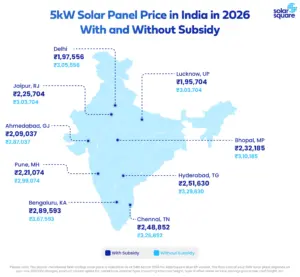
| What is the solar panel price in 2026 in India without subsidy?* |
|
| How much is the solar subsidy in India under the PM Surya Ghar Muft Bijli Yojana? | It’s capped at Rs. 78,000 for 3 kW or higher-capacity systems for homes and at Rs. 90 lakh for 500 kW or higher-capacity systems for housing societies. |
| What is the solar panel price in India with subsidy in 2026?* | Post-subsidy, a 2 kW solar system can cost as low as ~Rs. 93,000 in Lucknow and up to ~Rs. 1.53 lakh in Bangalore. A 10 kW system starts at ~Rs. 4.72 lakh in Lucknow and can go up to ~Rs. 5.72 lakh in Bangalore. |
| What is the solar panel price per watt for homes for DCR on-grid projects?* | For residential DCR-compliant systems, the solar panel cost per watt is ~Rs. 24 + GST. |
| What is the solar panel price per watt for housing societies for DCR on-grid projects?* | Housing societies pay ~Rs. 40-45 per watt with subsidy. |
| What is the solar panel cost per watt for commercial complexes for on-grid projects?* | Commercial systems cost ~Rs. 42/Wp for <100 kW and drop to ~Rs. 28/Wp for 1 MW+ systems. |
| Top factors that affect the solar cell price in India | Panel type, inverter technology, brand quality, mounting structure height, warranty, and location-based charges significantly impact the total system cost. |
| On-grid vs off-grid systems: Which is better for homes and why? | On-grid solar is better for homes due to lower cost, no battery requirement, and easy access to solar net metering. Off-grid is ideal for remote locations without grid power. |
| Myths about rooftop solar cost in India | Common notions like solar is only for big homes or only large systems get subsidies are false. Even 1 kW-2 kW systems get financial support and deliver a solid ROI. |
*Please note prices are subject to change: The solar panel price in India for on-grid solar systems listed in the section above is indicative and not fixed. The final solar plate price depends on your DISCOM charges, city, product variant opted for, panel type, inverter type, mounting structure height, type of after-sales service, savings guarantee, roof height, etc. Prices are subject to change, depending on whether they’re for homes, housing societies, or commercial complexes. Also, DCR solar panels are ALMM-approved, made-in-India panels eligible for a solar subsidy.
What is the Solar Panel Price in 2026?
The solar panel price in India in 2026 for homes depends on whether you’re eligible for a solar subsidy under the PM Surya Ghar Muft Bijli Yojana. In this section, we first explain the solar panel price without subsidy, then provide details on who qualifies for a subsidy (and how much).
Let’s first check out the solar panel price in India that you’ll have to pay if you are not eligible to receive a subsidy in 2026:
| Solar System Size | Solar Panel Price in India without Subsidy (Starting Price – Indicative for Base Variant)* |
| 2 kW solar system | Ranges from ~Rs. 1.83 lakh in Lucknow to ~Rs. 1.90 lakh in Bhopal, and ~Rs. 2.13 lakh in Bangalore. |
| 3 kW solar system | Ranges from ~Rs. 2.13 lakh in Lucknow to ~Rs. 2.23 lakh in Bhopal, and ~Rs. 2.47 lakh in Bangalore. |
| 4 kW solar system | Ranges from ~Rs. 2.70 lakh in Lucknow to ~Rs. 2.70 lakh in Bhopal and ~Rs. 2.93 lakh in Bangalore. |
| 5 kW solar system | Ranges from ~Rs. 3.27 lakh in Lucknow to ~Rs. 3.33 lakh in Bhopal, and ~Rs. 3.83 lakh in Bangalore. |
| 10 kW solar system | Ranges from ~Rs. 5.80 lakh in Lucknow to ~Rs. 5.90 lakh in Bhopal, and ~Rs. 6.50 lakh in Bangalore.. |
*Please note: The solar panel price in India for on-grid solar systems listed in the section above is indicative as of 09th July 2026 for the SolarSquare Blue 6ft variant. The final solar plate price depends on your DISCOM charges, city, product variant opted for, panel type, inverter type, mounting structure height, type of after-sales service, savings guarantee, roof height, etc. Prices are subject to change.
How Much is the Solar Subsidy in India?
Indian homeowners can receive a maximum subsidy of Rs. 78,000 for 3 kW or higher capacity solar systems under the PM Surya Ghar Muft Bijli Yojana if they meet certain eligibility conditions, listed below:
- You’re an Indian citizen installing a grid-connected solar system with made-in-India ALMM-approved solar panels.
- You have never received a subsidy for systems up to 3 kW before.
- You are the legal owner of the property where the installation is taking place.
- You will use the system for personal use. Commercial rooftop systems are not eligible for a subsidy under this scheme.
- You have a valid electricity connection in your name with your local DISCOM.
If you meet the conditions listed above, you can claim the below-listed subsidy as a homeowner under the PM Surya Ghar Muft Bijli Yojana:
| Solar System Size | Subsidy on Solar Panels Under the PM Surya Ghar Muft Bijli Yojana |
| 1 kW solar system | Rs. 30,000 |
| 2 kWp solar system | Rs. 60,000 |
| 3 kWp solar system | Rs. 78,000 |
| 4 kWp solar system | Rs. 78,000 |
| 5 kWp solar system | Rs. 78,000 |
| 10 kWp solar system | Rs. 78,000 |
UP and Delhi homeowners receive a special state subsidy in addition to the solar subsidy under the PM Surya Ghar Muft Bijli Yoajana.
- Additional state solar subsidy in UP for 1-2 kW solar systems: Rs. 15,000/ kW
- Additional state solar subsidy in UP for systems >=2 kW: Rs. 30,000
- Additional state solar subsidy in Delhi: Rs. 10,000 per kW for solar systems up to 3 kW.
Based on the details above, here’s a snapshot of the total solar subsidy in Delhi and UP:
| Solar System Size | Solar Subsidy in India Under the PM Surya Ghar Yojana | Total Solar Subsidy in Delhi | Total Solar Subsidy in UP |
| 1 kW | Rs. 30,000 | Rs. 40,000 | Rs. 45,000 |
| 2 kW | Rs. 60,000 | Rs. 80,000 | Rs. 90,000 |
| 3 kW | Rs. 78,000 | Rs. 1,08,000 | Rs. 1,08,000 |
| 4 kW | Rs. 78,000 | Rs. 1,08,000 | Rs. 1,08,000 |
| 5 kW | Rs. 78,000 | Rs. 1,08,000 | Rs. 1,08,000 |
| 10 kW | Rs. 78,000 | Rs. 1,08,000 | Rs. 1,08,000 |
Solar Price List in India in 2026 for Different Capacity Solar Systems with Subsidy
Now that you know how much solar subsidy you can get, let’s check out the solar price list in India with subsidy for different capacity solar systems across various cities:
| Solar System Size | Solar Price List in India’s Lucknow with Subsidy (Starting Price – Indicative for Base Variant)* | Solar Price List in India’s Pune with Subsidy (Starting Price – Indicative for Base Variant)* | Solar Price List in India’s Bhopal with Subsidy (Starting Price – Indicative for Base Variant)* | Solar Price List in India’s Bangalore with Subsidy (Starting Price – Indicative for Base Variant)* |
| 2 kW | ~Rs. 93,000 | ~Rs. 1.23 lakh | ~Rs. 1.30 lakh | ~Rs. 1.53 lakh |
| 3 kW | ~Rs. 1.05 lakh | ~Rs. 1.37 lakh | ~Rs. 1.45 lakh | ~Rs. 1.69 lakh |
| 4 kW | ~Rs. 1.62 lakh | ~Rs. 1.82 lakh | ~Rs. 1.92 lakh | ~Rs. 2.15 lakh |
| 5 kW | ~Rs. 2.19 lakh | ~Rs. 2.45 lakh | ~Rs. 2.55 lakh | ~Rs. 3.05 lakh |
| 10 kW | ~Rs. 4.72 lakh | ~Rs. 5.05 lakh | ~Rs. 5.12 lakh | ~Rs. 5.72 lakh |
*Please note: The solar panel price in India for on-grid solar systems listed in the section above is indicative as of 9th July 2026 for the SolarSquare Blue 6ft variant. The final solar plate price depends on your DISCOM charges, city, product variant opted for, panel type, inverter type, mounting structure height, type of after-sales service, savings guarantee, roof height, etc. Prices are subject to change.
What is the Solar Panel Cost Per Watt in India in 2026?
The solar panel price per watt in India in 2026 depends on whether you’re installing a rooftop solar panel system for homes, housing societies, or commercial complexes.
- For homes: The solar panel cost per watt for on-grid systems is ~Rs. 24* + GST for DCR projects.
- For housing societies: The solar panel price per watt for on-grid solar systems is ~Rs. 40* to ~Rs. 45* with a subsidy.
- For commercial and industrial installations: The solar panel price per watt ranges from ~Rs. 42* for systems below 100 kW to ~Rs. 28* for solar systems with 1 MW or higher capacity.
*Please note: The above-mentioned solar panel price per watt for on-grid systems is indicative and not fixed. The final cost of installing on-grid rooftop solar systems depends on your DISCOM charges, city, product variant opted for, panel type, inverter type, mounting structure height, type of after-sales service, savings guarantee, roof height, etc. Prices are subject to change, depending on whether they’re for homes, housing societies, or commercial complexes.
Now, let’s check out the solar panel price per watt for homes, housing societies, and commercial and industrial complexes in detail.
What is the Solar Panel Price Per Watt for Homes?
The solar panel price per watt for homes for on-grid solar systems is ~Rs. 24* + GST for DCR projects, where homeowners are eligible to receive a solar subsidy under the PM Surya Ghar Muft Bijli Yojana. These prices are specific to high-efficiency solar panels, such as 540-550 Wp mono-PERC bifacial solar panels.
*Please note: The above-mentioned solar panel cost per watt is indicative and not fixed. The final solar plate price in India depends on your DISCOM charges, city, product variant opted for, panel type, inverter type, mounting structure height, type of after-sales service, savings guarantee, roof height, etc. Prices are subject to change. Also, DCR solar panels are ALMM-approved, made-in-India panels eligible for a solar subsidy in India.
What is the Solar Panel Price Per Watt for Housing Societies?
The solar panel price for housing societies for on-grid solar systems with subsidy ranges between ~Rs. 40,000* to 45,000* per kW + GST rates. This translates to ~Rs. 40* to ~Rs. 45* per watt with subsidy for a rooftop on-grid solar system in 2025.
*Please note: The above-mentioned solar panel price for housing societies in India for on-grid systems is indicative as of 29th October 2025 for the SolarSquare’s Blue 4-8ft variant. The final cost of installing on-grid rooftop solar systems in housing societies depends on your DISCOM charges, product variant opted for, panel type, inverter type, mounting structure height, type of after-sales service, savings guarantee, roof height, number of floors in your society, etc. The solar panel prices listed above apply only to DCR subsidy projects.
Here’s a tabulated snapshot of the estimated rooftop solar system cost for the three most common capacities preferred by housing societies:
| Solar System Size | Solar Subsidy for Housing Societies Under the PM Surya Ghar Yojana | Solar Panel System Price in India in 2025 for Housing Society* |
| 30 kW solar system | Rs. 5.40 lakh | ~Rs. 12 lakh to ~Rs. 13.5 lakh + GST |
| 50 kW solar system | Rs. 9 lakh | ~Rs. 20 lakh to ~Rs. 22.50 lakh + GST |
| 100 kW solar system | Rs. 18 lakh | ~Rs. 40 lakh to ~Rs. 45 lakh + GST |
*Please note: The above-mentioned solar panel prices are indicative as of 29th October 2025 for SolarSquare’s Blue 4-8 ft variant and apply to on-grid rooftop systems for housing societies. The final installation cost may vary depending on your DISCOM charges, product variant opted for, panel type, inverter type, mounting structure height, type of after-sales service, savings guarantee, roof height, number of floors in your society, etc. The listed prices apply only to DCR-compliant subsidy projects.
What is the Solar Panel Cost Per Watt for Commercial Buildings and Industries?
The solar panel price per watt for commercial rooftop systems in India in 2025 ranges from ~Rs. 42* for systems below 100 kW to ~Rs. 28* for large-scale projects, such as a 1 MW solar system and above.
*Please note: The solar panel cost per watt listed above is indicative, and not fixed. The final cost of industrial solar systems can vary based on the type of solar panels you use (imported and non-DCR solar panels have a cost variation of ~15%), type of solar inverter you choose (string inverters and optimizers have a cost variation of ~10-15%), type of solar system, whether or not you use a battery energy storage system (it increases the final cost by almost 30%), mounting structure height, type of after-sales service, roof height, etc.
Here’s a tabulated snapshot of the estimated cost for installing industrial solar panels in India in 2025:
| Commercial Rooftop Solar System Size | Solar Panel Cost per Watt* | Estimated Cost of Commercial Solar Panels in India in 2025* |
| Less than 100 kW | Rs. 42 per Wp | Less than ~Rs. 42 lakh |
| 100 kW to 200 kW | Rs. 37 per Wp | ~Rs. 37 lakh to ~Rs. 74 lakh |
| 200 kW to 500 kW | Rs. 33 per Wp | ~Rs. 66 lakh to ~Rs. 1.65 crore |
| 500+ kW | Rs. 30 per Wp | ~Rs. 1.5 crore+ |
| 1 MW+ | Rs. 28 per Wp | ~Rs. 2.8 crore+ |
*Please note: The solar panel cost per watt listed above is indicative, and not fixed. The final cost of industrial solar systems can vary based on the type of solar panels you use (imported and non-DCR solar panels have a cost variation of ~15%), type of solar inverter you choose (string inverters and optimizers have a cost variation of ~10-15%), type of solar system, whether or not you use a battery energy storage system (it increases the final cost by almost 30%), mounting structure height, type of after-sales service, roof height, etc.
Top Factors that Affect the Solar Cell Price in India
The price of a solar panel system in India varies significantly depending on factors such as the type of panel and inverter you choose, brand reputation, manufacturing quality, and even warranty.
Here’s a detailed breakdown of the multiple factors that influence the overall cost of solar installation in India:
- Component availability and market prices: Prices for panels, steel, silicon used to make solar cells, inverters, and copper wiring fluctuate based on global supply chains, foreign exchange rates, and import duties. When the cost of components changes, it is reflected in the final price of the solar system installation, too.
- The type of solar panel you choose: High-efficiency mono PERC, TOPcon, or bifacial panels cost more than basic polycrystalline panels, which are almost obsolete in India. But they also produce more power from the same space, making them worth the investment.
- Brand reputation: High-quality modules from premium solar panel manufacturers cost more because reputed brands ensure they use the highest quality products. They also test their panels rigorously to ensure optimal performance throughout the panel’s life. This increases manufacturing and testing costs, which, in turn, raise installation costs. However, these panels prove cost-effective in the long run, as they generate more power, resulting in higher savings.
- Warranty and longevity coverage: Longer product and performance warranties from top brands cost more upfront but provide better value and reduced risk over the long term.
- Size of the solar system: A larger system means more panels, wiring, inverters, and structure. So, the final cost increases with size, but the per-watt cost reduces.
- Inverter technology: String inverters are up to 90% cheaper and widely used. Microinverters are more expensive and should be used only if nearby objects shade your rooftop during peak sunshine hours.
- Structure height and custom design: If your system needs a taller mount to avoid shade, that will increase the cost. More height means more steel and more labor, which increases the cost of installing the system.
- Your roof and site conditions: Flat RCC roofs are easier and cheaper to install on. If your roof is uneven, sloped, shaded, or fragile, it may need special structures and safety gear.
- City and DISCOM-related charges: Application, inspection, and net metering fees vary across DISCOMs. Local labor rates and logistics also lead to small price differences across cities.
- Subsidy eligibility: If you’re eligible for the PM Surya Ghar Muft Bijli Yojana, the government will cover a part of your cost. That brings down the price sharply.
- Type of solar system: On-grid photovoltaic systems are the most affordable options. Off-grid and hybrid solar systems require lithium batteries, which are expensive and need to be replaced every few years.
- AMC (Annual Maintenance Contract): Opting for a full-service AMC will cost more upfront but protects your system over time. It covers things like inverter health checks, solar panel cleaning, and service visits.
Solar Panel Price in India vs Solar Savings in 25 Years
You can use SolarSquare’s solar roof calculator to get a free estimate of the solar savings you will achieve in your city and compare them with the system installation cost.
For clarity, we’ve made this table that cites the solar savings in Pune over 25 years of a solar system’s life vs the solar installation cost:
| Solar System Size | Solar Panel Price in Pune with Subsidy (Starting Price – Indicative for Base Variant)* | Solar Savings in Pune over 25 Years* | Return on Investment (ROI) |
| 2 kW | ~Rs. 1.23 lakh | ~Rs. 10.74 lakh | ~7.8 times the investment |
| 3 kW | ~Rs. 1.37 lakh | ~Rs. 16.12 lakh | ~10.7 times the investment |
| 4 kW | ~Rs. 1.82 lakh | ~Rs. 21.49 lakh | ~10.8 times the investment |
| 5 kW | ~Rs. 2.45 lakh | ~Rs. 33.46 lakh | ~12.6 times the investment |
| 10 kW | ~Rs. 5.05 lakh | ~Rs. 66.93 lakh | ~12.3 times the investment |
*Please note: The above-mentioned solar panel price in Pune for on-grid solar systems listed is indicative as of 9th July 2026 for the SolarSquare Blue 6ft variant. The final solar plate price depends on your DISCOM charges, city, product variant opted for, panel type, inverter type, mounting structure height, type of after-sales service, savings guarantee, roof height, etc. Prices are subject to change. Additionally, when calculating savings, we have considered an annual tariff escalation of 3% and an annual plant degradation rate of 1%. The actual final savings from an on-grid rooftop solar system depend on the types of solar panels you’ve installed and their efficiency, intensity of sunlight your rooftop receives, orientation of the panels and tilt angle, the pollution level and weather conditions in your city, the temperature, shadow on the roof, impact of dirt/dust, and how well you maintain your panels after installation.
On-Grid vs Off-Grid Solar Systems: Which is a Better Investment for Homeowners?
On-grid solar systems are preferred for residential installations because they do not require lithium batteries to store solar energy. Lithium batteries are expensive, and because on-grid systems do not need them, they’re a lot less expensive than off-grid solar systems.
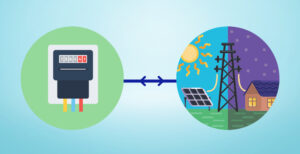
On-grid systems are connected to the main utility grid:
- When panels generate more power during the day, excess energy is sent to the grid.
- At night, the system draws energy from the grid to keep your appliances running.
Here are the key differences between on-grid and off-grid solar systems that make it abundantly clear why on-grid systems are a better investment:
| Aspect | On-grid Solar Systems | Off-grid Solar Systems |
| Are they connected to the grid? | Yes | No |
| Do they require a lithium battery bank? | No | Yes |
| Why or why don’t they depend on lithium batteries? | DISCOM does not put any limit on how much energy an on-grid system can send to or draw from the grid. Thus, these systems don’t need to store solar electricity in batteries for nighttime usage. | Since they’re not connected to the grid, charging lithium batteries during the daytime through a solar panel charge controller is the only way to ensure an uninterrupted power supply at night. |
| When are they preferred? | They’re preferred for residential and commercial installations in areas with reliable grid power and infrequent power cuts. | They’re preferred in remote or rural areas without grid power. |
| Are they expensive to maintain? | No | Yes, they are expensive to maintain because lithium batteries, which are already costly, have to be replaced periodically. |
Common Myths About Rooftop Solar Panel Cost in India That You Must Avoid
Top myths about solar system installation costs in India that you should not believe include: solar panels are too expensive for smaller 1-2 BHK homes, maintaining on-grid solar systems is costly, and subsidies are only available for large solar systems.
Let’s debunk all these myths that might be making you second-guess your decision to install a rooftop solar system in your home.
| Myth | Reality |
| Myth 1: Solar panels are too expensive for smaller 1-2 BHK homes | A 1-2 BHK home ideally requires a 2 kW solar system, which can cost as little as ~Rs. 93,000* in Lucknow. The ROI you can receive on this system in Lucknow is ~4.6x. No other form of investment will offer such high returns. Plus, banks offer solar loans, and SolarSquare offers a zero-investment plan, making solar affordable for everyone. |
| Myth 2: Maintaining on-grid solar systems is expensive | Reputable solar installers offer AMC services, where they take care of your solar system’s overall health. For example, SolarSquare offers a 5-year AMC to all its customers. Maintenance costs are high for off-grid solar systems but minimal for on-grid systems. |
| Myth 3: Only bigger solar systems are eligible for a subsidy under the PM Surya Ghar scheme | The PM Surya Ghar Muft Bijli Yojana is applicable to systems as small as 1 kW, with a financial assistance of Rs. 30,000. It’s capped at Rs. 78,000 for 3 kW or higher-capacity systems for homes. |
Conclusion
Solar panel price in India depends on multiple factors, such as your DISCOM charges, city, whether the installation is for homes, or housing societies or industries, product variant opted for, panel type, inverter type, mounting structure height, type of after-sales service, savings guarantee, and even the roof height.
The solar panel price per watt for homes is ~Rs. 24* + GST for DCR subsidy projects, ~Rs. 40* to ~Rs. 45* with a subsidy for housing societies, and between ~Rs. 42* for systems below 100 kW to ~Rs. 28* for 1 MW or higher capacity solar systems for commercial rooftop systems.
*Please note: The solar panel price in India for on-grid solar systems listed in the section above is indicative and not fixed. The final solar plate price depends on your DISCOM charges, city, product variant opted for, panel type, inverter type, mounting structure height, type of after-sales service, savings guarantee, roof height, etc. Prices are subject to change based on whether they’re for homes, housing societies, or commercial complexes. Also, DCR solar panels are ALMM-approved, made-in-India panels eligible for a solar subsidy.
For any further queries regarding rooftop solar installation, you can book a free solar consultation call with SolarSquare now.
Calculate your savings

Forecast your savings with solar on your investment on the SolarSquare’s plant
FAQs
Q1. Can a 3 kW solar run a 1.5-ton AC?
Ans. Yes, a 3 kW solar system that generates 4,200 to 4,350 units of electricity yearly is sufficient to run one 1.5-ton air conditioner.
Q2. How many ACs can run on a 5 kW solar system?
Ans. A 5 kW solar system can generate 7,000 to 7,250 units of electricity yearly, which is sufficient to power two 1.5-ton air conditioners.
Q3. How many kW is a normal house?
Ans. Most Indian homes require at least a 2 kW solar system that can meet annual energy requirements of 2,800 to 2,900 units.


 Previous Article
 18 min