Hybrid Solar System Buying Guide

Hybrid Solar System for Homes and Businesses with Price, Subsidy, and Sizing Details
An on-grid rooftop solar system stops producing power when the grid goes down, even if the sun is shining. As a result, homes and businesses facing regular power cuts need more than just a solar system that can lower their electricity bills. They also need a reliable backup power source to keep essential appliances running during a power outage.
A hybrid solar system addresses both needs –
- It stores energy in a battery energy storage system and retains the grid as an additional power source.
- It uses rooftop solar to power the property
During a power outage, the battery and available solar generation can continue supplying power to selected appliances.
However, a hybrid solar system for homes must be sized carefully. Solar capacity determines how much energy your PV system can generate, inverter capacity determines how much load can operate at once, and battery capacity determines how long the battery backup can last.
This guide explains how a hybrid solar power system works, what it costs, whether a hybrid solar system gets a subsidy, and whether it is suitable for your property.
What is a Hybrid Solar System?
A hybrid solar rooftop system is a PV (photovoltaic) system that integrates solar panels, battery storage, and the utility grid via a hybrid solar inverter. It can use solar electricity during the day, store energy in batteries for later, and draw power from the grid when solar generation and available battery energy cannot meet the property’s requirements.
In simple terms, a hybrid grid solar system combines:
- The bill-saving potential of an on-grid solar system
- The battery backup available in an off-grid solar system
- The reliability of a grid connection
People searching for ‘what is a hybrid solar system’ sometimes assume that it uses a special type of panel. In reality, it does not. A hybrid solar panel is any photovoltaic module installed as part of a hybrid PV system. The system becomes hybrid because its inverter manages solar generation, battery storage, and grid electricity together.
A hybrid PV system can also be configured to prioritize different objectives. One customer may want to save most of the battery power for outages. Another may want to use stored solar electricity every evening. The inverter settings and battery size should reflect that objective.
What Are the Main Components of a Hybrid PV System?
A hybrid solar power plant comprises multiple components, including solar panels and a hybrid inverter, that work in tandem to produce and supply electricity. Let’s check out all the major components that make a hybrid solar system functional, and their specific roles:
- Solar panels: These high-efficiency modules capture photons in sunlight and convert them into direct current (DC).
- Solar mounting structures: These are the mounts or stands on which solar panels are installed.
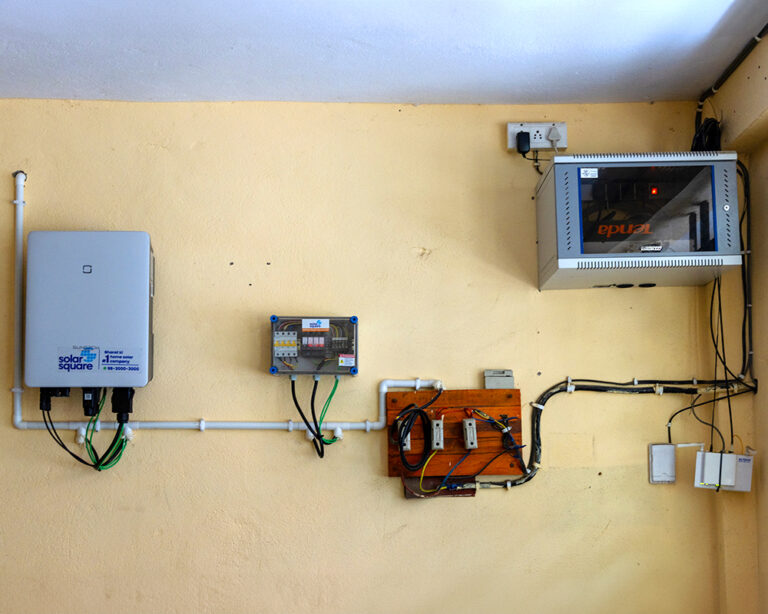
- Hybrid solar inverter: It converts DC to alternating current (AC), charges the batteries safely through built-in charge controllers, and, if needed, converts AC from the grid to DC to charge batteries.
- Battery bank: Batteries store solar energy for later use at night or during power outages.
- Grid connection and net meter: Many hybrid solar systems are grid-connected. If the state DISCOM (distribution company) allows export, a bidirectional net meter or smart meter is installed. It records the units taken from and sent back to the grid. If export is not allowed, the system can be set to zero export.
- Solar accessories: These include AC and DC combiner boxes, AC and DC cables, MC4 solar connectors, conduit trays and pipes, earthing wires, and a lightning arrestor.
- Monitoring system: It shows solar generation, grid consumption, battery charge, and system performance.
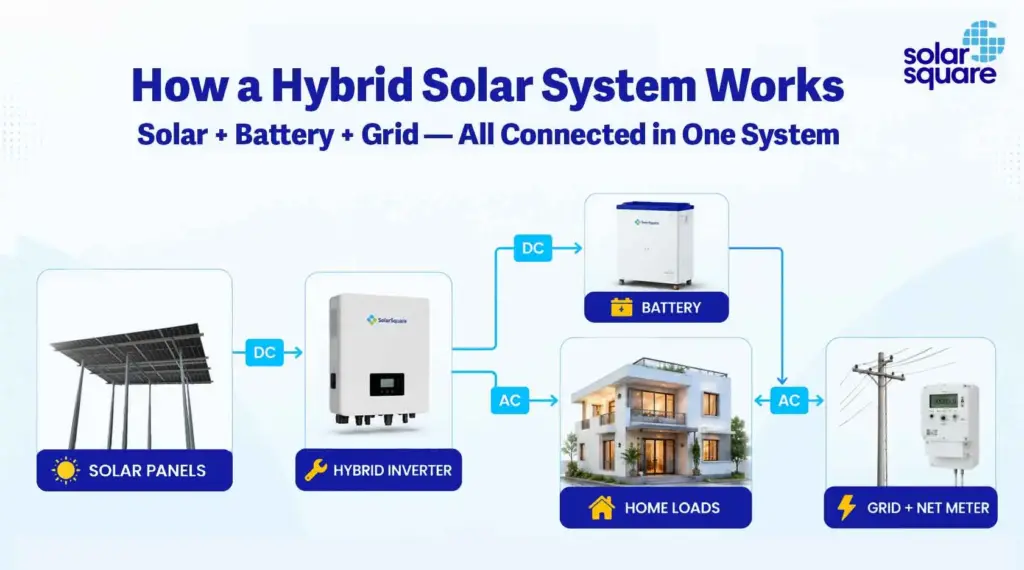
How Does a Hybrid Solar Power System Work?
A hybrid solar system works differently depending on whether solar generation is available, whether the grid is active, and how much charge is available in the battery. Its operation can be understood across four common situations:
- During a sunny day
- At night or when solar generation is low
- During a power cut
- After the grid supply returns
Let’s understand the working across all four parameters in detail –
1. During a Sunny Day
Solar generation is normally used during the daytime, when it delivers the most immediate value. The usual working sequence in this case is listed below:
- Solar electricity is supplied first to the connected appliances/loads.
- Available surplus solar energy charges the battery.
- Further surplus may be exported to the grid if the DISCOM permits net metering.
- The grid supplies any shortfall when consumption exceeds available solar and battery output.
The sequence can be configured differently. For example, the system may maintain a minimum battery reserve instead of using all stored energy for routine consumption.
2. At Night or When Solar Generation Is Low
The panels produce less electricity during cloudy conditions and stop producing the electricity at night. The system must then rely on stored energy, grid electricity, or a combination of the two.
Depending on the selected mode:
- The battery can supply power to the selected loads.
- The grid can supply power once the battery reaches its discharge limit.
- The system can preserve a fixed battery reserve for power outages.
- Grid electricity may recharge the battery when permitted by the settings.
- The inverter can switch automatically between the available sources.
Solar panels do not generate electricity at night. Nighttime solar use means consuming energy that was produced earlier and stored in the battery.
3. During a Power Cut
When the grid fails, the inverter isolates the property’s backup side from the utility supply. This prevents electricity from flowing into a failed grid and protects utility workers.
The system then operates as follows:
- The battery supplies power to the appliances connected to the backup circuit.
- Non-backup circuits remain without power.
- Grid export stops until the utility supply returns.
Backup is not determined solely by the size of the rooftop solar system. The connected load must remain within the inverter’s specified backup output and the battery’s charge and discharge limits.
Starting load also matters. Refrigerators, pumps, and air conditioners can briefly draw much more power while starting than during regular operation. Therefore, the inverter must have sufficient short-duration capacity to handle these surges.
4. After the Grid Supply Returns
Once grid voltage and frequency return to the permitted range, the hybrid solar inverter reconnects the property to the utility supply.
The hybrid PV system can then:
- Transfer the selected loads back to normal operation
- Continue using available solar generation
- Recharge the battery according to the chosen settings
- Resume grid import when required
- Resume permitted export through the approved net metering arrangement
This transition is generally automatic. Its exact speed and behavior depend on the inverter and system configuration.
How Does a Hybrid Solar System Convert Sunlight into Electricity?
This is done through the photovoltaic effect, where photons from solar radiation are captured and converted into direct current (DC) electricity.
Let’s understand step-by-step how a hybrid solar power system transforms sunlight into electricity:
- Step 1 – Solar panels absorb photons: Solar panels are composed of PV cells, mostly made of silicon. These silicon cells absorb photons present in the sunlight. Once absorbed, photons transfer their energy to electrons present in the solar cells.
- Step 2 – Electrons in the solar cells get excited: Once they gain energy from photons, electrons leave their positions. The empty place they leave behind is called a hole, and holes are positively charged. Every photon that manages to knock an electron loose creates an electron-hole pair.
- Step 3 – The built-in electric field prevents electrons from merging with holes: It pushes holes and electrons in opposite directions.
- Step 4 – Electrons flow in one direction: The unidirectional flow of electrons is known as direct current (DC).
- Step 5 – Direct current flows into the hybrid solar inverter: The inverter converts DC (direct current) to AC (alternating current) to power the loads. If the batteries are discharged, the inverter uses a portion of the DC power to charge them through a built-in solar panel charge controller. If it’s an AC-coupled design, the inverter doesn’t have a built-in charge controller. Instead, a separate charge controller is used to regulate DC to charge the batteries safely.
- Step 6 – Excess energy is sent to the grid: If the DISCOM allows it, any excess energy that remains after the batteries are charged can be sent to the grid through the net meter. However, if the DISCOM doesn’t allow unit export, the system can be set to zero export, ensuring no electricity from the system flows out to the grid.
What Are the Benefits of a Hybrid Solar System?
A hybrid solar system provides two clear benefits. It can reduce the electricity purchased from the grid and provide battery backup when the grid fails. It is most valuable in areas where power outages are frequent and long, to justify the additional cost of adding battery storage.
Its main benefits include:
- Backup during outages: Selected lights, fans, internet equipment, refrigerators, and other essential loads can continue operating.
- Lower grid consumption: Daytime solar generation can directly supply power to appliances that would otherwise use grid electricity.
- Use of stored solar energy: Surplus generation can be stored in batteries for evening use or during an outage.
- Automatic power management: The hybrid inverter manages solar, battery, and grid electricity without requiring repeated manual switching.
- Configurable battery reserve: Part of the battery can be reserved specifically for power cuts.
- Cleaner backup: Battery storage operates without diesel fumes, fuel handling, or generator noise.
- Grid support when required: The property can still draw electricity from the grid when solar and stored energy are insufficient.
- Possible export of surplus electricity: Export is available where the DISCOM approves net metering for a hybrid configuration.
A well-designed hybrid PV system offers flexibility. On the other hand, an improperly sized hybrid solar system can be expensive and still fail to provide the expected backup. Let’s explore all such limitations.
What Are the Limitations of a Hybrid Solar System?
A hybrid solar system costs more than a comparable on-grid rooftop solar installation because it includes battery storage, a compatible hybrid inverter, and additional electrical integration. The battery’s operating life is also shorter than the lifespan of solar panels and will eventually require replacement.
The main limitations are:
- Higher upfront cost: Batteries and hybrid inverters increase the installation cost.
- Battery replacement expense: The battery must be replaced during the panels’ operating life.
- Longer payback: Battery storage raises investment without increasing solar generation on its own.
If grid supply is reliable and bill reduction is your main goal, an on-grid rooftop solar system will generally offer better financial returns.
On-Grid vs Off-Grid vs Hybrid Solar Systems: Which One Should You Choose?
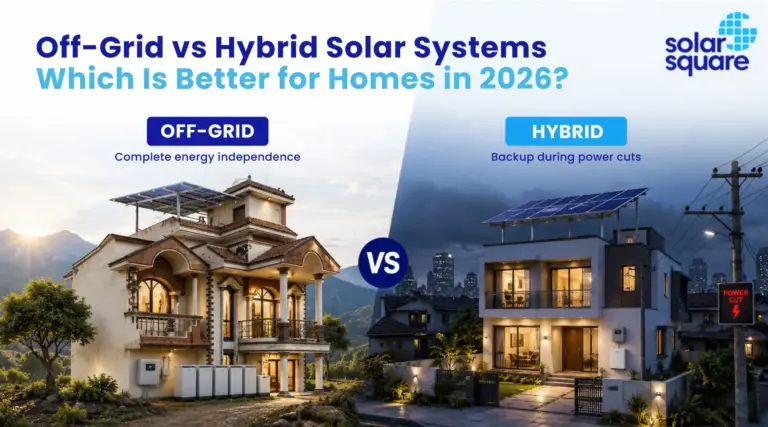
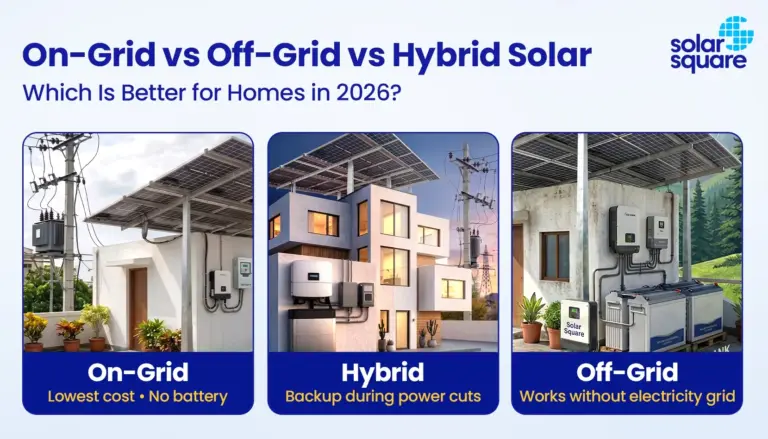
On-grid solar systems offer the lowest initial cost and the strongest return on investment (ROI) where the grid is reliable. Hybrid solar systems add battery backup while retaining the grid connection. Off-grid solar systems, on the other hand, rely on panels and batteries without utility support and are intended primarily for locations without a grid supply.
Here’s a side-by-side comparison of all three types of solar systems:
| Factor | On-Grid Solar System | Off-Grid Solar System | Hybrid Solar System |
| Grid connection | Required | Not required | Required |
| Battery requirement | Not required | Required | Required for backup |
| Electricity during a power cut | No | Not applicable, as off-grid solar is not connected to the grid. | Yes, for selected backup loads |
| Export of surplus solar electricity | Yes | No | Yes, if the local DISCOM approves net metering |
| Net metering | Yes | No | Yes |
| Main power sources managed | Solar + grid | Solar + battery | Solar + grid + battery |
| Energy storage | No | Yes | Yes |
| Level of energy independence | Low | 100% | Balanced |
| Upfront system cost | Lowest | Highest due to autonomy | Higher than on-grid solar systems |
| Maintenance requirement | Moderate | High | High |
| Installation complexity | Low | High | High |
| DISCOM approval requirement | Yes | No | Yes |
| Subsidy eligibility | Yes | No | Yes, if the DISCOM allows net metering |
| Best suited for | Reliable grid conditions | Remote and rural areas with no grid connection | Frequent power cuts and non-net-meter cases |
For a more detailed comparison, you can check out our blog post on on-grid vs off-grid vs hybrid solar systems: Which is better for homes in India in 2026?
Consider a hybrid solar system when:
- Your area experiences frequent or prolonged power outages.
- You work from home and need uninterrupted internet and computer power.
- Refrigeration, security, or medical equipment requires backup.
- You want one PV system to manage solar generation and backup.
- You want to use some stored solar electricity after sunset.
- You want a quieter alternative to diesel-generator backup.
The decision should be based on the outages you actually experience, not only on the appeal of having a battery.
Choose an on-grid rooftop solar system when:
- Power cuts are extremely rare or short.
- You want fewer components and lower maintenance.
An on-grid solar inverter shuts down during a grid failure because of anti-islanding protection. Sunlight alone is therefore not enough to power the load during an outage.
Go for an off-grid solar system for:
- Remote farmhouses
- Isolated buildings
- Rural facilities without grid access
- Properties where grid extension is technically difficult or too expensive
- Areas where grid supply is so unreliable that power comes for ~2 hours only
How Is the Right Hybrid Solar System Size Calculated?
Solar capacity, inverter capacity, and battery capacity must be calculated separately. The panels determine daily energy generation, the inverter determines how much load the system can handle at once, and the battery determines how long the selected loads can receive backup.
Let’s understand how to size a hybrid solar system in simple steps.
1. Calculate the Solar Array Capacity
Solar array capacity should be determined on the basis of:
- Daily electricity consumption
- Daytime load
- Available shadow-free roof area
- Peak sun hours
- Expected system losses
- Long-term solar panel degradation
- The inverter’s permitted solar input
Here’s a simple formula you can use to find the required solar capacity for your home:
Required daily solar generation = Daily electricity requirement ÷ (overall system yield × panel degradation factor)
Let’s consider a property that requires 30 kWh or 30,000 Wh of energy per day with the following assumptions:
- Overall usable system yield of 75%
- Panel degradation factor of 90%
- 5 peak sun hours per day
- 600 W panels used
The daily generation required in this case, based on the formula above, is: 30,000 Wh ÷ (0.75 × 0.90) = ~44,444 Wh per day.
The required solar array capacity is = 44,444 Wh ÷ 5 hours = ~8,889 W
The property would therefore require ~8.9 kW of solar capacity under these assumptions.
With 600 W panels used, you’ll need ~15 panels (8,889 W ÷ 600 W = 14.8 panels).
*Please Note: This example does not establish a universal panel requirement. The final array must comply with the proposed inverter’s maximum PV power, voltage, current, and MPPT (maximum power point tracker) limits.
2. Calculate the Required Inverter Capacity
Inverter capacity should be based on the appliances that may operate simultaneously, not on the total wattage of all appliances you own.
The assessment must include:
- Continuous simultaneous load
- Starting load of motors and compressors
- Inverter backup-output rating
- Single-phase or three-phase connection
- Battery discharge capability
- Required future expansion
For a modern inverter with a power factor of 1, Power in kW = Apparent power in kVA × Power factor.
Therefore, 10 kVA × 1 = 10 kW or 10,000 W
This means a compatible 10 kVA inverter can provide up to 10,000 W of real power when operating at a power factor of 1. During an outage, the appliances on the backup circuit must remain within the inverter’s specified backup output and battery limits.
3. Calculate the Required Battery Capacity
Battery capacity should be based on two practical questions:
- Which appliances require backup?
- How long must they operate?
Here’s a simple formula that can be used:
Backup time = (Battery voltage × total Ah × usable depth of discharge × round-trip efficiency) ÷ connected load
Let’s consider two 51.2 V, 100 Ah lithium batteries connected in parallel.
The combined battery bank in our example becomes:
- 51.2 V
- 200 Ah
The nominal energy is = 51.2 V × 200 Ah = 10,240 Wh.
Using 85% usable depth of discharge and 90% round-trip efficiency, the battery capacity needed = 10,240 Wh × 0.85 × 0.90 = 7,833.6 Wh of usable AC energy.
This provides the following estimated backup time:
| Connected Load | Backup Time |
| 3,000 W | 2.61 hours |
| 5,000 W | 1.57 hours |
| 10,000 W | 0.78 hours |
These figures clearly demonstrate why battery count is not a useful measure of backup by itself. The same battery bank lasts more than three times as long at a 3,000 W load as at a 10,000 W load.
Please note: These figures are examples, not guaranteed backup times. Actual performance can change with battery age, temperature, BMS (Battery Management System) settings, initial state of charge, appliance consumption, inverter losses, and system configuration.
4. Separate Critical and Non-Critical Loads
Backing up every circuit can make the battery unnecessarily expensive. A critical-load design focuses storage capacity on appliances that matter during an outage.
Common critical loads include:
- LED lights
- Fans
- Wi-Fi router
- Laptop and phone charging
- Selected sockets
- Television
- Security equipment
- Refrigerator
Loads commonly excluded from a basic backup circuit include:
- Geysers
- Induction cooktops
- Electric heaters
- Large pumps
- Multiple air conditioners
- Heavy machinery
How Much Does a Hybrid Solar System Cost in India?
The hybrid solar system price depends on solar capacity, usable battery storage, inverter output, and installation requirements. A price linked only to panel capacity is incomplete because two systems with the same solar array can provide very different backup capabilities.
Indicative SolarSquare hybrid system prices are listed below:
| Hybrid Solar System Size | Approximate SolarSquare Hybrid System Prices* |
| 2 kW | ~₹2.73-₹3.13 lakh |
| 3 kW | ~₹3.00-₹3.40 lakh |
| 4 kW | ~₹3.52-₹3.92 lakh |
| 5 kW | ~₹4.16-₹4.56 lakh |
| 10 kW | ~₹8.72-₹9.72 lakh |
*DISCLAIMER (Very Important): The SolarSquare hybrid system prices listed above are an indicative range and should not be treated as a final quotation. The actual price can vary based on the solar capacity, battery capacity in kWh, battery chemistry, hybrid inverter rating, single-phase or three-phase configuration, number and range of MPPTs, panel technology and wattage, roof type and installation height, mounting-structure design, electrical modifications, monitoring features, protection equipment, warranty and after-sales coverage, location, taxes, DISCOM requirements, inverter type, panel and inverter brand, whether you receive the subsidy, etc.
Is Subsidy Available on Hybrid Solar Systems?
A residential grid-connected hybrid solar system may qualify for central financial assistance (CFA) under the PM Surya Ghar Muft Bijli Yojana when it meets the scheme’s consumer, equipment, vendor, installation, and commissioning requirements.
A hybrid solar system subsidy eligibility does not mean the battery cost is covered. The maximum subsidy offered under the PM Surya Ghar Muft Bijli Yojana is capped at ₹78,000 for systems with a capacity of 3 kW or higher.
Since many of our customers frequently ask, ‘Does a hybrid solar system get a subsidy?’, the straightforward answer is that it depends on the approved grid connection and system configuration.
The installation must satisfy applicable requirements relating to:
- Eligible residential consumer category
- Grid-connected rooftop installation
- Application submitted through the PM Surya Ghar Muft Bijli Yojana National Portal
- Installation through a registered empanelled solar vendor
- DCR (Domestic Content Requirement) solar modules
- Applicable ALMM requirements
- Inspection and commissioning
- Required documents and bank details
The answer to the question ‘is subsidy available on hybrid solar systems?’ is therefore conditional.
- A battery-backed hybrid PV system does not receive financial assistance simply because solar panels have been installed.
- If it meets the MNRE (Ministry of New and Renewable Energy) guidelines set for the scheme and the DISCOM permits net metering for hybrid installations, the subsidy is provided.
Please note: A residential hybrid solar system government subsidy does not extend to commercial installations. Only homes and housing societies can claim the subsidy under the PM Surya Ghar Muft Bijli Yojana.
Why Choose SolarSquare for a Hybrid Solar System?
A reliable hybrid installation begins with an accurate assessment of consumption, simultaneous load, and required backup time. SolarSquare designs the solar array, inverter, battery, and backup circuits around the property’s actual requirements rather than relying solely on a standard capacity label.
Besides, we’re the #1 home solar company in India with 1,92,458 kWp of rooftop solar installed across 47,215 properties as of 2nd September 2026, as listed on the PM Surya Ghar Muft Bijli Yojana National Portal for Rooftop Solar.
We’re India’s first and only solar company that:
- Offers a savings guarantee with a money-back promise of ₹8 per unit if we fall short of the committed generation.
- Offers a ₹1 lakh water leakage guarantee for 1 year if our installation results in a leaky roof.
Here are some reasons why 15,000+ customers have rated us 4.8 on Google:
- We offer maintenance and servicing visits over a 5-year period for deep cleaning and preventive checks.
- All our rooftop PV systems have IIT-Bombay-approved cyclone-proof structures, WindPro Mount™, that can withstand wind speeds up to 170 km/h.
- Over 10 years, we have solarized 60,000+ homes in India.
- We have helped our customers claim over ₹300 crore in subsidies.
For any further questions on what makes a rooftop hybrid solar system the right choice, you can book a free solar consultation call with SolarSquare today.
Frequently Asked Questions
Recent blogs