

 1371 Reads
 44 mins


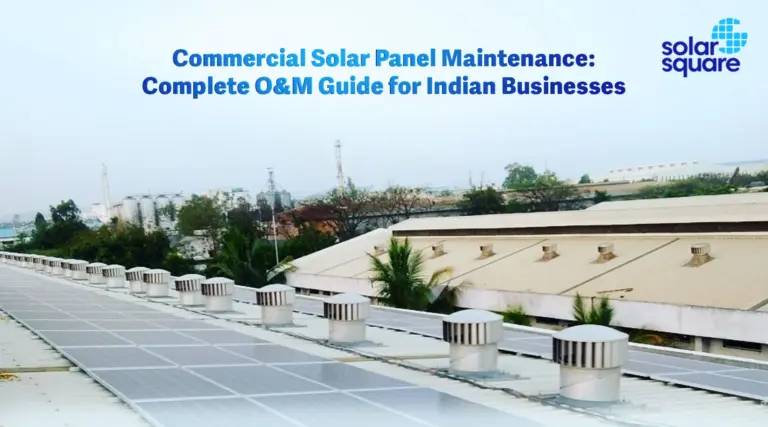
Commercial solar panel maintenance is the process of regularly cleaning, inspecting, and servicing a solar system to ensure it generates electricity at its maximum capacity throughout its 25-30 year lifespan. Without proper maintenance, even high-quality commercial/industrial solar panels can lose a significant portion of their energy output over time. And, this output loss, by no means, is small.
- Drop in power generation if commercial solar panels are not cleaned for 3 months: 10-15%
- Drop in power generation if commercial solar panels are not cleaned for 6 months: 25-35%
- Drop in power generation if commercial solar panels are not cleaned for 1 year: 40-50%
In highly dusty environments such as areas near cement factories or industrial zones like MIDCs, the impact becomes even more severe. In such conditions, uncleaned industrial solar panels can lose over 50% of their output.
Solar panel cleaning, however, is only one part of commercial solar maintenance. A complete PV O&M plan also includes inspecting electrical wiring and equipment, checking mounting structures for strength and corrosion, ensuring connectors and termination points are tight and secure, and monitoring system performance through performance diagnostics.
In the lapse of proper preventive and corrective maintenance, the financial losses for businesses can be huge. For example, if a 100 kW commercial rooftop solar system loses 10-15% of its output, that loss is equivalent to ~Rs. 10,000* to ~Rs. 12,000* a month. You can imagine for yourself what this loss will amount to over an entire year and over the system’s 25-year lifespan if left unaccounted for.
*Disclaimer: The estimated monthly loss listed above for a 100 kW commercial solar system is indicative and not fixed. Actual losses can vary significantly depending on multiple factors, including system location, solar irradiance levels, seasonal variations, dust and pollution intensity, frequency of cleaning, system design and efficiency, module quality, inverter performance, shading conditions, downtime due to faults, differences in plant capacity, and maintenance practices.
Read on to explore the ins and outs of commercial solar maintenance, including the commercial solar panel maintenance cost and what is included in that overall price, dos and don’ts of PV O&M for businesses and industries, most common issues discovered during maintenance, difference between preventive and corrective maintenance, signs that your solar system needs a repair not cleaning, and a detailed solar PV O&M checklist to take care of your asset.
TL;DR Summary Box: How Often Do Commercial Solar Panels Need to be Cleaned?
Ideally, commercial solar panels should be cleaned twice a month by professionals to maintain optimal power generation and prevent efficiency losses caused by dust accumulation.
In highly dusty environments, such as MIDCs or areas near industrial activity, the cleaning frequency should be increased to 2-3 times per month to avoid significant generation drops.
Here are the main topics covered in this blog in detail:
| Main Topics | Key Takeaways |
| What does commercial solar panel maintenance include? | It includes panel cleaning to remove dust and a complete technical inspection of wiring, inverters, switchgear, mounting structures, and system performance to prevent faults and ensure optimal power generation. |
| Why is PV O&M important for businesses and industries? | PV O&M ensures consistent energy generation, reduces downtime, prevents costly failures, improves ROI, extends system lifespan, and maintains electrical and fire safety. |
| Common maintenance issues that commercial solar maintenance fixes | It helps identify and fix string faults, inverter and equipment failures, grid fluctuation issues, and severe component damage that can impact performance and safety. |
| What’s an ideal commercial solar panel maintenance schedule? | Panels should be cleaned twice a month, or 2-3 times in dusty areas, with monthly preventive inspections and quarterly technical checks using advanced diagnostics. |
| What is the commercial solar panel maintenance cost in India? | For systems above 20 kW, the commercial solar panel maintenance cost in India can range between Rs. 750* to Rs. 2,000* per visit under an AMC with 22-24 service cycles per year. |
| What’s the cost of neglecting commercial PV O&M? | Even a 10-15% drop in generation can lead to losses of Rs. 10,000** to Rs. 12,000** per month for a 100 kW system, which can scale to lakhs annually. |
| Professional commercial solar panel maintenance vs attempting DIY maintenance on your own: Which is better? | Professional maintenance is safer and more effective because it uses trained technicians and advanced diagnostic tools. DIY methods, on the other hand, cannot detect hidden faults and can cause damage or safety risks. |
| Preventive Maintenance (PM) vs Corrective Maintenance (CM) |
|
| Solar panel maintenance checklist for summer | Focus on frequent cleaning, monitoring overheating, checking inverter ventilation, and inspecting cables and connectors for heat-related damage. |
| Solar PV O&M checklist for monsoons | Includes checking earthing and lightning protection, inspecting cables and connectors, securing structures to deal with high wind load, and conducting post-monsoon inspections. |
| PV maintenance checklist for winters | Involves regular cleaning, monitoring reduced generation, checking for shading, inspecting wiring, and reviewing system performance for efficiency drops. |
*Disclaimer: The above-listed per-visit maintenance cost of solar panels in India for commercial and industries solar systems is indicative and may vary significantly depending on system capacity, plant location, accessibility of the installation site, frequency of cleaning cycles, scope of services included in the AMC, type and quality of components used, level of automation or monitoring systems, labor requirements, and site-specific conditions such as dust intensity, pollution levels, and weather exposure. Costs may also differ based on service provider expertise, use of specialized equipment such as thermal imaging or IV testing, and additional corrective maintenance requirements.
**Disclaimer: The estimated monthly loss listed above for a 100 kW commercial solar system is indicative and not fixed. Actual losses can vary significantly depending on multiple factors, including system location, solar irradiance levels, seasonal variations, dust and pollution intensity, frequency of cleaning, system design and efficiency, module quality, inverter performance, shading conditions, downtime due to faults, differences in plant capacity, and maintenance practices.
What Does Commercial Solar Panel Maintenance Include?
Commercial solar panel maintenance covers routine panel cleaning and technical inspections to ensure the system operates safely and generates the maximum possible solar electricity without significant generation loss.
Cleaning helps maintain solar panel efficiency by removing dust and debris. Technical PV O&M, on the flip side, goes deeper to inspect electrical and mechanical components, identify early signs of faults, and ensure all parts of the solar system function as intended.
To understand this better, take a closer look at what each of these core pillars of commercial solar maintenance includes.
Solar Panel Cleaning
Professionals focus on using special safety and cleaning gear and equipment to get your panels squeaking clean.
Here’s what commercial panel cleaning handles:
- Removal of dust, dirt, bird droppings, and industrial pollutants from solar modules.
- Use of soft-bristle brushes and appropriate cleaning methods to avoid surface damage.
- Regular cleaning cycles to prevent efficiency loss due to soiling.
Preventive Maintenance
Preventive maintenance includes a detailed solar system inspection to ensure that no faults, which can lead to serious defects and generation loss, go undetected or unattended.
Here’s everything that preventive maintenance (PM) handles:
- Inspection of wiring, cables, and electrical connections for damage.
- Checking switchgear, inverters, and other equipment for proper functioning.
- Structural inspection of mounting systems for stability and rusting.
- Ensuring all connectors and termination points are tight and secure.
- Performance monitoring and diagnostics to detect generation issues early.
- Remote monitoring setup for real-time tracking, or installation of monitoring devices at an additional cost if not already available.
Why is PV O&M Important?
PV operations and maintenance (O&M) is important because it ensures that commercial and industrial solar systems deliver consistent performance, pose no fire or safety risks, and achieve their expected return on investment over a 25-30-year lifespan.
Solar energy systems are constantly exposed to dust, heat, weather stress, rain, and electrical load variations. All these factors can reduce system efficiency and lead to serious faults and failures in the inverter and wiring if not monitored. A well-planned PV O&M helps maintain energy output, reduce downtime, and extend the life of key solar components.
To understand its importance in practical terms, here’s what PV O&M ensures for commercial solar systems:
- Maintains solar energy generation: Commercial solar maintenance prevents losses caused by dust, faults, or underperforming components.
- Reduces downtime: Regular inspections and timely fault detection keep the system operational and prevent unexpected shutdowns or inverter trips.
- Identifies faults early: This helps avoid expensive repairs and component failures later.
- Extends system lifespan: Commercial solar maintenance minimizes solar panel degradation, corrosion, and issues such as hotspots and microcracks.
- Improves financial returns: Well-maintained solar systems deliver the maximum possible output, resulting in a higher ROI.
- Ensures fire and electrical safety: PV O&M can detect electrical risks from loose connections, overheating, or faulty components before they escalate into a fire.
- Helps meet performance benchmarks: With continuous monitoring, PV O&M can detect significant generation losses, which can then be traced to the actual fault. As a result, monitoring and diagnostics identify causes for generation losses before they can impact the ROI.
Dos and Don’ts of Commercial Solar Maintenance
The following table outlines essential best practices and common mistakes to avoid during commercial PV O&M.
| Dos of Commercial Solar Panel Maintenance | Dont’s of Commercial Solar Panel Maintenance |
| Schedule a professional AMC (Annual Maintenance Contract) for regular inspections and servicing. | Avoid DIY panel cleaning on your own, as it can damage even the best solar panels and pose safety risks due to DC power and the risk of falling from height. |
| Use soft nylon bristle brushes and proper cleaning tools to prevent surface damage. | Do not use high-pressure water jets, as they can cause microcracks in all types of solar panels. |
| Ensure regular inspection of wiring, connectors, and switchgear for safety and performance. | Avoid ignoring faults such as loose connections or small burn marks. |
| Monitor system performance and inverter data to detect early issues. | Do not rely only on visual inspection without diagnostic tools. |
| Maintain proper earthing and lightning protection by installing a lightning arrestor and proper grounding. | Do not operate a system with damaged cables or exposed wiring. |
| Hire only trained professionals with safety equipment for cleaning and maintenance. | Avoid unsafe cleaning practices like dry wiping with rough materials or mops. |
| Keep fire safety equipment such as CO₂ fire extinguishers in commercial and industrial facilities. | Do not pour water on solar panels during the day or in the event of a fire. |
| Conduct quarterly thermal and electrical inspections to detect internal cell defects, including hotspots and microcracks. | Avoid delaying maintenance, especially in dusty or high-load environments. |
What are the Maintenance Issues that Commercial Solar Maintenance Fixes?
Regular PV O&M helps identify and resolve performance and safety issues before they result in major failures, energy losses, or system downtime. Many of these issues fall under corrective maintenance, in which faults are diagnosed and corrected to restore normal system performance.
Here are the most common maintenance issues that commercial solar panel maintenance addresses:
- String faults: These occur when one or more panels in a string underperform or stop generating power due to wiring issues, shading, or module defects. This comes under corrective maintenance (CM) and directly impacts overall system output.
- Equipment failure: Inverters, switchgear, and other electrical components can fail due to overheating, wear and tear, or electrical stress. Regular maintenance helps detect early warning signs and prevent complete breakdowns.
- Grid fluctuations affecting inverters: Voltage fluctuations from the grid can cause inverter tripping or irregular performance. In such cases, additional safety switchgear and protection systems are recommended to stabilize operations.
- Severe component failure: Critical failures such as burnt connectors, damaged modules, or faulty termination points can impact system performance and pose safety risks. These require immediate corrective action to restore functionality and prevent further damage.
What’s the Ideal Commercial Solar Panel Maintenance Schedule? How Frequently Should You Book PV O&M?
Following a recommended commercial solar panel maintenance schedule from professionals is important to ensure the system works reliably throughout the year. Since commercial and industrial solar plants are exposed to dust, heat, and continuous electrical load, maintenance cannot be occasional.
Here’s the recommended PV O&M schedule for commercial solar systems:
- Panel cleaning: For commercial and large industrial plants, solar panels should ideally be cleaned twice a month to prevent dust buildup. In highly dusty or polluted environments, such as MIDCs, cleaning frequency should be increased to 2-3 cycles per month.
- Once a month preventive maintenance (PM): This includes visual inspections of electrical terminals, cables, and connections, along with parameter checks at each termination point to ensure the system is operating within expected limits.
- Quarterly preventive maintenance (PM): This involves more in-depth technical checks, such as inspecting cooling fans, verifying termination tightness, using thermal imaging to detect hotspots, and EL imaging to detect early-stage microcracks that may not be visible during routine inspections.
How Much Does Commercial Solar Maintenance Cost?
The maintenance cost of solar panels in India for businesses and industries depends on system size, location, and service scope. For systems above 20 kW, the commercial solar maintenance cost ranges between ~Rs. 750* to ~Rs. 2,000* per visit under an Annual Maintenance Contract (AMC) that includes around 22-24 service cycles per year.
*Disclaimer: The above-listed per-visit maintenance cost of solar panels in India for commercial and industries solar systems is indicative and may vary significantly depending on system capacity, plant location, accessibility of the installation site, frequency of cleaning cycles, scope of services included in the AMC, type and quality of components used, level of automation or monitoring systems, labor requirements, and site-specific conditions such as dust intensity, pollution levels, and weather exposure. Costs may also differ based on service provider expertise, use of specialized equipment such as thermal imaging or IV testing, and additional corrective maintenance requirements.
What is the Cost of Neglecting Commercial Solar Maintenance?
Paying Rs. 750 to Rs. 2,000 per visit for PV O&M won’t look a lot when you understand how much money you can lose per month in the absence of professional commercial solar maintenance.
Let’s take an example of what happens if just 10-15% energy drops due to poor solar maintenance in a 100 kW solar system. That 10-15% drop results in a monthly loss of ~Rs. 10,000* to ~Rs. 12,000*. Which means a yearly loss of ~Rs. 1.20 lakh* to ~Rs. 1.44 lakh*.
Here’s a tabulated snapshot of the cost of neglecting commercial solar maintenance for 3 months, which can lead to a 10-15% generation loss.
| Commercial Solar System Size | Generation Loss When Plant is Not Maintained for 3 Months | Monthly Revenue Loss (Read Full Disclaimer Below)* | Yearly Revenue Loss (Read Full Disclaimer Below)* |
| 100 kW | 10-15% | ~Rs. 10,000 to ~Rs. 12,000 | ~Rs. 1.20 lakh to ~Rs. 1.44 lakh |
| 200 kW | 10-15% | ~Rs. 20,000 to ~Rs. 24,000 | ~Rs. 2.4 lakh to ~Rs. 2.88 lakh |
| 300 kW | 10-15% | ~Rs. 30,000 to ~Rs. 36,000 | ~Rs. 3.60 lakh to ~Rs. 4.32 lakh |
| 500 kW | 10-15% | ~Rs. 50,000 to ~Rs. 60,000 | ~Rs. 6 lakh to ~Rs. 7.20 lakh |
| 1 MW | 10-15% | ~Rs. 1 lakh to ~Rs. 1.20 lakh | ~Rs. 12 lakh to ~Rs. 14.40 lakh |
*Disclaimer: The estimated loss listed in the section above for commercial solar systems is indicative and not fixed. Actual losses can vary significantly depending on multiple factors, including system location, solar irradiance levels, seasonal variations, dust and pollution intensity, frequency of cleaning, system design and efficiency, module quality, inverter performance, shading conditions, downtime due to faults, differences in plant capacity, and maintenance practices.
Professional Commercial Solar Panel Maintenance vs Attempting DIY Maintenance on Your Own: Which is Better?
While it may seem cost-effective to handle solar panel cleaning and basic checks internally, DIY maintenance on your own is neither practical nor safe for commercial and industrial solar systems.
Large-scale solar plants operate at very high DC voltages and require specialized tools, trained personnel, and strict safety protocols. Without the right expertise, DIY efforts on your own can lead to incomplete maintenance, undetected faults, safety risks that can result in the loss of life, and serious damage to the solar system.
Professional PV O&M, on the other hand, is carried out by trained solar professionals who have the right safety gear and expertise to handle DC power and work at height safely. They have advanced equipment that leads to accurate fault detection through infrared imaging and EL testing, which DIY methods cannot achieve.
To understand the difference clearly, here’s a detailed comparison:
| Parameter | Professional Commercial Solar Maintenance | DIY Maintenance on Your Own |
| Safety | Performed by trained technicians with proper safety gear and equipment. | High risk due to lack of training, safety gear, and exposure to high-voltage DC power. |
| Investment in safety equipment | Professionals carry their own gear and tools. No cost has to be borne by customers. | Requires ~Rs. 13,000 to ~Rs. 18,000 per person for safety gear and lakhs of rupees for advanced equipment like infrared cameras. |
| Cost efficiency | AMC spreads costs across services and prevents major repair expenses. | Appears cheaper initially, but the hidden equipment costs can run into lakhs. And working without safety equipment can lead to the loss of life. |
| Equipment used | Advanced tools such as thermal imaging, EL imaging, and IV testing for accurate diagnostics. | Limited to visual checks as advanced diagnostics are not possible. |
| Fault detection | Can identify hotspots, microcracks, inverter issues, solder defects, and electrical faults early. |
|
| Risk of damage | None | High risk of microcracks, wiring damage, or connector issues. |
| Monitoring and diagnostics | Includes performance monitoring and system-level analysis. | No structured monitoring or performance tracking. |
Preventive Maintenance (PM) vs Corrective Maintenance (CM) in Commercial Solar Systems
Preventive maintenance includes routine inspections and checks designed to detect early signs of wear, faults, or inefficiencies in the system. The goal is to address minor issues before they turn into major failures.
- Inspection of wiring, connectors, and termination points
- Checking switchgear, solar inverters, and electrical components
- Identifying loose connections, rusting, or overheating risks
- Monitoring system performance to detect irregularities
- Detecting early-stage faults that can lead to failures such as MCB burnout
A small issue identified during preventive maintenance can be resolved with minimal cost. If ignored, the same issue can escalate into a major failure, leading to higher repair costs and generation losses.
Corrective maintenance, on the other hand, comes into play when a fault has already occurred and needs to be repaired to restore system performance. These issues are usually more severe and may require component repair or replacement.
- Repair or replacement of damaged components, including connectors, cables, and modules.
- Resolving inverter faults, tripping issues, or equipment failures.
- Fixing faulty terminations or damaged wiring.
- Addressing system shutdowns or significant drops in solar generation.
For commercial systems, corrective maintenance is offered as a service package. For example, a CM package in Assure by SolarSquare starts at ~Rs. 10,000 per case, which covers fault identification, basic repairs, and resolution of issues that fall within this price range.
However, it is important to understand that the cost of corrective maintenance (CM) is not fixed or universal. The actual cost of corrective maintenance cannot be predicted in advance, as it depends entirely on the root cause identified during inspection.
- If the fault is minor, such as loose connections or small component-level issues: It can be resolved within a base package.
- If the problem involves major component failure, such as inverter damage or module defects: The cost can increase significantly depending on whether the damage can be repaired or requires a complete replacement.
Why are both PM and CM Essential in a Commercial PV O&M Plan?
Preventive and corrective maintenance serve different purposes, and relying on only one of them can lead to inefficiencies, higher costs, and operational risks.
- Preventive maintenance: It focuses on identifying and resolving small issues early, before they escalate into serious faults. For example, a loose connection detected during routine inspection can be fixed at a minimal cost. In contrast, if ignored, the same issue can lead to MCB burnout, inverter damage, or even system shutdown.
- Corrective maintenance: It becomes necessary when faults have already occurred and are impacting system performance. In such cases, timely corrective action, whether repair or replacement, ensures that the system is restored quickly, generation losses are minimized, and there’s no safety risk.
From a business perspective, preventive maintenance helps reduce the frequency and severity of failures, while corrective maintenance ensures that unavoidable issues do not lead to prolonged downtime or safety risks.
Signs that a Solar Plant Needs Repair Instead of Routine Servicing
Routine cleaning and preventive maintenance are essential for keeping a solar plant efficient, but certain warning signs indicate deeper issues that require immediate corrective maintenance.
Here are the key signs that commercial solar panel repair is now necessary, and regular cleaning and PM won’t do:
- Burn marks on wires, modules, or termination points: These indicate overheating, loose connections, or electrical faults, which can escalate into fires if not addressed immediately.
- Sudden drop in power generation: A noticeable decline in solar panel output, beyond expected seasonal variation, points to issues such as string faults, module damage, or inverter problems.
- Frequent inverter tripping: Repeated tripping suggests instability in the system, which may be caused by grid fluctuations, internal faults, or protection mechanism triggers.
- Snail trails on solar panels: These appear as dark, irregular patterns on modules and are associated with microcracks, moisture seepage, and cell degradation.
- Inverter error messages or alerts: Error codes or warnings from the inverter indicate system-level issues that require technical diagnosis and repair.
- Early signs of PID loss: A reddish or brownish discoloration near the positive end of the module indicates potential-induced degradation, which reduces panel efficiency over time.
Key Performance Metrics to Track in Commercial PV O&M
Consistent monitoring of system performance helps identify deviations early, validate system health, and ensure that the plant is delivering expected returns. Metrics such as these are indicators of both efficiency and technical issues.
Here are the key metrics to track in commercial PV O&M:
- Optimum monthly solar generation: The system’s actual monthly output should closely match the expected generation based on location, season, and installed capacity. Consistent deviation over time, despite ample solar energy, indicates issues such as soiling losses, equipment inefficiencies, or faults in the system.
- Inverter performance and tripping frequency: A high-performing system should have minimal to no inverter tripping. Frequent tripping is a clear sign of instability, which may be caused by grid fluctuations, internal faults, or protection system issues.
- Switchgear health and reliability: The condition of switchgear plays a critical role in system protection. Healthy switchgear ensures safe operation by handling electrical loads, preventing faults, and protecting equipment from damage due to surges or short circuits.
Solar Panel Preventive Maintenance Checklist Across Seasons to Improve Efficiency
A PV maintenance checklist, when followed, ensures that a commercial solar system operates efficiently despite seasonal changes. In India, solar plants are exposed to extreme heat, heavy rainfall, humidity, dust, and seasonal temperature fluctuations.
Each season introduces different risks that can impact system performance, safety, and equipment life.
That’s why we’ve created a seasonal solar panel cleaning checklist that will keep the system ready for whatever nature throws at it.
Solar Panel Maintenance Checklist for Summers
Here’s a solar panel maintenance checklist that can be followed to ensure maximum efficiency during the summer season when temperatures soar:
- Increase cleaning frequency to control dust buildup and prevent efficiency loss.
- Inspect panels for hotspots or microcracks caused by panel overheating.
- Check inverter performance and ensure it is not overheating.
- Verify proper ventilation around inverters and electrical equipment.
- Inspect cables and electrical connectors for heat damage or insulation wear.
- Monitor generation output for any drop due to excessive soiling or thermal losses.
- Ensure mounting structures remain stable despite thermal expansion.
Solar PV O&M Checklist for Monsoons
Here’s a solar PV O&M checklist that can be followed to ensure your solar system is ready for the rainy season:
- Conduct electrical inspections before and during the monsoon to ensure all cables and connectors are intact.
- Check that modules, mounting structures, and clamps are tightly secured to withstand strong winds.
- Inspect lightning arrestors and ensure proper functioning.
- Verify that MCBs and protection devices are working correctly.
- Ensure proper rooftop drainage to prevent water accumulation near panels.
- Inspect mounting structures for rust and apply protective coating if required.
- Check earthing systems to ensure they can handle lightning surges.
- Remove any loose objects that could damage panels during storms.
- Perform a full system inspection after the monsoon to identify weather-related damage.
PV Maintenance Checklist for Winters
Here’s a PV maintenance checklist that can be followed to make your solar system winter-ready:
- Clean panels regularly to remove dust, fog residue, or pollution deposits.
- Monitor system output closely to compare against expected seasonal generation.
- Inspect wiring and connectors for any damage caused by temperature fluctuations.
- Check inverter performance, especially during low-generation conditions.
- Ensure no shadows from nearby structures fall on the panels during the day.
- Inspect mounting structures for any looseness caused by weather changes.
- Review system performance data to identify any gradual decline in efficiency.
How to Choose the Right Commercial Solar PV O&M Partner?
Choosing the right PV O&M partner is critical for system performance, safety, and ROI. Since solar plants operate for 25-30 years, the quality of maintenance directly impacts long-term generation, equipment life, and overall profitability. A reliable O&M partner proactively monitors the system, identifies risks early, and ensures timely resolution of issues.
To make the right decision, here are the key factors businesses should evaluate when selecting a commercial solar panel maintenance partner:
- Experience with commercial and industrial systems: The partner should have proven expertise in handling large-scale rooftop solar installations in industrial environments.
- Comprehensive service scope: Look for service providers like Assure by SolarSquare that offer end-to-end services, including panel cleaning, preventive maintenance, corrective maintenance, performance monitoring, and diagnostics.
- Use of advanced diagnostic tools: A professional PV O&M partner should use tools such as thermal imaging, IV testing, and performance monitoring systems to detect issues that are not visible during routine inspection.
- AMC offerings: Evaluate the inclusions of the Annual Maintenance Contract, including service frequency, response time, and scope of corrective maintenance.
- Safety standards and protocols: Ensure the team follows proper safety practices, uses certified equipment, and adheres to electrical and fire safety protocols.
- Transparency in reporting: Regular performance reports, maintenance logs, and clear communication help track system health and build trust.
How Can Assure by SolarSquare Help With Commercial Solar Panel Maintenance?
Assure by SolarSquare provides professional solar panel cleaning, maintenance, and inspection services for businesses and industries. With operations in cities such as Bhopal, Nagpur, Delhi, and Lucknow (and expanding across India), Assure has already supported 1,000+ customers.
Here’s a list of our Preventive Maintenance (PM) services that help improve your system’s performance and reliability:
- Warranty-safe panel cleaning: Our trained technicians clean your panels using only manufacturer-approved methods. Soft-bristle equipment protects the anti-reflective coating and glass. Every visit includes documentation of before-and-after photos and compliance logs. As a result, your warranty stays intact if you ever need to raise a claim.
- Automated maintenance schedule: We build a cleaning and maintenance calendar around your specific site conditions, dust load, and system size. You get WhatsApp, SMS, and email reminders before every visit. Your full service history, including technician notes, is available for download at any time.
- Performance diagnostics and reporting: We compare your system’s actual power generation with the expected output and review your inverter data. If we detect any drop in performance, we identify the cause and provide you with a clear action plan to recover lost power.
- Electrical and safety check: Trained technicians inspect the wiring, earthing, connectors, and safety devices in your system. They fix loose connections and overheating points on the spot. Each visit also includes checks for DC and AC cables, MCBs and surge protectors, proper tightening of terminals, and seals that keep moisture out.
- Thermal health scan: We use an infrared camera to scan your solar panels and detect issues like hotspots, faulty cells, or shading that you cannot see with the naked eye. Each problem is identified for the exact panel and shared with you as clear images along with a simple list of what needs attention first.
Assure also provides Corrective Maintenance (CM) services when your solar system needs emergency repairs.
- Problem identification: If a panel cracks, the inverter fails, wiring gets damaged, or a protection device stops working, our trained technicians diagnose the issue and clearly explain what went wrong.
- Best fix recommendation: Our team helps you understand the best course of action before arranging the required parts and repairs.
- Repair or replacement services: Once approved, the team fixes the problem and restores your system’s performance.
Conclusion
Commercial solar maintenance includes panel cleaning and preventive maintenance services that perform an overall health check of the entire solar system.
The ideal panel cleaning frequency for businesses is twice a month. However, for dust-heavy industrial sites, it’s recommended to clean the panels 2-3 times a month without fail. Visual checks during preventive maintenance must be carried out once a month, and advanced quarterly checks are recommended for a more thorough technical inspection.
The cost of avoiding commercial solar panel maintenance is huge. Even a 100 kW solar system that hasn’t been cleaned for 3 months, producing 10-15% less power, results in a loss of ~Rs. 10,000* to ~Rs. 12,000* a month. You can imagine for yourself how many lakhs you’ll lose if this issue goes unaddressed.
*Disclaimer: The estimated monthly loss listed above for a 100 kW commercial solar system is indicative and not fixed. Actual losses can vary significantly depending on multiple factors, including system location, solar irradiance levels, seasonal variations, dust and pollution intensity, frequency of cleaning, system design and efficiency, module quality, inverter performance, shading conditions, downtime due to faults, differences in plant capacity, and maintenance practices.
For any cleaning or maintenance-related queries, you can get in touch with Assure’s team for free.
If you’re looking to install rooftop solar at your office/commercial space, you can book a free solar consultation call with SolarSquare. It’s a no-obligation call, meaning you don’t have to buy from us. You buy only if you are convinced.
FAQs
How does extreme weather affect commercial solar panels?
Extreme weather conditions impact both the performance and safety of commercial solar panels.
- High temperatures reduce panel efficiency
- Dust accumulation blocks sunlight and lowers generation
- During monsoons, moisture can cause corrosion, loose connections, and electrical faults
- Strong winds can affect mounting structures
- Lightning can damage electrical components if proper protection is not in place
What kind of maintenance is required on solar panels?
Commercial solar panels require a mix of panel cleaning and technical maintenance. This includes removing dust and debris from panels, inspecting wiring and connectors, checking inverters and switchgear, ensuring structural stability, and monitoring system performance.
How long does a commercial solar panel last with proper maintenance?
With proper maintenance, commercial solar panels last between 25 and 30 years. However, the actual lifespan depends on the quality of components used, such as whether the panels are tier-1 or tier-2 and whether they are made with grade A or grade B materials.
Regular cleaning, timely inspections, and professional maintenance also play a major role in ensuring that the system continues to perform efficiently throughout its lifespan.
What is the best time to wash solar panels?
The best time to wash solar panels is early in the morning or late in the evening when the panels are cool. Cleaning during peak sunlight hours should be avoided, as splashing cold water onto hot panels can cause microcracks. Cleaning panels during cooler periods ensures effective dirt removal and reduces the risk of damage.
What tools are needed to clean solar panels?
Commonly used tools to clean solar panels include long-handle soft-bristle brushes, non-abrasive cleaning solutions, and controlled water flow. For commercial installations, professional cleaning equipment and safety gear are essential to ensure safe, efficient maintenance without causing scratches or microcracks.


 Previous Article
 15 min