

Common-area electricity usage contributes to recurring high bills for housing societies. Lifts running through the day, water pumps pulling load every few hours, parking lights, clubhouse air conditioning, and security systems can push the monthly bill well above a lakh for a mid-sized society. For larger ones with multiple towers, the number can even cross five lakh a month.
Using solar power for common areas in a housing society can reduce CAM (common area maintenance) bills by almost 90%. However, the barrier most societies hit when planning to go solar is the upfront cost. This is where solar financing for housing societies changes everything.
Today, registered societies do not need to dip into their CORPUS or run special member contributions to switch to solar. NBFCs (Non-Banking Financial Companies), which are lenders that operate outside the traditional banking system, and RESCO developers offer specific solar financing models built for housing societies.
This blog covers what those housing society solar loan options look like, who qualifies, the required documents, and how to apply.
Importance of Solar Financing for Housing Societies
Most housing societies in India have a CORPUS or sinking fund. However, committees prefer keeping those funds for emergencies like waterproofing, lift replacements, or structural repairs.
Even if the society needs a 100 kW rooftop solar system and qualifies for a Rs. 18 lakh solar subsidy under the PM Surya Ghar Muft Bijli Yojana, that would still require an investment of ~Rs. 42 lakh* to ~Rs. 47 lakh* after the subsidy. Pulling out that much money from the CORPUS can leave the society exposed. Solar financing for housing societies solves this issue by spreading the project cost over 3 to 7 years, with EMIs lower than the monthly CAM electricity bill the society was already paying.
*Please note that the prices listed above are subject to change: The cost of rooftop solar for housing societies listed in the section above is indicative as of 29th May 2026. The final cost of solar panels for a housing society depends on your DISCOM charges, city, solar system size, site conditions, project specifications, product variant opted for, panel type, inverter type, mounting structure height, type of after-sales service, savings guarantee, roof height, etc.
Solar financing can help a society in 5 practical ways.
- It improves the long-term asset value of the property.
- It avoids large one-time collections from members.
- It lets society start saving on electricity from the first month.
- It preserves the CORPUS for genuine emergencies.
- It offers predictable energy costs over 25 years as grid tariffs continue to rise.
A society is in a strong position to access apartment solar financing if it has the following things set in place:
- Clean financial records: Audited statements that show consistent maintenance collections and no major dues.
- Stable maintenance income: A predictable monthly inflow from members that lenders can map against the EMI.
- Registered legal status: A cooperative society or RWA registered under the relevant state act.
- Proper committee approvals: A managing committee resolution authorizing the solar installation.
When these conditions are in place, NBFCs are usually willing to fund the project through EMIs that the society can repay from its maintenance collection or directly from the electricity savings generated by the solar plant.
What are the Different Solar Financing Options for Housing Societies?
There are two major financing routes that housing societies in India use today. The third option, where individual flat owners can take personal solar loans and the society coordinates a bulk installation, exists in theory but is rarely used in practice because the project is almost always meant for common-area consumption rather than flat-level use.
Here’s a side-by-side comparison of the two main solar housing project financing models in India, the Society/RWA Group Solar Loan and the RESCO/OPEX model.
| Aspect | Society/RWA Group Solar Loan | RESCO/OPEX Solar Financing |
| Ownership of plant | Society owns the system | Third-party developer owns system |
| Upfront investment | ~20% of project value | ~10% of project value |
| EMI responsibility | Society pays EMIs to the lender | No EMIs, as the society pays only for the units consumed |
| Savings benefit | Full savings on common-area bill flow to society | Reduced tariff on common-area consumption |
| Best suited for | Registered societies with stable finances | Societies that want to avoid upfront investment and ownership responsibility |
| Subsidy eligibility for society | Yes, the society claims the PM Surya Ghar Muft Bijly Yojana subsidy | No, the developer owns the system and claims any applicable benefits |
| Loan tenure | Up to 5 years for the loan | Long-term PPA (Power Purchase Agreement) of around 10 years |
| Maintenance responsibility | Society or vendor through an AMC (Annual Maintenance Contract) | RESCO developer handles all maintenance |
Now, let’s explore the details of both solar housing project financing schemes.
#1. Society/RWA Group Solar Loan
A society group solar loan is a financing arrangement in which the housing society or RWA takes a collective loan in its own name, as a registered entity, to install a rooftop solar system. The society owns the system from day one, and the housing society solar loan is repaid through monthly EMIs, which the society funds either from its maintenance collection or from the electricity bill savings generated by the solar system.
In most cases, the EMI is lower than the previous monthly electricity bill, which means the society moves into a positive cash flow position almost immediately.
This is the most popular type of solar financing for housing societies that want to own the asset, capture 100% of the electricity savings, and claim the PM Surya Ghar Muft Bijli Yojana subsidy.
If your society meets the following eligibility conditions, you can apply for the group solar loan:
- Registered legal status: The society or RWA must be registered under the relevant state cooperative act.
- Operational history of 1 to 3 years: Lenders want to see that the society has been functional for at least a year, ideally longer.
- Stable maintenance collections: Consistent monthly inflows from members across the past 6 to 12 months.
- Healthy bank statement: No bounced cheques, no negative balances, and a clean transaction history.
- Adequate shadow-free rooftop space: The roof must support the system size needed for the society’s common area consumption.
- Committee resolution: A formal resolution from the managing committee approving the solar installation.
Who Can Apply?
Cooperative Housing Societies, Apartment Owners Associations, and RWAs are all eligible to apply as institutional borrowers. You will, however, need the following documents to apply for the group solar loan:
- Society registration certificate
- PAN card of the society
- Society bye-laws
- Last 6 to 12 months of bank statements
- Audited financial statements for the past 2 to 3 years
- Committee resolution approving the solar installation
- Electricity bills for the common area meter, ideally for the past 12 months
- KYC documents of the authorized signatories of the society
#2. RESCO/OPEX Solar Financing for Housing Societies
Under the RESCO (Renewable Energy Service Company) or OPEX solar loan for housing societies, a third-party developer installs, owns, and operates the solar system on the society’s rooftop.
The society does not buy/own the plant from day 1. Instead, it signs a Power Purchase Agreement (PPA) with the RESO developer, a long-term contract under which the society agrees to purchase the electricity generated by the solar plant at a pre-agreed tariff, which is lower than the grid tariff the society was paying earlier.
The developer handles the capital investment, installation, and all maintenance for the duration of the contract, which is usually 10 years or longer. At the end of the contract, the society can either renew, ask the developer to remove the system, or buy the system at a depreciated value.
The trade-off is that the society does not own the asset and, therefore, cannot claim the PM Surya Ghar Muft Bijli Yojana subsidy of Rs. 18,000 per kW. As a result, the long-term savings are lower than those from the group solar loan.
For societies that want zero ownership headache and minimal upfront commitment, the RESCO solar financing model works.
Here are the eligibility conditions a society must meet to be considered for RESCO/OPEX solar financing for housing societies:
- Adequate shadow-free rooftop space: Developers look for societies that can host at least 50 to 100 kW of capacity, since smaller projects do not justify economics.
- Minimum monthly electricity consumption: The society should have a high enough common-area consumption to enable the developer to recover their investment through the PPA tariff.
- Long-term rooftop access agreement: The society must commit the rooftop to the developer for the full PPA tenure.
- Stable occupancy and maintenance collections: Developers want to ensure the society will remain operational and pay its electricity bills for the next decade.
Who Can Apply?
Cooperative Housing Societies, Apartment Owners Associations, and RWAs are eligible, provided they meet the consumption and rooftop size thresholds developers look for. Here’s a list of documents needed for RESCO solar financing for housing societies:
- Society registration certificate
- PAN card of the society
- Society bye-laws
- Last 6 to 12 months of bank statements
- Audited financial statements
- Committee resolution approving the PPA and rooftop access
- Electricity bills for the common area meter
- KYC of the authorized signatories
- Rooftop ownership or NOC documents
Are There Any Solar Loans Provided by PSU (Public Sector Undertaking) Banks for Housing Societies?
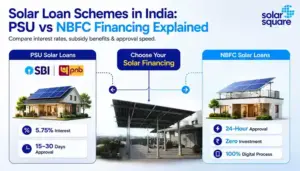
PSU (Public Sector Undertaking) banks, such as SBI and PNB, do not extend term loans to housing societies for solar installations. A term loan is a standard business loan with a fixed repayment schedule, and PSU banks consider housing societies a non-standard borrower category for this product.
What societies usually do at PSU banks is take a loan against an existing fixed deposit the society already holds with the bank, which is a much smaller and more constrained option.
The active lenders in the housing society solar loan space right now are NBFCs.
- They offer loans in the range of 14% to 17% interest
- They may charge a processing fee of 1-2% of the loan amount
- Tenures usually go up to 5 years
If your society is exploring a group solar loan, your starting point should be NBFCs that specifically lend to cooperative housing societies, as well as your solar vendor, who can introduce you to lenders with whom they have an existing relationship.
Is PM Surya Ghar Muft Bijli Yojana Solar Subsidy for Housing Societies a Loan?
No, the PM Surya Ghar Muft Bijli Yojana subsidy is not a loan. It is a capital subsidy, meaning a one-time grant from the Indian central government that directly reduces the cost of rooftop solar for housing societies. There is no repayment, no interest, and no tenure attached to it.
The solar subsidy for housing societies under the PM Surya Ghar Muft Bijli Yojana is fixed at Rs 18,000 per kW for systems up to 500 kW, with a maximum cap of Rs. 90 lakh. The subsidy applies to the common-area solar installed by the society or RWA, including capacity used for amenities such as EV charging.
Here’s a tabulated snapshot of the solar subsidy for housing societies for different capacity solar systems:
| Solar System Size | PM Surya Ghar Muft Bijli Yojana Subsidy for Housing Societies |
| 30 kW solar system | Rs. 5.40 lakh |
| 50 kW solar system | Rs. 9 lakh |
| 100 kW solar system | Rs. 18 lakh |
| 200 kW solar system | Rs. 36 lakh |
| 300 kW solar system | Rs. 54 lakh |
| 500 kW solar system | Rs. 90 lakh |
The subsidy and the loan work together, not against each other.
- A society can take a group solar loan to fund the full project cost.
- Once the subsidy is disbursed to the society’s bank account, the society can use the amount to make a part-payment on the loan principal, thereby significantly reducing the remaining EMI.
To qualify for the subsidy, the solar panels must be DCR (Domestic Content Requirement) models, meaning the panels and cells must be manufactured in India.
Eligibility Criteria for a Society Group Loan
If your society checks these eligibility conditions, it will most likely qualify for a group solar loan:
- Registered housing society: The society must be formally registered under the relevant state cooperative act, since lenders only fund recognized legal entities.
- Proper committee authorization: A formal managing committee resolution must approve the solar installation and authorize a specific representative to sign on behalf of the society.
- Clean financial records: Audited financial statements for the past 2 to 3 years, with no unexplained gaps in the books.
- Regular maintenance collection history: Consistent monthly inflows from members across the past 6 to 12 months, since this is the income lenders map against the EMI.
- Sufficient shadow-free rooftop area: The roof must accommodate the system size needed for the society’s common area consumption, with no significant shadowing from trees, water tanks, or adjacent buildings.
- Healthy bank statement profile: No bounced cheques, no negative balances, and a clean transaction history that signals the society manages its money responsibly.
- No major ongoing legal disputes: Pending litigation involving the society’s finances can derail loan approval, since lenders see it as a recovery risk.
- Stable occupancy in the society: A society with consistently high occupancy generates predictable maintenance income.
- Adequate common-area electricity consumption: The monthly bill should be high enough to ensure the solar project delivers sufficient savings.
How to Apply for a Housing Society Solar Loan in India?
Here’s a step-by-step walkthrough of how you can apply for a housing society solar loan in India:
- Step 1 – Assess common area electricity consumption: Pull together the society’s common area electricity bills for the past 12 months. This gives you the baseline consumption pattern that every conversation with vendors, lenders, and the DISCOM will be built on.
- Step 2 – Conduct a rooftop feasibility survey: Engage an EPC vendor to do an on-site survey. They will assess the shadow-free area, the roof’s structural strength, the electrical setup, and the optimal direction for panel placement.
- Step 3 – Obtain quotations from approved solar vendors: Reach out to at least 3 vendors and request detailed proposals. Compare them on system size, inverter and panel brands, project cost, warranty, AMC terms, and references from other housing societies they have worked with.
- Step 4 – Finalize system size and expected savings: Lock in the system capacity based on your common-area consumption and rooftop area. The vendor’s proposal should clearly show expected monthly generation, monthly savings, payback period, and the cost breakup with and without subsidy.
- Step 5 – Pass a committee resolution approving the project: The managing committee needs to formally approve the solar installation, the loan amount, the chosen vendor, and authorize a representative to sign loan and vendor documents on behalf of the society.
- Step 6 – Collect required society documents: Pull together the society registration certificate, PAN card, bye-laws, audited financials for the past 2 to 3 years, last 12 months of bank statements, committee resolution, electricity bills, vendor proposal, and KYC of the authorized signatories.
- Step 7 – Apply for subsidy, if applicable: Register the society on the PM Surya Ghar Muft Bijli Yojana National Portal for Rooftop Solar. Submit the required details and wait for DISCOM feasibility approval, which confirms the society’s eligibility for the Rs. 18,000 per kW subsidy.
- Step 8 – Submit the loan application to an NBFC: Hand over the full document set to the shortlisted lender. NBFCs are currently the active lenders in this space, so the application will most likely go to an NBFC that funds housing society solar projects.
- Step 9 – Complete lender due diligence and approvals: The lender will run a credit assessment on the society and the authorized signatories, review the audited financials, may visit the site, and then issue a sanction letter with the approved loan amount, interest rate, tenure, EMI schedule, and processing fee.
- Step 10 – Execute the loan agreement and vendor contract: Sign the loan agreement with the lender and the project contract with the EPC vendor.
- Step 11 – Install the solar system and complete DISCOM approvals: The vendor installs the panels, inverters, mounting structure, and wiring. Once installation is done, the DISCOM inspects the system, installs the net metering setup, and issues a solar commissioning certificate, after which the plant goes live.
- Step 12 – Start EMI repayment using electricity savings: The society’s monthly EMIs begin from the maintenance collection, which is now offset by reductions in the common area electricity bill. When the PM Surya Ghar Muft Bijli Yojana subsidy is disbursed, the society uses the amount to part-pay the loan principal, thereby reducing the remaining EMI burden.
What are the Benefits of Solar Financing for Housing Societies?
Here are some of the most important advantages of solar financing for housing societies that every RWA must know:
- Lower electricity bills from month one: A well-sized rooftop solar plant can reduce common area electricity bills by 70% to 90%.
- No large upfront collections from members: Solar financing for housing societies removes the need to demand a one-time contribution from members, which is usually a politically difficult task in an AGM.
- CORPUS and sinking funds remain protected: The society’s reserve funds remain untouched and available for emergencies such as structural repairs, lift overhauls, or waterproofing.
- Predictable energy costs for the next 25 years: Solar locks in a stable electricity cost for the society for the lifetime of the system, which insulates members from year-on-year grid tariff hikes.
- Higher long-term property value: Buildings with solar and lower maintenance bills are more attractive to buyers and tenants, which improves both resale and rental rates.
- Full subsidy benefits captured by the society: When the society takes a solar loan and owns the system, it claims the full subsidy and uses it to reduce the loan principal.
- EMIs are structured to match electricity savings: Most lenders set the EMI equal to or lower than the monthly electricity bill before going solar, so society does not feel an additional outflow.
- Lower per-flat maintenance burden over time: As the common area bill drops, the maintenance charge per flat either reduces or is redirected to other society improvements.
Things to Consider Before Taking a Group Solar Loan
Here’s a practical checklist for committees before signing the loan agreement.
- Verify the actual shadow-free rooftop area: Trees, water tanks, lift machine rooms, and adjacent tall buildings can cast shadows on the roof.
- Compare interest rates and processing fees from at least three lenders: NBFC rates can vary for the same society profile.
- Understand the subsidy disbursement timeline clearly: Subsidies are disbursed within 30 to 90 days after commissioning, and the loan should be sized to absorb this gap.
- Match the EMI against expected monthly savings: If the EMI exceeds the savings, the society will experience a monthly outflow until the loan is closed.
- Clarify maintenance and AMC responsibilities: Confirm whether the vendor offers an AMC, what it covers, and what it costs annually.
- Confirm your state’s net metering and group net metering policies: Net metering rules vary by state, and some DISCOMs cap the system size eligible for net metering. If your society has multiple common-area meters across different towers or amenities, also check whether your state allows group net metering, which lets surplus solar electricity get credited across all those meters instead of just one.
- Ensure all society approvals are in place: Missing committee or AGM resolutions can delay loan disbursement by weeks.
- Review prepayment charges in the loan agreement: Some lenders charge a 2-3% foreclosure fee, which matters if the society plans to prepay using the subsidy.
- Pick an experienced solar vendor: A solar plant is a 25-year asset, and the vendor should still be around in year 15 to service it.
- Assess the long-term structural strength of the rooftop: A structural certification from a qualified engineer is worth the cost, especially for older buildings.
For a detailed checklist, you can also visit our blog post, Solar for Apartment Buildings: Legal and Technical Checklist.
Case Study: How Green Heights CHS in Pune Financed Their Solar Project?
Green Heights CHS in Pune is a mid-sized housing society with 120 flats across three towers. The society was running a common area electricity bill of ~Rs 1.2 lakh a month, driven by lifts, water pumps, clubhouse facilities, and parking lights.
After a feasibility assessment, the committee approved the installation of a 120 kW rooftop solar plant.
The committee initially considered using the society’s sinking fund to pay for the project upfront. Members pushed back on this idea because they wanted the sinking fund preserved for future structural repairs.
- RESCO was rejected: The committee evaluated the RESCO model but preferred owning the asset to capture full long-term savings and claim the subsidy.
- Member financing was rejected: Individual member financing was ruled out because the system was intended solely for common-area use, not flat-level use.
The society opted for a group solar loan from an NBFC with a 5-year repayment tenure. The PM Surya Ghar Muft Bijli Yojana subsidy reduced the effective project cost by Rs. 21.60 lakh, and the monthly EMI was lower than the society had been paying earlier for grid electricity.
Here are the details of the project cost and how solar financing covered it entirely:
| Case Study Details | Details |
| Housing society name | Green Height CHS, Pune |
| System capacity installed | 120 kW |
| Total project cost | Rs. 72 lakh |
| PM Surya Ghar subsidy received | Rs. 21.60 lakh |
| Net project cost after subsidy | Rs. 50.40 lakh |
| Upfront paid by society | Rs. 15 lakh |
| Loan approved | Rs. 57 lakh |
| Monthly EMI | Rs. 1.38 lakh |
| Payback period | 5 years + additional cash flow of Rs 6.60 lakh |
Conclusion
A decade ago, a society wanting to install solar had to either pull lakhs from the CORPUS or get every member to agree to a one-time contribution. Today, a registered society with clean books and a working committee can install a rooftop solar system without touching the CORPUS, get the PM Surya Ghar Muft Bijli Yojana subsidy, and pay off the loan in five years through electricity savings that would have gone to the grid anyway.
The main decision for most committees comes down to two questions.
- Does the housing society want to own the asset and capture 100% of the savings over 25 years?
- Does it want the developer to handle everything and pay a discounted tariff instead?
If you’re in the 1st category, a group solar loan is ideal. For societies that do not want the hassle of plant maintenance, the RESCO financing model is beneficial.
For any further queries about installing rooftop solar in your housing society, you can book a free solar consultation call with SolarSquare.
FAQs
Is solar financing available for individual apartments or only for common areas?
Solar financing is available for both. Individual flat owners can take personal solar loans for in-flat consumption, and societies can take group solar loans for common area projects.
In practice, solar power for apartments and societies helps lower common-area bills because rooftop space is shared property, and the savings flow back to every resident through reduced maintenance costs.
What is the repayment tenure of solar financing for housing societies?
Most NBFC group solar loans for societies offer tenures of up to 5 years. On the other hand, RESCO/OPEX contracts run longer, usually 10 years or more, because the developer needs that duration to recover their investment through the PPA tariff.
What is the interest rate of an NBFC solar loan for apartments and housing societies?
NBFC solar loan interest rates for housing societies currently range from 14% to 17%, along with a processing fee of 1-2%. The exact rate depends on the society’s financial profile, project size, and tenure.
Can a housing society take a loan as a registered entity?
Yes, registered cooperative housing societies can apply for solar loans as institutional borrowers in the society’s own name. The authorized signatories sign the loan agreement on behalf of the society, backed by a committee resolution and, in some cases, an AGM resolution.
Does the PM Surya Ghar subsidy still apply if the society takes a loan?
Yes, the subsidy eligibility is independent of the financing route. As long as the society owns the system, the subsidy of Rs. 18,000 per kW (up to Rs. 90 lakh for systems with a capacity of 500 kW or more) is available regardless of whether the society funded the project through a loan, CORPUS, or a mix of both.
Is RESCO/OPEX financing better than taking a loan for a housing society?
It depends on the society’s priorities. RESCO removes the upfront investment and the maintenance burden, which suits societies that want a hands-off arrangement. A group solar loan with ownership, on the other hand, provides society with higher long-term savings and a full subsidy.
What happens to the loan if the society wants to prepay after the subsidy comes in?
Most lenders allow partial or full prepayment after the subsidy is disbursed. Some charge a foreclosure fee of 2% to 3% of the prepaid amount. The society should clarify the prepayment terms in the loan agreement before signing.
What documents does a housing society need to apply for a solar loan?
The most common documents needed to apply for a housing society solar loan are the society’s registration certificate, PAN card, society bye-laws, last 6 to 12 months of bank statements, audited financial statements for the past 2 to 3 years, committee resolution approving the solar project, electricity bills for the common area meter, KYC of the authorized signatories, and rooftop ownership or NOC documents.
How much can a housing society save on electricity bills after going solar?
Depending on the system size relative to the society’s common area consumption, a well-designed solar plant can reduce the common area electricity bill by 70-90%. Societies with very high daytime consumption see the higher end of this range.
Is collateral required for a housing society solar loan?
For smaller projects, many NBFCs offer unsecured or partially secured loans backed by the society’s audited financials and the cash flow from the solar plant itself. For larger projects, lenders may ask for a fixed deposit lien, a corporate guarantee from the society, or a hypothecation of the solar asset.









![10 kW Solar Panel Price in India [With and Without a Subsidy]](https://cdn.solarsquare.in/blog/wp-content/uploads/2025/07/18165650/10-KW-solar-panel-300x167.webp)