

 1788 Reads
 20 mins


Electricity is one of those business costs that increase every year while offering no relief whatsoever. Installing a commercial rooftop solar system can solve that problem by turning a rising monthly expense into a stable, super-predictable one.
The hardest question for businesses is which solar business model to choose, because the solar investment model you adopt today determines who owns the asset, who bears the risk, and how much you actually save over 25 years.
Currently, there are two dominant solar business models in India:
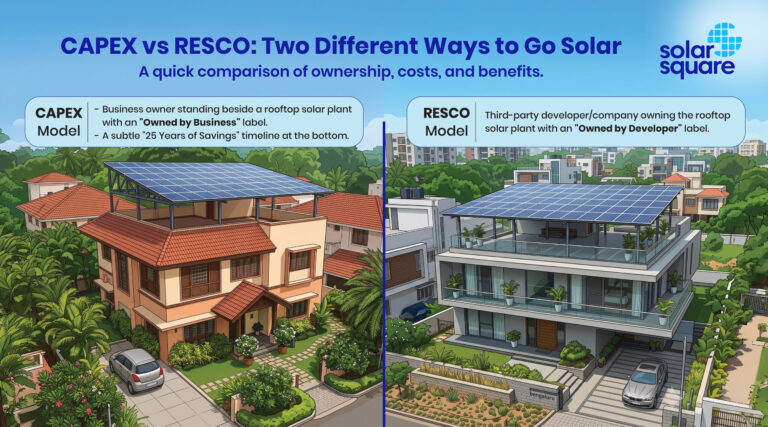
- CAPEX solar model: Here, your business buys and owns the plant from day one.
- RESCO model: Here, a third party owns the plant and sells you the power.
Simply put, the difference between RESCO vs CAPEX is plant ownership. Under CAPEX, you own the asset and keep all the savings. Under RESCO, you own nothing and pay a fixed per-unit rate that is lower than your grid tariff.
Neither solar investment model wins automatically for every business profile.
- The CAPEX solar model is better for businesses with lots of capital or loan access that want asset ownership, accelerated depreciation benefits, and the lowest cost over the full plant life.
- The RESCO model suits businesses that want negligible upfront investment and no maintenance responsibility in exchange for not owning the system from day 1 and committing to a long PPA.
This guide takes you through the full scope of RESCO vs CAPEX solar models for financing commercial solar panel systems, including their cost-to-benefit ratios, pros and cons, and the factors to consider when choosing the model that fits your business needs and cash profile.
What Is the CAPEX Solar Model?
Under the CAPEX solar model, your business pays for the solar plant and owns it. The money comes from either your own funds or a solar loan. From the day the plant is commissioned, every unit it generates belongs to you.
Simply put, in the CAPEX solar model, you spend once, maintain the asset, and it keeps producing value for years after it has paid for itself.
Key Features of the CAPEX Solar Model
Here’s a snapshot of the key features of the CAPEX solar business model in India:
- Upfront investment: You fund the full project cost at the start, either directly or through financing, and the plant is yours from commissioning.
- Business owns the asset: The rooftop solar system is your asset throughout its operational life of 25 years.
- Higher long-term savings: Once the payback period ends, the electricity is close to free, except for routine upkeep.
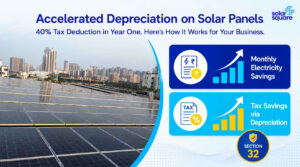
- Eligible for accelerated depreciation benefits: Because you own the asset, your business can claim up to 40% accelerated depreciation, which improves the return further.
- Full control over vendor, equipment, and maintenance: You pick the EPC partner, the inverter and panel brands, and how the plant is serviced. Therefore, the quality stays in your hands.
Cost-to-Benefit Ratio from CAPEX Solar Model
To give you a feel for the lifetime savings and payback from the CAPEX solar investment model, here are actual numbers from a 100 kW commercial rooftop solar plant. The example is a mid-sized commercial unit in a Maharashtra or Gujarat industrial zone, and the figures below show what ownership earns over the plant’s life.
- Solar system size: 100 kW
- Rooftop space required: ~9,000 to 10,000 sq. ft.
- Monthly electricity consumption: 14,000 to 16,000 units
- Grid tariff: Rs. 10.5 per unit
- Annual solar generation: ~1.45 lakh units
- Plant life: 25 years
Here is the full cost and benefit picture for this plant under the CAPEX solar model:
| Particulars | Value |
| Cost of solar panels + inverters + structure | ~Rs. 38 lakh |
| Cost for installation and electricals | ~Rs. 5 lakh |
| Cost for net metering and approval | ~Rs. 1 lakh |
| Total project cost | ~Rs. 44 lakh |
| Gross annual savings (1,45,000 units × Rs. 10.5) | ~Rs. 15.2 lakh/year |
| Annual O&M cost (cleaning, monitoring, and AMC) | ~Rs. 1 lakh/year |
| Net annual savings | 14.2 lakh/year |
| Payback period | 3.1 years |
| Total lifetime savings (25 years) | Rs. 3.2 to 3.8 crore |
DISCLAIMER: The figures mentioned above are illustrative estimates for a 100 kW commercial rooftop solar system. Actual costs, tariffs, and savings vary with location, city, system size, system technology, vendor pricing, and prevailing policy, etc.
As you can see from the table above, the plant pays for itself in ~3.1 years, which gives a practical payback range of 3 to 4 years. Even after you account for yearly solar panel degradation and an inverter replacement around Year 12 to 15, the long-term returns stay very strong.
How Can a CAPEX Solar Loan Help?
Many businesses walk away from the CAPEX solar model because they assume it means writing a single large cheque on day one. That assumption is outdated. Most commercial rooftop solar projects today are financed through banks and NBFCs, which changes the math completely.
Under a solar loan structure, the ownership and control stay with you while the capital pressure eases.
- The business owns the solar plant: Financing does not change ownership, so depreciation and full savings still belong to you.
- The lender finances 70% to 90% of the project cost: You bring in only a small share of the total upfront.
- Repayment happens through EMIs over 3 to 7 years: The cost is spread over the years rather than charged in a lump sum.
- Monthly electricity savings often offset a large part of the EMI: The plant helps pay for itself while you are still repaying the loan.
Here is how that looks for the same 100 kW project from above:
| Particulars | Value |
| Total project cost | ~Rs. 44 lakh |
| Loan amount (80%) | ~Rs. 35 lakh |
| Your contribution to upfront investment (20%) | ~Rs. 9 lakh |
| Monthly EMI | ~Rs. 80,000 |
| Monthly electricity savings | ~Rs. 1.25 lakh |
DISCLAIMER: For the monthly electricity savings, we have considered the 100 kW plant generating ~12,000 units a month and a grid tariff of Rs. 10.5 per unit, which works out to ~Rs. 1.25 lakh saved every month. For the monthly EMI, we have assumed a Rs. 35 lakh loan over 5 years at the kind of interest rates commercial solar loans usually carry. Your actual savings and EMI will change with the interest rate, loan tenure, real generation, and state tariff. So, treat these as indicative numbers only.
As you can see from the table above, even during the loan period, the business generates positive monthly cash flow, since the Rs. 1.25 lakh in savings covers the Rs. 80,000 EMI while still leaving savings. After the loan is repaid, the solar power becomes far cheaper for the remaining 2 decades of the plant’s life.
What Is the RESCO Model (OPEX-PPA) in Solar Rooftop Business?
Under the RESCO model, also known as the OPEX solar model, you do not buy the plant. A third-party developer installs and owns the solar system and sells your business the electricity the plant produces at an agreed rate, well below your grid tariff.
Since you have to sign a long-term power purchase agreement (PPA) with the third-party installing the plant, this model is also known as the solar PPA model. The PPA runs for 5 to 25 years, depending on the terms, and during that period, you pay for the solar electricity units you consume.
The investor behind the plant is either an HNI or a financing partner seeking stable, long-term returns.
Key Features of the RESCO Solar Model
Here’s a snapshot of the key features of the RESCO/OPEX solar model in India:
- Low upfront investment: The business usually has to make a deposit of 10%. As a result, your out-of-pocket capital investment stays minimal.
- Third-party ownership of the solar asset: The developer owns the plant for the duration of the solar PPA model.
- Pay-per-unit electricity pricing: You pay only for the solar power you actually consume, billed per unit. A close cousin to this is the solar lease model, where you pay a fixed monthly amount rather than per unit generated. However, it should not be confused with RESCO, as the two are different.
- Long-term solar PPA agreement: After the PPA term ends, the plant is usually transferred to the customer, though this depends on the contract and is not guaranteed in every case.
- Operations and maintenance handled by the RESCO investor: Servicing, monitoring, and repairs are the developer’s responsibility.
- Predictable electricity costs: Your solar tariff is fixed and below grid rates, which protects you from rising power prices.
- Lower financial and operational risk: With no large assets to fund or maintain, the developer bears the capital risk and maintenance costs, not your business.
Cost-to-Benefit Ratio from the RESCO Model
To show the RESCO numbers fairly, we have used the same 100 kW plant details as used for the CAPEX example. The plant, consumption, and generation stay identical. What changes is that the developer owns the system, and the business pays a fixed PPA tariff instead of funding anything.
- Solar system size: 100 kW (developer-owned)
- Annual solar generation: ~1.45 lakh units
- Existing grid tariff: Rs. 10.5 per unit
- RESCO solar tariff: Rs. 6.8 per unit
- PPA term: 20 to 25 years
Here is the cost and benefit picture for the business under the RESCO model.
| Particulars | Value |
| Solar plant cost to business | Rs. 0 |
| Security deposit/infra changes | ~Rs. 2 to 4 lakh (varies) |
| Plant owner | Developer |
| Per unit savings for business (Rs. 10.5 − Rs. 6.8) | ~Rs. 3.7/unit |
| Annual savings (Rs. 3.7 × ~1,45,000 units) | ~Rs. 5.4 lakh/year |
| Upfront investment | Minimal |
| O&M responsibility | Developer |
DISCLAIMER: For the annual savings, we have considered a RESCO solar tariff of Rs. 6.8 per unit against a grid tariff of Rs. 10.5 per unit, which gives a saving of Rs. 3.7 on every unit. Applied to the same 100 kW plant generating around 1.45 lakh units a year, that comes to ~Rs. 5.4 lakh saved annually. Your actual savings, however, will change with the PPA tariff your developer offers, any yearly tariff escalation in the contract, the system size, and your state grid rate. So, treat the figures in the table as indicative only.
The savings start in the first month in the RESCO model, but they remain capped by the PPA rate for the full contract term. That’s the real trade-off for paying nothing up front. There is no large outlay to recover, so the small deposit is earned back within 1 to 3 years.
RESCO vs CAPEX: Quick Comparison Table
Now, let’s compare RESCO and CAPEX models side-by-side for clarity. To give a fair evaluation, we have used the same numbers from a 100 kW commercial solar system, which has been used unanimously throughout this blog.
| Factor | CAPEX Solar Model for a 100 kW Commercial Solar System | RESCO Model for a 100 kW Commercial Solar System |
| Ownership | Business owns the plant from day one | Developer owns it through the PPA term |
| Upfront cost | ~Rs. 44 lakh (own funds) or ~Rs. 9 lakh with 80% financing |
|
| Annual savings | ~Rs. 14.2 lakh net saving, rising to near-free power after payback | ~Rs. 5.4 lakh |
| Payback period | 3 to 4 years on the full investment | 1 to 3 years on the small deposit |
| 25-year lifetime savings | ~Rs. 3.2 to 3.8 crore | Capped by the PPA tariff for the term |
| O&M responsibility | Business invests ~Rs. 1 lakh/year on maintenance | Developer is responsible for the maintenance throughout the PPA tenure |
| Tax/depreciation benefit | Up to 40% accelerated depreciation benefits go to the business | Up to 40% accelerated depreciation benefits go to the developer, not the business |
| Best for | Capital-ready businesses chasing maximum lifetime returns | Capital-light or multi-site businesses wanting zero hassle |
| Contract lock in | None, as the asset is yours | Long PPA of 5 to 25 years |
| Risk | Upfront capital and O&M are the responsibility of the business |
|
Benefits of CAPEX Solar Model for Businesses
CAPEX solar model wins on what ownership earns you over the full life of the plant rather than what it costs on day one. Here are the main advantages of this solar business model that you must know.
- Maximum savings after payback: Once the 3 to 4 year payback ends, the savings you make each year are pure gain for the remaining 2 decades.
- Ownership of a 25-year asset: The plant stays an owned asset on your books for its full life.
- Protection from rising grid tariffs: Every unit the plant generates for you shields you from the annual grid tariff hikes.
- Tax benefits such as accelerated depreciation: Eligible businesses can claim accelerated depreciation of up to 40% on the asset, thereby lowering taxable income and shortening the effective payback period.
- Better control over plant quality and vendor selection: You choose the solar components and the vendor. Therefore, generation and reliability stay in your control.
Limitations of the CAPEX Solar Model for Businesses
Ownership comes with responsibilities that not every business is set up to carry. These are the real disadvantages of the CAPEX solar model.
- High upfront investment: Even with financing, you commit capital and a repayment obligation that a leaner business may not want.
- O&M responsibility: Cleaning, monitoring, and repairs are the plant owner’s responsibility, which can be handled in-house or through a managed contract.
- Longer internal approval cycle: A capital purchase of this size requires board or management sign-off, which slows the decision-making process.
Benefits of the RESCO Model for Businesses
The RESCO model wins on speed, affordability, and simplicity. You get solar savings without funding or running anything. Here are the key advantages of the RESCO model that you must know.
- Minimal upfront investment: A small security deposit of just 10% of the entire project cost.
- Immediate electricity bill savings: You save money on power as the solar electricity you purchase in a solar PPA model is at rates lower than the grid tariffs.
- O&M handled by the investor: Maintenance, monitoring, and plant performance guarantee are the developer’s headaches in the RESCO model.
- Better for multi-site or capital-light businesses: Companies operating in multiple locations can go solar without tying up significant capital at each site.
- Predictable solar tariff through the PPA: Your per-unit rate is locked for the contract term, which makes budgeting straightforward while grid rates keep climbing.
Limitations of the RESCO Solar Investment Model for Businesses
Here’s a snapshot of the main disadvantages of the solar PPA model:
- Lower lifetime savings than CAPEX: You never reach the near-free power that the CAPEX solar business model delivers after payback.
- Long-term PPA commitment: You are tied to the developer for years, which limits flexibility if your plans change.
- Exit clauses can be restrictive: Leaving the contract early or relocating can trigger penalties that are easy to miss at signing.
- Contract terms matter as much as the tariff: A low per-unit rate looks great on paper, but it means little if the contract raises that rate every year or makes leaving early expensive. The escalation clause, buyout terms, and exit conditions decide your real savings in the RESCO model.
Which Model Gives Better Long-Term Savings: CAPEX or RESCO?
Over the full 25-year lifespan of the solar system, CAPEX gives higher total savings, and the gap is wide. In the example we’ve used in this blog, the CAPEX model saves ~Rs. 3.2 to 3.8 crore across the 25-year lifespan of a 100 kW solar system because you keep every unit generated after the payback period.
RESCO, on the other hand, saves a steady but smaller amount each year, capped by the PPA tariff, since the developer takes a margin for owning and running the plant.
Simply put, RESCO wins on early cash flow while CAPEX wins on lifetime value.
Which Model Is Better for MSMEs?
For MSMEs, the answer depends on capital and tax position.
- When to choose CAPEX: An MSME that is profitable, owns its premises, and can access a solar loan does best with CAPEX, since the accelerated depreciation and full savings strengthen the balance sheet.
- When to choose RESCO: An MSME that is short on capital, operates from rented premises, or wants zero operational involvement fits the RESCO model better, because it gets immediate savings without locking up funds the business might already be short on.
Which Model Is Better for Large Commercial and Industrial Businesses?
Large C&I businesses with capital and high daytime load usually prefer CAPEX for the depreciation benefit and the lowest long-term cost per unit. However, a business that wants to preserve capital for its core operations, or one expanding across multiple sites, tends to lean toward RESCO to keep solar off the balance sheet while still cutting power bills from day one.
Important Things Businesses Should Check Before Choosing the CAPEX Solar Model
Here’s a practical checklist to consider before you choose the CAPEX solar investment model:
- Total upfront investment required: Confirm the full project cost and how much you fund directly vs through a loan.
- Expected payback period: For a well-sized commercial rooftop solar system, this is between 3 and 4 years.
- Roof condition and available space: The roof must take the structural load and offer the area the system needs, ~9,000 to 10,000 sq. ft. for a 100 kW plant.
- Solar system quality and EPC vendor selection: Generation over 25 years depends heavily on component quality and a reliable solar partner.
- Operations and maintenance costs: Budget for cleaning, monitoring, and an eventual inverter replacement to keep the ownership math realistic.
Important Things Businesses Should Check Before Choosing the RESCO Model
Here’s a checklist of what you should consider when planning to go ahead with the RESCO solar business model:
- Contract duration and lock-in period: Know exactly how long you are committed and what flexibility, if any, you retain.
- Electricity tariff and annual price escalation: Check the starting rate and any yearly escalation, since a rising tariff erodes your savings over time.
- Expected payback period: Because your share is only a small deposit, the payback period is short, i.e., 1 to 3 years.
- Maintenance and downtime responsibility: Ensure the PPA clearly assigns O&M responsibilities to the developer throughout the PPA’s tenure.
- Exit or early termination penalties: Understand the cost of leaving early or relocating before you sign, not after.
- Ownership terms after the agreement ends: Confirm whether the plant transfers to you at the end of the term and on what terms, as this varies by contract.
Conclusion
You cannot simply pick RESCO vs CAPEX based on a single factor. The solar investment model you choose must align with your business’s cash flow and whether you prefer higher savings over time or a lower upfront investment.
CAPEX solar model offers the highest lifetime savings. The RESCO model, on the other hand, is a great option for businesses that value cash flow, flexibility, and a hands-off setup with immediate savings and no upfront burden.
Whichever solar investment model you choose, the plant still has to be designed and installed well. Thus, picking a strong EPC or RESCO partner matters as much as picking the model.
If you are still weighing the two, work through this quick decision path.
- Do you own your premises? If not, RESCO is usually the practical choice, or you negotiate with your landlord for a CAPEX setup.
- If so, do you have capital or access to loans? If yes, go with CAPEX for maximum ownership and savings.
- If yes to premises but no to capital? RESCO lets you go solar now and save from month one without funding the plant.
For any further details on commercial rooftop solar installation, you can book a free solar consultation call with SolarSquare.
FAQs
Which is cheaper: RESCO or CAPEX?
CAPEX solar model is cheaper over the full project lifecycle because the business owns the asset and keeps all the savings after a short payback period of 3-4 years. RESCO, on the other hand, costs less upfront but more over the long run, since the developer’s margin is built into the tariff.
Which model gives better ROI?
The CAPEX solar model tends to offer a better long-term ROI, thanks to ownership, full savings, and depreciation benefits that you will receive. RESCO, on the other hand, offers faster short-term cash flow benefits because savings begin immediately with almost no investment.
Can businesses claim depreciation under RESCO?
No. Under the RESCO model, the developer owns the asset. Therefore, the depreciation benefit stays with the developer rather than your business.
Does RESCO affect my balance sheet?
Usually, it does not, because you do not buy/own the solar system. The payments are treated as an operating expense. This off-balance-sheet treatment is one of the main reasons capital-light businesses prefer the RESCO financing model.
Who is responsible if panels underperform under RESCO?
The RESCO developer is responsible for the performance under the PPA. Even maintenance falls under the developer’s scope throughout the PPA.
Can I switch from RESCO to CAPEX later?
Some agreements allow a buyout after a few years, which lets you have the plant ownership. Whether this is possible, and at what price, depends entirely on how the contract is structured. Therefore, always check the buyout clause before signing.
Is RESCO the same as OPEX?
Yes, RESCO and OPEX are the same solar investment models, and are used interchangeably in the Indian solar industry.
What is the difference between RESCO and solar PPA?
A solar PPA is the agreement used within the RESCO model. In other words, RESCO describes who owns and runs the plant, and the PPA (power purchase agreement) is the agreement that sets your tariff, term, and exit terms.


 Previous Article
 22 min