

 632 Reads
 20 mins


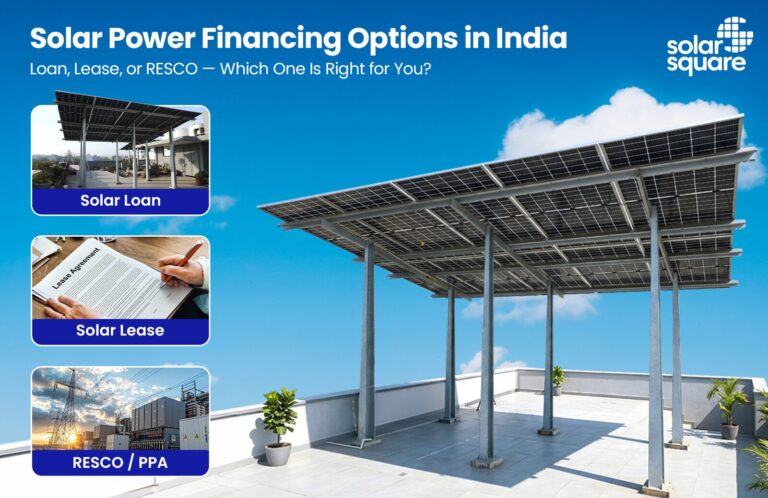
Did you know? Solar financing choices can change the estimated 25-year savings on the same 100 kW rooftop solar system by over Rs. 1 crore.
- A solar loan could deliver lifetime savings of ~Rs. 2.5-3 crore
- A RESCO model may generate only ~Rs. 1.2-1.8 crore in savings.
This is why choosing how to pay for solar can significantly affect its long-term financial value. Solar reduces electricity bills for 25 years, but its upfront cost can range from a few lakhs for homes to tens of lakhs for businesses.
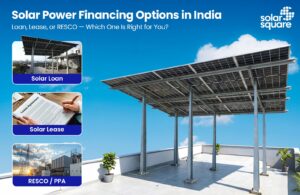
Depending on your budget and priorities, you can finance the system in multiple ways:
- Buy the system using a solar loan
- Lease it for a fixed payment
- Choose a RESCO/PPA model in which a third party owns the plant and sells you the electricity it generates.
Clearly, the solar rooftop financing model you choose today will decide who owns the rooftop solar system, who maintains it, who gets the subsidy or accelerated depreciation tax benefit, how much you save every month, and what happens if the system underperforms.
This guide compares all three solar power financing options in India side by side. Dive in to explore the real cost, savings, ownership, risk, and long-term value of each model before choosing the right financing route.
What Does Solar Financing Mean in India?
Solar financing in India is an arrangement that lets you install rooftop solar without paying the full system cost upfront. Instead of making one large payment, you can spread the cost over time through a loan, lease, or per-unit tariff. You can also let a developer fund the system and recover the investment through the electricity you purchase.
- Where does the money come from? Solar finance can flow from banks, NBFCs, RESCO developers, or government-backed schemes such as the PM Surya Ghar Muft Bijli Yojana for homes.
- What are the different forms of solar financing for businesses and homes? A solar loan in India that’s repaid through EMIs, a lease, the self-funded CAPEX model, and the RESCO model with a solar power purchase agreement.
- Why do banks offer solar loans? RBI classifies renewable energy financing in India under priority sector lending. The limits are up to Rs. 35 crore per borrower for renewable energy power projects and Rs. 10 lakh for individual households. That classification pushes banks to lend loans for solar, which is why dedicated solar loan products keep expanding.
The Three Main Ways to Pay for Solar in India: Quick Comparison between Solar Loan, Lease, and RESCO
In India, there are three common ways to finance a rooftop solar system, apart from paying the full amount in cash.
- Rooftop solar loan in India (you own, you borrow): A solar loan lets you buy the rooftop solar system without paying the full cost upfront. A bank such as SBI or PNB, an NBFC, or solar financing partner funds the installation. You simply repay the amount through EMIs. Here, you own the solar system from day one.
- Solar lease financing (you pay rent, ownership usually transfers later): A solar lease lets you use a rooftop solar system without buying it immediately. A third party installs and owns the system, and you pay a fixed monthly or periodic lease amount for using it.
- RESCO solar model or PPA (the developer owns the system, you buy the power): Here, a solar developer installs, owns, operates, and maintains the solar plant on your roof. You do not buy the system. You simply buy the solar power it generates, usually at a tariff lower than your grid electricity rate. RESCO is the model, while PPA is the agreement that sets the tariff, tenure, payment terms, and responsibilities.
To fairly compare the three solar power financing options in India (loan vs lease vs RESCO solar), we have used the same base case for each option. The example below assumes a 100 kW commercial rooftop solar system. It applies the same generation, tariff, cost, and tenure assumptions across the loan, lease, and RESCO/PPA models.
For this comparison, we have assumed:
- System cost: Rs. 45 lakh
- Annual generation: ~1.5 lakh units
- Grid tariff: Rs. 9/unit
- Plant life: 25 years
- Solar loan: 80% funding, 5-year tenure, ~10-11% interest
- Lease tenure: 10-15 years
- RESCO/PPA tariff: Rs. 5.5-6.5/unit with escalation depending on contract
Here’s how the three models, i.e., loan vs lease vs RESCO solar, compare:
| Factor | Solar Loan in India | Solar Lease Financing | RESCO Solar Model |
| Upfront cost | Rs. 9-12 lakh margin money + financed balance | Minimal security deposit or low upfront cost | ~10% |
| Ownership | Customer |
| RESCO developer |
| Monthly payment | EMI of ~Rs. 70k to ~Rs. 80k per month for financed portion | Fixed lease rental | Pay only for solar units generated at agreed tariff |
| Maintenance | Customer or AMC provider | Usually provider | RESCO developer |
| Annual electricity savings |
| Moderate savings vs grid power | Immediate reduction in power cost without investment |
| Lifetime savings over 25 years | Rs. 2.5-3 crore | Rs. 1.8-2.3 crore | Rs. 1.2-1.8 crore |
| Which option saves more? | Highest long-term savings | Moderate savings | Lower total savings but no capital required |
| Typical payback | 4-6 years |
| No payback since customer does not own the asset |
| Best for | Businesses and MSMEs seeking ownership and maximum ROI | Users wanting predictable monthly expenses and low upfront cost | Factories, warehouses, hospitals, schools and institutions preferring OPEX over CAPEX |
| Main risk | EMI obligation and performance risk, unless covered by warranty/AMC | Contract terms, exit clauses, and ownership restrictions | Long-term PPA lock-in and tariff escalation |
| Who gets depreciation benefits? | Customer | Usually owner/lessor | RESCO developer |
| Subsidy eligibility | Possible but subject to scheme and eligibility | Depends on ownership structure | Generally not available to customer |
| Cash flow impact | Initial equity + EMIs | Fixed periodic outflow | No CAPEX, operating expense only |
| Who bears performance risk? | Customer/EPC | Provider (depends on contract) | Mostly developer |
Solar Loan in India
A solar loan in India works just like a car loan or a home loan. You borrow the system cost from a bank, an NBFC, or the financing partner, the panels go up on your roof, and you repay the borrowed amount in monthly EMIs. The system belongs to you from the first day, and that’s exactly what separates this route from a lease or a RESCO contract.
Who Should Choose a Solar Loan?
A solar loan in India works best when you want to own the system, keep the long-term savings, and can manage the EMI comfortably.
It’s a good fit for the following people and businesses.
- Homeowners who want full ownership: A solar loan lets you install rooftop solar without paying the full cost upfront. You own the system from day one, which means the savings from lower electricity bills stay with you after the loan is repaid.
- Buyers eligible for subsidy-linked rooftop solar schemes: Under the PM Surya Ghar Muft Bijli Yojana, eligible residential consumers can reduce their installation cost through subsidy support. For systems of 3 kW or more, the central subsidy is Rs. 78,000. This lowers the amount you need to fund through savings or a loan.
- MSMEs with stable cash flow: A solar loan in India can work well for MSMEs with predictable electricity bills. The monthly savings from solar can help offset a significant portion of the EMI while the business continues to own the asset.
- Businesses that want long-term savings and asset ownership: A rooftop solar loan is the most suitable option for solar financing, especially for businesses comfortable taking on debt in exchange for higher lifetime savings. Once the loan is repaid, the system continues to generate power for many more years, thereby improving the overall return on solar.
Pros of a Solar Loan
The strength of a solar loan in India is ownership without writing the full cheque on day one. That ownership flows into a set of real advantages.
- Once the loan is repaid, the system continues to generate power for more than two decades.
- Homes and housing societies benefit from the PM Surya Ghar Muft Bijli Yojana if they meet the eligibility rules.
- Different lenders offer different EMI amounts and tenures, so you can choose a plan that fits your cash flow.
Cons of a Solar Loan
The trade-off is that a loan is still a debt, and it behaves like one. A few points deserve a hard look.
- A weak credit profile or incomplete documents can delay or block the loan.
- You must pay the EMI even if solar generation is lower in some months.
- Some lenders fund only part of the system cost, so you may need to pay a share upfront.
- Since you own the system, review the warranty, insurance, and maintenance terms before signing.
Solar Lease Financing in India
Solar lease financing lets you use a rooftop solar system without buying it upfront. A third-party provider installs or funds the system, and you pay a fixed lease amount for the duration of the contract.
In most lease models, the solar system belongs to the provider for the duration of the lease term.
- You get the benefit of using solar power, while ownership stays with the company that has installed or financed the plant.
- This model is more common for commercial, industrial, and institutional users in India. It is still less widely available for homes.
The most important detail to check is what happens at the end of the lease.
- Some agreements allow ownership to transfer to you at the end of the term.
- Others may require renewal, removal, or a separate buyout.
Who Should Choose Solar Lease Financing?
A solar lease works best when you want to start using solar electricity with low upfront payment and predictable monthly cost. It is suitable for users who want convenience and cash-flow comfort, even if the total lifetime savings may be lower than owning the system.
- Users who want a lower upfront cost: A lease can help you avoid paying the full system cost at the time of installation.
- Users who prefer fixed monthly payments: The lease amount is usually predictable, which makes budgeting easier.
- Housing societies and commercial users: A lease can work for group housing societies and businesses that want solar but do not want to make a large capital investment.
Pros of Solar Leasing in India
Solar leasing is useful when you want to use solar power without making a large upfront payment or managing the system on your own.
Here are all the benefits in detail.
- You can start using solar without paying the full system cost at the beginning.
- The lease amount is usually fixed, which makes it easier to plan your monthly cash flow.
- Many lease agreements include service and maintenance during the contract period.
Cons of Solar Leasing in India
While solar leasing lowers the upfront burden, it can also reduce long-term benefits.
Here are some limitations to consider before you choose leasing as the best solar financing option in India.
- Since you do not fully own the system during the lease term, your total savings are lower than a loan or cash purchase.
- Ending the lease early may involve charges, lock-in conditions, or approval from the provider.
- Some leases transfer ownership at the end, while others do not. This should be written clearly in the agreement.
- Since ownership may rest with the provider, subsidy eligibility can become unclear and should be confirmed before signing.
- Lease options can vary by state, installer, consumer type, and project size.
RESCO Solar Model/PPA
A RESCO, or Renewable Energy Service Company, finances, installs, owns, operates, and maintains the plant on your roof. You buy only the electricity it generates, usually through a long-term solar power purchase agreement, and you never put capital into the asset. In simple terms, the RESCO solar model removes the investment question almost entirely.
This is why the RESCO solar model has become the default for large commercial and industrial solar systems that prefer to invest their capital in their core business rather than in a power plant.
How a Solar Power Purchase Agreement Works in India?
A solar power purchase agreement in India (PPA) is the contract used in the RESCO solar model. The solar developer installs, owns, and operates the plant, while you agree to buy the power it generates at a fixed tariff set out in the PPA.
Here is how it works.
- The developer pays for the plant: You do not make a large upfront investment. The developer funds and owns the solar system.
- You pay for the power you use: Instead of paying for the plant, you pay a pre-agreed rate for every unit of solar power generated.
- The contract runs for a long term: Most PPAs are signed for 15 to 25 years, with tariff escalation terms mentioned in the agreement.
- A buyout option may be included: Most PPAs allow you to buy the plant after a certain number of years at a price agreed in advance.
(H3) Who Should Choose the RESCO Solar Model?
The RESCO solar model works best for users who want solar savings without buying, owning, or maintaining the plant.
- Commercial and industrial users: Businesses with high daytime power consumption can use more solar power as it is generated.
- Large institutions: Schools, hospitals, warehouses, factories, and campuses can benefit from solar without making a large capital investment.
- Users who want zero upfront investment: The developer funds the plant, so you do not have to pay for the system at the start.
- Organizations that want lower maintenance responsibility: Since the developer owns and operates the plant, you do not have to manage day-to-day maintenance yourself.
Pros of the RESCO/PPA Model
The RESCO financing model lets you use solar energy without buying the plant or managing it yourself. The developer invests in the system, runs it, and sells you the power it generates.
- You can switch to solar without making a large capital investment.
- The developer handles system maintenance, repairs, and performance monitoring throughout the contract term.
- Your organization can use clean power without adding the solar plant as a major capital purchase.
Cons of the RESCO/PPA Model
RESCO gives you solar without upfront investment, but it also means a long contract and lower lifetime savings than ownership.
Let’s check out all its limitations:
- Most PPAs run for 15 to 25 years, so you need to be comfortable with the long-term commitment.
- Since the developer owns the plant, you do not keep the full financial benefit of solar.
- Some PPAs increase the solar tariff every year, which can narrow the gap between solar power and grid power over time.
- RESCO is usually better suited to commercial and institutional projects. For rooftop solar systems in homes, it may only work if an aggregated model is available.
What is a Self-Funded CAPEX Solar Model?
A self-funded CAPEX model is one in which you pay the full cost of the solar system upfront and own the plant from day one. There is no loan, lease, or RESCO developer involved. This means you keep the full savings from solar.
The trade-off is that you also take responsibility for upkeep, either through your own team or through an annual maintenance contract (AMC).
This model works best for:
- MSMEs and businesses with surplus cash: They can invest upfront and convert idle capital into long-term electricity savings.
- Businesses that can use tax benefits: Companies with taxable profits may benefit from accelerated depreciation, subject to eligibility and tax advice.
- Customers who want no debt: There is no EMI, interest cost, or lender approval involved.
- Users staying in the same property for the long term: Since the full benefit builds over many years, CAPEX works best when you plan to use the site for a long period.
Which Solar Financing Option Is Safer for You?
Safety in solar financing options in India really comes down to who absorbs the risk. In the real world, generation can fall short, a component can fail, a policy can change, or you may need to exit early.
When you weigh loan vs lease vs RESCO solar, follow this checklist to end up with the best financing option for you:
- Choose a solar loan in India only if you want ownership and can handle EMIs.
- Choose CAPEX only if you have cash and want maximum long-term savings.
- Choose a solar lease only if you want low upfront cost and fixed payments.
- Choose RESCO/PPA if you are a business or institution that wants zero CAPEX and does not want to manage the plant.
The table below maps all risks to the party that bears them under a loan, a lease, or a RESCO or PPA contract.
| Risk type | Solar Loan | Solar Lease | RESCO/Solar PPA |
| Credit risk | Customer | Provider/customer depending on contract | Developer |
| Performance risk | Customer/EPC warranty | Provider | Developer |
| Maintenance risk | Customer unless AMC included | Usually provider | Developer |
| Policy/subsidy risk | Customer | Depends on contract | Developer/customer depending on PPA |
| Tariff risk | Grid tariff changes affect savings | Lease terms fixed | PPA tariff and escalation matter |
| Exit risk | Loan foreclosure terms | Lease termination terms | PPA lock-in and termination cost |
| Ownership risk | Low | Medium | High if user expects future ownership |
How to Finance Solar Panels in India? A Step-by-Step Guide
Choosing the right solar financing options in India gets easier when you follow the right order. Wondering what that order is? Here’s a step-by-step breakdown:
- Check your electricity bills: Review your last 12 months of bills to understand your average usage, peak demand, and current tariff.
- Check your usable roof space: A solar vendor can do this professionally. The aim is to determine how much shadow-free roof area is available and whether you have the right to use it for solar.
- Estimate the right system size: Match the system capacity to your electricity use, sanctioned load, and available roof area.
- Decide how much you want to pay upfront: CAPEX works when you can pay the full cost. A solar loan works when you want ownership with EMIs. Lease and RESCO work when you want to reduce or avoid upfront investment.
- Check subsidy and tax benefits: Residential buyers should verify their eligibility for the PM Surya Ghar Muft Bijli Yojana subsidy. Businesses should check GST input credit and accelerated depreciation with their tax advisor.
- Get written quotes from multiple providers: Ask for detailed quotes that mention system cost, equipment, generation estimate, warranty, service terms, and payment structure.
- Compare the actual financing terms: Look at the EMI, interest rate, lease rental, PPA tariff, escalation, O&M charges, and expected savings.
- Review ownership and exit terms: Check who owns the system, who maintains it, what happens at the end of the term, and what charges apply if you exit early.
- Finalize the model and complete installation: Once the terms are clear, proceed with the loan, lease, RESCO agreement, or CAPEX purchase. After that, the DISCOM and your chosen vendor will handle the complete installation, net metering, and plant commissioning.
Documents Required for Solar Loan or Solar Financing
The exact paperwork depends on the lender, but most solar loan applications in India ask for the same core documents.
- Identity and address proof: Aadhaar, PAN, passport, voter ID, or similar.
- Income proof: Salary slips and Form 16 or ITR for the last one to two years for salaried applicants, and audited financials for businesses adopting solar to lower their electricity bills.
- Bank statements: Usually the most recent six months.
- Property documents: Proof of ownership of the roof or premises (a no-objection certificate where the property is shared).
- The solar quotation: A detailed quote from your vendor or EPC that shows the system size and cost.
Key Clauses to Check Before Choosing Lease, Loan, or RESCO Models for Solar Financing
The right solar financing options in India cannot be decided by the lowest upfront cost alone. It depends on what you pay over time, who maintains the system, and how much flexibility you have if your needs change.
Before choosing a lease, loan, or RESCO solar model, make sure the agreement clearly answers these questions.
- Who owns the system during and after the contract?
- What is the total tenure and lock-in period?
- Will your payment, rental, or tariff increase over time?
- Who handles maintenance, inverter replacement, insurance, damage, and roof repairs?
- What happens if the system generates less power than promised?
- Who gets the subsidy, tax benefit, REC, or carbon benefit?
- Can the contract be transferred if the property is sold?
- What is the early termination cost?
- Is there an option to buy the system later?
Solar financing options in India can make rooftop solar adoption easier, but the contract determines how good the deal remains in the long run. Choose the model only when the costs, savings, ownership, and responsibilities are clearly documented in writing. For any further information you need before going solar, you can book a free solar consultation call with SolarSquare.
FAQs
Is a solar loan better than a solar lease?
A solar loan in India generally delivers higher long-term savings and ownership benefits, while a lease offers lower upfront costs and predictable payments. The better choice depends on whether you value ownership with high savings or a lighter monthly commitment.
Is solar lease financing available for homes in India?
Yes, but residential solar leasing is still limited in India. It is more commonly available for commercial, industrial, and institutional users.
Can I combine a solar subsidy with a solar loan?
Yes, eligible residential consumers can claim the applicable government subsidy and finance the remaining system cost through a solar loan. Final eligibility depends on the scheme rules, system size, vendor, and the application process.
Which bank is best for a solar loan for homes?
Banks such as SBI, PNB, Union Bank of India, and Bank of Baroda offer solar loan options. The best choice depends on the interest rate, loan tenure, processing fee, repayment terms, and your eligibility.
How much CIBIL is required for a solar loan?
Most lenders prefer a good credit profile, and a CIBIL score of 650 or higher can improve your chances of approval. However, the exact requirement depends on the lender, income, repayment capacity, and loan amount.
What is the interest rate on solar loans in India in 2026?
Solar loan interest rates in India vary widely, depending on the lender, borrower profile, loan tenure, and whether the loan is offered under a specific solar financing scheme. Many loans fall in the range of 5.75% to 16% per annum, but you should check the latest rate directly with the bank or financing partner before applying.
Who claims accelerated depreciation in the RESCO model, the business or the developer?
In most RESCO models, the developer claims accelerated depreciation because they own the solar asset.
What is the CAPEX-lite or hybrid solar financing model?
CAPEX-lite is a hybrid structure where the customer invests part of the project cost, and the balance is funded by a lender or developer, reducing upfront capital requirements.


 Previous Article
 16 min