
 1231 Reads
 20 mins


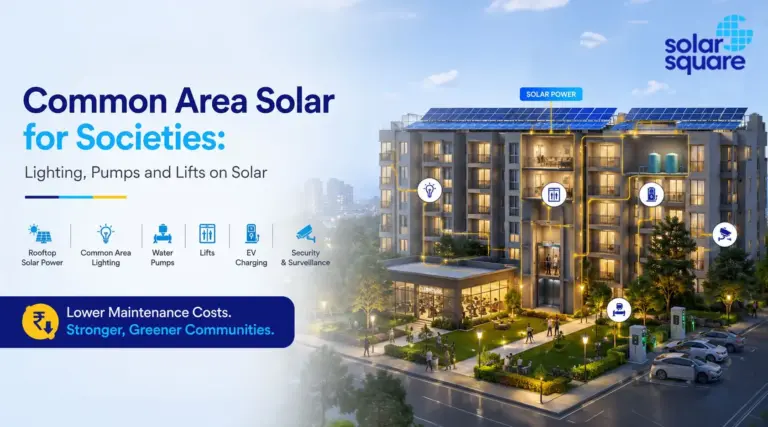
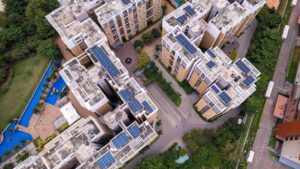
Every resident in a housing society pays monthly maintenance charges. What many people do not realize is that ~40% of these charges come from the common-area electricity bill (CAM). This includes the electricity used for corridor and parking lights, lifts, water pumps, clubhouses, air conditioning, and surveillance systems.
Since lighting and daytime operations account for a major share of this common area power consumption, common area solar for societies is one of the most effective ways to significantly reduce these costs. We’re not making this up. The numbers speak for themselves!
- Well-designed rooftop solar for apartment complexes can reduce common-area electricity costs by 50-60%.
- In societies with sufficient rooftop space and a larger system, the reduction can even reach 90%.
That happens because most of the common area loads, such as lifts, pumps, corridor lights, parking lights, and clubhouse ACs, consume electricity during the day, which naturally aligns with peak solar power generation hours.
This blog walks you through what can run on solar in a housing society’s common areas, how much solar for apartment complexes costs, the subsidies available, the benefits of using solar electricity for common areas, and how the savings are distributed to each flat.
Services that Can Run on Solar for Common Areas in Housing Societies
Almost every electrical load in your society’s common areas can be powered by solar energy. The ones that generate the most savings on your common-area electricity bills are those that run during daylight hours. That’s primarily because daytime is the time when your solar plant is generating power at its peak efficiency.
Here’s a snapshot of the most relevant services in a common area that can be powered through solar electricity for maximum savings on CAM bills.
- Solar power for water pumps: Most societies operate their pumps on a scheduled cycle during the day to fill overhead tanks. You can easily align those cycles with peak solar generation hours. Different societies use different types of solar pumps for apartments depending on their layout. Sump pumps lift water from underground tanks, booster pumps maintain pressure in tall buildings, and STP pumps handle sewage treatment. No matter the type of solar water pump used, they can all be shifted to solar.
- Solar power for lifts and elevators: An on-grid solar system can cover daytime consumption for your lifts and significantly reduce the common-area electricity bill. During power cuts and at night, you’ll need a solar lift backup. In areas with prolonged power cuts, a hybrid solar system with battery backup might make sense. In areas with a stable grid and very rare outages, a diesel generator makes more sense for solar lift backup.
- Solar lighting for apartments and common areas: Clubhouse lights, gym lights, corridor and staircase lights, and basement lights can all be powered through solar energy. Daytime lighting in basements and indoor common areas gets fully offset by solar, and the savings continue around the clock when your plant is connected via net metering.
- Security and surveillance in corridors and basements: CCTV systems, access control, intercom panels, and basement ventilation fans run continuously. These are low-wattage but high-uptime loads, and solar combined with net metering covers them efficiently.
- Parking lot lighting: Lighting in covered parking and basement parking runs during the day and evening. Your solar generation during the day offsets this consumption directly.
- Clubhouse and gym air conditioning: AC is one of the heaviest electrical loads in any society, and clubhouse and gym ACs run during daytime and early evening hours when occupancy is highest. That makes them a strong load to plan your solar capacity around.
- Street lighting and landscaping: Garden lights, pathway lights, and perimeter lighting run mostly at night, which means they get powered through net metering credits you’ve earned during the day rather than directly from solar generation.
Why Are Common Areas the Perfect Starting Point for Solar?
While there are options for individual apartments to offset their personal flat bills through solar by opting for virtual net metering, common areas are still the best starting point for any society to go solar. Need a reason to believe that? Let’s give you four.
- Load timing works in your favor: Common-area loads run heavily during daylight hours. Pumps fill tanks during the day, lifts move residents in and out, basements stay lit, and clubhouse ACs run when the gym and lounge are in use. Solar generates power during the same hours. So, the match between generation and consumption is naturally strong. Less power is wasted or exported, and more of each unit you generate is used directly.
- Single ownership simplifies billing and approvals: Your society’s common-area meter is a single connection to a single DISCOM, with a single bill. The RWA or managing committee runs one billing cycle and receives one set of DISCOM approvals, rather than dealing with hundreds of individual flat-level meters. The AGM still needs to vote in favor of solar for the project to go ahead, but the technical and billing sides remain simple because there’s only one meter and one connection involved.
- Shared benefit drives consensus: Every rupee saved on the common area bill stays within the society. The managing committee decides how to use these savings. Some societies pass them through as lower maintenance charges, while others redirect the money into the CORPUS fund for repairs, painting, or future upgrades.
- Asset clarity removes disputes: The rooftop is already a common asset owned collectively by all society members. Installing solar there doesn’t require carving up individual ownership or arguing over which flat the panels belong to. The society owns the rooftop and the plant, and the savings belong to everyone.
How Much Solar Does Your Society Need?
Every housing society has a different power footprint. The right solar capacity depends on how many lifts you run, how many lights stay on through the night, whether you have water pumps running during the day, and how much rooftop area you have available.
For instance, a 60-flat society with two lifts and a clubhouse will need far less than a 60-flat society running a swimming pool filter and a sewage treatment plant. This is why you start with an energy audit of all common-area meters before sizing anything.
The audit provides the actual monthly consumption, which becomes the foundation for every decision that follows.
Here’s an indicative sizing guide to give you an idea:
| Society Size | Typical Common Area Load | Recommended Solar Capacity |
| Small (up to 50 flats) | Up to 20 kW | Up to 20 kW |
| Medium (50-150 flats) | 10-50 kW | 10-50 kW |
| Large (150-300 flats) | 20-100 kW | 20-100 kW |
| Large complex (300+ flats) | 100+ kW | 100+ kW |
DISCLAIMER: Treat the figures in this table as an indicative range and a starting point, not a final recommendation. Actual solar capacity needed varies based on the usable rooftop or open space you have after accounting for shading, the sunlight your city receives across seasons, your sanctioned load, and the net metering caps your state DISCOM enforces. Future additions, such as EV charging points or new amenities, also matter, since it is wiser to size for tomorrow than only for today. For an accurate number, get a site assessment from a qualified installer who can review your audit data, inspect your rooftop, and account for local regulations.
What are the Different Solar Solutions for RWAs?
Once your society decides to install rooftop solar, the next decision is how the generated electricity will be measured, billed, and credited. India has three main models for housing societies, and the right one depends on how your electrical metering is set up and on what your state DISCOM allows.
- Net metering for housing societies: This is the most common model, in which the solar plant connects to your common-area meter. Any excess generation gets exported to the grid, and your society receives credit for those units on the next bill.
- Group net metering for housing societies: In this model, a single solar plant generates electricity that gets credited across multiple meters within the same society. This works well when your society has separate meters for different blocks or different common-area circuits.
- Virtual net metering (VNM) for apartments: VNM works when the solar plant is installed at a separate location, usually on DISCOM premises. Flat owners who sign up for the plant get credits on their individual electricity bills based on the share of solar capacity they had agreed to. This works well for societies where rooftop space is limited or unavailable.
Types of Solar Systems Best for Housing Societies
There are three main types of solar systems to choose from. One is an on-grid rooftop solar system, which is connected to the grid. Second is an off-grid solar system that’s connected to a battery bank, not the grid. And third is a hybrid solar system, which is connected to the grid as well as a battery bank.
Wondering which one your society should choose? Let’s find out.
- When is an on-grid solar system better? If your society has a stable grid supply and any backup needs are already handled by diesel generators, on-grid is the recommended choice. The plant connects directly to the grid through your common-area meter, generates during the day, offsets daytime consumption, and exports the excess to earn net metering credits. Since there’s no battery, the upfront cost is the lowest of the three options, and the payback is the fastest.
- When is an off-grid solar system better? If your society faces frequent power outages and very high electricity fluctuations, and has no diesel generator backup at all, then off-grid with battery storage makes sense. The plant runs independently of the grid, and the battery handles any periods of outages when solar generation is low. This is uncommon in most urban housing societies and more relevant in semi-rural locations or areas with unreliable grid supply.
- When is a hybrid solar system better? A hybrid solar system combines solar generation with battery storage and grid connectivity. The catch is that battery energy storage systems (BESS) are very expensive, which is why hybrids are not generally recommended for societies. However, if your society specifically wants solar backup so that loads continue running on solar during a power cut, then a hybrid system can be considered.
A Practical Checklist Before Installing Apartment Solar Panels
Before your society finalizes a common-area solar installation, the managing committee must put in place the necessary legal and approval requirements. The technical feasibility step is crucial for running checks such as shadow analysis, structural assessment, and inverter placement.
- AGM approval: A formal resolution covering project scope, budget, financing model, and vendor selection authority.
- Builder NOC: Required if the society hasn’t been formed or terrace ownership hasn’t been transferred from the builder.
- Terrace and society documentation: Roof rights, society registration certificate, PAN, and the last 6 months of common-area electricity bills.
- DISCOM net metering authorization: Signed authority for the vendor to file the net metering application on your society’s behalf.
Step-by-Step Guide: Evaluating and Implementing RWA Common Area Solar
Once the legal items are in place, implementation moves through a series of phases.
- Load analysis: Share 6 months of common-area bills with your vendor to set the right system size.
- Space optimization: Vendor conducts a rooftop survey and structural inspection, and finalizes the system design.
- Legal and DISCOM approvals: AGM resolution, DISCOM net metering filing, and PM Surya Ghar Muft Bijli Yojana subsidy registration.
Read the full technical and legal checklist and steps to apply for solar for housing societies in our detailed guide on Solar for Apartment Buildings: The Technical and Legal Checklist Every RWA Needs.
How Much Does it Cost to Install Common Area Solar for Societies?
To give you a ballpark range, the cost to install common area solar for societies can range from ~Rs. 60,000* per kW and ~Rs. 65,000* per kW without a subsidy.
*Please note prices are subject to change without any prior notice. The above prices are as of 22nd May 2026. The cost to install common area solar for societies varies and depends on multiple factors such as your DISCOM charges, city, solar system size, site conditions, project specifications, product variant opted for, panel type, inverter type, mounting structure height, type of after-sales service, savings guarantee, roof height, etc.
Most societies, however, can install rooftop solar at lower rates than this, thanks to the government subsidy, which we explain in the section below.
Is There Any Subsidy For Installing Solar for Common Areas in Housing Societies?
Yes, Group Housing Societies (GHS) and Resident Welfare Associations (RWAs) can claim a subsidy under the PM Surya Ghar Muft Bijli Yojana. If eligible, you can get a subsidy of Rs. 18,000 per kW, up to 500 kW, for grid-tied or on-grid solar plants installed for common facilities. This includes loads like lifts, pumps, lighting, and EV charging.
Here’s a snapshot of the cost to install common area solar for societies both with and without a subsidy:
| Solar System Size | Cost to Install Common Area Solar for Societies without a Subsidy* | PM Surya Ghar Muft Bijli Yojana Subsidy for Eligible Societies | Cost to Install Common Area Solar for Societies with a Subsidy* |
| 30 kW solar system | ~Rs. 18 lakh to ~Rs. 19.50 lakh | Rs. 5.40 lakh | ~Rs. 12.60 lakh to ~Rs. 14.10 lakh |
| 50 kW solar system | ~Rs. 30 lakh to ~Rs. 32.50 lakh | Rs. 9 lakh | ~Rs. 21 lakh to ~Rs. 23.50 lakh |
| 100 kW solar system | ~Rs. 60 lakh to ~Rs. 65 lakh | Rs. 18 lakh | ~Rs. 42 lakh to ~Rs. 47 lakh |
| 200 kW solar system | ~Rs. 1.20 Cr. to ~Rs. 1.30 Cr. | Rs. 36 lakh | ~Rs. 84 lakh to ~Rs. 94 lakh |
| 300 kW solar system | ~Rs. 1.80 Cr. to ~Rs. 1.95 Cr. | Rs. 54 lakh | ~Rs. 1.26 Cr. to ~Rs. 1.41 Cr. |
| 500 kW solar system | ~Rs. 3 Cr. to ~Rs. 3.25 Cr. | Rs. 90 lakh | ~Rs. 2.10 Cr. to ~Rs. 2.35 Cr. |
*Please note that these prices are subject to change: The above-listed cost to install rooftop solar for common areas in societies for on-grid solar systems is indicative as of 22nd May 2026. The final cost of solar panel systems for housing societies depends on your DISCOM charges, city, solar system size, site conditions, project specifications, product variant opted for, panel type, inverter type, mounting structure height, type of after-sales service, savings guarantee, roof height, etc.
How Much Money Can Solar for Apartment Complexes Save Per Flat?
The simplest way to think about per-flat savings is to break down your maintenance bill itself. In most housing societies, ~40% of the monthly maintenance charge you pay goes towards CAM electricity costs.
- Let’s assume that you’re paying Rs. 100 in monthly maintenance.
- Around Rs. 40 of that Rs. 100 is going towards the common area electricity bill.
- If a properly sized solar plant offsets the bulk of this CAM electricity cost, that Rs. 40 will be saved.
- Your total maintenance bill could come down to ~Rs. 60.
To make things even simpler, here’s a snapshot of housing societies where SolarSquare installed rooftop solar systems, along with the savings they have generated to date.
| Name of the Housing Society and System Capacity Installed | When Was the Solar Energy System Commissioned? | Breakeven Period | Solar Savings |
| Housing Society – Godrej Infinity Housing Society: 400 kW Solar System | June 2024 | 1.4 years | Savings till April 2026: Rs. 2,07,90,000 (two crore seven lakh ninety thousand) |
| Housing Society – Ganga Ishanya: 235 kW Solar System | February 2024 | 2.18 years | Savings till April 2026: Rs. 1,44,98,437 (One crore forty-four lakh ninety-eight thousand four hundred thirty-seven) |
| Housing Society – Ganga Ishanya: 40 kW Solar System | October 2024 | 2.11 years | Savings till April 2026: Rs. 17,01,600 (Seventeen lakh one thousand six hundred.) |
What are the Different Financing Options to Install Solar for Apartment Complexes?
There are two main options for financing solar for apartment complexes, and they differ based on who owns the plant, when the savings begin, and how the money flows. The right choice between these two models, CAPEX or OPEX/RESCO, depends on whether your society has the upfront capital available and how soon residents want to see the savings.
- CAPEX financing model: Your society funds the plant upfront through the CORPUS funds. As soon as the plant is commissioned and goes live, 80-90% savings start appearing on the common-area electricity bill. Since the society owns the asset from day one, the benefit reaches residents from month one itself.
- OPEX or RESCO: A third-party installs and owns the plant. So, your society doesn’t pay upfront. However, true savings only kick in after the plant ownership is transferred to your society at the end of the contract, which could be 5-15 years. When your society does not own the plant, you purchase solar electricity from the current plant owner at pre-decided rates that are cheaper than what you pay for grid power.
You can read more about these financing schemes in our blog on CAPEX vs RESCO Solar Financing: Which One Should You Choose?
What are the Benefits of Using Solar Electricity for Common Areas?
Using solar electricity for common areas in a housing society has multiple financial and environmental advantages that every RWA and flat owner must know.
- Lower CAM bills every month: This is the most direct and most visible benefit. Your common-area electricity bill drops significantly, the savings flow into the CAM account, and every resident sees a lower maintenance charge each month. Over a 25-year plant life, the cumulative savings are substantial.
- Protection from future tariff hikes: Electricity tariffs in India increase by 3-6% every year. A society on grid power has no control over these hikes and absorbs them fully through its CAM bill. With solar, you generate a large share of your own electricity and stay insulated from these future increases.
- A green, low-carbon society: A common area solar plant offsets a measurable amount of CO2 emissions every year. For societies that care about their environmental footprint, this is a tangible step. For instance, if your society installs a 100 kW solar system today, this will be equivalent to planting 3,920 trees. Speaking about carbon offset, a 100 kW solar system will offset ~26 lakh kg of carbon dioxide over its 25-year lifespan.
- A property value boost: Properties in societies with rooftop solar are attractive to buyers and tenants who pay attention to running costs. Lower maintenance charges and a green building tag both contribute to better resale and rental value over time.
Conclusion
Installing common area solar is the most practical, lowest-friction, and highest-impact entry point for any housing society looking to cut costs and go green. The loads are predictable, the daytime generation matches daytime consumption, the rooftop is already a common asset, and the savings stay within the society.
The managing committee can choose to pass savings to residents through lower CAM charges or redirect them into the CORPUS fund for repairs, upgrades, and future needs. Either way, the benefit from solar for apartment complexes belongs to all residents collectively.
Thinking about installing rooftop solar in your society, but don’t know where to start? Book a free solar consultation call with SolarSquare, India’s #1 residential rooftop solar installation company.
FAQs
Do solar panels make rooftop space unusable?
Not at all. Modern mounting solutions include elevated structures in which the panels sit above the terrace surface, leaving the space below usable. Your society can still use the terrace for gatherings, functions, walking areas, or even a terrace garden. A site survey will confirm what’s possible for your specific rooftop.
Can solar power run lifts during a power cut?
If it’s an on-grid solar system, then no. On-grid solar cannot run lifts during a power cut because it’s designed to shut down when the grid goes off. This is a safety feature known as anti-islanding, which is implemented to protect line workers. To keep lifts running during outages, your society can either use a diesel generator for backup, which is what most societies do, or install a hybrid solar system with battery storage if the power cuts are prolonged and very frequent.
Will solar fully replace the common area electricity bill?
Well-designed solar for common areas in societies can lower the common area electricity bills by up to 90%.
What approvals does an RWA need before installing solar for common areas?
Your society needs an AGM approval authorizing the installation. Also, terrace roof rights need to be clear, which usually means your society has formally taken over the building from the builder, and the rooftop is in the society’s name. DISCOM approval for net metering is also required for an on-grid system.
How much solar capacity does a housing society need to cover common area loads?
The solar capacity a housing society needs depends on its actual common area electricity consumption, including lifts, water pumps, lighting, clubhouses, and other shared facilities. As a broad guideline, small societies (up to 50 flats) may need up to 20 kW, medium societies (50-150 flats) may require 10-50 kW, while larger societies often need 100 kW or more. An energy audit of the common-area meter is the best way to determine the appropriate system size for your society.
Is AGM approval mandatory before a housing society installs solar for common areas?
Yes, an AGM approval is mandatory. The rooftop is a common asset owned collectively by all residents, and any installation on it requires a formal resolution from the society. Without this approval, the installation doesn’t have a legal basis and your society cannot enter into a contract with an EPC partner.


 Previous Article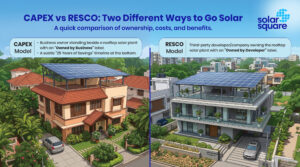
 20 min


![10 kW Solar Panel Price in India [With and Without a Subsidy]](https://cdn.solarsquare.in/blog/wp-content/uploads/2025/07/18165650/10-KW-solar-panel-300x167.webp)