

 3856 Reads
 25 mins


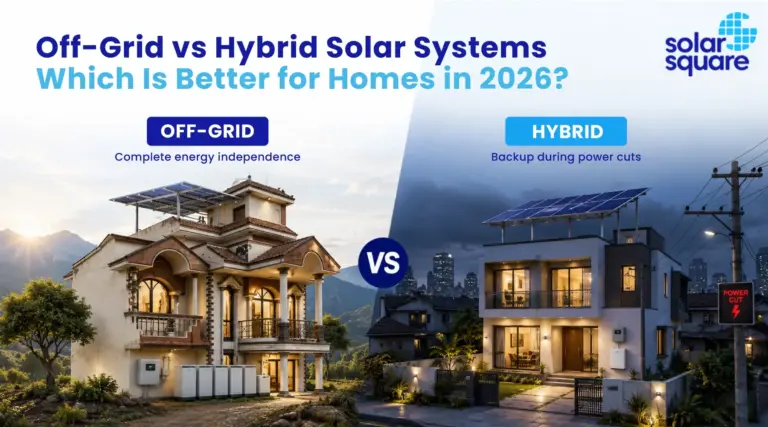
Electricity bills rising by 3-6% annually and unpredictable power cuts have pushed many homeowners in India to consider solar energy adoption in 2026. But one key decision creates a lot of confusion: off-grid vs hybrid solar system, which one is actually better for your home?
On the surface, both types of solar systems look quite similar because both store solar energy in lead-acid or lithium batteries. However, the major difference between the two lies in how they interact with the electricity grid.
A hybrid solar system is connected to the grid and, at the same time, it has a battery bank that stores solar energy for later use during outages or periods of low solar generation, and at night. An off-grid solar system, on the other hand, is a completely standalone solar system. It is connected only to a battery bank, not the grid.
Since off-grid solar systems are not connected to the grid, they must be designed for full autonomy. Autonomy is preparing for a low-solar day when solar production is~12-15% of what happens on a sunny day. In such cases, the system must produce enough energy and store it in the battery the day prior, so it can power the home on a rainy day. If it powers the home through 1 day, it’s called 1 day of autonomy, and so on.
It’s achieved by:
- Adding more solar panels than needed to meet the energy needs of a home.
- Using a bigger battery to store solar energy that can power the house on its own for that many days of autonomy.
Since a hybrid solar system is connected to the grid, it does not require adding more panels than necessary. Only the battery should be sized to provide backup power for the entire duration of the power outage.
A hybrid solar system is therefore cheaper than an off-grid solar system and is most preferred in urban areas or rural/semi-rural areas where power outages are frequent and last for 2-3 hours. On the other hand, an off-grid solar system is the only practical option in remote and rural areas where grid supply is either unavailable or so poor that electricity comes for only 2-3 hours a day.
In this blog on off-grid vs hybrid solar systems, we will unpack many such differences between the two, including their cost, availability of the PM Surya Ghar solar subsidy, and which of the two is better and under what scenarios.
TL;DR Summary Box: Off-Grid vs Hybrid Solar Systems, Which is More Expensive?
An off-grid solar system is more expensive than a hybrid solar system because it has to operate independently without any support from the grid.
To achieve this, it must be designed for full autonomy. This means it needs to generate and store enough solar electricity to power the home for at least 2 days during periods without solar generation.
As a result, off-grid systems require:
- More solar panels to produce excess energy.
- Larger battery banks to store that energy.
- Higher-capacity inverters to handle the full household load.
These additional requirements significantly increase the overall cost. The inverter is the heart of any solar system, and we recommend using grid-connected inverters for offgrid systems too. Thus, the inverter technology and models used in the off-grid system are the same as Hybrid.
Below are some advantages of using grid-compatible inverters (used in Hybrid systems) for offgrid systems too:
Lithium-Optimized: Direct BMS integration maximizes battery life (15-20+ years).
97%+ Efficiency: Dual MPPT captures more solar, cuts losses 5-10%.
Rugged Performance: Handles surges/pumps flawlessly for Indian conditions.
Future-Proof: Add grid/BESS anytime—no rewiring needed.
Here are the main topics covered in this blog in detail:
| Main Topics | Key Takeaways |
| What is an off-grid solar system? | It’s a standalone solar system that operates without any grid connection. It relies entirely on solar panels and battery storage to generate and supply electricity to the home at all times. |
| What is a hybrid solar system? | It’s a grid-connected solar system with battery backup. It uses solar power first, stores excess energy in batteries, and draws electricity from the grid only when solar generation and battery storage are insufficient. |
| What are the pros and cons of an off-grid solar system? |
|
| What are the pros and cons of a hybrid solar system? |
|
| Off-grid vs hybrid solar systems: what are the main differences? | The key difference lies in grid dependency. Off-grid systems operate independently and must be sized for full autonomy. In contrast, hybrid systems stay connected to the grid and use batteries only for backup, making them more cost-effective and flexible. |
| When to choose an off-grid solar system? | Choose an off-grid system for remote or rural areas where grid supply is unavailable or extremely unreliable, and the system must power the home independently at all times. |
| When to choose a hybrid solar system? | Choose a hybrid system in urban areas where grid power is available, but outages are frequent, as it provides backup while keeping costs lower than off-grid systems. |
What is an Off-Grid Solar System, and What are its Benefits for Homeowners?
An off-grid solar system is a standalone PV system that converts solar radiation into DC power, which is used to power the home and solar batteries during the day. Stored solar power is used at night or when solar generation is completely absent.
Here’s how it works:
- During the day, solar cells in solar panels absorb photons present in the sunlight.
- The photons transfer their energy to electrons present in the solar cells, exciting them.
- Excited electrons begin to flow in a single direction. This unidirectional flow of current is direct current (DC) electricity.
- This DC power is sent to a solar inverter, which converts it to alternating current (AC) to run household appliances.
- Excess DC energy generated during the day is used to charge the lithium battery bank.
- The battery’s stored power is used at night or during periods of low or no solar generation.
Some of the biggest benefits of off-grid solar systems are as follows:
- They are the only power source in remote locations with no grid power.
- They’re the only practical choice in rural areas with a highly unreliable grid that gives electricity supply for just 2-3 hours a day.
- They offer complete energy independence with no reliance on the grid.
- You don’t have to worry about electricity bills, since all power comes from solar.
What are the Disadvantages of an Off-Grid Solar System?
Off-grid solar systems have to be designed with full autonomy in mind. It makes them quite expensive. And their high upfront cost is their biggest disadvantage.
Here’s a look at all the disadvantages in detail:
- The government does not offer the PM Surya Ghar subsidy for installing off-grid systems.
- They’re costlier than hybrid solar systems. The higher upfront cost is a result of large battery storage and additional panels.
- Once the grid supply becomes available, the system becomes much larger than required.
What is a Hybrid Solar System, and What are its Benefits for Homeowners?
A hybrid solar system is a grid-connected PV system that also includes battery storage. It allows your home to use solar power during the day, store excess energy in batteries, use stored power during outages, and draw power from the grid when needed.
Here’s a step-by-step breakdown of how a hybrid solar system works:
- Solar panels convert sunlight into direct current (DC) power.
- A hybrid solar inverter converts DC power to AC power, keeping your household appliances running.
- Excess DC power is stored in the solar rechargeable batteries and used at night or during power cuts.
- If there’s any additional power left after the batteries are charged, it is sent to the grid.
Here are some of the biggest benefits of using a hybrid solar system for homes:
- It offers a battery backup that ensures an uninterrupted power supply even during outages.
- If the DISCOM permits net metering for hybrid systems in your city, you will be eligible for the PM Surya Ghar solar subsidy, which reduces the overall system cost.
- Since hybrid systems prioritize solar energy, they reduce electricity bills by reducing reliance on grid power.
- The grid support acts as a safety net, eliminating the need for full autonomy, as is the case with off-grid systems.
What are the Disadvantages of a Hybrid Solar System?
Despite benefits like uninterrupted power supply during outages and the availability of a solar subsidy if net metering is allowed, the biggest limitation of a hybrid solar system is that it costs more than an on-grid solar system.
Having said that, their cost is extremely justified in areas where power cuts are frequent. If you use an on-grid solar system in such areas, you will either be left in darkness during power outages or rely on UPS-based systems that increase electricity bills by drawing power from the grid to charge themselves.
Therefore, a hybrid solar system is the best option for urban areas where power outages happen almost daily for 2-3 hours.
Off-Grid vs Hybrid Solar Systems: What are the Main Differences?
Here’s a tabulated snapshot of the main differences between an off-grid and a hybrid solar system. We’ve compared the two across multiple parameters to help you decide which one is better based on your specific needs:
| Parameter | Off-Grid Solar System | Hybrid Solar System |
| Is it connected to the grid? | It is not connected to the grid and operates completely independently. | It is connected to the grid but also operates using battery backup during outages. |
| Does it need a battery bank to store solar energy? | Yes, it requires batteries to store energy since there is no grid to rely on. | Yes, it requires batteries to store solar power for use during power cuts. |
| Is the PM Surya Ghar solar subsidy provided? | No, subsidy is not offered since it is not connected to the grid. | Yes, a subsidy is offered, but only if net metering is permitted by the DISCOM. |
| Cost | It’s the most expensive type of solar system due to higher panel capacity and large battery storage. | It costs more than on-grid systems but less than off-grid systems. |
| When is it recommended? | Ideal for remote or rural areas where grid supply is unavailable or limited to just 2-3 hours a day. | Suitable for areas where power outages occur regularly for 2-3 hours each day. |
How to Choose the Right Solar System for Your Home?
Choosing the right solar system can directly influence the solar savings you can make over 25 years of the system’s lifespan. This is because each system type differs in upfront costs, battery requirements, subsidy eligibility, and grid dependence. All these factors impact how much you spend initially and how much you save on electricity bills over time.
Let’s give you a brief on when it makes sense to use hybrid and off-grid solar systems.
- When to choose an off-grid solar system? An off-grid solar system, designed with autonomy in mind, makes the most sense in remote and rural areas where grid supply is absent or so patchy that electricity is available for just 2-3 hours a day.
- When to choose a hybrid solar system? A hybrid solar system makes the most sense in urban areas where power cuts happen frequently and last for 2-3 hours.
Off-Grid vs Hybrid Solar Systems: A Detailed 2026 Cost Comparison
Here’s a tabulated snapshot of the cost of an off-grid rooftop solar system in India in 2026:
| System Size | Off-Grid Solar System Price in India in 2026* |
| 1 kW off-grid solar system price in India with a 4.7 kWh lithium battery | ~Rs. 1.6L |
| 2 kW off-grid solar system price in India with a 9.5 kWh lithium battery | ~Rs. 1.6L |
| 3 kW off-grid solar system price in India with a 14.2 kWh lithium battery | ~Rs. 4.6L |
| 5 kW off-grid solar system price in India with a 23.7 kWh lithium battery | ~Rs. 7.6L |
| 6 kW off-grid solar system price in India with a 28.4 kWh lithium battery | ~Rs. 9.4L |
| 8 kW off-grid solar system price in India with a 37.9 kWh lithium battery | ~Rs. 12.2L |
| 10 kW off-grid solar system price in India with a 47.3 kWh lithium battery | ~Rs. 15.5L |
*Please note: The above-mentioned off-grid solar energy system prices are indicative and exclusively for lithium-ion batteries (LFP). The final prices can vary based on multiple factors such as the type and brand of solar panels, battery technology and capacity, inverter size, installation complexity, and location-specific requirements. Off-grid systems, in particular, depend heavily on autonomy planning, meaning higher battery backup and additional panels can significantly increase costs. Prices may also change based on site conditions, mounting structure, wiring requirements, and labor charges. Additionally, these are the price figures for a single-phase connection. If you have a 3-phase connection that requires a 3-phase inverter, the cost can further increase.
Here’s a tabulated snapshot of the cost of a hybrid solar system in India for homes in 2026:
| Hybrid Solar System Size with Battery | Cost of a Hybrid Solar System in India (Read the full DISCLAIMER below)* |
| 3 kW solar system with a 2.5 kWh battery | ~Rs. 96,800 |
| 4 kW solar system with a 5 kWh battery | ~Rs. 1,56,400 |
| 5 kW solar system with a 5 kWh battery | ~Rs. 1,75,000 |
| 5 kW solar system with a 10 kWh battery | ~Rs. 2,57,100 |
| 10 kW solar system with a 10 kWh battery | ~Rs. 3,50,000 |
| 10 kW solar system with a 15 kWh battery | ~Rs. 4,32,100 |
*DISCLAIMER (IMPORTANT): The hybrid solar system prices listed above are indicative and not fixed. They can vary depending on factors such as battery capacity, inverter specifications, solar panel brand, and the required backup capacity. In hybrid systems, costs also depend on how long you want power during outages, as longer backup hours require larger batteries. Additionally, installation complexity, location, mounting structure, and electrical components can impact the final pricing. Additionally, these are the price figures for a single-phase connection. If you have a 3-phase connection that requires a 3-phase inverter, the cost can further increase.
Why Choose SolarSquare to Install Rooftop Solar at Your Home?
Kyunki, mehangi bijli se muft bijli tak ka safar aasaan banaata hai SolarSquare!
SolarSquare is India’s #1 home solar company, and the only solar company nationwide to offer a savings guarantee with a money-back promise. If your system generation falls short of what we promised at the time of installation, we compensate for the shortfall at Rs. 8 per unit.
Here are the many reasons why 12,000+ customers have rated us 4.8 on Google:
- Over a decade of hands-on solar expertise: For more than 10 years, SolarSquare has designed and installed residential solar systems built to handle cyclonic winds of up to 170 km/hr.
- Storm-safety record of 99.91%: Thanks to our IIT-Bombay-approved solar mounting structures, our solar installations have maintained a safety record of 99.91% over the last two years, even during cyclonic winds of up to 170 km/hr.
- Guaranteed solar savings with a money-back promise: We are India’s first and only solar company that offers a money-back promise if the generation falls short of what we predicted. For every unit short, we compensate the customer at Rs. 8 per unit.
- 36,000 homes powered by SolarSquare: More than 36,000 nationwide have already trusted SolarSquare for smooth installation, stable performance, and predictable generation year after year.
- More than Rs. 100 crore in verified customer savings: These savings come from real systems producing electricity month after month. Each installation contributes to long-term bill reduction.
- More than Rs. 220 crore disbursed in subsidy: We have helped our customers receive over Rs. 220 crore in solar subsidies.
- A 5-year after-sales maintenance plan: We offer a 5-year AMC plan with scheduled monthly visits to take care of the structural, electrical, and mechanical health of your solar system.
Conclusion
While they’re both connected to a battery bank, it’s their relation with the grid that truly differentiates them. A hybrid solar system is connected to both the grid and a battery bank. An off-grid solar system, on the other hand, is connected just to batteries, not the grid.
The better choice between an off-grid vs hybrid solar system truly depends on your specific situation. If you live in an area where power outages last 2-3 hours daily, a hybrid solar system makes the most sense. For homeowners living in areas with an extremely unreliable grid that provides power for only 2-3 hours, an off-grid system is the only practical choice.
For any further queries about the system type and size that best suit your needs, you can book a free solar consultation call with SolarSquare.
FAQs
Which is better, off-grid or hybrid solar systems?
A hybrid solar system is generally the more practical and cost-effective option for homes in urban areas where power cuts last for a few hours daily. The battery can be sized based on outage duration to ensure uninterrupted power.
However, in remote or rural areas where grid supply is unavailable or highly unreliable, an off-grid solar system is a better choice, as it can operate independently.
What are the disadvantages of a hybrid solar system?
The biggest disadvantage of a hybrid solar system is that it costs more than an on-grid solar system. However, in areas with frequent power cuts, this investment is justified as it ensures uninterrupted power and reduces reliance on grid electricity.
Can I run AC on a hybrid solar system?
Yes, a hybrid solar system can run an air conditioner, provided the system is properly sized based on your home’s energy consumption and backup requirements.
Can you convert a hybrid to an off-grid solar system?
Yes, a hybrid solar system can be converted into an off-grid system. However, this requires adding more solar panels, increasing battery storage capacity, and upgrading the inverter to ensure the system can operate independently without grid support.
Does a hybrid solar system work during a power outage?
Yes, a hybrid solar system can supply power during a power outage through its battery backup. However, these systems stop drawing power from solar panels during outages for safety reasons, so the home runs on stored battery energy until grid power is restored.


 Previous Article
 20 min