


The PM Surya Ghar Muft Bijli Yojana solar subsidy scheme finances up to Rs. 78,000 of the solar installation cost for systems of 3 kW or more in the form of a subsidy. That’s a huge relief for homeowners, sure. But what about the remainder of the cost?
If we specifically talk about a 3 kW on-grid rooftop solar system in a tier-1 city like Pune, it would cost ~Rs. 2.15 lakh*. Even with the Rs. 78,000 from the government subsidy, it still leaves ~Rs. 1.37 lakh* on the table. For a 5 kW or 10 kW system, the gap is much wider. This is the reason a solar loan is the smartest way forward for homeowners.
*Please note that these prices are subject to change: The above-mentioned cost of rooftop solar in Pune is indicative as of 26th May 2026 for the SolarSquare Blue 6ft variant. The final cost of installing an on-grid rooftop solar panel system for a home depends on your DISCOM charges, city, product variant opted for, panel type, inverter type, mounting structure height, type of after-sales service, savings guarantee, roof height, etc.
Almost every major bank in India offers a bank solar loan at rates far lower than those for personal loans. The interesting twist is that the cheapest interest rate isn’t always the best. Why? Because financing options from NBFCs and SolarSquare can be far more flexible in terms of CIBIL eligibility requirements.
This guide breaks down solar loan interest rates from every major bank in India in 2026 and helps you figure out which option is truly the best solar loan in India for you.
How Solar Loans in India Work?
A solar loan is a financing option designed to help homeowners install rooftop solar. It’s different from a personal loan in three important ways, and these differences are exactly why homeowners should never use a regular personal loan to fund their solar installation.
- Rate of interest: Dedicated solar loan interest rates from public sector banks start as low as 5.75% per annum. A regular personal loan from the same bank? You’d pay 11% to 16% per annum. This huge difference exists because dedicated solar loans under the PM Surya Ghar scheme are backed by the government, allowing banks to lend at concessional rates.
- Repayment period: Solar loans stretch up to 10 years at public sector banks like SBI and PNB. Personal loans, on the other hand, cap out at 5 years. A longer tenure means smaller EMIs and breathing room in your monthly budget.
- Collateral requirement: Loans up to Rs. 2 lakh under the PM Surya Ghar scheme require no collateral, guarantor, or security. The solar system itself acts as the asset on paper. Try getting an unsecured personal loan of Rs. 2 lakh, and you’ll see why this matters. You’ll have to provide the bank with a guarantee in the form of some valuable asset.
Which Bank is the Best for Solar Loans in India in 2026?
The answer depends on what matters most to you.
- Do you want the lowest interest rates, even if that means a hassle-some physical application process?
- Is the fastest and easiest process your priority, even if that means slightly higher interest rates?
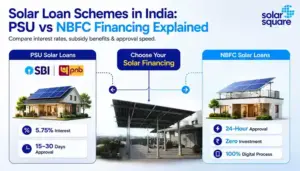
PSU banks offer the lowest solar loan interest rates, while NBFC solar financing is better for homeowners who want speed and convenience.
- Public sector banks like SBI, PNB, Bank of Baroda, Canara Bank, and Union Bank offer the lowest solar loan interest rates at 5.75% to 7% per annum. However, these banks usually incorporate the PM Surya Ghar subsidy into the loan structure. It means that you may not receive the Rs. 78,000 subsidy separately in your account.
- NBFC-backed solar loans offer faster approvals, fully digital processing, and full subsidy retention. Although interest rates are higher at ~12% to ~13% p.a., the subsidy stays with you and can act as your down payment, reducing your upfront burden.

Top Banks in India that Offer the Best Solar Loan Interest Rates
Here’s a solar loan rates comparison table for the top banks and NBFCs in India in 2026. Have a look before going deep.
| Bank Solar Loan | Interest Rate on Loan for Solar Panels | Max Loan Amount | Max Loan Tenure | Collateral |
| State Bank of India (SBI) |
|
Rs. 6 lakh | 10 years | None |
| Punjab National Bank (PNB) |
|
Rs. 6 lakh | 10 years | None |
| Canara Bank |
|
Rs. 6 lakh | 10 years | None |
| HDFC Bank |
|
Up to Rs. 50 lakh as personal loan | 7 years | None |
| ICICI Bank |
|
Up to Rs. 90 lakh under partnership route | 5 years | None |
| Bank of Baroda |
|
Rs. 6 lakh | 10 years | None |
| Union Bank of India |
|
Up to Rs. 2 lakh | 10 years | None |
| Bank of India (BOI) |
|
Up to Rs. 6 lakh | 10 years | None |
| Federal Bank | No dedicated rooftop solar loan for homes | Not applicable | Not applicable | Not applicable |
| NBFCs (such as Ecofy, Fibe, CreditFair, etc) | 12-13% per annum | The full cost of the system can be financed | 6-60 months | None |
Now, let’s have a look at the loan schemes from all the banks in detail.
#1. SBI Solar Loan Scheme in India
The State Bank of India’s rooftop solar loan is called Surya Ghar Loan, and it runs under two tracks.
- Loan for systems up to 3 kW through a simple loan slab up to Rs. 2 lakh.
- Loan for systems between 3 kW and 10 kW through a higher slab up to Rs. 6 lakh.
Interestingly, SBI is the only PSU bank backed by World Bank financing for this scheme, which is part of how it sustains the 5.75% concessional rate on the smaller slab. The other thing worth noting is that SBI mandates registration on the Jan Samarth portal before the loan application can proceed, and KYC must be completed in person at a branch.
Here are the key details of the SBI solar loan scheme:
| Key Aspects | Details |
| Loan type | Dedicated rooftop solar loan under the PM Surya Ghar Muft Bijli Yojana |
| Solar loan interest rate in SBI |
|
| Loan amount offered | Rs. 50,000 to Rs. 6 lakh, depending on the system size |
| Maximum loan amount | Rs. 6 lakh |
| Maximum loan tenure | 10 years (120 months) including moratorium |
| Down payment |
|
| Prepayment charges | Nil |
| Moratorium | 6 months from the date of disbursement |
| Eligibility criteria | Indian resident, age 18 to 65 (up to 75 with co-borrower), rooftop in applicant’s name, and mandatory SBI savings account |
| Portal registration requirement | Mandatory registration on the PM Surya Ghar portal, followed by a loan application via the Jan Samarth Portal |
#2. PNB Solar Loan Scheme in India
Punjab National Bank’s solar loan is officially called the Scheme for Financing of Rooftop Solar Power Systems. The structure follows the standard PM Surya Ghar template with two slabs.
- Up to Rs. 2 lakh
- Between Rs. 2 lakh and Rs. 6 lakh
However, PNB remains slightly stricter than SBI on credit profiles. A minimum credit score of 680 is required regardless of loan size. Processing fees are nil, foreclosure charges are nil, and the scheme is fully aligned with both Jan Samarth and the PM Surya Ghar portal workflow.
Here are the key details you must know about the PNB bank solar loan in India:
| Key Aspects | Details |
| Loan type | Dedicated rooftop solar loan under PM Surya Ghar Muft Bijli Yojana |
| Solar loan interest rate in PNB |
|
| Loan amount offered | Rs. 50,000 to Rs. 70,000 per kW of solar capacity |
| Maximum loan amount | Rs. 6 lakh |
| Maximum loan tenure | 10 years including moratorium |
| Down payment |
|
| Prepayment charges | Nil |
| Moratorium | 6 months from the date of disbursement |
| Eligibility criteria | Credit score of 680+, age up to 75 years, property in applicant’s name, mandatory PNB savings account |
| Portal registration requirement | Mandatory registration on the PM Surya Ghar portal, followed by a loan application via the Jan Samarth Portal |
#3. Canara Bank Solar Loan Scheme
Canara Bank’s scheme is called Canara Rooftop Solar (CRTS) PMSGY, and is split into two separate loan products instead of one.
- The first product covers loans up to Rs. 2 lakh.
- The second covers loans above Rs. 2 lakh and up to Rs. 6 lakh.
For the smaller slab, no income documents are required; a self-declaration is sufficient. For the larger slab, on the other hand, ITR filings and salary proofs are mandatory.
Here are the key details you must know about the Canara Bank solar loan scheme in India:
| Key Aspects | Details |
| Loan type | Dedicated rooftop solar loan under PM Surya Ghar Muft Bijli Yojana |
| Solar loan interest rate in Canara Bank |
|
| Maximum loan amount | Rs. 6 lakh |
| Maximum loan tenure | 10 years |
| Down payment |
|
| Prepayment charges | Nil |
| Moratorium | 6 months from the date of first disbursement |
| Eligibility criteria | Credit score of 680+, age 18 to 75 years, rooftop rights, latest electricity bill |
| Portal registration requirement | Mandatory registration on the PM Surya Ghar portal, followed by a loan application via the Jan Samarth Portal |
#4. HDFC Bank Solar Loan Scheme
HDFC Bank does not run a dedicated PM Surya Ghar solar loan scheme on its retail lending portfolio. Even the Go Green Financing Option is for installing solar in housing societies, not homes.
Homeowners approaching HDFC for solar financing are routed to a personal loan or a home improvement loan, depending on the loan amount and their existing relationship with the bank.
- Personal loans go up to Rs. 50 lakh and usually don’t need any collateral.
- The trade-off is the rate slab, which sits between 9.99% to 24% per annum.
HDFC’s CSR initiative Solar Shiksha exists but is an educational platform, not a financing product, and shouldn’t be confused with a solar loan.
Here are the key details you must know about solar financing through HDFC Bank:
| Key Aspects | Details |
| Loan type | Personal loan, as there’s no dedicated solar loan |
| Solar loan interest rate in HDFC Bank | 9.99% to 24% per annum for personal loans |
| Loan amount offered | Based on salary, profile, and credit score |
| Maximum loan amount | Up to Rs. 50 lakh |
| Maximum loan tenure | 7 years |
| Down payment | Not applicable for personal loan |
| Prepayment charges | As per HDFC personal loan terms |
| Moratorium | Not available |
| Loan processing time | Instant approval for existing HDFC customers |
| Eligibility criteria | Salaried with minimum income as per HDFC norms, good credit score, age 21-60 |
| Portal registration requirement | Not required |
#5. ICICI Bank Solar Loan Scheme
Just like HDFC Bank, ICICI Bank also does not run a standalone PM Surya Ghar solar loan scheme. What ICICI has instead is a financing tie-up with Tata Power Solar that lets homeowners purchase Tata-branded solar systems through ICICI’s existing personal loan or home improvement loan rails.
Here are the key details you must know about solar financing through ICICI Bank:
| Key Aspects | Details |
| Loan type | Personal loan or home improvement loan routed through Tata Power Solar tie-up |
| Solar loan interest rate in ICICI Bank | Starting ~9.99% per annum for personal loan rates |
| Loan amount offered | Based on credit profile and salary |
| Maximum loan amount | Up to Rs. 90 lakh under the Tata Power Solar partnership |
| Maximum loan tenure | 5 years |
| Prepayment charges | As per ICICI personal loan terms |
| Moratorium | Not available |
| Eligibility criteria | ICICI Bank customer, good credit score, salaried or self-employed |
| Portal registration requirement | Not required for the personal loan route |
#6. Bank of Baroda (BOB) Solar Loan Scheme
Bank of Baroda runs two parallel solar loan schemes under PM Surya Ghar, each built for a different borrower type.
- The composite scheme: It is for homeowners taking a fresh home loan from BOB at the same time as the solar loan, and bundles both into a single sanction.
- The standalone scheme: It is for homeowners who only want a solar loan without any home loan.
The interest rate is identical across both at 5.75% per annum for loans up to Rs. 2 lakh. What sets BOB apart from most PSU banks is that it offers a fixed solar panel interest rate option alongside a floating rate, letting you lock in EMIs for the entire tenure if you prefer predictability.
Here are the key details you must know about Bank of Baroda’s solar loan scheme in India:
| Key Aspects | Details |
| Loan type | Dedicated rooftop solar loan under PM Surya Ghar Muft Bijli Yojana |
| Solar loan interest rate in Bank of Baroda |
|
| Loan amount offered | Rs. 50,000 to Rs. 6 lakh |
| Maximum loan amount | Rs. 6 lakh |
| Maximum loan tenure | 10 years |
| Down payment |
|
| Prepayment charges | Nil |
| Moratorium | 6 months from the date of disbursement |
| Eligibility criteria | Resident should be Indian with property in own name, age 21 to 75, salaried or self-employed |
| Portal registration requirement | Mandatory registration on the PM Surya Ghar portal and loan application via the Jan Samarth Portal |
#7. Union Bank Solar Loan Scheme
Union Bank of India’s solar loan scheme is officially called URTS-PM Suryaghar Muft Bijli Yojna (PMSMBY). The most distinctive feature is the project size cap.
While most PSU banks limit solar capacity to 10 kW, Union Bank allows you to install systems up to 25 kW under this scheme. The eligibility list is also wider than usual and covers three borrower segments:
- Existing Union Bank home loan customers
- Applicants who haven’t taken a home loan
- Applicants who have a home loan from another bank (subject to an NOC from the existing lender)
New-to-bank applicants with a credit score of 680 and above are also accepted.
Here are the key details you must know about Union Bank’s solar loan scheme in India:
| Key Aspects | Details |
| Loan type | Dedicated rooftop solar loan under PM Surya Ghar Muft Bijli Yojana |
| Solar loan interest rate in Union Bank |
|
| Loan amount offered | Up to 90% of project cost |
| Maximum loan amount | Rs. 2 lakh per individual borrower |
| Maximum loan tenure | 10 years |
| Down payment |
|
| Prepayment charges | Nil |
| Moratorium | 6 months from the date of disbursement |
| Eligibility criteria | Resident should be Indian with an independent house, a credit score of 680 and above, age 18 to 75 years at the end of repayment |
| Portal registration requirement | Mandatory registration on the PM Surya Ghar portal and loan application via the Jan Samarth Portal |
#8. Bank of India (BOI) Solar Loan Scheme
Bank of India’s solar loan is called the Star Rooftop Solar Panel Finance Loan, and it differs from most other PSU schemes.
The loan covers two distinct borrower types under a single product:
- Individual homeowners
- Registered housing societies
Individual borrowers get up to Rs. 6 lakh. In comparison, housing societies get up to Rs. 1 crore (Rs. 100 lakh) for collective installations, making BOI one of the very few PSUs for apartment complexes and gated societies.
Here are the key details you must know about Bank of India’s solar loan scheme in India:
| Key Aspects | Details |
| Loan type | Dedicated rooftop solar loan under PM Surya Ghar Muft Bijli Yojana |
| Solar loan interest rate in Bank of India |
|
| Loan amount offered |
|
| Maximum loan amount |
|
| Maximum loan tenure | 10 years |
| Down payment |
|
| Prepayment charges | Nil |
| Moratorium | 6 months from the date of disbursement |
| Eligibility criteria | Indian resident, age 21 to 70, rooftop rights, KYC and income documents based on slab |
| Portal registration requirement | Mandatory registration on the PM Surya Ghar portal and loan application via the Jan Samarth Portal |
#9. Federal Bank Solar Loan Scheme
Federal Bank is the third major private bank without a dedicated retail rooftop solar loan option. Federal Bank’s green financing work is also focused on the wholesale side and covers renewable energy project loans for developers, not homeowners.
- The bank runs internal sustainability initiatives, such as installing solar panels at its branches, but these don’t translate into a product homeowners can apply for.
- For Federal Bank customers who want to finance solar, the two available paths are a personal loan or a home improvement loan top-up against an existing Federal Bank home loan.
#10. Solar Financing by NBFCs
SolarSquare’s zero-investment solar loan is a prime example of NBFC-backed solar financing schemes. Most homeowners stall going solar at the mention of a down payment. Even with the PM Surya Ghar subsidy waiting to land in their account, the upfront 10% to 20% that PSU banks demand is enough to push the project by a few months.
SolarSquare’s scheme removes that bottleneck by treating your eligible subsidy as the down payment itself.
Here are the key details of the SolarSquare zero-investment solar loan:
| Key Aspects | Details |
| Loan type | NBFC-backed solar loan |
| Solar loan interest rate | 12-13% |
| EMI tenure | 6 to 60 months |
| Foreclosure charges | Nil |
| Maximum loan amount | There’s no cap. It depends on your credit score. The loan can finance even 100% of the project cost. |
| Documents required | PAN, Aadhaar, latest electricity bill |
| Loan approval | Within 24 hours |
| Out-of-pocket investment as down payment | None, as the PM Surya Ghar subsidy replaces the upfront out-of-pocket investment |
What Solar Panel Loan Interest Rate You’ll Actually Get: 4 Factors That Decide It
The rooftop solar loan interest rate of 5.75% is the starting point for solar loan interest rates at PSUs. But it’s not always the actual solar loan rate that every borrower walks away with.
The actual interest rate on loans for solar panels depends on a handful of factors, as shown below, which vary significantly across PSU banks and NBFCs.
| Factors | PSU Banks | Private Banks + NBFCs |
| CIBIL Score | 680 or above | 650+ |
| Loan amount vs collateral bracket | Maximum Rs. 6 lakh + no collateral needed |
|
| Floating vs fixed solar panel loan interest rates | Floating rates are most prevalent | Fixed |
| Existing relationship with the bank | Only someone with an account with the bank is considered for the loan. |
|
Let’s understand all the factors that affect the actual home solar loan interest rate in detail:
- Your credit score (CIBIL) does more work than you think: For loans up to Rs. 2 lakh, most PSU banks don’t enforce a minimum credit score, which is genuinely homeowner-friendly. But the moment your loan amount crosses Rs. 2 lakh, the minimum threshold jumps to 680 at most PSU banks. A score above 750 is what gets the best rate on bigger loans. NBFCs are more accommodating here, as the CIBIL cutoff is 650+, which is useful for first-time borrowers with thinner credit histories.
- Loan amount can change the collateral story: Under the PM Surya Ghar scheme, loans up to Rs. 2 lakh are completely collateral-free at every PSU bank. The solar system itself is the security on paper. Cross Rs. 2 lakh, and the rules tighten. Some banks require a third-party guarantee, while others may require a co-applicant. NBFCs don’t have an upper cap and can finance 100% of the system cost without collateral.
- Floating rates move, fixed rates don’t: Almost every PSU bank solar loan runs on a floating rate, which means your EMI changes when the RBI changes its policy rate. When rates fall, this works in your favor. When rates rise, your EMI goes up. NBFCs and private banks usually lock in a fixed rate for the full tenure, which gives you certainty but takes away the chance of benefiting from a rate cut.
- PSU banks need a savings account, NBFCs don’t: Every PSU bank requires you to have a savings account with them before you can apply for the solar loan. NBFC-backed loans, on the other hand, such as SolarSquare’s zero-investment scheme, don’t require any prior banking relationship. Your existing account stays where it is.
If you want to check how much EMI you will have to pay for a specific amount of loan, you can use SolarSquare’s Solar EMI loan calculator for free. Simply inputting your pin code and electricity bill amount will give you an estimate of the solar system size you’ll need, how much it will cost you, the overall lifetime savings, and EMI.
Things to Keep in Mind While Taking a Loan to Install Rooftop Solar at Home
Before you sign on any loan agreement, no matter how enticing the solar panel loan interest rates look, a few details deserve a closer look.
- Loan-to-value (LTV) ratio: This is the percentage of the project cost that the bank will fund. Most PSU banks fund 90% of the cost for loans up to Rs. 2 lakh and 80% for loans above Rs. 2 lakh. NBFCs, on the other hand, can fund up to 100% in some cases. A higher LTV means less money needed upfront from your end.
- Tenure duration: PSU banks give you up to 10 years. NBFCs, on the other hand, cap out at 5 years. A longer tenure means smaller EMIs and easier monthly budgeting, but a higher total interest paid over the life of the loan. A shorter tenure means bigger EMIs but less total interest. Pick what your monthly cash flow can handle without strain.
- Foreclosure charges: Always confirm there are no foreclosure penalties before you sign. Almost every PM Surya Ghar solar loan and NBFC-backed solar loan comes with zero foreclosure charges by design. This matters because the subsidy is deposited in your account a few weeks after installation, and you’ll want to use it to part-pay the loan principal without incurring a penalty.
- Moratorium period: A moratorium is the gap between when you take the loan and when your EMIs actually begin. PSU banks offer a 6-month moratorium on solar loans, which is genuinely useful because it gives your solar system time to start generating electricity and savings before the EMI clock starts ticking.
Benefits of Taking a Solar Loan in India
Taking a solar loan to fund your rooftop installation offers multiple benefits beyond just spreading the cost. Here’s what you actually gain.
- Your EMI is usually lower than your old electricity bill: The monthly EMI on a solar loan tends to be lower than what you were paying on grid electricity before installation. The math flips in your favor from day one.
- You build a positive credit history: A solar loan that’s repaid on time adds a green tick to your credit profile. For first-time borrowers, this is one of the best ways to start building credit, especially since loans up to Rs. 2 lakh don’t require a minimum score.
- You can use the subsidy to part-pay the principal: When the subsidy lands in your account, you can use it directly against the loan principal.This drastically reduces your outstanding balance and trims thousands of rupees off the total interest you’ll pay.
- You lock in 25 years of low-cost electricity: A rooftop solar system has a 25-year lifespan. Once the loan is paid off, you get free electricity for the remaining years.
Conclusion
The cheapest solar panel loan interest rate is not always the best deal. That’s the one insight most homeowners miss when they’re comparing solar loan interest rates across PSU banks and NBFCs.
- PSU banks like SBI, Bank of Baroda, Canara, and Bank of India offer solar loan interest rates between 5.75% and 7% per annum, but they require a higher CIBIL score, mandatory branch visits, and Jan Samarth filing, along with physical site inspections. Overall, the low interest rate is a trade-off for hidden costs in the form of your time and effort.
- NBFC financing, such as SolarSquare’s zero-investment solar loan, offers an interest rate of 12-13% per annum. However, you retain the full subsidy, the entire process is digital, approval comes within 24 hours, and installation happens without you investing an out-of-pocket upfront down payment.
Whichever route you pick, the bigger picture is the same. Rooftop solar is no longer a luxury that needs deep pockets. With the right financing, it becomes one of the easiest financial decisions a homeowner can make. For any further details, you can book a free solar consultation call with SolarSquare.
FAQs
Is it worth taking a solar loan in India?
Yes, it’s quite beneficial. The monthly EMI on a solar loan from a PSU bank or an NBFC is lower than what you were paying as a monthly electricity bill before solar. Moreover, your system starts generating electricity worth more than your EMI from month one, which makes the loan effectively self-paying.
How to apply for a solar loan in India?
You can follow these simple steps to apply for a solar loan in India:
- Select a vendor for installation: Choose an experienced vendor that offers benefits such as a generation guarantee with a money-back promise and an after-sales maintenance plan.
- Apply through the Jan Samarth Portal: The loan journey begins with online registration on the portal.
- Branch visit and KYC completion: Once your application is in, you visit the bank branch for verification and document submission.
- Site inspection by the bank: A bank representative physically inspects your rooftop before sanctioning the loan.
- Sanctioned and staged disbursement: A part of the loan is released to the vendor before installation begins. The rest is released after your system is fully installed and commissioned by the DISCOM.
Does PM Surya Ghar Muft Bijli Yojana offer a loan or a subsidy?
PM Surya Ghar Muft Bijli Yojana is a subsidy scheme launched by the Government of India in February 2024. It’s not a loan. Under the scheme, homeowners receive direct financial assistance of up to Rs. 78,000 for installing a rooftop solar system with a capacity of 3 kW or higher. The loan is obtained separately from PSU banks and NBFCs that offer financing options to fund the amount that remains after the subsidy is applied.
How does subsidy disbursement happen with a solar loan?
You just have to add your bank details at the time of loan filing to get subsidy disbursement in the correct account along with a solar loan.
Can I get a solar loan without collateral?
Yes, under the PM Surya Ghar scheme, loans up to Rs. 2 lakh are entirely collateral-free. NBFC-backed solar loans, including SolarSquare’s, are also collateral-free regardless of the loan amount.
What is the maximum loan amount available for a residential solar installation?
Here’s the financing that usually happens in Public Sector Understanding (PSU) banks:
- 90% of the project cost: For loans up to Rs. 2 lakh
- 80% of the project cost: For loans above Rs. 2 lakh
NBFCs don’t operate within these caps and can finance up to 100% of the system cost for larger residential installations.
Is a solar loan better than a personal loan for buying solar panels?
Yes, this is true in almost every case. A dedicated solar loan offers a much lower interest rate (5.75% to 8% per annum at PSU banks or 12-13% at NBFCs) than a personal loan. The tenure for a solar loan stretches up to 10 years at PSU banks, while a personal loan caps out at 5 years.
What CIBIL score is needed to get a solar loan?
PSU banks usually require a higher CIBIL score of 680+. NBFCs, on the other hand, have a lower CIBIL cutoff of 650+.
















![10 kW Solar Panel Price in India [With and Without a Subsidy]](https://cdn.solarsquare.in/blog/wp-content/uploads/2025/07/18165650/10-KW-solar-panel-300x167.webp)