

 41334 Reads
 15 mins


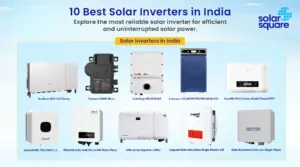
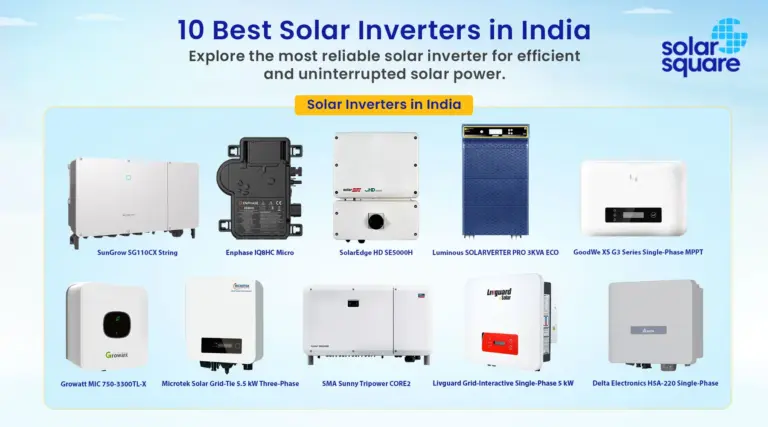
A solar inverter is the part of your system that decides how much of the sun’s energy you actually get to use, and for most homes in India, an on-grid inverter is the best fit. It’s the most affordable option, qualifies for net metering, and works well as long as your area has reasonably stable grid power. Off-grid and hybrid inverters cost more but are worth considering if your home experiences frequent power cuts and you need battery backup.
Here’s a quick look at how the options stack up before we get into the details:
| Inverter Type | Efficiency | Best For |
| On-Grid (String) | 95%+ with MPPT (Maximum Power Point Tracking) technology | Homes with stable grid supply, want net metering and the fastest payback |
| Off-Grid | Slightly lower (battery charging losses) | Areas with long or frequent power cuts, weak grid connectivity |
| Hybrid | High, but battery management adds cost | Homes wanting grid-tie plus backup for essential appliances |
| String Inverter | High | Standard for most residential rooftops |
| Micro-Inverter | Highest – isolates each panel | Roofs with partial shading or panels facing multiple directions |
Types of Solar Inverters for Indian Homes
1. On-grid inverter
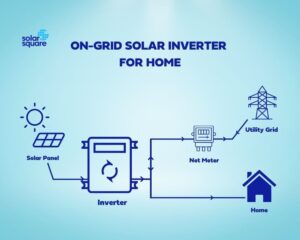
On-grid solar inverters are chosen for an on-grid solar system, i.e., the ones connected to the grid. It plays a major role in converting DC power into AC power.
Additionally, this inverter shuts down the power supply from the solar system whenever there is an electrical arc. This shutting down feature is called Anti-Islanding Protection. This feature makes an on-grid inverter one of the best solar inverters for home. Anti-islanding is mandatory because if electricity flow continues from the solar panel while a wireman/lineman works at the site of the fault, it could be a life-threatening situation.
2. Off-grid inverter
Off-grid solar inverters are an essential component of the off-grid solar power system. The device converts DC power to AC power. Moreover, the off-grid inverter is connected to a battery bank wherein the extra solar power produced during the daytime gets stored. So, an off-grid solar inverter helps store excess charge and supplies the same to power all the electrical appliances during nighttime.
3. Hybrid inverter
What is a hybrid solar inverter? A combination of a solar inverter and a battery inverter into a single piece of equipment is called a hybrid solar inverter. So, you do not require a separate battery inverter. It is one of the best solar inverters for homes.
It manages power from your solar panels, utility grid, and solar batteries simultaneously. Hence, it’s highly efficient.
It is to be noted that a hybrid solar inverter can function without batteries as well. You can attach them to solar panels and the power grid in such a system. However, they’re more expensive than on-grid inverters. Ideally, an on-grid solar system is the best option for homes.
4. String vs Micro-Inverters
Separately from the on-grid/off-grid/hybrid choice, you’ll also come across string inverters and micro-inverters; these describe how the inverter connects to your panels, not how it connects to the grid. A string inverter is wired to a series (“string”) of panels, typically 7 to 10, and handles their combined output through a single unit. It’s the standard choice for most residential rooftops because it’s cost-effective and easy to maintain.
A micro-inverter, on the other hand, is installed on each individual panel, converting its output to AC right at the source. This means one underperforming panel, due to shading from a water tank or a tree, for instance, won’t drag down the output of the rest of the array, which is a real advantage on roofs with mixed sun exposure. The trade-off is cost: you’re paying for one inverter per panel instead of one for the whole array, so micro-inverters typically work out more expensive for a standard home setup.
Not sure which type fits your roof and your power situation? Get a free site assessment from SolarSquare and our team will help you map out the right option.
So, Which is the Best Solar Inverter For Home?
Your choice of a solar inverter depends on several factors. However, for most people, the on-grid is the best solar inverter for home because it gives you an option of grid electricity to fulfil your power requirements. They adjust input voltage and ensure minimal damage to the household appliances. Moreover, the anti-islanding property makes it all the more worthwhile and special.
Amongst string and micro-inverters, string inverters have the benefit of being a short-term cheaper solution. This is why they are considered the best solar inverter for a home. They have lower equipment needs, as one string inverter handles the energy produced from a series of up to 7-10 panels. Purchasing a string inverter rather than 7-10 micro inverters is better for people with budget issues. For people who do not have a budget constraint, microinverters might be handier.
How to Size the Right Solar Inverter for Your Home?
Getting the inverter size right matters; too small, and it can’t handle your peak load; too large, and you’re paying for capacity you’ll rarely use. Here’s a simple way to think it through –
- Start by listing the appliances you’re likely to run at the same time during the day. Say a refrigerator (150W), three ceiling fans (75W each, so 225W), and a few LED lights plus a TV (around 220W combined), that adds up to roughly 600W of continuous load.
- Next, account for appliances with motors, water pumps, mixers, and washing machines, which can draw two to three times their running wattage for a second or two when they switch on. If your home occasionally runs a 750W mixer alongside everything else, your inverter needs to handle that surge without tripping.
- As a rule of thumb, add a 20-25% buffer over your highest expected continuous load to cover these surges and any future appliances. A home with around 1.2kW of continuous daytime load and occasional motor-driven surges would typically be comfortable with a 2kW inverter.
- One more thing to check: your inverter’s capacity should roughly match your solar panel array’s capacity. Most installers recommend a DC:AC ratio between 1:1 and 1.2:1, so a 3kW inverter pairs well with a 3kW to 3.6kW panel array. If you’re unsure how big your panel array needs to be in the first place, SolarSquare’s solar calculator can estimate this based on your monthly electricity bill.
Best 5 Solar Inverters for Home in India (2026)
With dozens of brands available in the Indian market, the shortlist below focuses on inverters that are widely DISCOM (Distribution Company)-approved, well-suited to Indian grid conditions, and backed by accessible after-sales support.
1. Sungrow (On-Grid, String)
Sungrow holds around 27-30% overall market share in India across C&I (Commercial and Industrial) and residential segments, making it the most widely deployed inverter brand in the country and chosen by SolarSquare as well. They also have a higher DC to AC conversion rate of 98.4%.
It carries strong MNRE (Ministry of New and Renewable Energy) approvals and broad DISCOM acceptance across Indian states. If reliability and after-sales support at scale matter to you, Sungrow is a good choice.
| Spec | Detail |
| Type | On-grid, string |
| Capacity Range | 1kW – 6kW (residential models) |
| Efficiency | Up to 98%+ |
| MPPT | Single/Dual MPPT depending on model |
| Warranty | 7 years standard warranty |
| Best For | Most Indian homes on stable grid supply |
2. Havells (On-Grid & Hybrid, Indian Brands)
For homeowners who prioritise local service availability above all else, especially in Tier 2 and Tier 3 cities, Indian brands like Havells and Luminous remain dependable options.
| Spec | Detail |
| Type | On-grid and hybrid options available |
| Capacity Range | 1kW – 2.16kW |
| Efficiency | 93-96% (varies by model) |
| MPPT | Single MPPT on most residential models |
| Warranty | 10 years standard warranty |
| Best For | Buyers prioritising local after-sales service and brand familiarity |
3. Growatt (On-Grid & Hybrid)
Growatt is a major name in India’s hybrid inverter market, especially for homes that experience regular power cuts. Its SPF (Solar Power Flexibility) series can manage grid, solar, and battery power, with switching speeds of under 20 milliseconds that help keep sensitive electronics running without noticeable interruptions.
| Spec | Detail |
| Type | On-grid [MIN series (Miniseries)] / Hybrid (SPF series) |
| Capacity Range | 3kW – 6kW for residential |
| Efficiency | Up to 97-98% |
| MPPT | Dual MPPT |
| Warranty | 5-10 years depending on model |
| Best For | Homes with frequent power cuts, battery storage plans |
4. GoodWe (On-Grid, String)
The GoodWe DNS G3 Series is a compact, high-efficiency single-phase inverter built for residential rooftop solar systems. It offers stable power conversion, smart monitoring support, low noise operation, and reliable safety protection.
| Spec | Detail |
| Type | On-grid, string |
| Capacity Range | 1kW – 6kW |
| Efficiency | Up to 97.8% |
| MPPT | Dual MPPT |
| Warranty | 5 years standard |
| Best For | Mid-range homes wanting reliable monitoring at a lower price |
5. Solis (On-Grid, String)
The Solis 5G (3-10kW) is well regarded for Indian conditions, DISCOM-approved and priced between Rs.18,000-Rs. 45,000 for residential capacities. It achieves 98.4% efficiency and its OLED (Organic Light-Emitting Diode) display makes on-site monitoring straightforward without needing an app at all times.
| Spec | Detail |
| Type | On-grid, string |
| Capacity Range | 3kW – 10kW |
| Efficiency | 98.4% |
| MPPT | Dual MPPT |
| Warranty | 5-10 years |
| Indicative Price | Rs. 18,000-Rs. 45,000 |
| Best For | Homes wanting premium efficiency without moving to hybrid |
Installation & Maintenance Basics
Where you install the inverter can affect its performance and lifespan. Since inverters generate heat, they should be placed in a shaded, well-ventilated area. Direct afternoon sunlight can cause the inverter to reduce its output or temporarily shut down to prevent overheating. Keeping the cable run between the solar panels and inverter as short as practical helps reduce power loss.
Most inverters need very little day-to-day maintenance, occasionally checking the display or app for error codes, and keeping the area around it free of dust, is usually enough. Many installers, including SolarSquare, offer an annual maintenance contract (AMC) that covers periodic inspection, panel cleaning, and firmware updates. It’s worth asking what’s included in such AMC before signing up, since coverage terms can vary by installer and sometimes by region.
Ready to find the right solar inverter for your home? Try SolarSquare’s solar calculator to estimate your ideal system size, or book a free site assessment and our team will help you choose the right inverter type and capacity for your roof and budget.
Frequently Asked Questions
Will an on-grid solar inverter work during a power cut?
No. An on-grid inverter is designed to shut down automatically when the grid goes down, as part of its anti-islanding safety feature. If you want power during outages, you’d need a hybrid or off-grid inverter with a battery, or add a battery to your existing on-grid system later.
What is the cost of a solar inverter for a home in India?
Solar inverter costs vary by type and capacity, but as a general guide, on-grid inverters for homes typically range from around Rs. 8,000 for 1kW to Rs. 35,000 for 3kW, while hybrid inverters with battery support cost roughly two to three times more for the same capacity. The inverter usually accounts for 20-25% of your total system cost.
Can I run an air conditioner on a solar inverter?
Yes, but it depends on the inverter’s capacity and your panel array size. ACs draw a significant power surge on startup, so you’ll need an inverter sized with enough headroom – and ideally a panel array large enough to support the AC’s running load alongside your other appliances during the day.
On-grid, off-grid, or hybrid, which is best for my home?
For most urban and semi-urban homes with reasonably stable grid power, on-grid is the most cost-effective choice and qualifies for net metering. Off-grid suits homes with little to no reliable grid access, while hybrid is a middle ground for homes that want net metering plus backup for a few essential appliances during outages.
How long do solar inverters last, and what warranty should I expect?
Most solar inverters come with a manufacturer’s warranty of around 5 years. When comparing the solar inverter options, check whether the warranty covers parts and labour, and whether instant service support is available or not.
Do solar inverters need regular maintenance?
Not much. Periodically checking the inverter’s display or monitoring app for error codes, and keeping the surrounding area free of dust, covers most of it. Many installers offer an annual maintenance contract (AMC) that includes a more thorough inspection and panel cleaning for long term benefits of the overall solar plant.


 Previous Article

 22 min