

 450 Reads
 14 mins


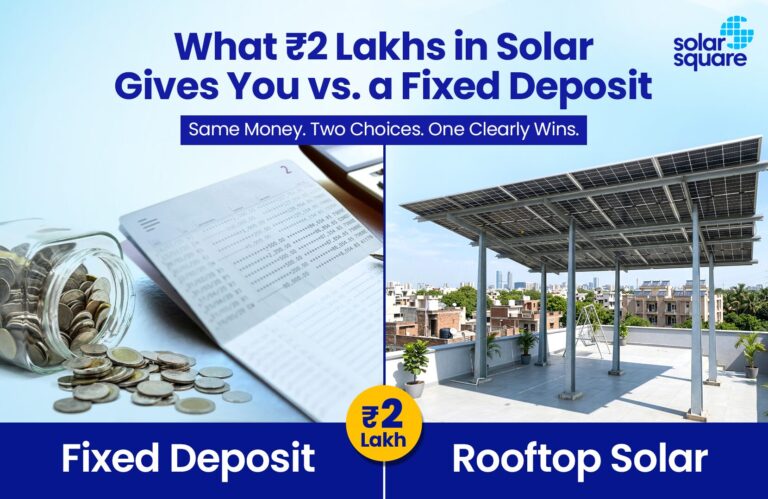
When people think about investing ~₹ 2 lakhs, the usual options that come to mind first are fixed deposits, gold, or mutual funds. These are familiar, easy to understand, and often seen as safe choices. But the one investment most homeowners rarely think of in the same way is rooftop solar. And it’s understandable.
At first, solar may look like a home upgrade or a high-ticket appliance purchase. But in reality, it does exactly what a good investment is expected to do, i.e., putting your money to work.
- A fixed deposit gives you returns in the form of interest.
- Rooftop solar gives you returns by lowering your electricity bills by up to 90%. Over 25 years of the system’s life, those monthly savings add up to a large financial benefit, while also protecting you from rising power tariffs. Also, it gives the satisfaction of running your home on clean energy.
That is why comparing solar with traditional investments makes sense.
In this blog, we compare what happens when you invest ~₹2 lakhs in a 2 to 4 kW rooftop solar system vs ~₹2 lakhs in a fixed deposit. The goal is not just to find out where your money can earn returns, but also to understand which option can improve your long-term wealth while reducing your monthly expenses.
1.Please note that the ~₹2 lakh in solar is only applicable for 2 to 4 KW system size (after subsidy) for most cities. The cost of a 4 KW system for Bengaluru, Gwalior, Indore, and Jabalpur locations is above this price. The solar system price for on-grid solar systems without subsidy listed in the section above is indicative as of 7th July 2026 for the SolarSquare Blue 6ft variant. The final cost of installing an on-grid rooftop solar panel system for a home depends on your DISCOM charges, city, product variant opted for, panel type, inverter type, mounting structure height, type of after-sales service, savings guarantee, roof height, etc.
2 Lakhs in Solar Vs 2 Lakhs in FD: Side-by-Side Comparison
Most traditional ways of investment provide returns by earning interest, dividends, and capital appreciation. On the other hand, solar works by eliminating recurring expenses instead of generating income. Let’s discuss the parameters that matter while comparing ~2 lakh in solar or 2 lakhs in FD below:
| Parameters | Rooftop Solar | Fixed deposit |
| Initial investment | ~₹ 2 lakhs for residential rooftop solar systems | ₹ 2 lakhs deposited in bank |
| Tax Impact | No tax, as electricity bill savings are not taxed as income | Interest earned is taxable according to the investor’s income tax slab |
| Benefits | Reduces electricity bills Long-term savings Improves property value Supports clean energy | Guaranteed returns Capital protection Predictable returns Easy liquidity |
| Lifespan | 25+ years | Fixed maturity period (few months to several years) |
| Inflation effects | Benefits often increase over time, improving long-term savings | Your actual returns can be much lower after taxes. |
| Risks | Depends on roof suitability, sunlight availability, system quality, and installation | It is a safe investment, but vulnerable to inflation and reinvestment challenges |
2.Please note that the ~₹2 lakh in solar is only applicable for 2 to 4 KW system size (after subsidy) for most cities. The cost of a 4 KW system for Bengaluru, Gwalior, Indore, and Jabalpur locations is above this price. The solar system price after subsidy listed in the section above is indicative as of 7th July 2026 for the SolarSquare Blue 6ft variant. The final cost of installing an on-grid rooftop solar panel system for a home depends on your DISCOM charges, city, product variant opted for, panel type, inverter type, mounting structure height, type of after-sales service, savings guarantee, roof height, etc.
Note 3: The tax on earned interest is deducted when the interest exceeds the specified threshold. The standard TDS on fixed deposits is 10%, which may extend to 20% if the customer has not submitted a PAN. The annual interest threshold of regular and senior citizens varies depending on the bank.
How is Solar Investment Better than Traditional FDs?
For many Indian households, fixed deposits have always been the default choice for safe investing. We have seen our parents and grandparents trust FDs because they are simple, predictable, and easy to understand.
Solar, on the other hand, has rarely been viewed as an investment. For most homeowners, it still feels like a technology purchase or a home upgrade.
But that view is changing.
- A fixed deposit helps your money earn interest.
- Rooftop solar saves you from a recurring monthly expense (your electricity bill) for 25 years. Over time, those savings offer an ROI far greater than the returns from a traditional FD.
In this section, let’s look at why rooftop solar can be a better investment than a fixed deposit for many Indian homeowners.
#1. Predictable Savings and Zero Tax on Returns
FDs are considered one of the safest investment options because the principal amount is protected, and investors know exactly how much they will earn over a fixed period. The same kind of predictability is possible with rooftop solar.
While solar does not generate returns in the form of interest, it creates returns through monthly electricity bill savings. These savings can be estimated in advance based on your electricity usage, system size, location, and tariff. You can estimate them using SolarSquare’s free solar calculator.
Furthermore, the money you save through solar is not taxed. In comparison, the interest earned from FDs is taxable as per your income tax slab.
#2. Government Subsidies
One reason rooftop solar can deliver better returns than a traditional FD is government support in the form of the PM Surya Ghar Muft Bijli Yojana.
Under the PM Surya Ghar Muft Bijli Yojana, the government aims to help 1 crore Indian homes install rooftop solar systems by March 31, 2027. The scheme was launched on February 13, 2024, and offers central financial assistance for eligible residential consumers.
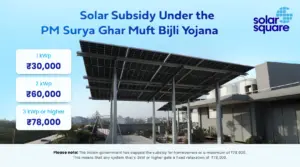
For homeowners, this subsidy directly reduces the upfront cost of installing solar. The central subsidy is ₹30,000 for a 1 kW system, ₹60,000 for a 2 kW system, and ₹78,000 for a 3 kW or larger system.
Some states also provide additional support over and above the central subsidy. For example, Delhi and Uttar Pradesh offer extra state subsidies for eligible residential rooftop solar installations.
The max state subsidy in Delhi is capped at ₹30,000 for 3 kW or higher-capacity PV systems. In UP, the max state subsidy is also ₹30,000 but for systems of 2 kW or higher capacity.
Because of these subsidies, homeowners can lower their initial investment and recover the cost faster through electricity bill savings.
The PM Surya Ghar subsidy amount based on system size is mentioned below.
| Solar System Size | Solar Subsidy Offered Under PM Surya Ghar Muft Bijli Yojana (central subsidy) |
| 1 kWp | ₹ 30,000 |
| 2 kWp | ₹ 60,000 |
| 3kWp and higher | ₹ 78,000 |
#3. Lower Electricity Bills and No Impact of Tariffs
People who are adopting solar focus mainly on reducing their electricity bills and creating a long-term savings plan for 25 years or more. But they are unaware of the factors, including sunlight availability, system size, electricity consumption, tariff rates, and more, on which their savings depend. Solar has the potential to reduce monthly electricity bills or make them nearly zero. Let’s understand how solar can increase your savings:
Understanding Solar Investments
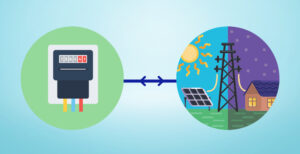
When you install a rooftop solar system, your panels start generating electricity from sunlight, and that electricity is used in your home first, before the grid gets involved. So, instead of buying those units from your electricity provider, you’re producing them yourself, for free. As a result, your bills drop by up to 90% every month. The best part? The bill reduction is not a one-time benefit. Rooftop solar continues generating free power for 25+ years.
Let’s make it real with a Nagpur example.
In Nagpur, one unit of electricity costs around ~₹12- ₹13. A 2-3 BHK home uses 350-400 units a month, which means a monthly bill of roughly ₹ 5,000.
A 3kW solar system is enough to cover this consumption. And unlike an FD, where you first invest the full amount and then wait for returns, solar starts with an upfront advantage.
Under the PM Surya Ghar Muft Bijli Yojana, you can get a subsidy of ₹78,000 for a 3 kW system.
- This is not a return you earn slowly over the years.
- It directly reduces your installation cost before your solar system even starts generating savings.
So, if the system costs ~₹ 2 lakhs, your effective investment can come down to ~₹1.22 lakhs after subsidy. From there, every monthly reduction in your electricity bill becomes your actual return.
So your actual out-of-pocket cost after the subsidy is much lower than the sticker price. And if you don’t want to pay even that in one go, you can choose solar financing options.
At SolarSquare, there’s a 6-month zero-cost EMI scheme, a 36-month EMI (Equated Monthly Instalment) scheme, and a 5-year EMI scheme. Considering the 5-year EMI scheme:
Here’s what the numbers look like:
| Particular | Approximate Values |
| 1 unit of electricity (Nagpur) | ~₹12- ₹ 13 |
| Monthly consumption (2-3 BHK) | ~350-400 units |
| Monthly Bill approx. | ₹4,200- ₹4,800~ ₹. 5000 |
| Government subsidy5 | ₹78,000 |
| Instalment per month | ~₹3,700-₹. 4,500 (yearly~₹44,400-₹.54,000) |
| Units produced by a 3 KW system (in 1st year) | ~4,260 |
| Tariff rate (1st year) | 12.2 |
| Savings through 3 KW system (Unit Produced x Tariff rate) | ~₹ 51,972 |
| Net saving in the first year | ₹51,972-₹.44,000=~7,972 |
4.Please note that the ~₹ 2 lakh in solar is only applicable for 2 to 4 KW system size (after subsidy) for most cities. The cost of a 4 KW system for Bengaluru, Gwalior, Indore, and Jabalpur locations is above this price. The solar system price for on-grid solar systems after subsidy listed in the section above is indicative as of 7th July 2026 for SolarSquare Blue 6ft variant. The final cost of installing an on-grid rooftop solar panel system for a home depends on your DISCOM charges, city, product variant opted for, panel type, inverter type, mounting structure height, type of after-sales service, savings guarantee, roof height, etc.
Note 3: The tax on earned interest is deducted when the interest exceeds the specified threshold. The standard TDS on fixed deposits is 10%, which may extend to 20% if the customer has not submitted a PAN. The annual interest threshold for regular and senior citizens varies depending on the banks.
5.Note we are considering that a 3- 3.5 kW system is sufficient for the above monthly consumption. And the government subsidy for a system size of 3 or above is 78,000. In addition, the monthly instalment for a 3-kW system is ~3,700. The above example is based on those values. The EMI of ₹ 4,500 is valid for 3.78 KW systems.
#4. Better ROI
If you look at the actual return on investment, solar offers almost 3X the savings compared to an FD over 10 years. Let’s compare the 10-year return for both, considering the initial investment as ~2 Lakhs:
Considering an FD of ₹ 2,00,000 at an average 7% annual return,
The value after 10 years would be ₹ 4,00,319 L, with a total gain of ₹ 2,00,319 L
In case of solar, considering a 4 KW system, the system cost after subsidy would be ~ ₹ 2,00,000
- The unit generated by the 4 KW system generates ~ 16-20 units
- Annual unit generation: 5840-6000
- After ten years, the generation would be ~58400-60000*
- With a tariff rate (₹12), the total saving= ~₹ 7,00800- ₹ 7,20,000
- Net gain would be (Total saving-Initial cost)= ~₹5,00800- ₹ 5,20,000
* Please note we are considering this value as an example. The unit generation will reduce over time. Usually, panels degrade by 0.3-0.5% every year.
Also, the ~₹ 2 lakh in solar is only applicable for 2 to 4 KW system size (after subsidy) for most cities. The cost of a 4 KW system for Bengaluru, Gwalior, Indore, and Jabalpur locations is above this price. The solar system price for on-grid solar systems after subsidy listed in the section above is indicative as of 7th July 2026 for the SolarSquare Blue 6ft variant.
How SolarSquare Help You Maximize Your Investments?
A rooftop solar system is a long-term investment, so the real value does not come from panels alone. It comes from the right system design, high-quality components, reliable installation, strong after-sales support, and savings that continue for years.
That is where SolarSquare adds value.
From helping you choose the right system size to ensuring quality installation and long-term performance, SolarSquare makes sure your solar investment delivers maximum savings with minimum hassle. We’re the #1 home solar installation company with 190+ MW of solar installed across over 43,000 homes as of July 6th 2026, as listed on the PM Surya Ghar Muft Bijli Yojana National Portal for Rooftop Solar. :
Premium Components and Installation Standards
SolarSquare focuses more on providing premium-quality components. We use panels from brands like Premier Energy, Renew Power, and more. Our inverters are from brands like Sungrow, and we provide Windpro Mount structures. The structure has an 80-micron coating that lasts for 25 years, and it can withstand wind speeds as high as 170km/hr.
The performance of the solar system depends highly on the components and installation process. SolarSquare’s professional system design and installation enable higher savings through maximum electricity generation. In addition, as per GoodZero’s money-back promise, if the installed system does not generate the promised units, you can get compensation of ₹ 8/ unit.
Our Services
Whether it’s about getting approvals from the DISCOM, maintenance assistance, documentation, service requirements, or any support for queries, SolarSquare provides a top-notch service.
Dirt, dust, and bird droppings can reduce the efficiency of solar panels, for which we need maintenance and cleaning. SolarSquare provides a 5-year* professional maintenance (as per Goodzero), where they visit every 45 days.
*Please note that since June 2026, we have offered only TopCon panels in Uttar Pradesh, Chhattisgarh, and Nagpur, backed by a 4-year GoodZero Savings Guarantee with a money-back promise. All other terms and benefits of the GoodZero plan remain the same. For all other states except Uttar Pradesh and Nagpur, our 5-Year GoodZero Savings Guarantee with a money-back promise continues to be available as of now.
As our product offerings (technology) and savings guarantee terms may evolve over time, please connect with your assigned Solar Consultant or schedule a FREE solar consultation with us for the latest information on available panel technologies and guarantee coverage.
Performance Monitoring
Modern rooftop solar systems come with the benefit of monitoring systems. You can track the real-time performance of your installed system through SolarSquare’s monitoring app. It gives real-time solar generation data, daily units, system status, and error alerts.
Final verdict: Solar or FD for 2 lakhs?
A fixed deposit keeps your money safe and gives you predictable returns. Rooftop solar, on the other hand, works differently.
- It turns a one-time investment into long-term electricity bill savings
- It helps you reduce recurring expenses year after year.
Needless to say, FDs offer safety, liquidity, and certainty, but the actual returns can become less attractive after inflation and taxes.
Rooftop solar delivers stronger long-term value because the savings continue for 25 years or more, and government subsidies can reduce the upfront cost further.
So, if your goal is only to keep money parked safely, an FD may still work. But if your goal is to use the same money to reduce monthly expenses and build long-term savings, rooftop solar can be a smarter investment for many homeowners.
Frequently Asked Questions
Is solar investment worth it?
Yes, solar is a good investment option for people with a budget. It is a one-time investment that helps to save on electricity bills and provides high ROI compared to traditional methods (FD, mutual funds, gold). Also, the solar installation is supported by government schemes, which provide good initial support.
Is rooftop solar a better investment than a fixed deposit?
Both FDs and solar investment provide benefits in distinct ways. People who are looking for guaranteed returns and capital protection should go with FDs. On the other hand, people looking for long-term investment and returns can choose solar investments. Though it gives a return in the form of reduced recurring electricity bills.
How much can I save by investing 2 Lakhs in a rooftop solar system?
People who are investing 2 lakhs in solar can typically save ₹ 25,000-₹ 50,000 annually on electricity bills. But providing the actual savings numbers depends on factors such as electricity consumption, local tariffs, system size, and more.
In how many days can I recover the solar installation cost?
Most residential solar systems recover the installation cost within 3-5 years, depending on factors such as location, electricity consumption, system performance, government subsidies, and more. Once they recover the installation cost, they can take the additional financial benefits.
Which gives better ROI, Solar or Fixed Deposit?
Over 25 years, a rooftop solar system delivers almost 3-4x better real returns than a fixed deposit. FD returns are fixed, taxable, and affected by inflation. Solar savings grow every time electricity tariffs rise, attract zero tax, and require no reinvestment decisions, making it a significantly stronger long-term performer than any traditional fixed deposit.


 Previous Article
 14 min