

 2735 Reads
 16 mins


A micro solar inverter optimizes each solar panel in a PV system independently, mitigates panel-level mismatch, and can offer an operating life of around 25 years.
So, why do most homes still use string inverters?
The answer comes down to what your rooftop actually needs and your budget.
- String inverters are cost-effective, have an operating life of ~8 years, are highly efficient, and work very well for homes with shadow-free roofs.
- Microinverters cost considerably more upfront than string inverters. But their panel-level MPPT (maximum power point tracking) and independent power conversion makes them valuable where shading, different panel orientations, or long-term performance matter. Plus, their operating life is ~25 years.
A micro solar inverter works at the module level. It means that each solar panel has its own microinverter. This prevents panel-level mismatch from affecting the performance of other panels. If one microinverter fails, only the panel connected to it stops producing power, while the remaining panels continue operating normally.
This guide explains what solar microinverters are, how they work, their price in India in 2026, advantages and disadvantages, battery compatibility, maintenance needs, and how they compare with string inverters and power optimizers.
What Is a Micro Solar Inverter?
A micro solar inverter is a small inverter dedicated to an individual solar panel. It converts the DC electricity produced by that panel into AC electricity at the module level, rather than sending the DC output of multiple solar panels to a single central inverter.
- Since each panel has its own microinverter and MPPT, it operates independently.
- This helps reduce mismatch losses because shading or lower output from one panel does not force the remaining panels to operate at the same level.
A solar microinverter also isolates inverter failure at the module level. If one microinverter stops working, only its connected panel stops producing power, while the other panel-microinverter pairs continue operating normally.
Where Is a Micro Solar Inverter Installed?
A micro solar inverter is installed directly behind or beneath each solar panel, usually on the rooftop mounting structure. This keeps the inverter close to the panel it serves and allows DC-to-AC conversion to happen right at the module level.
What Does a Microinverter Do in a Solar System?
A microinverter converts DC electricity to AC for your home, manages the output of the solar panel connected to it, and helps the system extract the available power from that panel.
Its main functions include:
- DC-to-AC conversion: It converts the DC electricity from the solar panel into usable AC electricity.
- Module-level power conversion: Power conversion occurs near the solar module rather than at a single central inverter.
- Individual MPPT: Maximum Power Point Tracking helps each panel operate near its optimal power point.
- Panel-level monitoring: You can track each solar panel’s power generation and performance separately.
Does Every Solar Panel Need Its Own Microinverter?
Yes, in a true microinverter system, every solar panel has its own dedicated microinverter.
However, you may come across newer products sold as 2-in-1 or 4-in-1 microinverters. These use one physical inverter unit for multiple solar panels. These products can provide some module-level optimization, but they are not the same as a true one-panel-one-microinverter architecture.
The key difference appears during an inverter failure. With a true microinverter, one failed inverter affects only one solar panel. With a 4-in-1 unit, a failure of that single inverter can stop power conversion from all four panels connected to it.
How Does a Micro Solar Inverter Work?
Instead of collecting high-voltage DC power from an entire string, a micro solar inverter operates on the DC output of an individual module.
The process follows five basic steps:
- Solar panels generate DC electricity: Sunlight reaches the solar cells, and the panel produces DC (direct current) solar electricity.
- MPPT for each panel: The microinverter’s MPPT continuously adjusts the electrical operating point to extract the maximum available power from its connected panel.
- The microinverter converts DC to AC: Its electronic conversion circuit converts the panel’s DC output into grid-compatible AC.
- AC power flows to the distribution board: AC outputs from the microinverters join an AC branch circuit and travel toward the building’s main electrical distribution system.
- Monitoring tracks individual panel performance: Communication hardware sends production and operating information to a solar energy monitoring system, where supported.
What are the Different Micro Solar Inverter Components?
A microinverter combines several electrical and communication components in a compact outdoor unit.
The main components include:
- Input connectors: These connect the solar module’s DC cables to the inverter.
- Maximum Power Point Tracker (MPPT): The MPPT adjusts voltage and current so the connected panel can operate near its maximum available power point.
- DC-to-AC conversion circuit: This electronic circuit converts the incoming DC power into AC power.
- Protective enclosure: The enclosure protects internal electronics from outdoor conditions such as dust and moisture. The required installation clearances and operating-temperature limits depend on the product.
- Communication and monitoring system: Depending on the model, Wi-Fi or another communication system can transmit panel-level production and fault information.
Mini Solar Inverter vs Micro Solar Inverter: Are They the Same?
No, a mini solar inverter and a microinverter do not necessarily mean the same thing.
- A micro solar inverter: It refers to a specific inverter design in which each solar panel has its own inverter and MPPT. The DC electricity produced by that panel is converted into AC electricity at the module level.
- A mini solar inverter: Mini is not a specific inverter architecture. The term is generally used for compact or lower-capacity inverters, which may include small string inverters, compact backup inverters, or other small inverter systems.
This means you cannot identify a microinverter simply by its size or by the word mini in the product name.
Here’s a snapshot of the key differences between the two:
| Feature | Mini Solar Inverter | Micro Solar Inverter |
| Meaning | A general term for a compact inverter | A specific module-level inverter design |
| Inverter arrangement | Depends on the type of solar inverter | One inverter for each solar panel |
| DC-to-AC conversion | May take place centrally or locally | Takes place at the individual panel |
| Panel independence | Depends on the system design | Each panel operates independently |
| Effect of inverter failure | Depends on the inverter architecture | Only the connected panel stops producing |
Micro Solar Inverter vs String Inverter
A string inverter and a micro solar inverter perform the same basic job of converting solar DC electricity into usable AC electricity. The difference lies in where the conversion happens and how the solar panels operate electrically.
- A string inverter connects several panels into DC strings and converts power at a single central inverter.
- A microinverter converts DC to AC at each solar panel, allowing each panel to operate independently.
Here’s a side-by-side comparison of both types:
| Feature | String Inverter | Micro Solar Inverter |
| Definition | One inverter converts power from one or more panel strings | One dedicated inverter converts DC to AC at each individual solar panel |
| Inverter location | One central location for the connected panel strings | Beneath, behind, or close to panels |
| MPPT | 2-4 in common rooftop solar systems for homes | Per panel |
| Operating life | ~8 years | ~25 years |
| Shading performance | One weak module can affect string production depending on design | Better isolation of module-level mismatch |
| Installation complexity | Fewer inverter units and simpler centralized servicing | More rooftop electronics and AC connections |
| Cost | Lower upfront inverter cost | Higher upfront cost |
| Inverter efficiency* | ~97.5-98.5% | ~96-97% |
| Overall system efficiency* | Good | Better when shading, orientation differences, or panel mismatch are present |
| Is it better for partial shading? | Usually no | Usually yes |
| Is it better for unshaded roofs? | Often the more economical option | Added cost may deliver less benefit |
*DISCLAIMER: The conversion efficiency of the inverter and the energy yield of the complete rooftop solar system are different measures. Most microinverter products commonly publish efficiencies around 96% to 97%. A string inverter may have higher conversion efficiency on paper, but module-level MPPT can improve total energy yield when panels experience shading, different orientations, or mismatches.
Microinverter vs Power Optimizer
A power optimizer is a module-level DC-to-DC device installed with an individual solar panel. It uses MPPT to optimize the panel’s DC output, but it does not convert it into AC. Instead, the optimized DC power travels to a central string inverter, which performs the final DC-to-AC conversion.
A microinverter goes one step further. It performs both panel-level MPPT and DC-to-AC conversion at the solar panel itself. Every panel has its own inverter and does not depend on a central inverter for power conversion.
So, a power optimizer optimizes DC power and sends it to a central inverter, while a microinverter converts the panel’s DC power into AC at the module level.
Here’s how the two compare:
| Feature | Power Optimizer | Micro Solar Inverter |
| Definition | A module-level device that optimizes the DC output of each panel | A solar inverter that optimizes and converts the DC output of each panel into AC |
| Conversion location |
| DC-to-AC conversion takes place at each panel |
| Central inverter requirement | Yes | No |
| Operating life | ~10-12 years | ~25 years |
| Cost | More cost-effective than microinverters for large systems | Costliest option because every panel has its own inverter |
| Best for | Large C&I and housing-society rooftop solar systems where panel-level optimization is useful but using a separate microinverter for every panel would make the system too expensive. | Best for shadow-prone rooftops and projects where long-term energy yield, panel-level independence, and system life matter more than upfront cost. |
What are the Advantages of Micro Solar Inverters?
Micro solar inverters improve panel-level performance by giving each solar panel its own MPPT and inverter. They reduce mismatch losses, perform well under shade, and isolate a single inverter failure to one panel.
Their key advantages include:
- Lower mismatch losses: An underperforming panel does not pull down the performance of the entire solar array.
- Better performance under partial shade: Each panel operates independently, so shade on one panel has a limited effect on the rest of the system.
- Individual MPPT: Every panel gets its own MPPT, allowing it to operate at its optimum power point.
- Panel-level monitoring: You can track each solar panel’s generation and performance separately.
- Suitable for complex rooftops: Panels facing different directions or receiving different levels of sunlight can operate independently.
- Easy system expansion: You can add more panels and microinverters later.
- Limited impact of inverter failure: If one microinverter fails, only its connected panel stops producing while the remaining panels continue operating.
- Long operating life: Quality microinverters can last ~25 years, making them suitable for long-term solar installations.
What are the Disadvantages of Micro Solar Inverters?
The biggest limitation of micro solar inverters is their higher upfront cost, as each panel needs its own inverter.
Here’s a snapshot of all limitations of microinverters:
- Higher upfront cost: Every panel needs its own inverter, so the system costs more than a string-inverter setup.
- Cost increases with system size: The economics become harder to justify on very large installations because the number of microinverters rises with the number of panels.
- May offer limited financial benefit on shadow-free roofs: For homes with a simple, uniform, unshaded roof, a string inverter is often the more economical choice.
Can Micro Solar Inverters Work With Batteries?
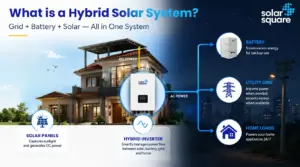
Yes, a rooftop solar system with microinverters can work with battery storage. Since microinverters convert solar DC into AC at the panel level, they are paired with AC-coupled batteries rather than connecting the battery directly to the solar panels.
The setup also requires a battery inverter and a system controller to manage power between the solar system, battery, home, and grid.
How Does Battery Storage Work With Microinverters?
The battery stores electricity as DC, so charging and discharging batteries in a solar system with microinverters require additional power conversion.
Here’s how the complete flow works:
- Solar powers the home first: The microinverters convert the panels’ DC electricity into AC, which supplies the home’s running loads.
- Surplus solar power charges the AC-coupled batteries: When generation exceeds consumption, the extra AC electricity is sent to the battery system.
- The battery inverter converts AC into DC: Since the battery stores DC electricity, its bidirectional inverter converts the surplus AC power back into DC for charging.
- The battery supplies power when required: When stored energy is needed, the battery inverter converts the battery’s DC electricity back into AC for the home.
- The system controller coordinates everything: It manages power flow between the microinverters, battery, home loads, and grid.
What’s the Micro Solar Inverter Price in India in 2026?
The cost of microinverters in India can range from ~Rs. 18 to ~Rs. 22 per watt* in 2026.
*Please note: The price range mentioned above is indicative and not final. The final price can vary based on the microinverter’s efficiency, warranty period, temperature derating behavior, brand, and the overall system configuration. Installers may also bundle accessories, monitoring equipment, electrical protection, cabling, warranties, and installation work into the final system price.
What Factors Affect Micro Solar Inverter Prices?
These are the four most critical factors that affect the cost of a micro solar inverter:
- Efficiency: Microinverters with higher conversion efficiency and more advanced MPPT performance cost more because they use more sophisticated power electronics.
- Long-term warranty: Products with longer warranty coverage can carry a higher upfront price because the manufacturer is committing to support the inverter for a longer period.
- Age and stability of the company: Established manufacturers with a longer operating history, wider service presence, and stronger after-sales support may price their microinverters higher than newer or lesser-known brands.
- Temperature derating behavior: Microinverters designed to maintain higher output at elevated rooftop temperatures may cost more because they require better thermal management and components suited for long-term outdoor operation.
How to Choose the Right Micro Solar Inverter?
A microinverter should match both your solar panel’s electrical characteristics and your roof conditions. Choosing only by wattage or price can lead to poor compatibility or unnecessary spending.
Before selecting a product, check the following:
- Panel compatibility: Compare the module’s Voc, Vmp, input current, short-circuit current, and recommended module power to the inverter’s limits.
- AC output rating: Confirm that the inverter’s output suits the panel size and intended DC-to-AC ratio.
- Efficiency: Compare conversion efficiency, but also consider roof shading and mismatch, as the highest inverter efficiency figure does not always yield the highest annual system yield.
- Outdoor protection: Check the manufacturer’s ingress protection (IP) rating and installation requirements.
- Warranty and service support: Check both the warranty period and who will provide service in your city in years to come.
Micro Solar Inverter Maintenance Checklist
Tier-1 micro solar inverters are rated IP68 and built for rugged outdoor conditions. That’s why they generally do not require heavy maintenance like solar panels. Most maintenance centers on proper installation, secure electrical connections, monitoring, and keeping the unit mounted in accordance with the manufacturer’s instructions.
Your installer should focus on this checklist:
- Confirm that all electrical connectors remain properly seated and tightened according to the manufacturer’s specified procedure.
- Check that the inverter remains securely mounted as required by the manufacturer’s SOP.
- Maintain the specified clearance and airflow around the unit.
- Review monitoring data for abnormal production, communication loss, or fault codes.
- Inspect visible cables, connectors, and enclosures for physical damage.
Most modern solar microinverters use sealed outdoor enclosures and natural cooling, which keeps routine maintenance requirements low. Still, the right inverter for your rooftop depends on factors such as shading, system size, budget, and long-term performance expectations.
If you’re planning to install rooftop solar and are unsure whether a microinverter, string inverter, or another setup would suit your requirements better, you can book a free solar consultation with SolarSquare and get a system recommendation based on your rooftop and electricity needs.
FAQs
Do microinverters come with built-in batteries?
No, they do not come with built-in batteries. A microinverter converts the DC power from a solar panel into AC power. To add battery storage, the system usually needs an AC-coupled battery, a battery inverter, and a system controller.
Is a micro solar inverter more expensive than a string inverter?
Yes, a microinverter system costs more because every solar panel gets its own inverter. String inverters are usually the more economical choice for homes with simple, shadow-free rooftops.
How many solar panels can connect to one microinverter?
In a true microinverter setup, one microinverter connects to one solar panel. This gives every panel its own MPPT and keeps its operation independent from the other panels.
What is the efficiency of a micro solar inverter?
Most microinverters have a conversion efficiency of around 96% to 97%. Their greater advantage is panel-level optimization, which can improve overall energy generation when shading or panel mismatches occur.
How long do micro solar inverters last?
A quality microinverter can have an operating life of around 25 years. This longer life is one reason microinverters make sense when long-term value matters more than the cost.
Can one microinverter support four solar panels?
A true microinverter connects to one panel. You may find 4-in-1 products on the market, but a single physical inverter in such a setup serves four panels. If that inverter fails, all four connected panels can stop producing. So, it does not provide the same failure isolation as a true one-panel-one-microinverter setup.
Can I add more panels to a microinverter system later?
Yes, you can usually expand a microinverter system by adding more panels with their own compatible microinverters, provided the overall electrical system has enough capacity for the expansion.
What happens if one microinverter fails?
If that happens, only the solar panel connected to that microinverter stops producing power. The remaining panels and their microinverters continue operating normally.
Where are micro solar inverters most useful?
Microinverters are most useful on shadow-prone rooftops, roofs where panels face different directions, and installations where panel-level performance and long-term value matter more than upfront cost.
When may a microinverter not be the best choice?
A microinverter may not be the best choice for a simple, shadow-free rooftop, especially when budget is a priority. In such cases, a string inverter offers a more economical balance of cost, efficiency, and performance.
Do micro solar inverters work during a power cut?
No, microinverters don’t supply power on their own during a power cut. Whether you get power during an outage depends on the type of solar system, not on whether you use microinverters.
- In an on-grid solar system without battery storage, the microinverters shut down when the grid fails due to anti-islanding safety protection. So, your home will not receive solar power during the outage.
- In a backup-capable hybrid or off-grid solar system with batteries, power can continue during an outage. The battery and control system create and manage the local power supply, allowing the solar system to serve the connected loads.
So, microinverters can be part of a power backup system, but they cannot provide backup on their own.


 Previous Article
 17 min