

 1472 Reads
 12 mins


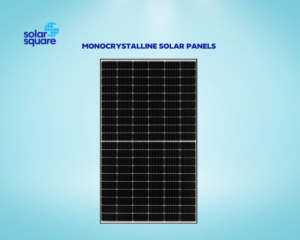
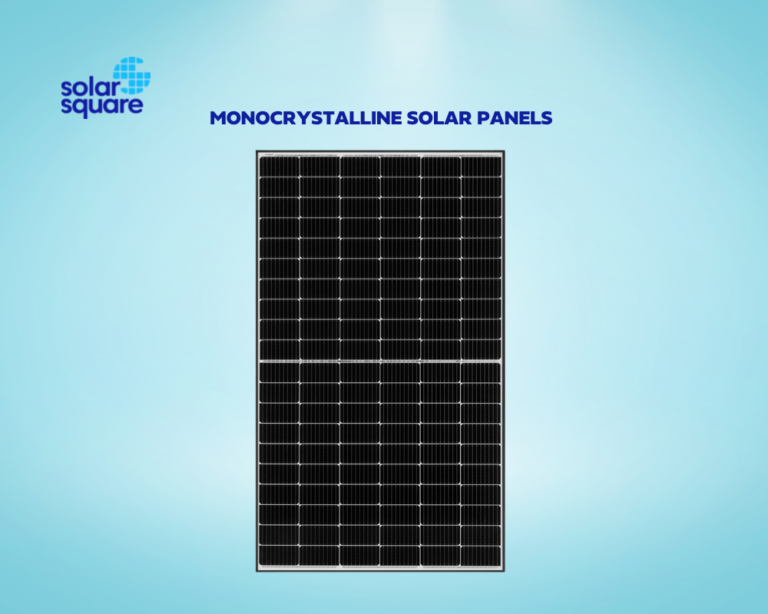
If you’ve done any research on solar panels, you’ve certainly come across the term “monocrystalline.” It’s the most popular panel type in India’s residential solar market, and for all good reasons. A monocrystalline solar panel, also called a mono solar panel, is a semiconductor device composed of monocrystalline solar cells. It is a highly popular, advanced type of solar panel.
Mono solar panels offer the highest efficiency among commercially available panel types, hold up well over decades, and increasingly fit within subsidy-eligible systems under PM Surya Ghar Muft Bijli Yojana.
But not all monocrystalline panels are the same. There are N-type and P-type variants, newer TOPCon and HJT technologies, and a wide range of prices depending on brand, wattage, and specifications.
What Is a Monocrystalline Solar Panel?
A monocrystalline solar panel (also called a mono solar panel) is made from solar cells cut from a single, continuous crystal of high-purity silicon. The silicon is grown into a cylindrical ingot using the Czochralski method, then sliced into thin wafers. These wafers are trimmed into an octagonal shape to reduce gaps when assembled into a panel, which is why mono cells have those characteristic chamfered corners.
The single-crystal structure means electrons can move through the material with minimal resistance. That’s the core reason monocrystalline panels are more efficient than their polycrystalline counterparts.
How Does a Monocrystalline Solar Panel Work?
When sunlight falls on the surface of a monocrystalline solar cell, it excites electrons in the silicon, creating an electric field across the p-n junction. This generates direct current (DC). Since household appliances run on alternating current (AC), a solar inverter converts the DC output into usable AC power.
In an on-grid system, excess power is fed back to the grid through net metering. In an off-grid or hybrid setup, a battery bank stores surplus energy for use at night or during grid outages.
The higher the panel’s efficiency, the more electricity it generates from the same roof area -which is why monocrystalline panels are especially valued in urban homes where rooftop space is limited.
Monocrystalline Solar Panel Efficiency
Modern monocrystalline solar panels commercially available in India typically achieve module efficiency between 20% and 23%, with premium N-type TOPCon and HJT variants reaching up to 24%+ in lab conditions.
For context:
- Standard P-type monocrystalline (PERC): 19-21%
- N-type monocrystalline (TOPCon): 21-23%
- HJT (Heterojunction): 22-24%
- Polycrystalline: 15-17%
Higher efficiency means fewer panels are needed for the same system output. This is a meaningful advantage when roof space is a constraint.
Types of Monocrystalline Solar Panels
Monocrystalline solar panels can be classified based on the type of silicon cell and cell technology used. P-type and N-type are the two broad categories, while technologies such as PERC, TOPCon, and HJT determine how the cells are designed and perform. Panels can also be monofacial or bifacial, depending on whether they generate electricity from one or both sides.
1. N-type Monocrystalline Solar Panels
Like all monocrystalline solar panels, the N-type solar panel comprises silicon crystal wafers. After the creation of the wafers, a semiconductor junction is created to conduct the current.
- In N-type monocrystalline solar panels, a phosphorus coating is applied on the wafer, which induces the current flow.
- The N-type monocrystalline solar panel does not suffer from light-induced degradation.
- Moreover, these panels experience no efficiency or power output decline over time.
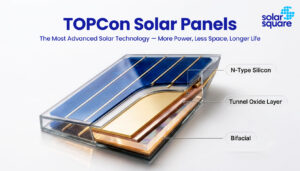
Two main N-type technologies are now available in India:
- Efficiency: 21-23%
- Lower degradation rate (~0.4%/year vs ~0.55% for PERC)
- Slightly higher cost than PERC
- Now widely offered by major brands including Adani, Waaree, and others
- HJT (Heterojunction Technology):
- Efficiency: 22-24%
- Excellent performance in low-light and high-temperature conditions
- Higher upfront cost; less widely available in India
2. P-type Monocrystalline Solar Panels
P-type panels use a boron-doped silicon wafer. They’ve been the industry standard for years and are still widely used across India.
The most common P-type technology today is PERC (Passivated Emitter and Rear Cell), which adds a reflective layer at the back of the cell to capture more light and improve efficiency.
Key characteristics:
- Efficiency: 19-21%
- Slightly susceptible to light-induced degradation (LID) in early weeks of operation
- More affordable than N-type
- Widely available from Tier-1 manufacturers
3. Bifacial Monocrystalline Panels
Both P-type and N-type panels are available in bifacial configurations, where the rear side also generates electricity from reflected light (albedo). Bifacial panels can produce 5-20% more energy depending on the installation surface.
Monocrystalline vs Polycrystalline Solar Panels
| Feature | Monocrystalline | Polycrystalline |
| Cell appearance | Black/dark blue, chamfered corners | Blue, square cells |
| Efficiency | 19-23% | 15-17% |
| Space required | Less | More |
| Temperature performance | Better | Slightly lower |
| Cost | Higher | Lower |
| Lifespan | 25-30 years | 20-25 years |
| Best for | Limited roof space, higher output | Budget-first buyers |
For most Indian homeowners today, monocrystalline is the better long-term investment, especially given falling panel prices and the fact that the PM Surya Ghar subsidy now covers DCR-compliant mono panels.
Monocrystalline Solar Panel Price in India
Mono solar panel prices vary by wattage, technology type, brand, and DCR (Domestic Content Requirement) compliance. Here are approximate retail price ranges in India:
| Panel Type | Price per Watt (approx.)* |
| P-type PERC monocrystalline |
|
| N-type TOPCon monocrystalline |
|
| HJT monocrystalline | ~Rs. 28 to ~Rs. 32 per watt |
*Please note: The per-watt solar panel price listed above is an indicative range and can change based on the manufacturer, module wattage, order size, location, and market conditions.
Prices change with ALMM (Approved List of Models and Manufacturers) listings, import duties, and seasonal demand; always get a current quote from your installer.
Subsidy on Monocrystalline Solar Panels
The current position under PM Surya Ghar Muft Bijli Yojana:
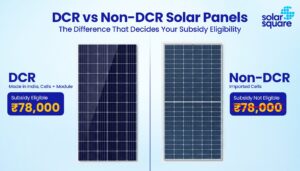
Subsidy is available for mono solar panels, provided they are DCR (Domestic Content Requirement) compliant, meaning both cells and modules are manufactured in India and listed on the MNRE’s (Ministry of New and Renewable Energy) ALMM.
Most leading Indian solar brands now manufacture DCR-compliant monocrystalline panels. The earlier restriction to polycrystalline-only was relevant under an older scheme framework and no longer applies.
Current subsidy structure (residential, on-grid):
- Up to 2 kW: ₹30,000/kW (₹60,000 for 2 kW)
- 2-3 kW: ₹18,000/kW for the additional 1 kW (total ₹78,000 for 3 kW)
- Above 3 kW: No additional subsidy beyond the 3 kW cap
- Maximum subsidy per household: ₹78,000
The subsidy is disbursed directly to the homeowner’s bank account after installation and grid connection through the PM Surya Ghar portal. Your installer should handle DISCOM (Distribution Company) approval and ALMM-compliant panel selection.
Pros and Cons of Monocrystalline Solar Panels
Pros of monocrystalline solar panels:
- Monocrystalline solar panels are highly efficient and well-known for their high power-generating capacity. More specifically, the bifacial variants of monocrystalline solar panels guarantee the highest levels of efficiency due to their unique and advanced design.
- They need less space for installation. So, monocrystalline solar panels are better if your rooftop space is limited, but you still want to install a solar panel system.
- Typically 25-30 year performance warranty, with degradation rates as low as 0.4% per year on TOPCon.
- They generate power even on cloudy days.
- DCR-compliant mono panels qualify under PM Surya Ghar Muft Bijli Yojana.
Cons of monocrystalline solar panels:
- They are expensive compared to other types of solar panels.
- Silicon gets wasted due to corner-cutting in the manufacturing process.
- More sensitive to shading as a partially shaded mono panel can see a sharper output drop. Bypass diodes, microinverters, and power optimisers can help reduce these losses.
Maintenance of Monocrystalline Solar Panels
Monocrystalline solar panels require relatively little maintenance, but regular cleaning and periodic inspections help keep the system operating efficiently. Keeping the panels free from dust, dirt, bird droppings, and other obstructions can improve sunlight absorption, while checking the mounting structure, wiring, and other components helps identify potential issues early.
- Cleaning: 2-4 times per year is sufficient for most Indian locations. Dusty regions (Rajasthan, parts of UP and MP) may benefit from monthly cleaning during summer. Use plain water and a soft brush or cloth; avoid abrasive materials.
- Tilt angle: Panels installed with proper tilt benefit from natural rain washing, reducing manual cleaning frequency.
- Monitoring: Use your inverter’s monitoring app to track daily solar power generation. A consistent drop in output, outside of cloudy days, usually signals a cleaning need or a shading issue.
- Professional inspection: Once a year is sufficient. Check for micro-cracks, junction box integrity, mounting hardware, and cable conditions.
- Warranty coverage: Manufacturing defects and panel degradation below the warranted level are typically covered by the panel manufacturer. Cleaning and physical damage from external causes (hail, accident) are generally not covered; check your specific warranty terms with your hired solar panel company.
Conclusion
Monocrystalline solar panels are the right choice for most Indian homeowners in 2026, particularly those prioritising efficiency, long-term performance, and subsidy eligibility under PM Surya Ghar Muft Bijli Yojana. Whether you go with a P-type PERC panel for a tighter budget or step up to an N-type TOPCon for better long-term returns, mono technology sits at the top of the residential solar stack for good reason.
If you’re evaluating a solar installation, make sure your installer is using ALMM-listed, DCR-compliant panels; that’s what unlocks the subsidy and protects your investment.
Frequently Asked Questions
Which is better: monocrystalline or polycrystalline solar panels?
Monocrystalline panels are more efficient, last longer, and perform better in heat and low-light conditions. Polycrystalline panels cost less upfront. For most urban rooftop installations in India today, mono panels offer better value over a 25-year lifespan.
How long do monocrystalline solar panels last?
Most monocrystalline panels come with a 25-year linear performance warranty, guaranteeing output above 80-82% of rated capacity at the end of the warranty period. N-type TOPCon panels typically degrade at 0.4%/year – meaning they retain more output over time.
How can I identify a monocrystalline solar panel?
Look for dark black or deep dark blue cells with chamfered (cut) corners. The panel datasheet or back label will state the cell technology; PERC, TOPCon, or HJT all indicate monocrystalline construction.
Do monocrystalline panels work on cloudy days?
Yes. All solar panels, including mono panels, generate electricity in diffuse/cloudy light – just at reduced output compared to full sunshine. N-type panels with lower temperature coefficients also hold up better on hot, hazy Indian summer days.
Which monocrystalline solar panel is best for home use in India?
For most homes in India, half-cut bifacial Mono-PERC or TOPCon monocrystalline panels are a strong choice because they offer high efficiency, lower degradation, and good performance in high-temperature conditions. When choosing a panel, also check its efficiency, degradation rate, warranty, ALMM listing, DCR compliance (if required for subsidy), and the manufacturer’s reputation.
What are the financial benefits of going solar with monocrystalline panels?
Beyond electricity bill savings, you benefit from net metering credits, protection against rising DISCOM tariffs, and capital appreciation on your property. Combined with the PM Surya Ghar subsidy of up to ₹78,000, payback periods for residential mono panel systems in India typically range from 4-6 years.


 Previous Article

 15 min