

Installing rooftop solar in India can eliminate electricity bills, but what about the upfront cost of installing solar? While the government offers a subsidy under the PM Surya Ghar Muft Bijli Yojana, it’s capped at Rs. 78,000 for systems equal to or above 3 kW. Making the remaining payment upfront can still be a challenge for many homeowners. That is where the SBI solar loan scheme comes in
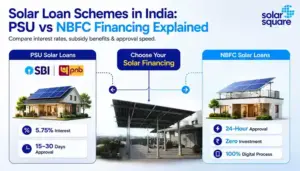
Offered by the State Bank of India, a government-owned PSU (Public Sector Undertaking) bank, this financing option is designed specifically for rooftop solar systems for homes. It offers interest rates starting at 5.75% per annum for loans up to Rs. 2 lakh and allows repayment over a tenure of up to 10 years. Since the SBI rooftop solar loan is provided at a highly concessional rate, you will not receive the PM Surya Ghar solar subsidy into your bank account separately
Furthermore, SBI solar rooftop loan approval takes 15 to 30 days, requires mandatory registration on the Jan Samarth Portal, involves physical branch visits for KYC, and includes property inspection before sanction
However, there’s another option for customers who want faster loan sanctions and a complete digital process: financing from NBFCs (Non-Banking Financial Companies). For example, SolarSquare’s zero-investment loan gets approved within 24 hours, requires no branch visits or physical inspections, and lets you retain the full subsidy amount
The interest rate for NBFCs is usually 12-13% per annum. This might look a tad higher than the 5.75% interest rate of the SBI solar rooftop loan, but the interest rate for SBI loans rises to 8-9% for loans above Rs. 2 lakh.
So, is the SBI solar rooftop loan truly worth it? Does the lower interest rate outweigh the longer approval timeline and structured compliance process?
In this guide, we break down everything you need to know about the SBI solar loan scheme, including eligibility criteria, interest rates, documentation requirements, application steps, subsidy treatment, and whether it makes financial sense for your home.
TL;DR Summary Box: How Much is the SBI Solar Loan Interest Rate?
The SBI solar loan interest rate starts at 5.75% per annum for loan amounts up to Rs. 2 lakh. For higher loan amounts, the rate increases based on eligibility slabs and borrower profile.
Here’s a quick snapshot of the SBI solar loan interest rate based on the loan amount approved:
- Interest rate for loan up to Rs. 2 lakh: 5.75%
- Interest rate for loan above Rs. 2 lakh: 8-9%
Here are the main topics covered in this blog in detail:
| Main Topics | Key Takeaways |
| What is the SBI solar loan scheme in India? | It’s a PSU-backed solar loan from SBI that lets homeowners finance a residential solar installation at concessional interest rates. |
| Who is eligible for the SBI solar rooftop loan? | Homeowners with rooftop ownership who meet SBI’s age limits, have an SBI savings account, and apply via the Jan Samarth portal are usually eligible. |
| What documents are needed for the SBI solar loan scheme? | Basic KYC documents are required for loans up to Rs. 2 lakh. |
| What’s the SBI solar loan interest rate for homeowners? |
|
| How to apply for the SBI solar rooftop loan? | Consumers must apply for the SBI solar rooftop loan by registering on the Jan Samarth Portal |
| What are the Benefits of installing rooftop solar in India on a solar loan? | You avoid a heavy upfront payment, spread the cost into EMIs while saving on power bills, get moratorium flexibility, and face zero foreclosure charges. |
What’s the SBI Solar Loan Scheme in India?
The SBI solar loan scheme is a PSU-backed solar financing option that helps homeowners install a rooftop solar system under the PM Surya Ghar Muft Bijli Yojana scheme without paying the full cost upfront. Under this loan scheme, the subsidy is not credited separately to the customer’s bank account. Instead, it is adjusted within the loan structure because the financing is already offered at concessional interest rates
Furthermore, the SBI solar loan scheme is financed by the World Bank to accelerate rooftop solar adoption in India
Let’s have a look at the key features of the SBI solar rooftop loan in detail.
Key Features of the SBI Solar Loan Scheme at a Glance
The SBI solar rooftop loan is designed to reduce upfront cost burden while offering one of the lowest interest rates in the residential solar financing market.
Here’s a snapshot of its most important features:
| Feature | Details |
| Maximum loan amount | Up to Rs. 10 lakh (up to 90% of project cost) |
| SBI solar loan interest rate |
|
| Eligibility conditions |
|
| Maximum loan repayment period | Up to 10 years (including 6-month moratorium) |
| Documents required | Basic KYC documents for a loan up to Rs. 2 lakh. |
| Prepayment penalty | Nil |
Who is Eligible to Receive the SBI Solar Rooftop Loan?
The SBI solar loan scheme is available to residential homeowners installing a grid-tied solar system under the PM Surya Ghar Muft Bijli Yojana. Applicants must meet age limits, credit requirements for higher loan slabs, rooftop ownership conditions, and mandatory portal registration rules before loan approval.
Here are the detailed eligibility conditions:
- Age criteria: You can apply for the SBI solar rooftop loan up to the age of 65. The loan must be structured so that it is fully repaid before you turn 70. If you apply with a co-borrower, the loan tenure can extend based on the co-borrower’s age, but repayment must be completed before the co-borrower turns 75.
- Rooftop ownership: The residential property and rooftop where the solar system will be installed must be in the applicant’s name.
- Loan amount & credit score: No minimum CIBIL score is required for loans up to Rs. 2 lakh. For loans above Rs. 2 lakh, a minimum CIBIL score of 650 is required.
- Mandatory portal registration: The applicant must register and apply for the loan through the Jan Samarth Portal before branch processing.
- Savings account requirement: The applicant must hold an SBI savings account or open one before disbursement.

What are the Documents Needed for the SBI Solar Loan Scheme in India?
The documents required for the SBI solar rooftop loan depend on the loan amount applied for. Lower loan slabs require basic KYC, while higher slabs involve income verification and credit assessment.
Here’s a structured overview:
| Loan Amount | Documents Required |
| Up to Rs. 2 lakh |
|
| Above Rs. 2 lakh |
|
How to Apply for the SBI Solar Rooftop Loan?
Since the SBI solar rooftop loan is a concessional government loan, the application must move through the official portal route, branch-level verification, and physical inspection before final sanction.
Here’s how the process works:
- Step 1 – Register on the PM Surya Ghar Muft Bijli Yojana Portal: Begin by registering your rooftop solar installation application on the official PM Surya Ghar portal and selecting SBI as your preferred lender.
- Step 2 – Apply through the Jan Samarth Portal: Submit your solar loan application online via the Jan Samarth Portal, providing the required personal, property, and system details.
- Step 3 – Visit the SBI Branch for KYC and documentation: After portal submission, visit your nearest SBI branch to complete KYC verification and submit physical documents.
- Step 4 – Property and technical inspection: SBI officials conduct a site inspection to verify rooftop ownership, system feasibility, and installation details.
- Step 5: Loan sanction and disbursement: Once approved, the partial loan amount may be released before installation. However, final loan disbursal happens after system commissioning and discom approval.
SolarSquare’s Zero-Investment Solar Loan vs SBI Solar Rooftop Loan: Which is Better?
When evaluating solar financing options, the interest rate alone does not determine which loan is better. The loan structure, how the subsidy is treated, approval speed, documentation requirements, and installation timelines all significantly impact the overall experience.
SolarSquare’s zero-investment solar loan is an NBFC-backed financing model available at an interest rate of 12-13% per annum. It’s designed to eliminate upfront out-of-pocket payment
- Instead of paying a down payment out of your pocket, the applicable PM Surya Ghar subsidy is adjusted toward the system cost
- The remaining balance is financed through EMIs
- The process is fully digital, approvals happen within 24 hours, there are no branch visits, and no physical bank inspections.
The SBI solar rooftop loan, on the other hand, is a PSU-backed concessional loan. It offers low interest rates starting at 5.75% per annum for loans up to Rs. 2 lakh and 8-9% per annum for loans above Rs. 2 lakh. However, it requires registration on the Jan Samarth portal, branch visits, and property verification. Since the interest rate is subsidized, the subsidy amount is adjusted within the loan and not offered to the customer.
Here’s a head-on comparison between the two that’ll help you choose the better one based on your needs:
| Parameters | SolarSquare’s Zero-Investment Loan Scheme | SBI Solar Loan Scheme |
| Loan type | NBFC | PSU |
| Interest rate | 12-13% p.a. |
|
| Down payment | Not required, as it’s a zero-investment model. |
|
| Subsidy treatment | Customer retains full subsidy | You do not receive the subsidy amount separately when choosing a PSU concessional loan. |
| Loan approval time | Within 24 hours | 15-30 days |
| Portal requirement | No Jan Samarth registration | Mandatory Jan Samarth application |
| Branch visit required | No | Yes |
| Physical inspection by bank | No | Yes |
| Prepayment charges | Nil | Nil |
| Moratorium period | No | Up to 6-month EMI moratorium available |
What are the Benefits of Installing Solar on EMI for Homes?
Paying for rooftop solar through EMIs completely changes the financial equation. Instead of blocking a large lump sum in one go, you convert the system cost into monthly payments. At the same time, your solar PV plant immediately starts generating savings by making your electricity bills zero or near zero
Here are the key advantages of choosing the SBI solar loan scheme to finance your solar energy system:
- Offers financial assistance for solar installation: You don’t need to dip into your savings to go solar. With the SBI loan, the upfront burden is reduced as the bank finances 90% of the project cost, allowing you to maintain financial flexibility
- Does not disturb your monthly budget: Once the system is operational, your electricity bill drops by 90% or more. In many cases, the EMI is fully offset by savings from solar power.
- Access to concessional rates: PSU-backed loans, such as the SBI solar loan scheme, offer low interest rates.
- No prepayment penalty: Most PSU solar loans allow early repayment without additional charges, giving you the option to close the loan sooner and reduce total interest paid.
- Moratorium option is available: The SBI solar loan scheme offers up to a 6-month moratorium period within the total tenure. A moratorium means you can delay the start of your EMI payments for a few months after loan sanction.
What’s the Cost of Rooftop Solar Systems in India in 2026?
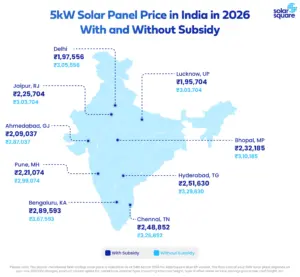
The cost of installing a rooftop solar system in India in 2026 depends on several factors, including system size, your city, DISCOM charges, and the type of solar components you choose. For example, a 2 kW solar system that costs ~Rs. 93,000* after a subsidy in Lucknow is priced at ~Rs. 1.53 lakh* in Bangalore.
Here’s a tabulated snapshot of the cost of installing rooftop solar in India with subsidy across different cities:
| Solar System Size | Cost of Rooftop Solar Panels in India for Homes with Subsidy (Starting Price – Indicative for Base Variant) as of 25th June 2026* |
| 2 kW solar system | Ranges between ~Rs. 93,000 in Lucknow, ~Rs. 1.20 lakh in Ahmedabad, ~Rs. 1.23 lakh in Pune, and ~Rs. 1.53 lakh in Bangalore |
| 3 kW solar system | Ranges between ~Rs. 1.05 lakh in Lucknow, ~Rs. 1.32 lakh in Ahmedabad, ~Rs. 1.37 lakh in Pune, and ~Rs. 1.69 lakh in Bangalore |
| 4 kW solar system | Ranges between ~Rs. 1.62 lakh in Lucknow, ~Rs. 1.75 lakh in Ahmedabad, ~Rs. 1.82 lakh in Pune, and ~Rs. 2.15 lakh in Bangalore |
| 5 kW solar system | Ranges between ~Rs. 2.19 lakh in Lucknow, ~Rs. 2.32 lakh in Ahmedabad, ~Rs. 2.45 lakh in Pune, and ~Rs. 3.05 lakh in Bangalore |
| 10 kW solar system | Ranges between ~Rs. 4.72 lakh in Lucknow, ~Rs. 4.95 lakh in Ahmedabad, ~Rs. 5..05 lakh in Pune, and ~Rs. 5.72 lakh in Bangalore |
*Please note prices are subject to change without prior notice. The solar panel price for on-grid solar systems with subsidy listed in the section above is indicative as of 25th June 2026 for SolarSquare Blue 6ft variant. The final cost of solar panels for homes in India depends on your city, DISCOM charges, product variant opted for, type of panel, inverter type, mounting structure height, type of after-sales service, savings guarantee, roof height, etc.
Cost of Rooftop Solar vs Solar Savings and ROI Over 25 Years
Investing money in rooftop solar in India is not an expense but an investment. We’re not making it up. Installing a solar system means getting free solar electricity for 25 years. It results in massive savings as your reliance on grid electricity drops sharply, lowering bills by 90% or more. When compounded over years, the savings from solar are in tens of lakhs of rupees
Don’t believe us?
Let’s give you the details of how much money a rooftop solar system saves for you in a city like Pune. Have a look.
| Solar System Size | Cost of Solar Panels for Homes in India’s Pune with Subsidy (Starting Price – Indicative for Base Variant) as of 25th June 2026* | Savings From Solar Panels for Homes Over 25 Years with SolarSquare as Your Solar Company in India* | Return on Investment (ROI) |
| 2 kW | ~Rs. 1.23 lakh | ~Rs. 10.74 lakh | ~7.8x |
| 3 kW | ~Rs. 1.37 lakh | ~Rs. 16.12 lakh | ~10.7x |
| 4 kW | ~Rs. 1.82 lakh | ~Rs. 21.49 lakh | ~10.8x |
| 5 kW | ~Rs. 2.45 lakh | ~Rs. 33.46 lakh | ~12.6x |
| 10 kW | ~Rs. 5.05 lakh | ~Rs. 66.93 lakh | ~12.3x |
*Please note prices are subject to change. The above-mentioned cost of solar panels for homes in Pune with subsidy for on-grid solar systems is indicative as of 25th June 2026 for the SolarSquare Blue 6ft variant. The final solar panel cost for homes in Pune depends on your DISCOM charges, product variant opted for, panel type, inverter type, mounting structure height, type of after-sales service, savings guarantee, roof height, etc. Also, while calculating savings from household solar panels in Pune, we have considered an annual tariff escalation of 3% and an annual plant degradation rate of 1%. The actual final savings from a solar panel system for homes depend on the types of solar panels you’ve installed and their efficiency, intensity of sunlight your rooftop receives, orientation of the panels and tilt angle, the pollution level and weather conditions in your city, the temperature, shadow on the roof, impact of dirt/dust, and how well you maintain your panels after installation.
If you’re not from Pune but would still like to get an idea of how much you can save by going solar, we can help you. Use SolarSquare’s free solar energy estimator to calculate your savings.
Conclusion
The SBI solar loan scheme is one of the most affordable solar financing options in India. With interest rates starting at 5.75% per annum for loans up to Rs. 2 lakh, a repayment tenure of up to 10 years, and zero foreclosure charges, it is best for homeowners who prioritize affordability.
However, concessional pricing at SBI comes with conditions. Mandatory Jan Samarth registration, branch-level documentation, physical inspection, and a 15-30-day approval timeline make the process compliance-heavy. Additionally, since the loan is offered at reduced interest rates, the subsidy is adjusted within the loan rather than given to the customer separately.
For any further information about rooftop solar installation and solar financing in India, you can book a free solar consultation call with SolarSquare
FAQs
Which bank is best for a solar loan?
SBI is among the best banks for a solar loan in India because it offers one of the lowest interest rates in the market, starting at 5.75% per annum for loans up to Rs. 2 lakh. It also offers a repayment tenure of up to 10 years, a 6-month moratorium, and zero processing or foreclosure charges.
Another great option for faster processing is SolarSquare’s zero-investment loan, which lets customers completely avoid paying the down payment out of their own pockets
What is the SBI solar loan interest rate?
The SBI solar loan interest rate is 5.75% per annum for loans up to Rs. 2 lakh. For loans above this amount, the interest rate is 8-9% per annum
What is the maximum amount of the SBI Surya Ghar loan?
The maximum loan amount that SBI offers for solar installation under the PM Surya Ghar scheme is Rs. 10 lakh for a tenure of a maximum of 10 years.
What is the processing fee for the SBI solar loan scheme?
The SBI solar loan scheme does not charge any processing fee. If you meet the eligibility criteria, your loan will be sanctioned without processing charges.
Can I pay off my solar loan early?
Yes. The SBI solar loan scheme does not charge any foreclosure or prepayment penalty. You can repay the loan before the end of the tenure without paying additional fees.