

Installing rooftop solar for hospitals can cost ~₹30,000* to ~₹50,000* per kW, depending on the system design and installation requirements. Hospitals can benefit from solar through lower electricity expenses because they consume substantial power throughout the day for air conditioning, diagnostic equipment, laboratories, kitchens, laundries, and administrative facilities.
*Please note that prices are subject to change: The above-mentioned commercial rooftop solar installation cost is indicative and not fixed. The final cost of hospital solar panels can vary based on the type of solar panels you use, the type of solar inverter you choose, the type of solar system you install, whether or not you use a battery energy storage system, mounting structure height, type of after-sales service, roof height, etc.
Solar reduces electricity expenses by generating power during high-consumption daytime hours. When paired with a suitably designed Battery Energy Storage System (BESS), solar panels for hospitals can also provide backup for selected critical loads.
This guide explains how solar energy for hospitals works, what different system sizes cost and generate, expected savings and Return on Investment (ROI), and what hospitals should assess before installing solar.
Why Are Hospitals in India Going Solar?
Hospitals are well-suited for solar because they consume substantial electricity during the day and have high operating expenses. A rooftop solar system can reduce dependence on costly grid electricity, make long-term energy expenses more predictable, and support sustainability goals.
The principal reasons behind the growing number of hospitals with solar panels include:
- Hospitals have large, predictable daytime loads: Air conditioning, ventilation, laboratories, imaging equipment, administrative facilities, kitchens, and laundries consume significant power while solar panels generate electricity.
- Electricity is a major controllable operating expense: Hospitals cannot reduce essential clinical services to save power. Solar lets them lower electricity costs without limiting hospital operations.
- Sustainability is becoming an institutional priority: Solar can reduce the emissions associated with grid electricity and support the hospital’s Environmental, Social, and Governance (ESG) commitments.
- Hospitals must prepare for emergencies: A properly designed solar system with battery storage can support selected critical loads during grid failures. The level of independence depends on battery capacity, backed-up load, and outage duration.
NABH and JCI Accreditation: The Compliance Bonus
The National Accreditation Board for Hospitals and Healthcare Providers (NABH) encourages healthcare organizations to consider climate resilience, resource efficiency, and environmental sustainability. Joint Commission International (JCI) standards also require hospitals to plan for safe and reliable facility operations.
Although solar installation does not automatically earn a hospital NABH or JCI accreditation, each organization has developed its own framework.
- The official NABH Guidebook for Climate Action and Sustainability in Healthcare specifically recommends considering solar panels after assessing the facility’s load-bearing capacity. It also asks hospitals to monitor energy consumption and establish measurable sustainability benchmarks.
- The guidebook provides real examples of these benefits. According to a case study in the guidebook, a 75 kW rooftop solar system at the 1,000-bed Gujarat Cancer & Research Institute generates ~82,000 units annually. At an electricity rate of ₹9 per unit, NABH reports estimated annual savings of ₹7.38 lakh and an annual carbon reduction of ~75.44 metric tonnes.
- NABH also offers a separate Self Certification Programme for Climate Change Resilience and Sustainability in Healthcare.
Similarly, JCI offers a separate Healthcare Sustainability Certification covering environmental resource use, green operations, sustainability reporting, and infrastructure resilience.
How Does a Solar Power System Work in a Hospital?
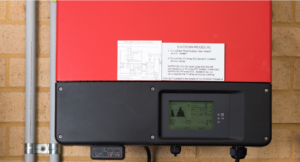
Solar panels for hospitals generate Direct Current (DC) electricity from sunlight. An inverter converts it to Alternating Current (AC), which the hospital’s electrical network uses. The grid, battery, or diesel generator (DG) supplies the balance when solar generation cannot meet demand.
Let us find out how solar energy used in hospitals responds under different operating conditions.
What Happens When Solar Generation Is Lower Than Hospital Demand?
The hospital consumes all the electricity produced by the solar system and draws the remaining requirement from the grid. For example, if the hospital requires 150 kW and the panels are producing 80 kW, solar supplies 80 kW while the grid supplies the remaining 70 kW.
Because hospitals generally have high daytime loads, they can often consume a large share of their solar generation directly.
What Happens When Solar Generation Exceeds Immediate Demand?
Surplus solar electricity may be exported to the grid under the applicable net-metering or net-billing arrangement. It may also be used to charge a battery if the hospital has a hybrid solar system.
The treatment and value of exported electricity depend on the state, Distribution Company (DISCOM), consumer category, system capacity, and applicable regulations.
What Happens at Night?
Solar panels do not generate electricity at night. The hospital therefore draws power from the grid, battery, or diesel generator, depending on the system configuration.
A standard solar system should not be sized under the assumption that daytime generation can directly serve the hospital’s complete 24-hour load.
What Happens During a Power Cut?
A standard on-grid solar system shuts down during a grid failure because of anti-islanding protection. This prevents the system from feeding electricity into a grid that maintenance personnel may believe is inactive.
- For solar-supported backup, the hospital needs a hybrid system with BESS and correctly segregated backup loads.
- Existing Uninterruptible Power Supply (UPS) and diesel generator systems may also remain part of the emergency-power arrangement and can be synchronized with solar.
What Size Solar System Does a Hospital Need?
The required capacity cannot be determined from bed count alone. An installer must assess the hospital’s historical consumption, daytime load, critical loads, sanctioned demand, available installation area, grid regulations, and future expansion before recommending a system size.
For an accurate assessment, the installer should review:
- At least 12 months of electricity bills
- Daytime and nighttime consumption
- Maximum demand and sanctioned load
- Critical and non-critical loads
- Existing UPS and diesel generator capacity
- Available shadow-free rooftop area
- Parking areas suitable for solar carports
- Net-metering or net-billing rules
- Planned beds, equipment, or building additions
How Much Do Solar Panels for Hospitals Cost in India?
The cost of solar panels for hospitals depends on plant capacity, module and inverter selection, mounting structure, roof conditions, electrical integration, battery requirements, and after-sales service. As a benchmark, solar panel installation for hospitals in India can cost between ~₹30,000* per kW and ~₹50,000* per kW.
The following estimates can be used for preliminary planning:
| Solar Capacity | Indicative Cost* | Approximate Annual Generation** | Approximate Area Required |
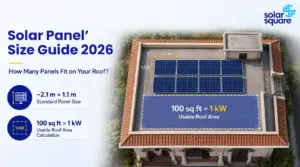
| 50 kW | ~₹15 lakh to ~₹25 lakh | 70,000 to 72,500 units | 5,000 square feet of shadow-free area |
| 100 kW | ~₹30 lakh to ~₹50 lakh | 1.40 lakh to 1.45 lakh units | 10,000 square feet of shadow-free area |
| 200 kW | ~₹60 lakh to ~₹1 crore | 2.80 lakh to 2.90 lakh units | 20,000 square feet of shadow-free area |
*Please note that prices are subject to change: The solar installation cost listed in the section above is indicative and not fixed. The final solar panel hospital project cost can vary based on system capacity, site conditions, taxes, and approvals. Domestic Content Requirement (DCR) and non-DCR modules may differ in cost by about 15%. String inverters and optimizer-based systems may differ in cost by ~10% to 15%. The cost also changes with the industrial solar system design, mounting structure height, roof height, installation complexity, and after-sales service. Adding a BESS can increase the project cost by almost 50% in some configurations. The actual increase depends on the critical load, required backup duration, battery chemistry, inverter capacity, and redundancy.
**Please note: The generation estimates use a benchmark of 1,400 to 1,450 units per kW per year. Actual generation can vary with local solar irradiance, weather, seasonal changes, air pollution, dust, orientation, tilt, shading, equipment efficiency, installation quality, solar system servicing frequency, and rooftop conditions.
Which Hospital-Specific Requirements Can Increase the Cost?
A hospital installation may require more specialized engineering than an ordinary commercial project. Additional costs may arise from:
- Structural strengthening
- Elevated mounting structures
- Solar carports
- Complex cable routing
- Modifications to High Tension (HT) or Low Tension (LT) panels
- Transformer or protection-system upgrades
- Integration with existing UPS and diesel systems
- Critical-load segregation
- Battery storage
- Remote monitoring
How Much Can a Hospital Save With Solar?
Hospitals with strong daytime demand can generally consume more solar power directly, increasing the value of every unit generated. Estimates indicate the following potential lifetime savings:
| Solar Capacity | Lifetime Savings From Rooftop Solar Systems Over 25 Years* |
| 50 kW | ~₹1.5-2 Cr |
| 100 kW | ~₹2-2.5 Cr |
| 200 kW | ~₹7 Cr |
*Please note: The lifetime savings listed above are indicative estimates and not guaranteed returns. While calculating lifetime savings, we have considered a tariff escalation rate of 3% YoY, an annual plant degradation rate of 1% in the 1st year (0.45% YoY from year 2 onwards), the plant’s maintenance/servicing cost, and an accelerated depreciation of 40% YoY. Actual final savings depend on your electricity tariff and how fast it rises over the years, the generation your site achieves based on irradiance level, orientation and tilt angle, panel performance, whether the system is set up behind the meter or net metered, the quality of panels, inverters, and other materials used, maintenance and plant uptime, and the financing model you choose.
What Is the ROI and Payback Period for Hospital Solar?
ROI measures the financial return relative to the investment, while the solar payback period estimates how long the accumulated savings will take to recover the project cost. Both depend on project cost, tariff, generation, self-consumption, financing, and tax treatment.
Here’s a snapshot of indicative returns and payback period for different capacities:
| System Size | Return on Investment (ROI) | Solar Payback Period for Systems with Non-DCR Solar Panels |
| 50 kW | 22-24% | 3 to 4 years |
| 100 kW | 22-28% | 3 to 4 years |
| 200 kW | 35-43 % | 2 to 4 years |
Please note: For systems using DCR modules, the payback period may extend to 5 years because of the higher initial cost. These figures are indicative and should not be treated as guaranteed returns.
Why Can the Payback Period Differ Between Hospitals?
The payback period becomes shorter when a hospital has high daytime consumption, a high electricity tariff, strong direct self-consumption, and consistent system generation. It can become longer when the project requires structural work, complex electrical integration, expensive financing, substantial battery storage, or receives low compensation for exported electricity.
The final payback calculation should therefore use the hospital’s actual tariff, consumption pattern, financing cost, site conditions, and proposed system design rather than a general industry benchmark.
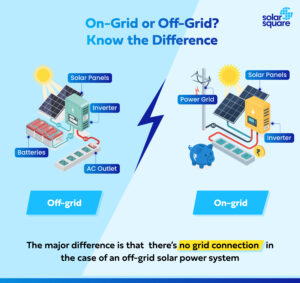
On-Grid vs Off-Grid vs Hybrid: Which Solar System Is Best for a Hospital?
A hybrid solar system is generally the best option for hospitals that want both electricity savings and battery-supported backup. However, the final choice depends on grid reliability, existing UPS and diesel generator infrastructure, critical loads, required backup duration, and available budget.
- An on-grid system is usually the most economical for reducing electricity expenses.
- An off-grid system requires enough generation and storage to operate without dependable grid supply. It may be suited only for areas where the grid supply is either unavailable or very unreliable.
- A hybrid solar system combines solar, grid electricity, and battery storage.
Here’s a side-by-side comparison of all three options:
| System Type | Reduces Grid Consumption | Works During a Power Cut | Battery Required | Best For |
| On-grid solar system | Yes | No | No | Hospitals with a reliable grid and existing emergency backup |
| Off-grid solar system | Yes | Yes | Yes | Remote healthcare facilities without a dependable grid |
| Hybrid solar system | Yes | Yes | Yes | Hospitals requiring a solar-supported backup |
CAPEX vs OPEX: How Should a Hospital Finance Solar?
Hospitals can purchase and own the solar plant through the Capital Expenditure (CAPEX) model or obtain solar electricity through an Operational Expenditure (OPEX) arrangement. The correct model depends on available capital, tax position, roof ownership, and long-term plans.
Under CAPEX:
- The hospital pays the project cost.
- The hospital owns the solar plant.
- The hospital receives the full electricity savings.
- Maintenance is handled by the hospital or through an Annual Maintenance Contract (AMC).
- The model can provide stronger long-term returns when capital is available.
Under OPEX:
- A solar developer funds and owns the system.
- The hospital purchases solar electricity under a long-term Power Purchase Agreement (PPA).
- The developer usually handles operations and maintenance.
- The hospital must review the tariff, escalation, contract period, exit conditions, and roof-use rights.
For a detailed comparison, you can also check out the blog, RESCO vs CAPEX Solar: Which Model Makes More Sense for Your Business?
Are Subsidies Available for Hospital Solar Systems in India?
Private commercial hospitals, just like other commercial properties, do not receive the residential rooftop solar subsidy available under the PM Surya Ghar Muft Bijli Yojana.
Government hospitals and public health facilities may have their solar installations fully or partly funded through state government programs, public procurement, National Health Mission initiatives, or Corporate Social Responsibility (CSR) projects. This is different from receiving a standard rooftop solar subsidy. Funding availability depends on the hospital’s ownership, location, and the programs operating at the time.
What Operational Challenges Must Hospitals Address During Solar Installation?
Solar installation in an operating hospital must be planned without disrupting clinical services, emergency systems, or access to essential facilities. The work schedule, safety controls, and shutdown procedures should therefore be agreed upon before equipment reaches the site.
Important operational challenges include:
- Scheduling electrical shutdowns without interrupting critical services
- Maintaining access to emergency exits, fire routes, and rooftop services
- Controlling dust, noise, and debris near occupied clinical areas
- Coordinating contractor access and hospital security requirements
- Protecting roof waterproofing during installation
- Keeping ventilation outlets, water tanks, and medical-service equipment accessible
- Managing work permits and electrical isolation procedures
- Coordinating roof repairs during the system’s operating life
- Establishing responsibility for monitoring alarms and system faults
Questions Hospital Management Should Ask Before Approving the Project: A Final Checklist
A hospital should understand the assumptions behind the proposed cost, capacity, and financial returns before approving the installation.
Important questions you should ask the installer include:
- How much of the hospital’s consumption will solar offset?
- How was the recommended capacity calculated?
- What electricity tariff has been used in the savings model?
- How are exported units valued?
- Which net-metering or net-billing regulations apply?
- Does the system operate during a grid failure?
- Which loads will receive battery backup?
- How will solar interact with existing UPS and diesel generator systems?
- What is included and excluded from the quoted price?
- Is structural strengthening required?
- What happens if the roof requires repair?
- Who monitors generation?
- Is live system tracking included?
- What are the service-response times?
- Which assumptions support the payback figure?
- If I want to scale the solar capacity, is it possible?
How to Choose a Solar Installation Partner for a Hospital?
A hospital should choose an installer that can handle the project from the initial load assessment to installation, grid approvals, monitoring, and after-sales service. The installer must also understand how solar will interact with the hospital’s existing electrical and backup infrastructure.
SolarSquare, for instance, provides end-to-end support for commercial rooftop solar projects at hospitals, beginning with an assessment of the hospital’s electricity consumption, available installation area, and existing electrical infrastructure. Based on this assessment, we can recommend a system capacity suited to your hospital’s daytime demand, roof conditions, and financial objectives.
Book a free consultation with SolarSquare to assess your hospital’s solar potential and receive a system recommendation based on actual electricity consumption and available installation area.
Frequently Asked Questions
Which hospital loads need uninterrupted power?
Critical loads may include ICUs, OTs, ventilators, emergency departments, blood banks, medicine refrigeration, essential communication systems, and medical-gas equipment.
Can solar panels run an ICU or operation theatre?
Yes. Solar can supply ICU and operation theater loads when the system’s available output matches their demand. Because these departments require uninterrupted electricity, their circuits must also remain connected to a properly coordinated UPS, battery storage system, diesel generator, or another compliant emergency-power source during outages.
Can a hospital replace its diesel generator with solar panels?
A hospital with a sufficiently sized BESS may be able to replace or substantially reduce diesel generator use for defined loads and outage durations. The decision requires a detailed assessment of critical demand, backup duration, battery redundancy, system maintenance, and applicable emergency-power requirements.
How often should a hospital solar system be maintained?
Panels in polluted areas or near regular emissions may require cleaning approximately once every two weeks. Under ordinary conditions, cleaning once every three weeks or once a month may be sufficient. Monitoring data and actual soiling should determine the final schedule.
How much does battery storage add?
Battery storage can increase the complete project cost by almost 50%. The actual increase can vary, depending on the backed-up load, required duration, battery chemistry, usable capacity, hybrid inverter, redundancy, and installation requirements.