

Even when solar reduces your energy charges to ₹0, your bill may still show ₹250 in fixed and meter charges. A non-zero bill after solar could also be a result of increased electricity use, incorrect system sizing, shade, poor servicing, nighttime consumption, and seasonal changes.
The realization that the electricity bill may not be ₹0 because certain fixed meter charges remain payable disappoints many homeowners. However, in reality, a non-zero solar bill doesn’t automatically mean the panels are defective or the installer made a mistake.
This blog explains the seven biggest reasons why a solar panel electricity bill isn’t always necessarily ₹0, and helps you identify what may be affecting your solar panel savings.
Is It Normal to Receive an Electricity Bill After Installing Solar Panels?
Yes, receiving an electricity bill after installing even modern high-efficiency solar panels can be normal. Rooftop solar primarily reduces the electricity units you purchase from the grid. Fixed charges, meter rentals, and other approved charges may continue, while consumption not offset by solar generation remains billable.
You must understand that a non-zero bill is not necessarily a high bill.
- A small payable amount consisting only of fixed or statutory charges may be normal.
- However, substantial energy charges need further investigation.
Your actual solar power savings depend on system size, solar generation, household consumption, and the metering arrangement applicable to your connection.
Here’s a snapshot of the multiple situations that may result in a non-zero bill:
| Situation | What Does it Usually Mean? |
| Energy charge is close to zero, but a small amount remains | Fixed or other non-energy charges are payable |
| Energy charges remain high | Solar generation is not fully offsetting your home energy consumption |
| Bill is almost unchanged from before solar | Check system operation, metering, and billing |
| Bill is high only during certain months | Seasonal generation or seasonal consumption may be responsible |
What Solar Can Offset on Your Bill
Solar electricity used directly in your home reduces the electricity you need to import from the grid. When the rooftop solar system generates more electricity than the home needs at that moment, the surplus may be exported to the grid through a bidirectional net meter.
The exported units, or their monetary value, are adjusted under applicable state regulations and metering arrangements. As a result, solar energy savings primarily affect the energy or variable charges on your bill.
Why Is My Electricity Bill Still High After Solar? 7 Real Reasons
A high electricity bill after solar usually comes from charges solar cannot offset, higher household consumption, or lower-than-expected solar generation. The 7 common reasons are fixed charges, overuse, incorrect sizing, shade, poor solar panel servicing, nighttime consumption, and seasonal generation changes.
Let’s understand all 7 reasons in detail here –
#1. Fixed Charges and Other Approved Charges Remain Payable
A grid-connected home continues using the DISCOM (distribution companies) network for electricity imports, exports, and supply availability. Therefore, certain charges may remain payable even when solar reduces the energy charge substantially.
Depending on the state, DISCOM, tariff category, and connection type, these may include:
- Fixed or customer charges
- Meter rental
- Sanctioned-load or demand charges
- Electricity duty or taxes
- Fuel-adjustment or regulatory charges
- Previous arrears
- Late-payment surcharge
For example, if solar reduces your energy charge to ₹0 but the bill contains ₹250 in fixed and meter-related charges, the final payable amount will still be ₹250. This does not necessarily indicate poor solar performance.
#2. Your Electricity Consumption Increased After Installing Solar
Some homeowners use more electricity after installing solar because they assume the photovoltaic system produces free, unlimited power. However, every rooftop solar system has a limited generation capacity.
Your consumption may increase if you:
- Run multiple air conditioners for longer
- Add more air conditioners
- Start charging an electric vehicle
- Install an electric geyser
- Shift to induction cooking
- Add a water pump or another heavy appliance
- Have more people working or living at home
Once household consumption exceeds the electricity supplied and adjusted by the solar system, the remaining requirement comes from the grid.
#3. Your Solar System Was Not Sized for Your Actual Requirement
A 3 kW system cannot produce the same solar power savings for every home. Select system capacity based on annual electricity consumption, monthly peaks, local solar potential, available roof area, and expected future loads.
A system may be undersized when it is designed using only one or two electricity bills.
- Consumption can change significantly across summer, winter, and monsoon months.
- Roof limitations, sanctioned load, or budget may also limit the capacity you can install.
Suppose your household consumes 600 units in a month, while the system generates 400 units. Even with an effective adjustment, 200 units remain uncovered.
An undersized rooftop solar system does not necessarily mean it is defective.
- It may have been designed to offset only part of your annual consumption.
- Review the generation estimate and compare annual consumption with annual generation before drawing a conclusion.
You can watch SolarSquare’s video for a detailed breakdown on the right rooftop solar system sizing.
#4. Shadow Is Reducing Your Solar Panel Generation
Even partial shade can reduce solar generation. Depending on the system design, shade falling on one panel may also affect other panels connected to the same string.
Common sources of shade include:
- Water tanks
- Parapet walls
- Trees
- Nearby buildings
- Poles and towers
- Satellite dishes
- Other panel rows
- New construction near the property
Shade patterns also change during the day and across seasons. A roof that appears clear at noon in summer may experience longer shadows during winter mornings or evenings.
Microinverters should be considered for shaded or complex roofs, depending on the shade pattern, roof design, and technical assessment.
#5. Improper Panel Servicing Is Reducing System Output
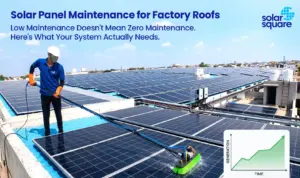
Solar panels have no moving parts, but that does not make the entire solar system free from servicing and maintenance. Dust, bird droppings, leaves, and other deposits can block sunlight and reduce generation. The extent of the loss depends on the location and the amount of soiling.
Homes close to busy roads, construction sites, open fields, or dusty and polluted areas may need more frequent solar inspection, cleaning and servicing. Rain can remove loose dust, but it may not remove stubborn deposits.
Proper solar panel servicing should include:
- Inspecting panels for dust, debris, and bird droppings
- Cleaning solar panels according to site conditions
- Checking the mounting structure
- Reviewing inverter alerts
- Checking exposed cables for visible damage
- Comparing actual generation with expected generation
- Arranging periodic professional electrical inspections
Please note: Avoid abrasive tools, harsh chemicals, and high-pressure water near electrical equipment. Do not walk on panels or open electrical enclosures yourself. Do not treat panel cleaning and servicing as a DIY (Do It Yourself) task. Only professionals have the right tools, skills, and safety gear to clean a rooftop solar system that generates direct current (DC) power.
A gradual decline in generation may indicate soiling or maintenance/servicing issues. A sudden drop, however, may point to an inverter, breaker, wiring, or string fault.
#6. Your Electricity Use Does Not Match Solar Generation Hours
Solar panels generate electricity during the day, while many households consume heavily in the evening and at night. Whether this mismatch increases your bill or not, it depends on the approved metering arrangement and the way your DISCOM adjusts exported electricity against imported electricity.
- During the day, solar generation first powers the appliances running in your home. Surplus electricity may then be exported to the grid.
- At night, an on-grid solar system imports electricity because its panels are not generating power.
Under a conventional solar net metering arrangement, eligible daytime exports may offset nighttime imports according to the applicable settlement rules.
However, consumption timing can affect savings more directly, when:
- Net billing applies
- Exported units receive a lower value than imported units
- Time-of-day (ToD) tariffs apply
- Export credits expire or are settled periodically
- Export is restricted
- The system is designed mainly for self-consumption
Where suitable, flexible loads such as washing machines, water pumps, dishwashers, or EV (electric vehicle) chargers can be operated during solar-generation hours. However, do not run several heavy appliances together if their combined load exceeds the system or electrical connection’s safe limits.
#7. Solar Generation Changes with the Season
A rooftop solar system does not generate the same number of units every month. Output changes with daylight hours, cloud cover, rainfall, sun angle, temperature, and local weather.
- Generation may fall during cloudy or monsoon periods.
- Shorter winter days can also reduce output in certain locations.
- Extremely high panel temperatures can reduce the operating efficiency of the panels even when sunlight is strong.
This means a bill may rise during a low-generation month without indicating a system fault. Consumption can also rise seasonally. For example, heavy AC use in summer or water-heating needs in winter can widen the gap between generation and consumption.
Therefore, a higher bill during one low-generation month does not necessarily indicate a system fault. Solar savings and system performance should be evaluated using longer-term generation and consumption data.
Why Should Solar Performance Be Evaluated Annually?
Monthly bills can fluctuate considerably, so annual data provides a more reliable performance assessment. Compare actual annual generation with the installer’s projection and examine whether household consumption has changed. Also check how your DISCOM carries forward or settles eligible export credits.
You can use SolarSquare’s free solar savings calculator to get an estimate of the lifetime savings you can receive from a rooftop solar system in your city.
How to Compare Seasonal Performance Correctly?
Do not compare a monsoon month with the system’s strongest summer month. Here’s what you should compare instead :
- The current month with the same month in the previous year
- Actual generation with the installer’s month-wise estimate
- Sunny days with other similarly sunny days
- Annual generation with projected annual generation
- Changes in consumption alongside changes in generation
Also, don’t compare total inverter generation with grid export because some of the generated electricity may have been consumed directly in your home.
How Can You Find Which of the Seven Reasons Is Affecting Your Bill?
Begin by separating fixed charges from energy charges. Then compare your current consumption, solar generation, grid imports, and exports. These figures can show whether normal fixed charges, increased consumption, an undersized system, or reduced generation cause the payable amount.
Here’s a snapshot to help you identify which of the 7 reasons could be behind a non-zero solar bill:
| What You Observe | Most Likely Explanation |
| Energy charge is nearly zero, but a small amount remains | Fixed charges or meter rental |
| Solar generation is normal, but grid imports increased | Household consumption increased |
| Generation has consistently remained below consumption | The system may be undersized |
| Output drops at similar times on sunny days | Shading may be affecting the panels |
| Output has gradually reduced | Soiling or solar panel servicing may be responsible |
| Most consumption occurs after sunset | The consumption pattern may affect savings |
| Generation falls during cloudy or monsoon months | Seasonal variation |
If the observations do not match any of these seven causes, the problem may lie outside normal consumption and generation patterns.
What If None of These Seven Reasons Explains the High Bill?
If consumption and generation appear normal but the electricity bill remains unusually high, check the net meter, inverter, and DISCOM bill. Incorrect meter activation, a system shutdown, missing export readings, or an incorrect bill can produce unexpected charges.
Possible issues include:
- The bidirectional meter was installed but not activated
- The net meter was not mapped correctly to the consumer account
- The bill includes consumption from before solar commissioning
- Export units are missing
- Import and export readings were entered incorrectly
- Export credits were not carried forward
- The inverter or a breaker shut down
- One or more panel strings stopped producing
- The tariff category was entered incorrectly
- Previous arrears were added to the bill
How to Read Your Electricity Bill After Installing Solar?
Start by checking the billing period, meter readings, imported units, exported units, applicable solar adjustment, and fixed charges. Your inverter app and DISCOM bill may show different measurements, so their figures may not match exactly.
The main terms are:
- Import units: Electricity drawn from the grid
- Export units: Surplus solar electricity sent to the grid
- Self-consumed solar: Solar electricity used directly inside your home
- Net units: The units considered after the applicable adjustment
Use this relationship to understand the difference:
Total solar generation = Self-consumed solar electricity + Exported electricity
For example, total solar generation at your home is 250 units used directly and 150 units exported. In this case, the total generation is 400 units.
- The inverter app may show 400 units, while the solar panel electricity bill shows only 150 export units.
- The remaining 250 units were used directly and never passed through the meter as exports.
How DISCOMs bill solar panels and adjust exported electricity depends on state regulations and the approved metering arrangement. Always check whether your bill records actual readings and whether the billing period includes any days before commissioning.
Step-by-Step Checklist for Investigating a High Bill After Solar
Use this checklist to verify whether the issue relates to consumption, generation, metering, or billing:
- Separate the energy charges from fixed and other charges.
- Confirm the billing period and solar commissioning date.
- Compare the physical import and export readings with the DISCOM bill.
- Compare inverter generation with the installer’s month-wise estimate.
- Check the inverter for errors, shutdowns, or sudden output drops.
- Review whether export credits and solar adjustments were applied correctly.
- Collect meter photographs, bills, and inverter screenshots before contacting the installer or DISCOM.
When Should You Contact the Installer or the DISCOM?
Contact the installer when the problem concerns system generation, performance, or equipment. Contact the DISCOM when the problem concerns meter readings, solar-unit adjustment, billing, or the tariff applied to your connection.
Here’s a breakdown of the main reasons for which you should contact your installer:
- When the solar system’s generation is zero or nil in the inverter app
- When generation suddenly falls without a weather-related explanation
- When the inverter displays an error
- When panels need inspection or servicing
- When new shade is affecting the system
- When cables, connectors, or mounting components show visible damage
Here’s a breakdown of the main reasons for which you must contact your DISCOM:
- When you cannot see the expected benefit in your solar panel electricity bill
- When the correct import and export readings are not visible
- When you cannot see the solar adjustment units
- When export credits are missing
- When meter readings do not match the readings recorded by the physical smart meter
- When the net meter has not been mapped to your account
- When the wrong tariff category or billing period has been used
Keep copies of your bills, meter photographs, commissioning documents, inverter screenshots, and complaint numbers. These records can help the installer or DISCOM identify the issue faster.
How Can You Reduce Your Electricity Bill Further?
Focus on the issue identified during your investigation. This may involve correcting a billing error, addressing low generation, controlling increased consumption, or planning additional capacity for new electrical loads. Also, continue monitoring your monthly generation, grid imports, exports, and household consumption.
A properly sized and maintained PV (photovoltaic) system can produce substantial solar power savings, but the final result still depends on your consumption and local billing rules. Book a free consultation with SolarSquare to understand the right rooftop solar capacity for your home and build dependable long-term savings.
Frequently Asked Questions
What is the difference between right solar and wrong solar?
Right solar is designed around annual consumption, usable roof area, shade, local generation conditions, future loads, and applicable billing rules. Wrong solar may be incorrectly sized, poorly positioned, inadequately maintained, or unable to deliver the promised bill reduction.
How to check whether your solar system is undersized?
Compare the system’s expected annual generation with your annual electricity consumption. If consumption consistently exceeds solar generation even when the system operates normally, its capacity may be insufficient to deliver the bill reduction you expect.
How should a rooftop solar system be sized for near-zero bills?
Sizing should consider at least 12 months of electricity consumption, seasonal peaks, future appliances, usable shadow-free roof area, system losses, sanctioned load, and applicable DISCOM rules. A professional site survey is also required.
Why can shade affect more than one solar panel?
Solar panels connected to a conventional string inverter operate together as a string. Heavy shade on one panel can restrict the output of other panels in that string. The actual effect depends on system design, bypass diodes, shade conditions, and power electronics.
Can an incorrect electricity bill be revised after solar installation?
Yes, billing errors may be corrected after the DISCOM verifies the meter readings, commissioning details, tariff category, and solar adjustment. Keep photographs of the meter, previous bills, commissioning documents, and complaint numbers to support your request.
Does using electricity at night increase my solar bill?
It depends on the metering and tariff arrangement. Some DISCOMs apply time-of-day (ToD) tariffs to domestic connections, including in Madhya Pradesh and certain other states. In such cases, daytime and nighttime consumption rates can differ and affect the bill.
Can I add more panels if my electricity bill remains high?
Possibly, but additional panels should be considered only after checking consumption, existing generation, roof space, sanctioned load, inverter capacity, and DISCOM requirements. A high bill caused by metering or equipment problems will not necessarily be solved by adding more panels.
How to check whether my net meter is working?
Check whether the bidirectional meter displays separate import and export readings. Compare these readings with your electricity bill. If surplus generation is verified but export units remain absent, contact your installer and DISCOM for inspection.
Can a solar battery reduce my grid electricity bill?
A battery can store surplus solar electricity for use after sunset, but whether it improves financial savings depends on – battery cost, usable capacity, efficiency, electricity tariffs, and the metering arrangement. A battery is generally installed primarily for backup or increased self-consumption.