

 13 Reads
 13 mins


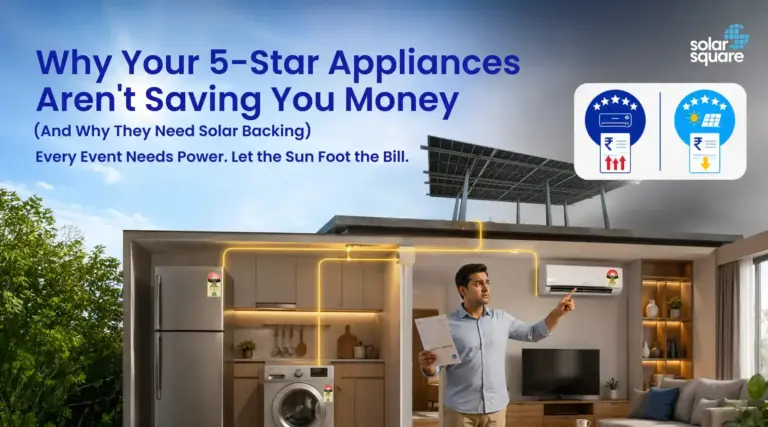
The minute you visit any mall or store to buy appliances, the first thing a salesperson recommends is 5-star appliances. According to them, 5-star appliances are more efficient and consume less electricity. Based on their promise and recommendations, you usually spend some extra money on the five-star appliances rather than any low-rated appliances.
Now you have spent more on that 5-star inverter AC and BEE (Bureau of Energy Efficiency)-rated refrigerator. You have switched every bulb in the house to LED (Light Emitting Diode). You even replaced the old ceiling fans with BLDC (Brushless Direct Current) ones.
Even after all this, is your electricity bill still high?
If yes, you are not alone, and you are still on the right path. You just need an upgrade. The problem is not your appliances. The problem is a gap that most people never talk about when they are standing in a showroom reading energy labels.
5-star appliances are more efficient than their lower-rated counterparts; that part is true. But efficient appliances still consume electricity. They just consume less of it. And when that electricity costs ~₹7 to ₹10 per unit and keeps climbing every year, even a well-optimised home ends up with a bill that stings.
This is when rooftop solar is emerging as a solution to combat rising electricity rates. In this blog, we will discuss more about 5-star appliances, how solar energy for the home works, subsidies, and why SolarSquare is the best choice.
What the BEE-Star Rating Actually Means?
The BEE star rating is nothing but the rating provided by the Bureau of Energy Efficiency to appliances on a scale of 1 to 5. Bureau of Energy Efficiency is an Indian government agency under the Ministry of Power. The agency is responsible for setting norms and standards for energy rating and works as an enforcement body. Five stars means the appliance is the most energy-efficient in its category. It uses less electricity to do the same job compared to a 1-star or 3-star model.
These ratings are genuinely useful. A 5-star 1.5-ton inverter AC consumes roughly ~0.9 to 1.2 units per hour, compared to a 3-star non-inverter model that can pull ~1.5 to 2 units per hour. Over a full summer season, that difference adds up.
One thing that nobody talks about is that a BEE-star-rated appliance still runs on grid electricity. Every unit it consumes still gets billed at your state’s commercial or domestic tariff. Every hour it runs, the meter moves. This is exactly where solar changes the equation:
- The units your AC or fridge pulls during the day get sourced from your own panels instead of the grid
- Your bill stops rising just because the tariff rate went up that year
- Running a 5-star appliance on solar power means you are saving twice, once on consumption and once on cost per unit
The star rating tells you how efficiently an appliance uses electricity. It says nothing about where that electricity comes from or what it costs you.
How Star Ratings Actually Affect Electricity Consumption: Appliance by Appliance
Most people assume that buying a 5-star appliance means their electricity bill will drop dramatically. The reality is a little more nuanced than that. Yes, higher-rated appliances consume less, but how much less depends entirely on the appliance type, how long it runs, and what it is doing.
In the table below, you can check the electricity consumption* by star rating of common Indian household appliances:
| Appliance | 1-Star Consumption | 3-Star Consumption | 5-Star Consumption |
| AC 1.5 Ton | 1.8- 2.0 units/hr | 1.3-1.5 units/hr | 0.9-1.1 units/hr |
| Refrigerator 250L | 480- 500 units/yr | 350-380 units/yr | 180-220 units/yr |
| Washing Machine 6kg | 0.8-1.0 units/wash | 0.6 -0.7 units/wash | 0.4-0.5 units/wash |
| Ceiling Fan | 70-80 watts | 55-65 watts | 28-35 watts |
| Water Heater / Geyser 15L | 2.0-2.5 units/hr | 1.6-1.8 units/hr | 1.2-1.4 units/hr |
| Microwave 20L | 1.4-1.6 units/hr | 1.1- 1.2 units/hr | 0.8- 0.9 units/hr |
| Television 43-inch | 120-150 watts | 90-110 watts | 60-75 watts |
| Air Cooler | 250-300 watts | 180-220 watts | 130-160 watts |
*Please note that the electricity consumption range provided for each appliance is approximate and varies by brand, model, usage pattern, and state tariff.
Why Are Your 5-star Appliances Not Saving You Money?
The appliances are not the only reason why electricity rates are getting high. Other factors like tariff rates and electricity usage are some of the other factors. You can check the reasons below:
Increasing Tariff Rates
The electricity tariffs in India have been rising consistently across every state for almost every consumer category. If you notice, what you paid per unit five years ago is less than what you pay today. What you pay today will almost certainly be less than what you will be paying five years from now.
This matters because every efficiency gain from a 5-star appliance is calculated against the current tariff. If the tariff goes up, your savings shrink in real terms even if you have not changed a single appliance or habit.
A household in Bangalore or Pune running a 5-star AC or refrigerator, LED lights, and BLDC fans can still end up with a lower monthly bill during peak summer than in cities like Delhi. In a city like Delhi, where summers are increasingly hot and ACs run longer, that number climbs further.
The efficiency is real. The savings compared to less efficient appliances are real. But the bill is still real, and it arrives every single month without fail.
The AC and Refrigerator Problem: Efficient, But Still Heavy
If you are running a 1.5-ton 5-star inverter AC, it runs at 1 unit per hour, which is better than the older fixed-speed models.
If you run it for 8 hours a day across a four-month summer, which is usual in most Indian cities, it will take roughly 960 units just from that one AC. At ₹8 per unit, that is ₹7,680 from a single appliance over four months.
Then there is the refrigerator, one of the few appliances in any home that runs continuously 24 hours a day, every day. A 5-star model is as efficient as a refrigerator gets. But multiply even 150 units per year by ₹8 per unit, and you are still paying ~₹1,200 a year just to keep food cold from a single, well-rated appliance. Run a larger 400-litre model, and that number roughly doubles.
Then the washing machine, the water heater, the microwave, the television, the router, and the phone chargers. All rated well. All still consuming.
The 5-star rating reduces how much each appliance pulls. It does not reduce the fact that every appliance is pulling.
The Usage Problem: Hours Matter More Than Stars
Here is something that does not get enough attention. The star rating tells you efficiency per hour of operation. It does not account for how many hours the appliance actually runs.
An AC set to 16°C and left running all night is going to cost significantly more than the same AC set to 24°C and used for six hours. A 5-star washing machine that is used daily costs more than a 3-star one used twice a week.
Usage behaviour shapes the bill more than most people realise. And as Indian summers get longer and hotter, usage hours are going up, not down. The AC that ran for four months now runs for five or six. The efficiency rating stays the same, but the bill climbs anyway.
Why is Solar a Good Backup for Home?
Going solar is a good option for homeowners, as the rooftop solar system does not care how efficient your appliances are. Solar panels work by generating electricity from sunlight and providing it to the home. Every unit your solar panels generate is a unit you do not buy from the grid.
Even if your 5-star AC runs at 1 unit per hour during the day, and your solar panels are generating 4 to 5 units per hour, your AC is running for free.
This proves that solar and efficient appliances work so well together. The electrical appliances reduce the amount of electricity required, whereas solar changes where the electricity comes from.
The PM Surya Ghar Subsidy Makes Solar Even More Accessible
PM Surya Ghar Muft Bijli Yojana is a central government subsidy of up to ₹78,000 for residential rooftop solar installations. For a 3-kW system, that cost is ~₹ 2 to ₹ 2.5 lakh* before subsidy; the effective cost after subsidy can come down to approximately ₹1.3 to ₹1.8 lakh*.
At that cost, and with monthly savings of ~₹ 2,000 to ₹4,000, the payback period sits between 2.5 and 4 years, after which you are generating electricity essentially for free for the next 20-plus years.
The most popular size for Indian homes is a 3-kW rooftop solar system. This system is eligible for the PM Surya Ghar subsidy. It generates approximately 12-15 units of electricity per day in most parts of India. That is 360 to 450 units per month.
The average Indian household running a 5-star AC, refrigerator, LED lights, fans, and basic appliances consumes between ~200 and 400 units per month, depending on location and usage.
A 3-kW system, in many cases, generates enough to cover most or all of that consumption during the day. What you draw from the grid in the evening gets offset through net metering, where surplus solar units generated during the day get credited against the evening grid consumption.
The result for many households after going solar includes monthly electricity bills that drop from ~₹ 3,000 to ₹ 6,000 to ~₹ 300 to ₹ 800. Some households get it to near zero.
*Please note that the above prices, with or without subsidy, are valid for a 3 KW system listed in the section above as of 13th July 2026 for the SolarSquare Blue 6ft variant. The final cost of installing an on-grid rooftop solar panel system for a home depends on your DISCOM charges, city, product variant opted for, panel type, inverter type, mounting structure height, type of after-sales service, savings guarantee, roof height, etc.
How SolarSquare Works Well with 5-star Appliances?
At SolarSquare, we believe that homes with well-chosen, efficient appliances and a correctly sized rooftop solar system get the best benefits. The efficient appliances help to reduce the required units, while the solar system ensures that electricity generated by panels offsets the required electricity consumption by the appliances.
The most important thing here is the correct-sized solar system. A correctly sized rooftop solar system can offset the home’s actual consumption.
SolarSquare’s site assessment looks at your actual bill data across 12 months, maps your consumption pattern, and recommends a system size that genuinely meets your needs. Not oversized to chase a bigger sale. Not undersized and leaving savings on the table.
Once installed, the monitoring dashboard shows you exactly what your panels generate, what your home consumes, and what the net savings are, updated every 15 minutes. For any further details, you can book a free solar consultation call with SolarSquare.
The Truth about 5-Star Appliance Salespeople Will Never Tell You
A 5-star appliance is way better than a 3-star appliance. If you are buying any new appliance, go for the higher rating. It actually provides long-term savings and appliances with better build quality.
One thing that most people get confused about is that a 5-star appliance running on expensive grid electricity is still running on expensive grid electricity. The star on the label reduces consumption. It does not change the cost of the electricity itself.
Installing rooftop solar is the only solution to change the cost of electricity. That is why people who choose solar for their homes see a bill drop. This bill drop is not because they suddenly started using less, but because a large portion of what they use is now coming from their own roof, for free.
Together, efficient appliances and solar form a combination that neither can achieve alone. Efficient appliances reduce how much power the home needs. Solar makes most of that power free. That is when the electricity bill genuinely starts looking different.
What we are really looking for is a solution so that the power we run on does not cost us more every year than the year before. That is what solar does. When efficient appliances and solar work together, the electricity bill stops being a problem you manage and starts being a number that barely registers.
Frequently Asked Questions
If I already have 5-star appliances, will solar still make a significant difference to my electricity bill?
Yes, solar can make a bigger difference than the appliances themselves. The appliances can only help you reduce electricity consumption, whereas solar changes the electricity costs. Even a home that has already optimised its appliances typically draws 200 to 400 units per month from the grid. A 3-kW solar system can generate enough to cover most of that consumption during daylight hours, with net metering handling the rest. The bill reduction is real and significant regardless of what appliances you already have.
My electricity bill is only around ₹ 1,500 to ₹ 2,000 a month. Does solar still make sense?
It depends on your usage pattern and how long you plan to stay in the property. At that consumption level, a smaller 1 kW to 2 kW system may be more appropriate than a 3 kW one. The PM Surya Ghar subsidy applies across all sizes, meaningfully reducing investment. At SolarSquare, we provide a proper site assessment to know whether the economics make sense for your specific situation, including an honest answer if they do not.
Do solar panels work well with inverter ACs specifically?
Yes. Inverter ACs and solar panels are actually a very good pairing. An inverter AC can adjust its compressor speed based on cooling needs. It does not switch on and off at full power, which means its power draw varies across the day rather than spiking constantly. Solar panels help to generate power that similarly varies all day. The AC draws what it needs, the panel supplies it, and the fluctuation in both tends to balance out during the day.
What happens at night when the solar panels are not generating? Do all my appliances stop?
No, your appliances continue to run normally. When solar panels are not generating, your home automatically takes power from the grid. The only difference is that your consumption is largely or fully covered by solar during the day, but at night you draw grid power. With net metering, the additional solar generation during the day gets back to the grid. It ensures the surplus amount gets credited against your nighttime grid consumption on your monthly bill.
Can solar fully eliminate my electricity bill?
Getting an electricity bill close to zero is possible in most households in India if the consumption is low and a correctly sized solar system is installed. Most households have seen a bill drop by 70-90% rather than reaching zero due to nighttime consumption, seasonal variation, and occasional high-usage days. Installing solar does not promise a zero bill, but a lower bill that stops being a concern.


 Previous Article
 15 min