

 9 Reads
 9 mins


Commercial and residential solar panels do the same basic job; they turn sunlight into electricity. But that’s really where the similarity ends. The difference between commercial and residential solar panels shows up in scale, panel type, system design, financing, and the approvals needed to get them running.
Residential solar panels are used in rooftop solar systems in homes, villas, and housing societies. Most rooftop solar in India uses half-cut Mono-PERC or TOPCon panels to maximize electricity generation. Commercial solar panels are used in offices, warehouses, and other industrial facilities and use 72 full-cell, 144 half-cut, and bifacial variants, with higher wattage per panel.
A homeowner looking into solar and a business owner evaluating the same thing aren’t actually looking for the same product, even though both technically fall under “rooftop solar.” A 3kW home system and a 300kW factory installation may have the same basic technology, but almost nothing else about how they’re planned, paid for, or approved looks the same.
In this blog, we’ll break down exactly what separates residential and commercial solar energy, based on panels and technology used, financing and investment, and approval required, so you know exactly which category you actually fall into.
Commercial vs Residential Solar Panels: Key Differences
The core differences between commercial and residential solar panels come down to eight things: system size, panel technology, roof space required, financing route, payback period, ownership model, regulatory approval, and metering type.
| Factor | Residential Solar | Commercial Solar |
| System size | 1 kW-10 kW | 20 kW to MW scale |
| Panel type | Mostly monocrystalline | Dual-glass or bifacial modules |
| Roof/land space | Household rooftops, villas, housing societies | Larger rooftop, warehouse, or open land |
| Financing | Loans, EMIs, subsidy-linked ownership | Capex, RESCO/OPEX, PPAs, group captive |
| Payback period | ~3-6 years | ~3-6 years |
| Ownership model | Homeowner-owned | Owned, leased, or third-party RESCO model |
| Regulatory approval | DISCOM net metering | Open access, gross/net metering, DISCOM |
| Metering type | Net metering | Net, gross, or open access metering depending on load |
This is really where the difference between commercial and residential solar panels becomes most concrete. On paper, both are “solar panels.” In practice, they’re built around completely different financial and regulatory realities.
What Is Residential Solar?
Residential solar refers to rooftop systems for individual homes, typically ranging from 1 kW to 10 kW. These systems are installed on residential buildings, villas, housing societies, and power household needs, including lights, fans, geysers, ACs, refrigerators, and other daily appliances.
Most residential installations in India run on net metering, where your panels’ surplus power gets credited back to the grid through your local DISCOM.
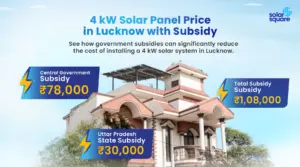
Under PM Surya Ghar Muft Bijli Yojana, the central government provides a subsidy up to ₹ 78,000 for a 3kW system or above. To avail the subsidy, your panels must be ALMM (Approved List of Manufacturers and Models)-listed and BIS (Bureau of Indian Standards)-certified. You can also avail an additional state subsidy in some states like Delhi, Rajasthan, and Uttar Pradesh.
What Is Commercial Solar?
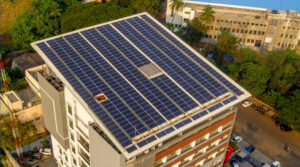
Commercial solar refers to larger-scale systems built for businesses, offices, factories, warehouses, or institutions. These typically start around 20 kW and can scale up to several megawatts for large industrial campuses.
Unlike a home, a commercial property usually carries heavier daytime loads, running machinery, HVAC (Heating, Ventilation, and Air Conditioning) systems, commercial refrigeration, and lighting across a much bigger footprint. Depending on load size and state policy, commercial solar can be set up through open access, group captive arrangements, or standard net or gross metering.
Commercial solar is ideal for businesses with high daytime electricity consumption and enough roof or ground space. This is where commercial solar panels vs residential setups start looking like genuinely different products, not just bigger versions of the same thing.
Difference in Panel Type and Technology Used
Residential systems usually lean on monocrystalline panels, high-efficiency PV modules made from a single, pure silicon crystal. Since home rooftops have fixed, limited space, getting the maximum output per square foot matters far more here than it does elsewhere, which makes monocrystalline the natural fit.
In 2026, most residential solar use high-wattage half-cut mono-PERC or TOPCon panels to reduce panel count and improve electricity generation from limited roof space.
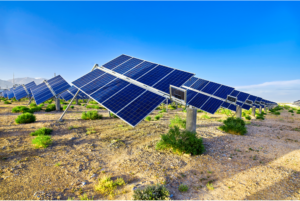
Commercial systems have more flexibility. With larger rooftops or open ground available, businesses can use a wider mix of technology, including bifacial panels or higher-capacity modules. Commercial solar systems commonly use 72 full-cell, 144 half-cut, and bifacial variants, with higher wattage per panel.
Inverter sizing and stringing configurations also differ significantly here; commercial setups usually run on three-phase power and handle much higher loads than a typical home connection.
Financing and Investment Differences
In India, solar financing mostly comes from three places:
- PSU banks like SBI and PNB: They offer concessional loans for residential rooftop solar systems under the PM Surya Ghar Muft Bijli Yojana. Most homeowners end up dealing with one of these banks first, simply because the scheme is built around them.
- NBFCs (Non-Banking Financial Companies): These offer quick, fully digital loans for homes, housing societies, and businesses, typically involved with a traditional bank.
- CAPEX and OPEX/RESCO models: Commercial solar works through a genuinely different set of financial levers. Businesses can choose CAPEX ownership, OPEX or RESCO (solar-as-a-service) models where a third party owns and maintains the system, power purchase agreements (PPAs), or group captive structures. But the single biggest financial lever for Indian businesses is accelerated depreciation. Under Section 32 of the Income Tax Act, 1961, commercial and industrial solar buyers can claim 40% depreciation on the Written Down Value of the system in the very first year, compared to just 15% for standard plant and machinery.
This is a big reason residential and commercial solar energy adoption looks so different on paper, even when the underlying panels are practically identical. A homeowner is thinking in terms of a subsidy and a solar EMI. A business is thinking in terms of depreciation schedules and tax planning.
Regulatory and Approval Differences
Residential installations generally go through a simpler path, standard DISCOM net metering approval, along with PM Surya Ghar subsidy eligibility for ALMM-listed systems.
Commercial solar carries extra layers. Depending on system size and structure, this can include open access approvals, higher-capacity net or gross metering rules, state-specific commercial solar policies, and in some cases, routing through DISCOM tenders for larger installations. Regulatory requirements have also tightened recently.
MNRE now mandates that all commercial and industrial solar projects, including open-access and net-metered rooftop installations, use modules exclusively from its ALMM List-II, effective from June 1, 2026.
Source: Ministry of New and Renewable Energy, ALMM Order
Open access allows larger consumers, typically above a state-defined load threshold, to buy power directly from a generator, including a solar developer, instead of only through their local DISCOM, in exchange for wheeling and cross-subsidy charges.
Group captive arrangements work a little differently, where multiple businesses jointly own a stake in a generating company and then draw its power at reduced rates.
Commercial and Residential Solar Panels in India: Where Things Stand Today
Under the PM Surya Ghar Muft Bijli Yojana, the government’s flagship residential scheme, installations have already crossed 50 lakh households as of mid-2026, and the target is to hit 75 lakh by December 2026, on the way to a full 1 crore homes by FY 2026-27.
Source: PIB: PM Surya Ghar Muft Bijli Yojana Update, June 2026
Under this scheme, homeowners can get a subsidy of up to ₹78,000 for a rooftop system up to 3 kW or above, as long as the installation uses ALMM-listed, government-approved panels. This single push has made residential solar far more accessible than it was even a couple of years ago, and it’s a big reason home installations are growing so fast.
Commercial solar runs on a single subsidy scheme the way residential does. Instead, businesses lean on open access, group captive setups, and CAPEX or RESCO financing models, and from June 2026, all new commercial and industrial installations also need to use panels from MNRE’s ALMM List-II. So while residential solar is being driven by one big government push, commercial solar is growing through a mix of financing routes and stricter compliance rules.
Looking ahead, both segments are only expected to grow further. On the residential side, the government’s own target of 1 crore homes by 2026-27 means millions more installations are still to come. On the commercial side, rising business electricity costs and tighter sustainability commitments are pushing more companies to look at solar seriously, not just as a nice-to-have.
Why Your Installer Matters More Than the Panel Itself
Here’s something that gets lost in most conversations about commercial vs residential solar panels: the panel is only one part of the equation. The installer decides almost everything else: correct sizing, ALMM compliance, approvals, and whether the system actually performs as promised.
This is exactly where SolarSquare comes in. We design systems for homes and businesses separately, not the same template stretched across both. For homes, we handle the entire PM Surya Ghar Muft Bijli Yojana subsidy process end to end. For businesses, we navigate open access, net metering, and financing suited to your load. Either way, our solar experts handle installation directly, backed by a written savings guarantee.
Whether you’re going solar at home or for your business, the right installer makes all the difference. Book a free consultation with SolarSquare and let’s design a system that actually fits your needs.
Frequently Asked Questions
What is the main difference between commercial and residential solar panels?
The core difference between commercial and residential solar panels is scale and purpose. Residential panels power a single home, typically 1kW to 10 kW, while commercial panels serve businesses with much higher loads, often starting at 20 kW and scaling into megawatts, with different financing and approval processes.
Are commercial solar panels more efficient than residential ones?
We can say commercial solar panels are more flexible. Commercial installations can use a wider mix of panel technology, including bifacial modules, since space usually isn’t as constrained. Residential systems lean on high-efficiency monocrystalline panels to make the most of limited roof space.
Can a residential solar system be used for a small business?
Yes, you can use a residential solar system if the business is run from home with a modest electricity load. Once daytime consumption grows significantly, though, a properly sized commercial system usually becomes more cost-effective.
Is the subsidy available for commercial solar installations?
No, the PM Surya Ghar Muft Bijli Yojana subsidy applies only to residential systems. Commercial and industrial solar buyers instead benefit primarily from accelerated depreciation, 40% in the first year under the Income Tax Act, which is a separate and often more valuable incentive for businesses.
Which offers better ROI: residential or commercial solar?
Both offer strong returns, just through different mechanisms. Residential ROI comes from subsidy-reduced upfront cost and bill savings. Commercial ROI often benefits further from accelerated depreciation, frequently shortening effective payback to 3-6 years for high-tax-bracket businesses.


 Previous Article

 13 min