

 1302 Reads
 15 mins


Picture this: you run the washing machine at 7 PM after getting home from work, charge your phone overnight, and switch on the geyser early in the morning before heading out. A few months ago, every one of those units of electricity cost you the same. In a growing number of Indian states today, that’s no longer true, and the reason is the Time-of-Day (ToD) tariff.
A ToD tariff means the price you pay per unit of electricity changes depending on when you use it. For example, a unit that costs ₹6 during normal hours might cost only around ₹4.80 during solar hours, but climb to around ₹7.20 during the evening peak. The exact rates and time windows vary by state and consumer category, but the underlying idea is the same everywhere: electricity costs less when it’s abundant and the grid is relaxed, and more when demand surges.
If you’ve recently gotten a smart meter installed, or noticed a new line on your electricity bill mentioning peak, normal, and off-peak charges, you’ve just met the Time-of-Day (ToD) tariff. It’s one of the biggest changes to how electricity is billed in India, and yet most consumers have barely heard of it.
What is ToD Tariff?
Time-of-Day (ToD) tariff is an electricity pricing system where the rate per unit changes depending on when you consume power, instead of staying flat all day. Electricity costs more during hours when grid demand is high (peak hours) and less when demand is low (off-peak and solar hours).
The mechanism was formalised nationally through the Ministry of Power’s Electricity (Rights of Consumers) Amendment Rules, 2023, which built on the original Electricity (Rights of Consumers) Rules, 2020. Under these rules, tariffs during solar hours (an 8-hour window set by each State Electricity Regulatory Commission) must be at least 10-20% cheaper than the normal tariff, while peak-hour tariffs run 10-20% higher.
The Ministry of Power’s Draft Electricity (Rights of Consumers) Amendment Rules, 2026 propose that ToD tariffs be implemented for commercial and industrial consumers above 10 kW by 1 April 2027, and for other non-agricultural consumers by 1 April 2028.
How Does a Time-of-Day Tariff Work?
Under a flat tariff, you pay the same rate per unit no matter when you switch on an appliance. Under a ToD tariff, the rate per unit changes depending on the time of day you consume it:
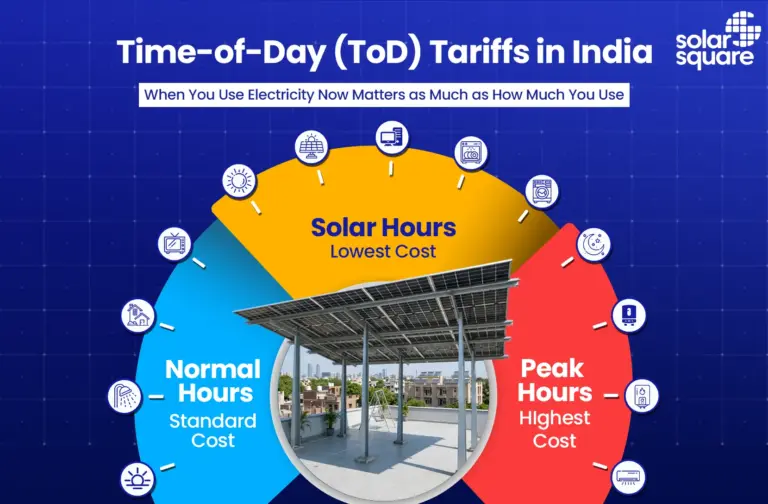
- Solar/off-peak hours (typically 9 AM-5 PM, when solar generation is abundant): This slot has the cheapest rate.
- Normal hours: This is the slot with the standard per-unit rate for electricity.
- Peak hours (typically early morning and evening, when grid demand is highest): This is the slot where electricity is the most expensive rate
During solar hours, the tariff is set at least 20% lower than the normal rate, while during peak hours it is at least 10% higher for most consumers and 20% higher for commercial and industrial consumers. The idea is simple: nudge consumption away from grid-stress hours and toward periods when solar power is more readily available.
What Is a ToD Meter?
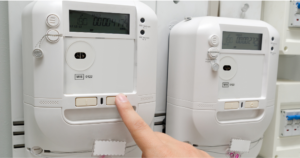
A ToD meter looks and works much like a regular digital energy meter, but with one key difference: it has an internal clock and separate registers that record how much electricity you use during different time slots of the day, typically peak, normal, and off-peak (or solar) hours.
The meter’s real-time clock ensures every unit of energy you consume gets logged into the correct time slot, so your bill reflects when you used electricity, not just how much.
This is only possible with smart meters; traditional electromechanical or basic digital meters cannot track hourly consumption, which is why ToD billing is rolling out alongside India’s smart meter programme.
ToD Meter Parameters: What Does It Actually Measure?
A ToD meter doesn’t just track one number; it continuously samples voltage and current and computes several parameters, each logged separately for every time slot:
- Active energy (kWh): The actual electricity consumed, which is the main basis for your energy charges.
- Apparent energy (kVAh): Often used as the billing basis for commercial and industrial tariffs.
- Reactive energy (kVArh): Relevant for power-factor-linked charges or incentives.
- Maximum demand (MD): The highest average load drawn over a 15- or 30-minute window, recorded separately for each time zone.
- Power factor: A measure of how efficiently the connected load uses electricity.
When Does ToD Tariff Apply and to Whom?
ToD isn’t applied uniformly to every consumer; it’s being rolled out in phases and depends on both connection type and smart metering.
- Commercial & Industrial (C&I) consumers with maximum demand above 10 kW: ToD became mandatory from 1st April 2024.
- All other consumers (except agricultural): ToD is mandatory once a smart meter is installed, with a deadline of 1st April 2025.
- Agricultural consumers: currently excluded from mandatory ToD.
- ToD applies only on the energy charge component of the tariff, not fixed/demand charges.
- The exact time bands and tariff multipliers vary by state and DISCOM. So, a household in Maharashtra may have different peak and off-peak slabs from one in Delhi.
In practice, large C&I connections have operated under ToD-style billing for years in several states; the newer rules extend this to residential consumers as smart meters get installed.
Advantages and Disadvantages of ToD Tariffs
Time-of-Day (ToD) tariffs can help consumers reduce electricity costs by shifting high-energy activities to cheaper off-peak hours. However, they can also make electricity bills more complex and may increase costs for consumers who cannot adjust their usage during peak periods. Here are some advantages and disadvantages of ToD tariffs:
Advantages
- Sends a clear price signal that helps consumers shift load to cheaper hours and reduce their bills.
- Eases pressure on the grid during evening peak hours, reducing utilities’ need to buy expensive short-term power.
- Improves grid integration of solar and other renewables by rewarding consumption during daylight hours.
- Gives DISCOMs better, more granular data for infrastructure and capacity planning.
- Makes solar-plus-battery setups and off-peak EV charging financially more attractive.
Disadvantages and Challenges
- Consumers with fixed schedules, factories running fixed shifts, or households where everyone is out during the day can’t easily shift load and may end up paying more.
- In several states, ToD time slots don’t fully align with actual local peak demand or rooftop solar generation patterns, limiting the savings consumers can realistically capture.
- Full rollout depends on smart meter installation, which is still ongoing across many states.
- For rooftop solar owners, projected savings can be affected depending on how ToD rebates and export/feed-in tariffs are structured.
- It requires an adjustment period, as ToD bills can be harder to understand at a glance than bills based on a single flat-rate tariff.
How to Maximize Solar Savings Under Time-of-Day Tariff?
To maximize solar savings under ToD, run high-load appliances during solar hours, size your solar system for daytime demand, avoid discretionary usage in peak hours, and pair solar with battery storage where possible to offset evening peak rates.
- Run high-load appliances during solar hours: Washing machines, water heaters, EV charging, and pumps cost less to run between the solar-hour window (typically late morning to mid-afternoon) than in the evening peak.
- Size your solar system to cover daytime peak demand: The solar system should be sized to maximise self-consumption and reduce the amount of electricity you draw from the grid during expensive hours.
- Avoid discretionary heavy usage during peak hours (typically 6 PM-10 PM): This is when ToD rates are highest, and grid demand is under the most stress.
- Pair solar with battery storage where feasible: So solar generated during the day can be discharged during the evening peak instead of drawing costlier grid power.
- Track your DISCOM’s specific ToD time bands: They’re not identical across states, so the “best” hours to shift usage to depend on your local tariff order.
- Use net metering strategically: Units exported during solar hours and drawn back during peak hours can work in your favour depending on how your DISCOM settles ToD credits; check your state’s net metering regulations for the exact treatment.
How to Calculate ToD Charges?
The basic approach:
- Identify your DISCOM’s time bands (solar/off-peak, normal, peak) and their respective rate multipliers, from your latest tariff order or bill.
- Split your metered consumption by band. Smart meters record usage in these slots automatically; check your bill or the DISCOM’s app/portal for the band-wise breakup.
- Multiply units consumed in each band by that band’s rate.
- Sum the band-wise costs to get your total energy charge; fixed/demand charges and other levies are added separately, as they are outside the ToD adjustment.
Formula: Total ToD Energy Charge = (Units in Solar Hours × Solar Rate) + (Units in Normal Hours × Normal Rate) + (Units in Peak Hours × Peak Rate)
Working Example of Time-of-Day Tariff
Assume a residential consumer on a normal (non-ToD) tariff of ₹8/unit, now moved to a ToD structure with these bands:
| Time Band | Hours | Rate vs Normal | Illustrative Rate (₹/unit) |
| Solar hours | 10 AM-4 PM | 20% cheaper | ₹6.40 |
| Normal hours | 4 PM-6 PM, 10 PM-6 AM | Base rate | ₹8.00 |
| Peak hours | 6 PM-10 PM | 20% costlier | ₹9.60 |
Sample daily consumption split:
| Time Band | Units Consumed | Rate (₹/unit) | Cost (₹) |
| Solar hours | 8 units | 6.40 | 51.20 |
| Normal hours | 6 units | 8.00 | 48.00 |
| Peak hours | 4 units | 9.60 | 38.40 |
| Total | 18 units | — | ₹137.60 |
Compare this to the same 18 units billed entirely at the flat ₹8/unit rate: ₹144. In this example, the household saves roughly ₹6.40/day simply because more of its consumption falls in solar hours than peak hours, without cutting total usage.
For a residential solar rooftop owner, the same logic works in their favour twice over: self-consuming solar output during the day avoids drawing grid power at any rate, and any grid draw that remains gets pushed toward the cheaper solar-hour band if usage is timed well.
Time-of-Day Tariff in India: Where Things Stand
ToD tariffs were introduced through the Electricity (Rights of Consumers) Amendment Rules, 2023, notified by the Ministry of Power.
Under this framework:
- Commercial and industrial (C&I) consumers with a sanctioned load above 10 kW have been under ToD billing since April 1, 2024.
- All other consumers (households, small businesses, institutions, excluding agriculture) were to move to ToD from April 1, 2025, though actual rollout depends on each state’s regulatory commission and smart meter availability.
- For anyone with a smart meter already installed, ToD billing applies immediately, regardless of category.
Most large C&I consumers across states are already on ToD billing, while domestic rollout is progressing unevenly as smart meters are deployed under the Revamped Distribution Sector Scheme (RDSS).
The Role of Smart Meters in Implementing ToD Tariffs
Time of Day billing is fundamentally dependent on smart meters, as traditional meters simply cannot capture which hour of the day electricity was consumed.
Smart meters make ToD practical in the following concrete ways:
- Real-time, hour-by-hour tracking: Usage is recorded instantly, so billing reflects actual consumption rather than past estimates.
- Two-way communication: Meters relay consumption data on each register directly to the utility, enabling precise monitoring without manual readings.
- Transparent, slot-wise billing: Consumers can see exactly how much they used and paid, in each time slot.
- Immediate activation: For any consumer who gets a smart meter installed, ToD billing applies right away, regardless of consumer category or the official rollout timeline
India’s smart meter rollout under RDSS targets 25 crore meters nationwide, and this rollout is effectively the backbone that will bring ToD billing to every consumer category over time.
How Is the ToD Tariff Set?
ToD slot timings and rates aren’t decided centrally; they’re set by each State Electricity Regulatory Commission (SERC) through their annual tariff orders, within the boundaries set by the central rules.
While the central framework sets minimum differentials (solar hours at least 20% below normal, peak hours 10-20% above normal for most consumers), each state defines its own solar hours, peak hours, and exact rate slabs based on local demand patterns and generation mix. This is why ToD timings and rates can look quite different if you compare, say, Maharashtra and Gujarat.
ToD Tariff Rate Examples by State
Here’s what ToD looks like on the ground in a couple of states. (Rates and slot timings are revised periodically by each SERC, so always cross-check against your latest bill or tariff order).
- Maharashtra (MSEDCL): Under MERC‘s Multi-Year Tariff Order effective April 1, 2025, LT and HT Industrial & Commercial consumers pay a 25% ToD surcharge on the normal energy charge during peak hours (5 PM-12 AM), while most other non-residential categories pay a 20% surcharge during the same window. On the residential side, domestic consumers on ToD billing get a rebate of roughly Rs. 0.80 per unit for consumption during solar hours (9 AM-5 PM).
- A common reference structure used across several states: A typical ToD design divides the day into three time slots. Off-peak hours usually run from 10 PM to 6 AM, when electricity may be billed at ~0.8 to 0.9 times the standard rate. Normal daytime hours generally run from 6 AM to 6 PM, when the standard rate applies. Evening peak hours run from 6 PM to 10 PM, when electricity is billed at a higher rate. However, the exact timings and rate multipliers vary by state.
- Gujarat (GUVNL): Gujarat has implemented ToD tariffs for HT and large LT consumers across its four DISCOMs: UGVCL, MGVCL, PGVCL, and DGVCL. Maharashtra and Tamil Nadu have had ToD tariffs for industrial consumers for longer, with stronger peak-hour price signals.
How to Check ToD Charges on Your Own Electricity Bill?
If you’re on ToD billing, your bill won’t show one single energy charge. Instead, it’ll be split into time-based components.
Here’s what to look for:
- Slot-wise consumption (in units/kWh): Usually labelled “ToD-1,” “ToD-2,” “ToD-3,” or “Zone A/B/C,” showing how many units you consumed in each time block (peak, normal, off-peak/solar)
- Slot-wise rate (Rs. /unit): Each slot carries its own energy charge, typically shown as the base rate plus or minus a ToD surcharge or rebate
- A separate ToD surcharge/rebate line item: Some DISCOMs show this as an adjustment line rather than folding it into the per-unit rate
- Your DISCOM’s smart meter app or web portal: Most utilities now offer hour-by-hour or slot-wise consumption graphs for smart meter consumers, which is the easiest way to see your own usage pattern against the ToD slots
- Your state’s latest tariff order: Published on your SERC’s website (MERC, GERC, DERC, etc.), this is where the exact slot timings and surcharge/rebate percentages for your consumer category are defined
If none of this appears on your bill, you’re most likely still on conventional flat-rate billing. ToD will apply once your meter is upgraded and activated for ToD billing by your DISCOM.
What Is Multi-Tariff Time of Day?
Multi-tariff ToD simply refers to a ToD structure with more than two pricing slots in a day. Instead of just “peak vs. normal,” the day is divided into multiple zones (e.g., solar hours, normal hours, evening peak, and night off-peak), each with its own rate.
Utilities typically divide the day into 4 to 8 such time zones, and a multi-tariff ToD meter records consumption separately against each one. This gives a more granular, accurate picture of when electricity is being used, and gives consumers more ways to save by shifting load to cheaper slots.
Why This Matters If You Have Rooftop Solar
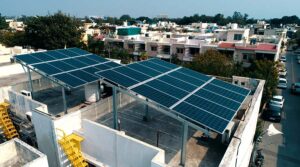
This is where ToD tariffs and solar intersect directly. Since solar generation peaks during the day, the same window ToD tariffs mark as cheapest, rooftop solar owners largely offset consumption that was already low-cost. But it also means grid electricity during evening peak hours becomes noticeably more expensive, increasing the value of pairing solar with battery storage to cover those hours, or shifting heavy loads (laundry, water heating, EV charging) to daytime or late-night off-peak slots.
If you’ve been following all along and haven’t installed rooftop solar yet, SolarSquare offers the perfect opportunity to clear all your grievances free of cost. Just book a free solar consultation call, and our solar experts will guide you through all your queries.
Frequently Asked Questions
Why do different times of day have different electricity tariffs?
Because the cost of generating and supplying electricity varies through the day, solar power is cheapest during daylight hours, while meeting evening peak demand requires costlier thermal and gas-based generation.
What are peak hours, off-peak hours, and solar hours under the ToD tariff?
Peak hours are usually evenings, when demand is high, and the grid is under pressure; off-peak hours are late nights or early afternoons when fewer people use electricity; and solar hours, typically around midday, carry the lowest rates. Exact timings vary by state; for instance, Bihar, Madhya Pradesh, and Maharashtra have set solar hours from 9 AM to 5 PM, while Gujarat’s solar hours window is shorter.
Is the ToD tariff mandatory for all electricity consumers in India?
It’s being rolled out in phases rather than applied everywhere at once. ToD tariffs are currently implemented across 23 states and 5 union territories, with high-tension and large C&I consumers covered first, and domestic/small consumers being added as smart meters are installed in each state.
Does ToD tariff affect rooftop solar owners with net metering?
Yes, the design of ToD charges and rebates can directly influence the projected savings of consumers with grid-connected rooftop solar systems. Since solar generation overlaps with the “cheap” solar-hour slot, the value of self-consumed solar units may be lower than under a flat tariff, making the rate offered for exported (surplus) units an important factor in overall savings.
Which states in India have implemented ToD tariffs?
ToD tariffs are now implemented in 23 states and five union territories across various consumer categories, though the exact time slots, rates, and categories covered vary by state based on each SERC’s tariff order.
What is the Cheapest Time of Day to Use Electricity in India?
The solar-hour window is generally the cheapest time to use electricity under ToD tariffs, as rates are designed to be lower when solar generation is abundant. This window often falls between 10 AM and 4 PM, but the exact hours vary by state and DISCOM. Evening peak hours, typically around 6 PM to 10 PM, are generally more expensive. Always check your DISCOM’s latest tariff order for the exact time bands and rates applicable to you.


 Previous Article
 16 min




![10 kW Solar Panel Price in India [With and Without a Subsidy]](https://cdn.solarsquare.in/blog/wp-content/uploads/2025/07/18165650/10-KW-solar-panel-300x167.webp)