

Panels typically lose 0.29–0.50%* of their output (based on the panel type) for every 1°C rise above the 25°C standard test temperature, so summer heat does impact performance. But summer still remains the most productive season for solar in India, since the sheer intensity of sunlight during these months more than makes up for the efficiency dip.
Every summer, India gets hotter. And from last year to now, it got hotter faster than anyone expected. Heatwaves that used to arrive in May started showing up in February. Cities like Barmer in Rajasthan recorded ~46.4°C in early April, breaking decades-old records. On a single day in late April 2026, all fifty of the world’s hottest cities were inside India’s borders. Delhi crossed ~40°C multiple times. Nagpur, Hyderabad, and large parts of central India baked for weeks without a break.
With the rise in temperatures, electricity demand has increased. India’s power grid hit an all-time peak of 270 gigawatts in May 2026 on the fourth consecutive day of a new national record. ACs ran all day. Grid pressure mounted. Power cuts stretched to sixteen hours in some areas.
In addition to all this, a question started appearing among homeowners, solar forums, and installer consultations across India: if it’s this hot, are my solar panels actually working properly? Or is the heat hurting them?
In this blog, we are going to discuss every aspect related to heatwave problems, solar panel outputs in heatwaves, temperature coefficient, and much more.
*Disclaimer: Please note that the temperature coefficient range presented above are indicative and has been compiled from multiple sources. Actual values may vary based on the solar panel model and manufacturer, and factors such as cell technology, panel construction, material composition, operating temperature, and manufacturing specifications. Therefore, the values should be considered approximate and may differ from the specifications of individual panels.
India’s Heatwave Problem Is Getting Worse and Faster
Before we talk about solar panels, we need to understand how dramatically the heat situation in India has changed.
Many parts of northern and central India regularly hit ~45-50°C in May. The India Meteorological Department warned that heatwave conditions were likely to persist over multiple weeks. Maximum temperatures are expected to climb to ~43°C across several regions. Ninety-seven of the world’s top 100 hottest cities were in India on one particular day in May 2026.
The electricity system felt it immediately. Demand for cooling surged. Grids strained. Power outages hit areas that had never experienced them before. And right in the middle of this energy crisis, rooftop solar systems across the country were quietly generating electricity, doing exactly what they were installed to do.
But were they generating as much as they should? That depends on understanding one important piece of solar physics.
The Surprising Truth: More Sunlight Doesn’t Always Mean More Power
Most solar homeowner assume their solar panels work at peak performance on the hottest days of the year. But the reality is different. Solar panels work better with light intensity, not heat.
Solar panels generate electricity through the photovoltaic effect. The photons of sunlight knock electrons in the silicon cells, and those electrons get loose and flow as electrical current. More light means more electrons knocked loose, which means more current.
But temperature complicates things. As a solar panel heats up, the silicon atoms inside it vibrate more intensely. These vibrations interfere with electron flow and create internal resistance that reduces the voltage the panel can produce. Less voltage, with similar current, means less power output.
This shows that at 48°C in the afternoon in Nagpur, your solar panels may actually be generating less electricity than they would on a clear, cool 28°C Day in October. Even though the sun feels much stronger in summer. This does not come under a manufacturing defect; it’s basic Physics.
What Is Temperature Coefficient: Why Does It Matter?
Every solar panel has a specification called the temperature coefficient of power. Panels are tested at 25°C as per the standard test conditions used in labs. The temperature coefficient in solar tells how much output the panel loses for every degree Celsius the panel temperature rises above 25°C. A typical temperature coefficient for solar panels is around -0.29% to -0.50% per °C based on the panel type.
On a hot day in Jaipur or Delhi, rooftop panel surface temperatures can easily reach 55-65°C, which is 30-40°C above the 25°C test standard.
Let’s do the math for a panel with a temperature coefficient of -0.40%/°C (taking the average value):
- Temperature rise above standard: 35°C
- Output loss: 35 × 0.40% = 14% loss
A 400W panel operating at this temperature is only delivering ~344W in real conditions. Multiply this across a 5kW system (roughly 12-13 panels), and you’re losing over 700W of potential output.
Over a full summer day, that loss compounds into meaningful units of electricity that your system doesn’t generate.
Do Solar Panels Work Better or Worse During Heatwaves?
Before this starts to sound like solar is a bad idea for hot climates, it isn’t. Not even close.
Extreme heat indeed reduces panel efficiency, but Indian summers also compensate for it with longer days of stronger, more direct sunlight.
At the peak of an Indian summer (April–June), most cities enjoy 10-12 hours of daylight, with 5 to 6.5 peak sun hours per day. Compare that to winter (November–January), when peak sun hours drop to 3.5 to 4.5 per day in many northern cities.
If we consider a 15% efficiency loss from heat, a solar panel in Nagpur in May, with 6 peak sun hours, generates more daily electricity than the same panel in December, receiving only 4 peak sun hours.
The heat costs you something. The longer days give you more back. Summer is still your solar panel system’s most productive season in most Indian cities.
Do All Solar Panels Handle Heat the Same Way?
No, the potential to handle heat is different in all types of panels. In the table below, we will discuss the four most used types of panels along with their temperature coefficient:
| Panel Types | Temperature Coefficient* |
| Monocrystalline panels (Mono-PERC) | ~0.32% per °C |
| Polycrystalline panels | ~-0.44% to -0.50% per °C |
| TOPCon panels | ~-0.29% per °C |
| PERC panels | ~-0.32% per °C |
Monocrystalline panels have a temperature coefficient of approximately ~-0.32% per °C. They handle heat better than polycrystalline panels. For hot Indian cities, this is a meaningful advantage over a 25-year system life.
Polycrystalline panels, on the other hand, have a temperature coefficient of approximately ~-0.44% to -0.50% per °C. They lose more output per degree of heat. In cities that regularly see 44-47°C air temperatures, including Nagpur, Jaipur, Hyderabad, and Ahmedabad, this difference compounds significantly across a full summer season.
In addition, TOPCon panels, the latest generation of monocrystalline technology, have temperature coefficients as low as ~-0.29% per °C. This provides the best heat performance of any mainstream panel technology available today. For homeowners in high-heat cities, TOPCon panels are increasingly the recommended choice precisely because of this advantage.
PERC panels sit between standard mono and TOPCon, typically with a temperature coefficient of -0.32% per °C. This is still significantly better than polycrystalline in hot conditions.
*Disclaimer: Please note that the temperature coefficient values presented in the table above are indicative and have been compiled from multiple sources. Actual values may vary depending on the solar panel model and manufacturer, and factors such as cell technology, panel construction, material composition, operating temperature, and manufacturing specifications. Therefore, the values should be considered approximate and may differ from the specifications of individual panels.
What Else Does Extreme Heat Do to a Solar PV System?
Beyond the panels themselves, extreme heat affects other components of your solar system too.
Inverters
Inverters are heat-sensitive. Most solar inverters are rated to operate up to 45–55°C ambient temperature. When installed in poorly ventilated spaces, a cramped utility room, or an enclosed box on a south-facing wall, inverter ambient temperature can exceed this limit on peak summer days.
Nowadays, modern inverters have a thermal throttling mechanism that protects themselves when they get overheated. This is safe, but it reduces the output during the extremely hot afternoons.
As a solution, we can install the inverter in a shaded, well-ventilated space, indoors, or under a canopy.
Wiring and connections
These can expand and contract with temperature cycles. The repeated thermal expansion in extreme heat can loosen connections and increase resistance at junction points. At SolarSquare, we provide wiring under conduit pipes that protect cables/wire from excessive heat, moisture, and physical damage.
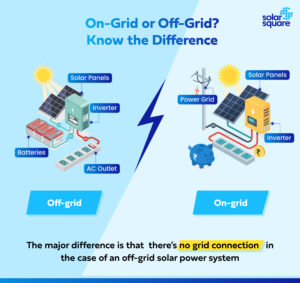
Batteries (in hybrid or off-grid systems)
Batteries are the most heat-vulnerable component of all. Lithium-ion batteries degrade faster at high temperatures. If these batteries are operating above 40°C consistently, it shortens battery lifespan noticeably. We must store our battery bank in a cool, shaded, ventilated indoor space, never on an exposed rooftop in Indian summer.
How to Maximise Solar Output During Indian Heatwaves
You can’t control the weather. But you can control how your system is set up and managed during peak heat periods. There are certain ways through which we can maximize solar output during heatwaves. Some of the ways are discussed below:
Choose panels with a low temperature coefficient.
When installing a solar PV system in India, ask your installer for the temperature coefficient specification. For cities above the Tropic of Cancer, including Delhi, Jaipur, Nagpur, Bhopal, and Lucknow, prioritise TOPCon or PERC monocrystalline panels over polycrystalline.
Install the inverter in a shaded, ventilated location.
Keep the inverter away from direct sunlight and enclosed spaces. If your inverter is on a south-facing wall or in an unventilated room, it will throttle output on hot afternoons. Place your inverter in a cooler location, which can meaningfully improve summer performance.
Shift heavy loads to solar hours.
During heatwaves, panels generate best in the early morning (8-11 am) and late afternoon (3-5 pm), before and after the peak heat of midday. Consider scheduling AC pre-cooling for the early morning when panels are cooler and output is higher. Some smart inverters allow time-of-use scheduling that does this automatically.
Keep panels clean.
Dust, dirt, and debris can reduce output by 15-25% in Indian cities. During dry summer months, clean the panels every 3-4 weeks with water and a soft cloth. At SolarSquare, we provide 45 power boost maintenance in our GoodZero plan, which means you don’t need to worry about cleaning and maintenance.
Monitor your system output.
Most modern solar inverters come with a monitoring app. Keep an eye on your daily generation numbers during summer. If output drops suddenly beyond what heat alone would explain, it may indicate a shading issue, a loose connection, or a panel problem, all of which are easier to fix early than later. You can also check the SolarSquare monitoring app to track the performance of the system.
Ready to Go Solar Before the Next Heatwave?
Every summer in India is now hotter than the last. Every summer, electricity demand breaks a new record. And every summer, the gap between what the grid can supply and what Indian homes and businesses need grows wider. Rooftop solar doesn’t solve India’s heat crisis. But it gives you control over your own energy.
At SolarSquare, we design every system for real Indian conditions, not lab conditions. We account for local temperature profiles, choose panels with the right temperature coefficients for your city, ensure proper inverter placement and ventilation, and back every installation with a performance guarantee. If you’ve been thinking about going solar, don’t wait for the next heatwave to remind you why you should. You can book a free solar consultation call with SolarSquare today.
Frequently Asked Questions
Do solar panels work in extreme heat?
Yes, solar panels continue generating electricity in extreme heat, but at reduced efficiency. For every degree Celsius above 25°C, a typical panel loses 0.30-0.45% of its rated output. If we take an example of Rajasthan at 60°C, rooftop panels will generate 15-20% less output compared to ideal conditions. Still, summer remains the most productive season overall due to longer days and sunlight intensity.
Which solar panel works best in hot climates like India?
TOPCon monocrystalline panels have the lowest temperature coefficient, which is around -0.29% to -0.30% per °C. These are the best choices for hot Indian cities like Nagpur, Jaipur, and Delhi. PERC monocrystalline panels are the next best option. Polycrystalline panels perform worst in heat and are not recommended for high-temperature regions.
Does a heatwave damage solar panels permanently?
Normal heatwave temperatures do not permanently damage solar panels. They are designed to withstand extreme heat. However, sustained very high temperatures over many years do contribute to gradual degradation. Quality panels from reputable manufacturers are tested and rated for operation in Indian climatic conditions.
Why does my solar PV system produce less electricity in peak summer afternoons?
This might happen for two reasons. First, panel efficiency drops as panel surface temperature climbs above 25°C. Second, if your inverter is in a poorly ventilated location, it may throttle output to protect itself from overheating. You must check your inverter’s placement and ventilation if afternoon output is noticeably low.
Does dust affect solar panel performance during heatwaves?
Yes, dust and dirt can impact solar panel performance. It can reduce solar output by 15-25%. People should clean their panels every 3-4 weeks during summer, preferably in the early morning when panels are cool.
Is rooftop solar still worth installing in very hot cities like Nagpur or Jaipur?
Absolutely. Hot cities have the most to gain from solar. Also, these cities have high electricity tariffs, long summer days, and strong sunlight. The heat-related efficiency loss is outweighed by the longer peak sun hours and higher electricity savings. Choosing TOPCon or PERC panels minimises heat-related losses further.