
 387 Reads
 17 mins


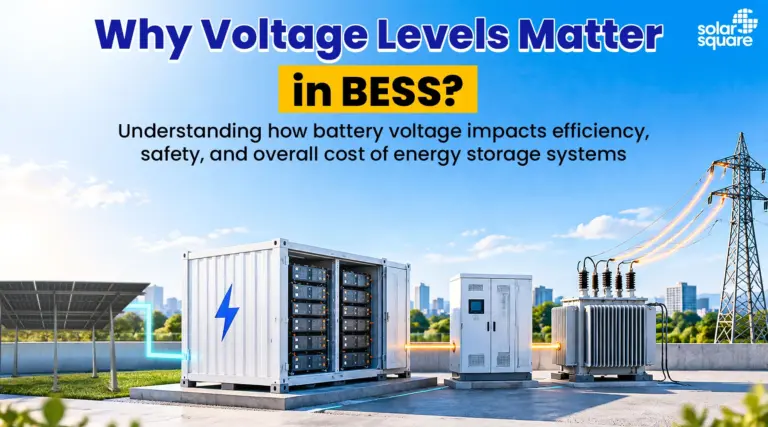
Did you know that a BESS (Battery Energy Storage System) can have enough energy to power an entire factory for hours and still perform poorly? That happens if its voltage architecture is wrong. Voltage determines how much current the system must carry to deliver the required power. An unsuitable voltage can therefore increase cable size, heat and energy losses, inverter and transformer requirements, safety protections, and the total project cost.
This is why voltage levels matter so much in a battery energy storage system.
- For commercial, industrial, and utility-scale solar projects, voltage is a major design choice that can shape the performance and total cost of the entire installation.
- For a home with a rooftop solar system, the topic of voltage barely matters. That’s because a residential battery is mostly there to steady the AC voltage coming in from the grid, and the voltage decisions are made for you.
Voltage in a BESS does not tell you how much electricity the battery can store. That is measured in kilowatt-hours, or kWh. Instead, voltage influences how efficiently and safely that stored energy moves from the battery racks to the inverter, the connected load, and ultimately the grid.
The reason voltage can feel slightly confusing at first is that a BESS operates across multiple voltage levels.
- The rechargeable solar batteries store DC electricity at one voltage
- The power conversion system produces AC electricity at another voltage
- A transformer may change it again to match the facility or grid connection
Each transition affects equipment selection, current, power losses, installation cost, and safety requirements.
This guide explains the main voltage levels used in a BESS, how voltage affects current and energy losses, why transformers are needed, how requirements change with project size, and what you should check when reviewing a BESS quotation.
What Does Voltage Mean in a Battery Energy Storage System?
Voltage in a battery energy storage system is the electrical force that pushes current through the battery, cables, inverter, and other solar components. It is measured in volts (V).
In simple terms, voltage determines how electrical energy moves through the BESS.
For the same power output, a higher-voltage BESS system requires less current, while a lower-voltage system requires more current. This affects cable thickness, heat generation, electrical losses, solar inverter design, protection equipment, and overall system cost.
Voltage vs Power vs Energy Capacity
Voltage, power, and energy capacity describe three different aspects of a BESS:
- Voltage, measured in volts (V): It is the electrical force that drives current through a circuit.
- Power, measured in kilowatts (kW) or megawatts (MW): It is the maximum amount of electricity the BESS can deliver or absorb at a given moment.
- Energy capacity, measured in kilowatt-hours (kWh) or megawatt-hours (MWh): It is the total amount of electricity the BESS can store.
Voltage should not be confused with the amount of electricity the battery can store. The battery’s storage capacity may remain the same even though the electrical designs of the systems differ.
Let’s understand this better through a simple example.
Consider two BESS installations, each with a storage capacity of 500 kWh and a power rating of 250 kW.
- One operates at 500 V DC
- The other operates at 1,000 V DC
Both systems can store and deliver the same amount of energy. However, the 1,000 V system can deliver the same power using roughly half the current. This may allow it to use smaller cables, reduce heat and electrical losses, and require fewer parallel connections.
The Three Voltage Levels Customers See in a BESS Quotation
A BESS quotation usually shows three voltage levels because electricity passes through three different parts of the system. These include the following:
- The battery or DC voltage
- The AC output voltage of the Power Conversion System PCS
- The voltage at which the system connects to the site or grid
Understanding the difference between them helps you check whether the battery, PCS, transformer, and connection equipment are compatible.
#1. Battery or DC Voltage
Battery voltage is the DC voltage at which electricity is stored and transferred between the battery racks and the Power Conversion System (PCS).
- Smaller lithium battery systems commonly use nominal voltages such as 48 V or 51.2 V.
- Larger commercial and utility-scale systems operate at several hundred volts and may exceed 1,000 V DC.
A quotation may provide a nominal DC voltage as well as an operating voltage range. This is because the actual battery voltage rises and falls depending on the battery’s state of charge.
#2. PCS Output or AC Voltage
The PCS converts the DC solar electricity stored in the battery into AC electricity that can be used by the facility or supplied to the grid. The PCS output voltage is the AC voltage produced after this conversion.
Simply put, it is the voltage the system delivers once the battery power has been stepped up and turned into usable AC.
#3. Point-of-Connection Voltage
The point-of-connection voltage is the voltage at which the BESS connects to the building’s electrical network, the facility’s main switchboard, or the utility grid.
This connection may be at either Low Tension or High Tension:
- Low Tension (LT): Homes and smaller commercial facilities generally connect at 230 V single-phase or 415 V three-phase AC.
- High Tension (HT): Large commercial facilities, industrial solar plants, and utility-scale projects may connect at 11 kV, 33 kV, or a higher voltage.
If the PCS output voltage is lower than the required point-of-connection voltage, a step-up transformer is used between the PCS and the connection point.
For example, a commercial BESS may have a battery voltage of 1,000 V DC, a PCS output of 415 V AC, and an 11 kV point of connection. These figures describe different parts of the same system and should not be compared as though they represent the same function.
Why Do Voltage Levels Matter in BESS?
For most homeowners, the voltage level of a BESS is not something they need to worry about or choose themselves. Residential batteries are sold as complete systems in which the battery voltage, inverter, cables, controls, and protection equipment have already been matched by the manufacturer.
A homeowner needs to focus more on battery capacity, backup duration, inverter power, appliance load, solar compatibility, and warranty. The internal voltage design is the responsibility of the manufacturer and installer.
Voltage, on the other hand, becomes a much bigger design consideration in large utility-scale and commercial & industrial solar systems. These projects move far more power and may use multiple battery racks, long cable runs, large inverters, transformers, and high-voltage grid connections.
The reason can be understood using a simple formula: Power = Voltage × Current.
For the same power output, a higher voltage allows the system to operate at a lower current. Lower current can reduce electrical losses, heat generation, cable size, and copper requirements.
These benefits become more significant as BESS size increases for commercial and industrial use.
- Current and energy losses: A higher DC voltage allows the system to deliver the same power with less current. Since some electrical energy is lost to heat when current passes through cables, busbars, and connections, lower current can improve the efficiency of the BESS.
- Cable size and copper use: Higher current requires thicker cables and larger busbars. These use more copper, cost more, occupy more space, and can be harder to install. A higher-voltage design may reduce the required cable size, although every component must still be properly rated and insulated for that voltage.
- Heat generation and cooling: Higher current produces more heat inside cables, battery racks, connections, and power electronics. The system may then need larger fans, stronger air-conditioning, or liquid cooling. Since cooling equipment also consumes electricity, reducing heat can improve overall system efficiency.
- Battery and PCS compatibility: The battery voltage must remain within the operating input range of the Power Conversion System, or PCS. Battery voltage changes as the system charges and discharges. So, the PCS must support the full voltage range rather than only the nominal figure. A mismatch may reduce output, lower efficiency, or cause the system to shut down for protection.
- Transformer requirements: A larger industrial project may connect at 11 kV or 33 kV. In that case, a transformer may be needed to raise the PCS output voltage. This adds cost, space, protection equipment, maintenance requirements, and some conversion loss.
Low-Voltage and High-Voltage BESS Explained
It is tempting to assume that residential BESS always means low voltage and C&I BESS always means high voltage, but the reality is more flexible than that.
Both residential and C&I customers can use low- or high-voltage BESS depending on their sub-category. That’s because a small shop and a large manufacturing plant are worlds apart, just as an individual house differs from a large multi-family housing society.
To see how the two approaches compare across the factors that matter most, the table below sets them side by side:
| Feature | Low Voltage BESS | High Voltage BESS |
| Typical DC voltage | 48V – 51.2V | Hundreds of Volts (e.g., 200V – 800V |
| Current | Higher | Lower |
| Cable size | Larger gauge / thicker copper | Smaller gauge / thinner copper |
| Heat loss | Higher resistive heat losses | Lower resistive heat losses |
| Equipment cost | Inverters are less expensive | Inverters are more expensive |
| System scale | Individual homes, small offices / shops | Housing societies, large C&I facilities, utilities |
How BESS Voltage Affects the Customer’s Total Project Cost?
A higher-voltage BESS is not automatically more expensive than a lower-voltage system of the same capacity. Voltage affects the cost of several components, but the final project price depends on how the battery, inverter, cables, and protection equipment are designed together.
Let’s understand all factors in detail:
- High-voltage inverters usually cost more: They require more advanced power electronics, higher insulation ratings, and more complex protection systems. This generally makes them more expensive than low-voltage inverters.
- Battery cost is not decided by voltage alone: Two batteries with the same energy capacity can operate at different voltages without having a major difference in cell cost. The price depends more on the type and number of cells used, and on how they are connected within the battery.
- Series connections increase voltage: Connecting more cells in series raises the battery voltage. Connecting cells in parallel increases the amount of current the system can supply. The final cost depends on this complete cell configuration rather than on voltage alone.
- Higher voltage can reduce cable and copper costs: A higher-voltage system carries the same power at a lower current. This may allow the use of smaller cables and busbars, reducing copper use, installation space, and cabling cost.
- The final cost depends on the project design: Capacity, power rating, cable length, site layout, equipment location, and connection voltage all affect whether a high-voltage or low-voltage system is more economical.
Do Voltage Level Matters for BESS Efficiency?
A BESS loses a small amount of energy during charging and discharging. These losses occur in the battery cells, cables, PCS, and any transformers used in the system.
- Higher voltage can reduce some of these losses because the same power can be transferred at a lower current.
- Lower current produces less heat in cables, busbars, and electrical connections.
The combined effect of all these losses is measured through the system’s round-trip efficiency.
Voltage and Round-Trip Efficiency
Round-trip efficiency (RTE) shows how much electricity the BESS returns after being charged.
Voltage architecture can improve RTE by reducing current-related losses, but it is only one part of the overall result. Battery chemistry, PCS quality, operating temperature, cooling, and transformer losses also affect efficiency.
A suitable voltage level helps reduce avoidable losses, but it does not determine BESS efficiency on its own.
Does Higher Voltage Make a BESS Safer or Dangerous?
Higher voltage increases the consequences of an electrical fault, making higher-voltage BESS riskier. High DC voltage can cause electric shock and sustain dangerous electrical arcing. As a result, the system needs stronger insulation, isolation, protection, and fault detection.
That’s why low-voltage DC (48V-51.2V) is preferred for small residential rooftop solar systems to minimize touch-voltage safety hazards.
Why Does Higher Voltage Require Additional Protection?
As voltage rises, the battery system requires protection designed for that voltage level. This may include contactors, fuses, circuit breakers, insulation monitoring, ground-fault detection, emergency isolation, and remote monitoring.
These measures allow commercial, industrial, and utility-scale systems to operate safely at higher voltages. They are essential parts of the system design rather than optional additions.
Does Lower Voltage Mean Risk-free?
Lower voltage definitely reduces the risk of electric shock and sustained DC arcing, making it safer.
A low-voltage BESS can still be affected by overheating, short circuits, or damaged cells. It therefore requires compatible equipment, proper installation, thermal management, and a functioning Battery Management System.
The Role of the Battery Management System
The Battery Management System, or BMS, continuously monitors cell voltage, current, temperature, and state of charge. It can limit charging or discharging and disconnect the battery when it detects unsafe operating conditions.
- In larger high-voltage systems, the BMS may work across the cell, module, rack, and system levels.
- Remote monitoring allows faults and unusual operating conditions to be identified without frequent physical inspection.
The safest BESS is therefore the one in which the voltage, components, protection systems, and installation have all been designed to work together.
Which BESS Voltage Architecture Is Suitable for Different Customers?
The appropriate voltage architecture mainly depends on the project’s size and power requirements. Larger systems generally use higher DC voltages to reduce current, losses, and cable requirements.
- Homes and small commercial establishments: They use 48 V or 51.2 V batteries with 230 V single-phase or 400 V three-phase AC output. These systems are mainly designed for backup power and solar energy use.
- Housing Societies & Small C&I (Shops/Offices): They may use mid-voltage or high-voltage battery systems depending on their peak load. Projects around 60-70 kW begin moving towards higher-voltage designs.
- Large C&I & Industrial Plants: They generally use high-voltage DC systems with large PCS units and step-up transformers. These systems may connect directly to 11 kV or 33 kV high-tension networks.
As project power increases, higher-voltage designs become more practical because they keep current, cable size, heat, and electrical losses under control.
What Should Customers Ask a BESS Supplier About Voltage?
For a home BESS, the battery voltage is already matched with the inverter and protection system. Homeowners should mainly confirm that the complete system is compatible with their supply, appliances, and backup needs.
However, for a C&I project, voltage has a greater effect on performance, cost, and future expansion. Customers should therefore ask the supplier the following questions.
- Does the battery’s full DC voltage range match the PCS operating range?
- Will the system require a step-up transformer, and what cost and efficiency losses will it add?
- How does the proposed voltage affect cable size, copper use, and heat generation?
- Can the voltage architecture support future capacity or power expansion?
- Are all cables, switchgear, protection devices, and safety systems rated for the proposed voltage?
Common Mistakes When Comparing BESS Voltage Levels
BESS quotations should be compared as complete system designs rather than by looking at the voltage or inverter price alone.
Common mistakes include the following.
- Comparing residential and C&I systems in the same way: Home systems prioritize simplicity and safety, while larger projects place greater emphasis on efficiency and cost at scale.
- Assuming higher voltage means more storage: Storage capacity is measured in kWh, not volts.
- Comparing only the inverter cost: A high-voltage inverter may cost more but can reduce cabling, copper, and installation costs.
- Assuming high voltage is always more expensive: Battery cost depends mainly on the cells, capacity, and internal configuration.
- Ignoring battery and PCS compatibility: The battery’s full DC voltage range must remain within the PCS input range.
- Leaving out transformer costs: HT projects may require a transformer, switchgear, extra space, and additional conversion stages.
- Overlooking future expansion: Changing the voltage architecture later can be difficult and expensive.
How to Choose the Right BESS Voltage Level?
For homeowners, BESS voltage is not a specification they need to select themselves. What matters is choosing a battery and inverter that are properly matched to your home’s load, solar system, backup requirement, and electrical supply.
In larger C&I projects, voltage becomes a much more important design decision because it affects current, cabling, efficiency, transformers, safety, and total project cost.
Therefore, choosing the right BESS starts with the right system design, not with the highest or lowest voltage on a quotation.
To understand what battery capacity, inverter rating, and voltage architecture would suit your property, book a free solar consultation call with SolarSquare. Our experts assess your electricity usage and roof conditions to help you plan a solar and battery system that works safely and efficiently for your home.
FAQs
When is a higher-voltage BESS not the better choice?
A higher-voltage BESS is not worthwhile for a small solar system with modest power requirements. In such cases, the additional cost and protection requirements may outweigh the savings from lower current and smaller cables.
Does a higher BESS voltage mean greater storage capacity?
No. Storage capacity is measured in kWh or MWh and depends on the number, capacity, and configuration of the battery cells. Voltage, on the other hand, affects how electricity flows through the system, not how much energy it stores.
What is the difference between battery voltage and grid voltage?
Battery voltage is the DC voltage inside the battery system. Grid voltage is the AC voltage at which the BESS connects to the home, facility, or utility network.
Why do some BESS projects require transformers?
Transformers are necessary if the AC output voltage of the Power Conversion System (PCS) needs to step up to match a High Tension (HT) grid or facility connection (such as 11 kV or 33 kV). Because transformers introduce extra equipment costs, space, and conversion losses, they are reserved for larger C&I or utility projects rather than smaller commercial sites.
Can a low-voltage BESS power a large industrial load?
Delivering a large amount of power at low voltage forces a very high current through the system, which demands thick, costly copper cabling and produces far more heat to manage. For a large industrial load, a higher-voltage architecture is almost always more efficient, compact, and economical.
Can the voltage of a BESS be changed after installation?
A system’s voltage level is tied directly to its physical wiring configuration (cells in series), cable sizing, thermal management, and PCS input range. Changing the system voltage post-installation requires replacing major components such as the inverter/PCS, re-cabling, and reconfiguring the protection infrastructure. Therefore, system scale and future expansion needs must be planned up front.
What voltage is commonly used for commercial BESS projects?
It varies with the size of the project. The DC side often runs at hundreds of volts, the PCS commonly outputs 415V three-phase AC, and the point of connection is either LT for smaller sites or stepped up to 11 kV or 33 kV HT for large C&I and utility installations.
Is a high-voltage BESS more expensive to maintain?
Not necessarily, but they require stricter safety protocols. High-voltage DC systems pose greater risks of continuous arcing and electrocution, requiring advanced multi-tiered Battery Management Systems (BMS), specialized electrical switchgear, and robust safety protection. Most ongoing maintenance is handled remotely via digital monitoring.


 Previous Article
 20 min