
 1337 Reads
 25 mins


If you live on a higher floor in an apartment building, you’re probably aware of this story, where you want to lower your personal electricity bill by going solar. However, every solar consultant tells you that without your own rooftop, solar is not really an option for you. Thanks to virtual net metering for apartments in housing societies, that story is changing now.
Virtual net metering (VNM) lets your society set up a single shared solar plant, and the electricity it generates is split as bill credits across all flats that join in. You don’t install anything yourself, you don’t need rooftop rights as an individual, and the savings reflect directly on your electricity bill every month.
In this guide, we will walk you through what virtual net metering for apartments is, how it differs from group net metering and traditional net metering for reducing common area electricity bills, what it actually costs your society, the benefits of solar power for gated communities, and how the savings reach individual flat owners.
What is Virtual Net Metering for Apartments?
Virtual net metering, or VNM, is a billing arrangement that allows a solar system to share its savings across multiple flats in the same housing society. The plant is located in a single common place, exports its electricity to the grid, and the units it generates are credited to the individual electricity bills of every flat that has signed up.
The whole arrangement operates within the area of a single electricity distribution company, aka a DISCOM. For example, if your society is under MSEDCL in Maharashtra or BSES in Delhi, both the grid-tied solar system and all participating flats must be under the same DISCOM for you to be eligible for the virtual net metering policy in India.
The plant itself can be installed on the society’s rooftop, on a separate piece of land that the society owns or leases nearby, the DISCOM premises, or even on a piece of land that is not adjacent to the society at all, as long as it falls within the same DISCOM area. The Maharashtra regulator, MERC, formally cleared this last option in its 2024 amendment.
How Virtual Net Metering Works For a Society? A Step-by-Step Guide
Setting up shared solar for apartments through virtual net metering for a housing society involves more than just installing panels on the roof. The arrangement is governed by operational rules that determine how the plant is set up, who signs the paperwork, how the bank account is managed, and how disputes are handled.
The most important concept to understand upfront is the role of the Lead Consumer.
The Lead Consumer is one of the participating flat owners, nominated by the rest of the group to act as the single point of contact with the DISCOM. Here are the duties of the Lead Consumer:
- They sign the formal agreement on behalf of everyone
- Manage the pooled bank account where the society’s contributions and the DISCOM’s year-end credits flow
- Communicate ratio changes or group decisions back and forth
Most societies appoint the secretary, the chairman, or another trusted member of the managing committee to this role. Once appointed, the Lead Consumer has irrevocable rights to act on behalf of the group.
Here’s a step-by-step breakdown of how virtual net metering for residential societies works in India:
- Step 1 – All participating consumers must be under the same DISCOM: VNM can provide apartment solar solutions only if all participants fall within the area of a single DISCOM. For example, if MSEDCL serves your society, every participating flat must be connected to MSEDCL.
- Step 2 – The Lead Consumer is formally appointed at the start: The nomination is documented in the consumer agreement and grants the Lead Consumer the right to apply for the connection, sign the agreement with the DISCOM, and change the sharing ratio in the future if the group agrees.
- Step 3 – All correspondence with the DISCOM flows through the Lead Consumer: Every letter, notice, or update from the DISCOM is sent only to the Lead Consumer. It is then the Lead Consumer’s responsibility to keep the rest of the group informed.
- Step 4 – A pooled bank account is opened in the Lead Consumer’s name: This account is used to collect contributions from participating flats and pay for the installation.
- Step 5 – The DISCOM uses this bank account for year-end settlement: At the close of the financial year, if unused solar units remain, the DISCOM credits the payment for those units to the Lead Consumer’s pooled account.
- Step 6 – The plant size cannot exceed the local transformer’s available capacity: The maximum plant capacity is limited by whichever is smaller, the total sanctioned load of participating consumers or the balance capacity of the distribution transformer serving the society. This is why the DISCOM does a feasibility check before approval.
- Step 7 – An independent auditor must be appointed for the group: The auditor handles the financial transactions of the pooled bank account. The group must meet at least once every six months and submit a report of these transactions to the DISCOM.
- Step 8 – Solar generation is split according to the agreed sharing ratio: Every unit of solar electricity the plant exports to the grid is credited to participating flats in proportion to the ratio fixed at the time of application.
- Step 9 – For Time of Day consumers, the credit applies within the same time block first: If your society falls under a TOD tariff, the solar generation in a peak time block is adjusted against consumption in that same block. Any surplus from peak hours is rolled into the off-peak adjustment.
- Step 10 – Surplus units in a month carry forward to the next month: If a flat’s solar share in a month exceeds what it actually consumed, the excess units carry over to the next billing cycle.
- Step 11 – Year-end surplus is bought back by the DISCOM at the APPC rate: Any units left over at the close of the financial year are purchased by the DISCOM at the Average Power Purchase Cost for that state. This is lower than your retail grid power tariff, which is why oversizing the plant is not financially smart.
- Step 12 – Disputes are resolved through arbitration within one month: If any disagreement arises between participating consumers, between the group and the DISCOM, or between the group and the EPC vendor, an arbitrator is appointed, and the dispute must be resolved within one month.
Why Some Apartments Can’t Go Solar the Traditional Way?
Regular net metering for residential societies was designed for one electricity connection paired with one rooftop solar plant, to lower common-area electricity bills. The society would install solar on the roof, the power would feed into the common-area meter, and the common-area electricity bill would drop.
That model of using solar power for common areas breaks the moment you try to apply it to an 80-flat apartment building, for three reasons.
- No individual roof rights: A flat owner on the 4th floor cannot claim the building’s terrace as their own. The terrace is owned by the society and by all flat owners collectively. Without exclusive rights, an individual flat owner cannot install solar on the society’s roof for personal benefits.
- Shared and limited rooftop area: Even if society agrees to install a rooftop solar system on the common terrace, the available area is rarely enough to power every flat individually. A 100-flat building might have just enough terrace space for a 50 kW solar plant, which can cover the common areas but cannot offset every individual flat’s personal bill.
- Split billing across many meters: Each flat has its own electricity meter and its own monthly bill. A single solar plant connected to one meter cannot send its electricity to dozens of separate accounts under the older net metering rules.
This is why traditional net metering, applied to the society’s common area connection, reduces the common area bill by 50% to 60%, but leaves every individual flat owner still paying the full retail tariff. Virtual net metering for apartments resolves that issue.
How Solar Credits Are Distributed Among Apartment Owners?
Solar credits in virtual net metering for apartments are split flat by flat, in the same ratio as the capacity each flat signs up for.
Say, 50 flats in an 80-flat building decide to go solar together. Each flat will have different power consumption. So, different participants choose different solar capacities that would fit their needs. For instance, a 2 BHK flat with just 1 AC could choose a 2 kW connection, while a 3-4 BHK flat with 2 ACs could choose a 5 kW connection, and so on.
All these individual capacities are added up, and that is the size of shared solar for apartments that’s installed under the VNM policy.
Once the solar system is up and running, the DISCOM splits each month’s generation evenly among all flats, as per the pre-decided ratio. The 5 kW flat gets a 5 kW share of the credits, the 3 kW flat gets 3 kW worth, and so on.
The PM Surya Ghar Muft Bijli Yojana subsidy follows the same logic.
- Each flat is treated as a residential consumer for the capacity it has signed up for, not as a housing society applying for a common-area system.
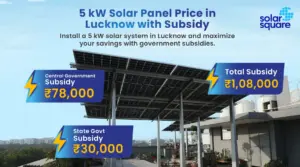
- You get the subsidy on what you applied for. A 2 kW flat is eligible for the residential subsidy of Rs. 60,000. And, a 3 kW flat gets the full residential cap of Rs. 78,000.
- Across 50 flats, the per-flat subsidies add up to a serious cut in the total project cost.
Now, let’s have a look at how the credit mechanics work month after month for each participating flat.
- The sharing ratio is set up front by the society: It can be a simple equal split, where every participating flat gets the same share, or it can be weighted by flat size, sanctioned load, or by how much each flat contributed to the cost of the plant.
- Credits appear directly on each flat’s monthly bill: Every month, your share of solar units from the society’s plant is applied to your electricity bill. Those units offset your actual consumption, and you pay only for whatever is left over.
- Surplus units carry forward to the next month: If the credited units in a month exceed what a flat actually consumed, the surplus does not vanish. It carries over to the next billing cycle as a credit.
- The DISCOM buys back year-end surplus: At the end of the financial year, any unused units are purchased by the DISCOM at the APPC (Average Power Purchase Cost). The money is credited to the Lead Consumer’s pooled bank account and then distributed back to participating flats in accordance with the agreed ratio.
- The sharing ratio can be updated once a year: It is not locked forever. The society can change the ratio once every financial year, with two months of advance notice to the DISCOM. So, if a flat owner sells the unit or a new participant joins, the ratio can be revised.
Let’s understand this better with the example of a 20 kW shared solar system for apartments through virtual net metering. Consider a 20 kW shared solar plant set up by a society with 5 participating flats, with the sharing ratio agreed in advance. Assume the retail electricity tariff in the state is Rs. 10 per unit.
Here’s what the math would look like for virtual net metering for this society:
| Flat | Capacity Chosen | Consumption | Share | Units from Solar Plant | Bill before VNM | Net Grid Import | Net Bill after VNM |
| 1 | 3 kW | 350 units | 15% | 360 units | Rs. 3,500 | 50 | Rs. 500 |
| 2 | 3 kW | 450 units | 15% | 360 units | Rs. 4,500 | 100 | Rs. 1,000 |
| 3 | 5 kW | 600 units | 25% | 600 units | Rs. 6,000 | -100 | Banked credits |
| 4 | 5 kW | 750 units | 25% | 600 units | Rs. 7,500 | -150 | Banked credits |
| 5 | 4 kW | 400 units | 20% | 480 units | Rs. 4,000 | 30 | Rs. 300 |
Please note: The table above is for illustration purposes only, and your actual bill will depend on your state’s tariff, your monthly usage, and your DISCOM’s billing rules. Here is how each column above was calculated.
- Bill before VNM = Monthly consumption × retail tariff. We assumed Rs. 10 per unit. So, a flat using 350 units pays 350 × 10 = Rs. 3,500.
- Share % = The portion of the total plant capacity each flat signed up for. In this example, the five flats pick 3, 3, 5, 5, and 4 kW respectively, totalling a 20 kW plant. That works out to a 15:15:25:25:20 ratio.
- Net Bill after VNM = Net grid import × retail tariff. Flats whose solar share covered their full month’s consumption and more end the month with a banked credit, which carries forward to the next billing cycle.
Virtual Net Metering vs Group Net Metering vs Net Metering for Housing Societies
A housing society in India can go solar in the following three distinct ways:
- Net metering for housing societies: The society installs a single apartment rooftop solar system connected to its common-area electricity meter. The savings flow only to that meter, offsetting the costs of electricity for lifts, water pumps, corridor lights, and other shared infrastructure. Individual flat bills are not affected here.
- Group net metering: Best suited when the society has separate meters for the lobby, water pump, gym, and other common areas, all in the society’s name. The plant sits at one location, and the credits get split across all those connections.
- Virtual net metering: Many distinct flat owners share a single solar plant that offsets their individual electricity bills. Credits flow to each participating flat’s electricity bill in accordance with a pre-agreed ratio.
Here’s a side-by-side comparison of all three types of apartment solar solutions in detail:
| Parameter | Net Metering for Housing Societies in India | Group Net Metering in India | Virtual Net Metering for Apartments in India |
| What is it? | A solar plant tied to the society’s common-area meter, with credits going to that one bill only. | A shared solar plant set up by a society that holds multiple common-area connections in its name, with credits split across all of them. | A shared solar plant whose generation is split as credits across multiple individual flat bills in the society. |
| Best for | Societies that want to cut their common-area electricity bill. | Societies wanting to offset multiple common-area bills with one shared plant. | Many residents in a housing society, sharing one plant to cut individual flat bills. |
| Panel location | Society’s rooftop | Society’s rooftop | Society rooftop, society land, or a remote site within the same DISCOM area. |
| Connection structure | One common-area connection, held by the society. | Multiple common-area electricity connections, all held by the society. | Multiple individual flat connections, each held by a different consumer. |
| Who can use it? | Any housing society with a registered common-area connection | Housing societies with multiple common-area connections registered under the society’s name. | Apartment flat owners, housing societies, gated community residents, and tenants where DISCOM allows. |
| How credits flow? | Directly to the society’s common-area meter | First netted at the connection where the plant is installed, with surplus credits flowing to the society’s other meters. | Allocated to all participating flat meters as per a pre-agreed sharing ratio. |
| Availability in India | Most popular and widely available apartment solar solution. | Available in many states. | Relatively very new, with on-ground implementation strongest in Delhi and Chhattisgarh. |
Virtual Net Metering Policy in India: Current Rules and Regulations
The Ministry of New and Renewable Energy, the central government body that drives solar policy in India, has formally backed virtual net metering for apartments as a model for residential rooftop solar.
Here’s a tentative timeline of how the policy has shaped over the years:
- October 2022: The MNRE clarified that the Central Financial Assistance (CFA) available under the Rooftop Solar Programme Phase II also applies to rooftop solar plants set up under VNM arrangements, subject to specific conditions for group housing societies (GHS) and resident welfare associations (RWA).
- February 2023: The MNRE issued a Standard Operating Procedure (SOP) to help DISCOMs and consumers implement VNM and group net metering. The SOP covered eligibility, agreement formats, and dispute resolution.
- December 2024: The MNRE issued guidelines under the PM Surya Ghar Muft Bijli Yojana, formally recognizing virtual net metering for residential consumers, making them eligible for the PM Surya Ghar Muft Bijli Yojana subsidy of Rs. 78,000 for systems of 3 kW or more. This was a turning point. It meant societies could now access the central subsidy when installing rooftop solar under VNM.
MNRE is also actively pushing the Forum of Regulators to encourage state electricity regulatory commissions that have not yet notified VNM regulations to do so.
States Where Virtual Net Metering for Apartments is Allowed
On paper, the virtual net metering policy in India now exists in the following states and union territories:
- Maharashtra
- Rajasthan
- Madhya Pradesh (MP)
- Chhattisgarh
- Delhi
- Union Territories under JERC, like Goa, Andaman and Nicobar, Puducherry, Chandigarh, Lakshadweep, Dadra and Nagar Haveli, and Daman and Diu.
- Kerala
However, it’s not yet followed in all states, as it’s still very new. The strongest implementation of virtual net metering for apartments as of today is in Delhi and Chhattisgarh.
- In Delhi, DERC allows VNM projects from 5 kW to 5,000 kW and exempts them from banking, wheeling, and cross-subsidy charges.
- In Maharashtra, MERC’s 2024 amendment makes VNM available specifically for residential consumers in multi-storey buildings and housing societies. It waives open-access charges and losses until the state’s rooftop solar capacity reaches 5,000 MW.
- In Odisha and JERC states, project capacity is capped at 500 kW.
Does the PM Surya Ghar Solar Subsidy Scheme Apply to Virtual Net Metering for Apartments?
Yes, virtual net metering for apartments in India allows individual flat owners to receive a solar subsidy under the PM Surya Ghar Muft Bijli Yojana. For a housing society applying through VNM, the central subsidy is structured the same way it is for individual homes.
Each participating flat, treated as a residential consumer under the scheme, can claim Central Financial Assistance of up to Rs. 30,000 per kW for the first 2 kW of its allocated share, Rs. 18,000 per kW for the third kW, with a cap of Rs. 78,000 per flat for a 3 kW or higher share. The cap is per residential consumer, not per project.
Here’s a simplified table that takes you through the subsidy tier applicable for shared solar for apartments through the virtual net metering policy in India in 2026:
| Solar System Size for Individual Apartments | PM Surya Ghar Muft Bijli Yojana Solar Subsidy for Apartments Installing Solar Through VNM |
| 1 kW solar system | Rs. 30,000 |
| 2 kW solar system | Rs. 60,000 |
| 3 kW solar system | Rs. 78,000 |
| 4 kW solar system | Rs. 78,000 |
| 5 kW solar system | Rs. 78,000 |
| 10 kW solar system | Rs. 78,000 |
What is the Cost of Virtual Net Metering for Apartments in India?
The cost of a virtual net metering project for a housing society is ~Rs. 50,000 per kW. This covers the solar panels, inverters, mounting structures, cables, the dedicated solar meter at the plant, and installation. Simply put, for a 100 kW solar plant designed for a mid-sized housing society, the total project cost is in the ballpark of ~Rs. 50 lakh before subsidy.
Since each participating flat applies under the PM Surya Ghar Muft Bijli Yojana for its own share of the subsidy, the most useful way to view the cost is per flat. Here is how the numbers might look, depending on how much capacity each flat signs up for.
| Solar Share Per Flat | Plant Cost Per Flat (Read Full Disclaimer Below) | PM Surya Ghar Muft Bijli Yojana Solar Subsidy | Net Cost of Shared Solar Per Flat (Read Full Disclaimer Below) |
| 2 kW | ~Rs. 1,00,000 | Rs. 60,000 | ~Rs. 40,000 |
| 3 kW | ~Rs. 1,50,000 | Rs. 78,000 | ~Rs. 72,000 |
| 5 kW | ~Rs. 2,50,000 | Rs. 78,000 | ~Rs. 1,72,000 |
DISCLAIMER (VERY IMPORTANT): The above-mentioned costs for virtual net metering for apartments are indicative. The final cost of installing shared solar for apartments under virtual net metering policy in India depends on your plant capacity, site type, the panel and inverter variants selected, civil and structural work required at the site, cable run distance from the plant to the main grid connection, DISCOM application and feasibility charges, number of participating flats requiring bi-directional meters, state-level subsidy top-ups, EPC service tier, AMC and after-sales plan, etc.
Breakeven and ROI from Virtual Net Metering in India
Most societies that install apartment solar solutions under virtual net metering see payback in 3 to 4 years, with the exact number depending on the retail tariff your DISCOM charges. The higher your state’s domestic tariff, the faster you recover the investment.
The society’s annual return on investment (ROI) is ~20-25%. That is higher than most fixed deposits or bonds, with the added benefit that the system continues to generate free electricity for another two decades after payback, as the best solar panels are warranted for a minimum of 25 years of useful output.
How to Apply for Virtual Net Metering for Apartments?
Once your managing committee decides to proceed with virtual net metering for apartments, the application process unfolds in stages. An experienced EPC partner handles most of the paperwork, but the society plays a central role at each step.
- Stage 1 – Demand aggregation and site identification: The EPC partner identifies each flat’s actual consumption. Based on that, the total project capacity is decided. Then, the plant installation site is decided. This is also the stage at which the sharing ratio is discussed and finalized.
- Stage 2 – Internal consumer agreement: Participating flats sign an agreement among themselves. This document spells out who is paying what share of the cost, how the units will be split, who will be the Lead Consumer, and how disputes will be handled.
- Stage 3 – Agreement with the RESCO developer or EPC contractor: If the society is using a RESCO solar financing model in which a third party owns the plant and sells power to the society, a separate agreement covers the tariff, the duration of the PPA, and the operations and maintenance terms.
- Stage 4 – Application to the DISCOM for technical feasibility: The Lead Consumer submits the formal VNM application to the DISCOM, along with the list of participating consumers, their connection numbers, the proposed plant capacity, and the sharing ratio. The DISCOM checks whether the local distribution transformer has the capacity to absorb the proposed plant.
- Stage 5 – Signing the DISCOM agreement: Once technical feasibility is approved, the Lead Consumer signs the formal virtual net metering agreement with the DISCOM on behalf of all participating consumers.
- Stage 6 – Plant installation, inspection, and meter setup: The EPC contractor installs the solar plant. The DISCOM inspects the installation, certifies it, and installs a dedicated smart meter at the plant.
- Stage 7 – Going live with billing: The DISCOM activates the VNM arrangement. Starting with the next billing cycle, every participating flat will have solar units credited to their electricity bill at the agreed ratio.
Who Can Apply for Virtual Net Metering in India?
The exact list of eligible consumers varies by state, but in general, the following can apply for virtual net metering in India.
- Residential apartment owners: Individual flat owners in multi-storey buildings, including those in cooperative housing societies, gated communities, and apartment owners’ associations.
- Housing societies and RWAs: A society can apply on behalf of all participating flat owners and the common area connection collectively.
- Government offices and local authorities: Most state regulations explicitly cover government buildings and offices of local bodies.
- Educational institutions, hospitals, and charitable bodies: DERC and OERC, for example, include schools, colleges, hospitals, and charitable institutions among eligible consumers.
- Commercial spaces and offices: In states like Delhi, commercial connections can also participate in VNM arrangements.
What are the Benefits of Virtual Net Metering for Apartments in India?
Here’s a snapshot of the uses/advantages of using solar power for gated communities and societies through VNM:
- Significant reduction in electricity bills: Most participating flats see their monthly bills drop by up to 90%, depending on the size of their solar share and their consumption pattern.
- A workable solar option when individual installation is impossible: Flats without their own rooftop access, top-floor units worried about heating, and buildings with weak roof structures all have a path to adopt solar without any installation in individual flats.
- A 20+ year insulation from tariff hikes: Electricity tariffs across most Indian states have been rising by 3-6% every year. Using solar power for gated communities means the society locks in a major portion of its electricity costs for the next two decades.
- Year-end cash from the DISCOM for surplus units: Any units the society does not consume during the year are bought back by the DISCOM at the APPC rate. The money is deposited into the Lead Consumer’s pooled account and then distributed back to flat owners.
- Possible premium on property value: Buildings with solar are attractive to buyers and tenants who track long-term electricity costs, especially in metro cities.
Conclusion
For years, apartment owners could not benefit from solar savings on their personal electricity bills because the rooftop in a housing society is a shared space, not an individual asset. The model was built around installing shared solar for apartments to offset common-area maintenance costs. Virtual net metering rewrites that story.
Now, with virtual net metering for apartments, one well-designed solar plant can offset individual electricity bills for many flats in the society.
At SolarSquare, we have helped housing societies across India design and commission solar systems, including those under virtual net metering arrangements. If your society wants a free feasibility check, you can book a free solar consultation with SolarSquare.
FAQs
What are the rules for virtual net metering for apartments in India?
The solar system should be connected to the grid, and the panels must be DCR- and ALMM-approved.
Do I need a battery if I have virtual net metering?
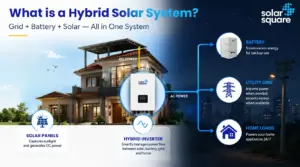
Not really. Virtual net metering works through the grid. The solar plant exports all its generation to the grid, the DISCOM tracks it, and credits show up on your bill. You do not need any battery storage in your flat or on the plant.
Can I use VNM if I live in a rented apartment?
If your DISCOM allows it and the flat owner gives a No Objection Certificate, then yes. Some DISCOMs are stricter about tenants joining VNM arrangements. Always check with your local DISCOM or EPC partner before signing up.
Do I need to install anything in my flat?
No, virtual net metering for apartments does not require any installation inside your flat. All the equipment sits at the common solar plant. If your existing electricity meter is a smart meter, it is sufficient. If it is not, the DISCOM will swap it out for you.
What happens if I move to a different flat or city?
The VNM benefit is tied to your electricity connection at the participating flat. If you move out, the next occupant of that flat continues to receive the credits as per the sharing ratio. You do not carry the benefit with you unless your new home is also a participating connection under a VNM arrangement with the same DISCOM.
How much can I save on my electricity bill through VNM?
Most participating flats see savings of up to 90% on their monthly electricity bill, depending on the size of their solar share and how much electricity they consume.
Is VNM available in my city?
VNM is available in cities and towns covered by 10+ state electricity regulatory commissions, including Delhi, Mumbai, Pune, Raipur, Bhubaneswar, Ranchi, and several union territories. The implementation is most active in Delhi and Chhattisgarh today. Your DISCOM or EPC partner can confirm whether your city is currently processing VNM applications.
Who manages the solar system under VNM?
The EPC partner who installed the system handles operations and maintenance under an annual contract. In a RESCO model, the developer owns and maintains the plant for the duration of the contract.
How is VNM different from simply paying for green energy?
Green energy tariffs are an option some DISCOMs offer, where you pay a slightly higher rate to source renewable electricity from the grid. You do not own any plant, you do not earn credits, and the premium is small. Virtual net metering, in contrast, makes you a part-owner of a real solar plant, gives you actual electricity unit credits on your bill, and pays back the investment in 3 to 4 years.
What happens to credits if a flat is sold?
The VNM credits are tied to the electricity connection, not the individual. When a flat is sold, the new owner inherits the participating consumer status as long as the connection stays active. The society can update the sharing ratio once a year if the new owner wants to change their share.
Do flats need separate solar panels under VNM?
No, that is the whole point. The solar plant is one shared installation. Individual flats don’t have to install panels separately. The savings are distributed to every participating flat through the DISCOM’s credit allocation.
What are the challenges of virtual net metering for apartments?
There are two main practical challenges/disadvantages today.
- Regulatory challenges: Not every state has notified VNM regulations yet, and even among those that have, on-ground implementation varies. DISCOMs in early-adopter states like Delhi and Chhattisgarh are processing applications smoothly, while others are still building internal capacity.
- Billing challenges: Allocating credits across multiple flats every month, handling carry-forward, and reconciling at year-end require DISCOM systems to be set up for these processes.


 Previous Article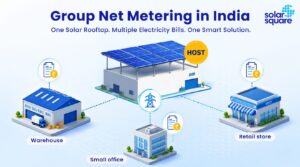
 16 min