

Did you know that a single rooftop solar plant can reduce the electricity bills of several properties you own in 2026? You do not necessarily need a separate solar system on every shop, office, building, or electricity connection. That is the idea behind group net metering.
Instead of limiting the benefit of rooftop solar to the meter connected to the solar plant, group net metering, or GNM, allows an eligible consumer to use surplus solar credits against other linked electricity connections within the same DISCOM area.
For businesses with several branches, institutions with multiple premises, or property owners with more than one connection, this can make rooftop solar viable even when only one location has enough usable rooftop space.
But there is an important catch!
Group net metering is not available under one identical set of rules across India. Eligibility, project size limits, credit allocation, and application requirements can change from one state to another.
This guide explains what group net metering means, how it works, how it differs from virtual net metering, which states currently allow it, and how solar credits are distributed across multiple electricity bills.
What Is Group Net Metering?
Group net metering (GNM) lets a single consumer with multiple electricity connections install one solar plant at any one of their premises, and use the surplus power generated there to offset bills at their other connections. This is possible as long as everything falls within the same DISCOM’s supply area.
Think of a shopkeeper who owns three stores in the same city, each with a separate electricity meter. Instead of installing three small rooftop solar systems, they can put one solar plant on the store with the best roof exposure and let it feed the other two connections through billing credits.
Unlike simple net metering, the electricity isn’t physically transferred between locations. What moves is the credit.
The DISCOM tracks how much surplus solar energy is exported from the host connection, and adjusts it against the consumption recorded at your other linked connections during the same billing cycle.
This is sometimes described in policy circles as a “group net metering policy” or “group net metering arrangement,” and it’s now formally recognized under India’s central rooftop solar framework administered by the Ministry of New and Renewable Energy (MNRE).
How Group Net Metering Works- Step by Step
- Host connection installation: The solar plant is installed at one of your electricity connections, chosen typically for the best roof space or sun exposure. This becomes the host or parent connection. Here, the host is a primary consumer.
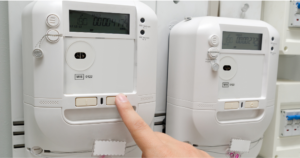
- Bidirectional metering at the host site: A net meter records how much solar power is generated and consumed at this location, just like in standard net metering.
- First-priority netting: Any surplus power generated at the host site is first adjusted against that connection’s own consumption.
- Surplus distribution: Whatever solar credit remains after the host connection’s needs are met is then allocated to your other, linked connections, in the priority order you’ve specified in your application to the DISCOM.
- Billing adjustment: Each of your participating connections sees its electricity bill reduced based on the credits allocated to it for that billing cycle.
No physical electricity moves between your properties. The grid itself acts as the connecting layer, and the DISCOM handles the accounting behind the scenes.
Group Net Metering in Action: A Simple Example
Numbers make this easier to picture. Say a homeowner has one 10 kW solar plant installed at their primary residence (the “host” connection), and three other residential connections, additional flats they own, all under the same DISCOM area, linked to this plant through a sharing ratio decided at the time of application. Most DISCOM application portals cap this at a maximum of four secondary connections per host connection.
Here’s the mechanic worth understanding: rather than a strict “netted first, surplus cascades down” order, many DISCOM application forms ask you to fix a sharing ratio upfront. A percentage split between the host connection and each secondary connection, entered directly in the application. The plant’s total generation is then divided by that pre-agreed ratio every billing cycle, rather than settled sequentially.
In short: the host and each secondary connection are allocated a fixed percentage share of the total solar generation, based on the sharing ratio submitted at the time of application, as this example shows.
Assuming a flat rate of Rs. 10/unit and total monthly solar generation of 1,200 units:
| Connection | Role | Sharing Ratio | Consumption | Units from Solar | Bill Before GNM | Net Grid Import | Net Bill After GNM |
| Flat 101 | Host (plant location) | 40% | 500 units | 480 units | Rs. 5,000 | 20 units | Rs. 200 |
| Flat 102 | Secondary Consumer 1 | 25% | 300 units | 300 units | Rs. 3,000 | 0 | Rs. 0 |
| Flat 201 | Secondary Consumer 2 | 20% | 450 units | 240 units | Rs. 4,500 | 210 units | Rs. 2,100 |
| Flat 202 | Secondary Consumer 3 | 15% | 200 units | 180 units | Rs. 2,000 | 20 units | Rs. 200 |
Who Is Eligible for Group Net Metering?
Eligibility comes down to one core requirement across nearly every state: all your connections must belong to the same consumer, whether that’s an individual, a business, or an institution, and they must sit within the same DISCOM’s supply area.
Beyond that baseline, most states extend eligibility to:
- Commercial consumers with multiple retail outlets, offices, or franchise locations
- Industrial units operating more than one facility under a single company
- Institutions such as schools, trusts, or religious bodies with several campuses or properties
- Residential consumers who own more than one property, each with its own separate connection
- Agricultural consumers with multiple pump or farm connections, where state rules permit it
- Group Housing Societies also come under residential consumers. For their common connection, the society can opt for Group Net Metering.
A few states also set minimum consumption thresholds at the host connection, or require the host and linked connections to belong to the same consumer category, rather than a mix of commercial and residential, for instance. Since these specifics differ by SERC (Structural Engineering Research Centre), it’s worth confirming your exact eligibility with your DISCOM or a solar installer familiar with your state’s regulations before applying.
Can You Get PM Surya Ghar Subsidy with Group Net Metering?
Short answer: mostly no, at least not in the way most people expect.
The central subsidy under the PM Surya Ghar Muft Bijli Yojana is structured around individual residential rooftop installations, net-metered at that specific residential connection. Since group net metering is built around distributing credits across multiple connections, most of which end up being commercial, institutional, or additional properties, it generally falls outside the subsidy’s intended scope.
As per the PMSGY guidelines, if all connections are under the Residential category and the secondary connection is also classified as Residential, then the subsidy will be applicable as per the current guidelines.
That said, there’s some nuance worth knowing:
- If your host connection is a genuinely residential connection, and the installed capacity there independently qualifies under the scheme’s residential criteria, that specific portion may still be subsidy-eligible on its own merit.
- Connections that only receive surplus credits, rather than hosting the plant themselves, typically won’t qualify for the subsidy, since no physical installation happens at their premises.
- Commercial and industrial consumers were never within PM Surya Ghar’s scope to begin with, group net metering or not.
What Is Virtual and Group Net Metering – And Why People Mix Them Up
Ask around, and you’ll notice “virtual net metering” and “group net metering” get used almost interchangeably. They’re related, but they solve different problems.
- Group Net Metering (GNM): One consumer, multiple connections, one solar plant. All connections belong to the same person or entity. A good example is a single company with several branch offices, or a homeowner who owns two adjoining properties with separate meters.
- Virtual Net Metering (VNM): Multiple, different consumers come together to co-own or subscribe to one shared solar plant. Each of them gets credited in proportion to how much they contributed or subscribed. This is the model housing societies typically use, since individual flat owners are separate consumers, not one legal entity.
The Council on Energy, Environment and Water (CEEW) explains this distinction well. In group net metering, electricity is first netted at the plant’s own location, and only the leftover surplus is distributed to the other connections in a pre-decided priority order. In virtual net metering, the entire output of the plant is exported and then split proportionally among all the participating consumers right from the start, since no one connection technically owns the plant.
Group Net Metering vs Virtual Net Metering vs Regular Net Metering
Regular net metering credits one connection at its own site. Group net metering shares one consumer’s solar credits across multiple connections. Virtual net metering splits one shared plant’s credits among different consumers.
| Parameter | Regular Net Metering | Group Net Metering | Virtual Net Metering |
| Number of connections | One consumer, one connection | One consumer, multiple connections | Multiple different consumers |
| Where the plant sits | Same site as consumption | One “host” connection among the consumer’s own sites | A single shared site, on behalf of all participants |
| How credits are shared | Surplus is credited directly to that one connection | Host is netted first; leftover surplus flows to other connections by priority order | Total output is split proportionally among all participants from the start |
| Ownership | Single owner | Typically one owner (the consumer) | Jointly owned, or accessed through a subscription-style model |
| Best suited for | A single home or business with adequate rooftop space | Businesses, institutions, or individuals with more than one connection | Housing societies, apartment owners, or anyone without individual rooftop access |
If you’re a homeowners’ association trying to go solar as a community, you’re almost certainly looking at virtual net metering. If you run one business with several billing connections across town, group net metering is the better fit. And if you simply have one home, one meter, and a decent roof, regular net metering remains the simplest, most widely available route.
Why Group Net Metering Matters Right Now
Group net metering matters because it removes the single biggest barrier to rooftop solar in India: the assumption that every connection needs its own suitable roof. By letting one good rooftop serve multiple electricity bills, it opens solar up to consumers who’d otherwise be locked out entirely.
That shift matters for a few concrete reasons:
- It unlocks solar for consumers with fragmented rooftop space: A business with three outlets, only one of which has usable roof area, no longer has to skip solar at the other two. One plant now works for all three.
- It makes solar financially viable at a more efficient scale: Installing one right-sized plant at a single site is usually more cost-efficient, per unit of capacity, than installing several smaller systems scattered across multiple premises.
- It supports India’s larger rooftop solar targets: Rooftop installations have consistently lagged behind utility-scale solar in India, and constrained roof access is a big part of why. Mechanisms like group net metering give the country a realistic way to close that gap without waiting for every consumer to individually own a perfect roof.
- It extends solar access to consumer segments that were previously excluded: This includes farmers with multiple agricultural connections, institutions running several campuses, and individuals who own more than one property.
It also makes things simpler under government rules. The MNRE has said that group net metering, virtual net metering, and net billing will now be treated the same as regular net metering. This means they follow the same regulations, including the Approved List of Models and Manufacturers (ALMM) requirements.
Group Net Metering Policy in India
Rooftop solar metering in India sits under the Electricity (Rights of Consumers) Rules, 2020, notified by the Ministry of Power. These rules originally capped net metering at a fairly restrictive level, which drew heavy pushback from the rooftop solar industry.
To address this, the Electricity (Rights of Consumers) Amendment Rules, 2021 increased the limit. They allow states to approve net metering for systems up to 500 kW or the consumer’s sanctioned load, whichever is lower, unless the state’s own regulations specify a different limit.
Group net metering itself, however, isn’t something the central rules define outright. Instead, the push came through an MNRE advisory. In January 2022, the Ministry wrote to all State Electricity Regulatory Commissions, requesting them to consider issuing dedicated guidelines enabling group net metering and virtual net metering, in order to widen access to rooftop solar for consumers who couldn’t otherwise use it.
This is the crux of how group net metering policy actually functions in India:
- The central government sets the broad framework and the maximum permissible capacity band under the Electricity (Rights of Consumers) Rules.
- The MNRE issues advisories and guidelines encouraging states to adopt group and virtual net metering as tools to boost rooftop solar penetration.
- Each State Electricity Regulatory Commission (SERC) then has to actually draft, notify, and operationalize its own group net metering regulations, deciding capacity limits, eligible consumer categories, and settlement mechanics for its state.
Which States Allow Group Net Metering?
Net metering rules in India are not the same everywhere. While the MNRE provides the overall guidelines, each state’s Electricity Regulatory Commission (SERC) decides its own rules, system size limits, and application process. The same applies to group net metering, which is being introduced gradually across different states.
Here are a few examples of how this looks on the ground:
- Delhi: Delhi was an early adopter of these frameworks. The Delhi Electricity Regulatory Commission (DERC) notified dedicated Group Net Metering and Virtual Net Metering guidelines in May 2019, setting the project capacity at a minimum of 5 kW and a maximum of 5 MW at a single location.
Source: DERC – Group Net Metering and Virtual Net Metering Guidelines, 2019 - Karnataka: In 2025, the Karnataka Electricity Regulatory Commission (KERC) introduced Group Net Metering and Virtual Net Metering under a tariff order effective from July 1, 2025. The framework sets a minimum plant size of 5 kW, while Group Net Metering requires the host connection to consume at least 20% of the plant’s monthly generation.
Sources: KERC- 2025-26 Solar Tariff Order listing. - Rajasthan: Introduced Group and Virtual Net Metering through an amendment to its distributed renewable energy regulations in 2025, allowing systems from 1 kW up to 1 MW under these arrangements. For Group Net Metering, surplus energy is first adjusted against consumption at the connection where the solar project is located and then against other connections according to a priority list submitted by the consumer.
Source: RERC Third Amendment Regulations, 2025 - Punjab: Punjab’s rooftop-solar framework permits Virtual Net Metering systems up to 500 kWp, subject to the applicable sanctioned-load/contract-demand and regulatory conditions.
Source: PEDA- Rooftop Solar Power Projects
How to Apply for Group Net Metering?
The exact process of applying for group net metering varies by DISCOM, but most states follow a broadly similar sequence:
- Check eligibility and confirm your state’s policy: Verify that your state’s SERC has notified group net metering regulations, and that all your connections qualify.
- Select your host connection: Choose the site with the best rooftop or ground-mount potential, usually the one with the highest available load capacity.
- Decide the priority order: List your other connections in the order you want surplus credits distributed; this becomes part of your formal application.
- Submit your application to the DISCOM: This typically includes proof of ownership or lease for all connections, recent electricity bills, a single-line diagram of the proposed system, and the applicable fee.
- Complete the feasibility check: The DISCOM assesses whether your proposed capacity and connections meet its technical and regulatory requirements.
- Sign the connection agreement: Once approved, you’ll sign an agreement with the DISCOM covering metering, billing, and settlement terms.
- Install and commission the system: Your solar installer sets up the plant along with the bi-directional net meter at the host connection.
- Start receiving credits: From the next billing cycle onward, surplus solar credits are adjusted across your linked connections as per your submitted priority order.
Things to Check Before You Apply for Group Net Metering in India
Because group net metering regulations vary so much by state, here are a few things worth confirming with your DISCOM or solar installer before moving forward:
- Are all your connections within the same distribution licensee’s area?
Group net metering generally only works within a single DISCOM’s supply zone. - Do all connections belong to the same consumer category?
Most states require the host and participating connections to be under similar categories (residential, commercial, etc.), though this varies. - What’s the minimum and maximum system size allowed?
The limits vary by state. Where Group Net Metering is available, minimum project sizes can start at 5 kWp, while maximum limits range from 500 kWp to several MWp, depending on the state’s regulations. For example, Delhi’s framework allows GNM/VNM projects from 5 kWp up to 5 MWp. - How is the priority order for surplus distribution decided?
You typically need to submit this order at the time of application, and it can affect how much credit each connection actually receives.
If you’re evaluating this for a business, farm, or multi-property setup, a quick conversation with your solar EPC partner about current state-specific rules will save a lot of back-and-forth later.
Frequently Asked Questions
Is group net metering available for residential consumers?
In most states that have notified group net metering rules, residential consumers are eligible, provided all their connections fall under the same distribution licensee’s area. Eligibility criteria differ by state.
Can group net metering and virtual net metering be used together?
No. These are distinct regulatory arrangements, and a consumer typically opts into one or the other for a given connection, not both at the same time.
Does group net metering reduce my subsidy eligibility under PM Surya Ghar?
No, group net metering does not by itself reduce subsidy eligibility under the PM Surya Ghar Muft Bijli Yojana. As per the scheme guidelines, if all connections are classified under the Residential category and the secondary connection is also classified as Residential, the subsidy remains applicable as per the prevailing guidelines.
Who owns the solar plant under a group net metering arrangement?
Typically, the same consumer who owns or holds all the linked electricity connections owns the plant, though RESCO (third-party ownership) models are permitted in several states as well.
Can group net metering connections be spread across different DISCOMs?
No. Most state regulations require the host connection and all linked connections to fall within the same distribution licensee’s supply area, since the DISCOM has to track and adjust credits across all of them within its own billing system.
Is there an application fee for group net metering?
Yes, in most states. Fees and documentation requirements vary by DISCOM, and typically cover viability assessment, registration, and connection agreement charges. Your solar installer or the DISCOM’s website will have the current fee schedule.