

 2 Reads
 15 mins


The common area electricity bill is one of the highest recurring costs for most housing societies. Lifts running all day, water pumps running every few hours, parking lights, clubhouse AC, and security can push the monthly bill well above a lakh for a mid-sized society. For larger societies with multiple towers, that number can cross five lakh a month.
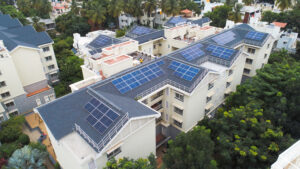
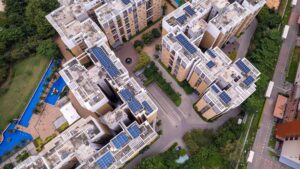
This is exactly where solar power for common areas makes a real difference. Societies that switch to solar can cut their CAM (common area maintenance) bills by almost 90%. You can also avail benefits from solar for apartments, depending on state regulations and building rules. A rooftop solar system for housing societies can help you with
- Cutting your society’s common-area electricity bill
- Spreads the cost across many households, so the per-flat burden stays manageable
- Qualifies your society for a dedicated government subsidy under PM Surya Ghar Muft Bijli Yojana
- Often shows up as a visible drop in your monthly maintenance charges
- Makes use of roof space that’s otherwise sitting idle
In this blog, you’ll learn exactly what it takes to get a solar project off the ground for your housing society, and some common mistakes that trip up most societies early on. Your exact process will still depend on your society’s size, how your roof ownership works, and your state’s rules.
Why Solar Makes Sense for Housing Societies
Installing solar for housing societies can cut your common-area electricity bill by 90%, offer an average payback time of 2 to 3 years, and unlock government subsidies like PM Surya Ghar Muft Bijli Yojana.
Your common-area consumption, including lifts, lighting, water pumps, and security systems, is a steady load running all day, exactly the kind of pattern solar can offset well. Also, you’re installing one larger shared system instead of several small individual systems; you typically get a lower cost per kW too.
A few more things make this worthwhile:
- Net metering applies to your common-area connection: If your panels make more power than your lifts, lights, and pumps use during the day, that extra power doesn’t go to waste. It gets sent back to the grid, and you get credit for it through net metering, which you can use against your bill later, like at night when your panels aren’t generating anything
- A dedicated government subsidy exists specifically for societies: Under the PM Surya Ghar scheme, GHS/RWAs (Group Housing Societies/Resident Welfare Associations) can claim ₹18,000 per kW for common facilities, including EV (Electric Vehicle) charging, up to 500 kW capacity, calculated at 3 kW per house
Source: pmsuryaghar.gov.in
- Lower maintenance bills, visible to every resident: Since your common-area electricity cost is usually already part of your monthly maintenance charge, the savings from solar aren’t hidden somewhere in a society account. Every resident sees it directly, as a smaller number on their own maintenance bill.
Common Area vs Individual Flat Solar: Know the Difference First
You must know that you can install solar for shared common areas or for your individual flat. Before your society goes any further, decide exactly what the solar system is powering, because this one decision changes everything downstream.
Common area solar: Installing solar for common areas can power your lifts, common lighting, water pumps, and security systems. It’s billed to your society’s own common-area electricity connection, and it’s the simpler, more established path.
Individual flat solar: Installing solar for apartments or an individual flat is a different arrangement entirely. This needs individual metering and separate permission from the society, and it’s considerably more complex to coordinate.
Tip: Most societies start with common-area solar for good reason. It’s simpler to execute, and both subsidy and metering rules are far more established for this use case than for individual flat arrangements on a shared roof.
Eligibility and Documents Required for Solar Housing Society
Your housing society must have a legal registration, a bank account, and other documents to be eligible for installing solar. The eligibility criteria for a housing society to avail of the subsidy include the following:
- The Society should be legally registered.
- The Society should have a PAN Card
- The Society should have an eligible Bank Account
- The panel should be an Indian-manufactured DCR (Domestic Content Requirement)
- The Society should have a Detailed Project Report (DPR) from Engineering, Procurement, and Construction (EPC) professionals
Under the PM Surya Ghar Muft Bijli Yojana, the Indian government offers rooftop solar subsidies at a flat rate of ₹18,000 per kW across all states and cities. Housing societies must have the documents below to secure this government subsidy.
- Proof of Identity and Address: Identity proof of the society’s authorised signatory (e.g., Aadhaar card, PAN card). Address proof of the society’s registered office (e.g., utility bill, rental agreement).
- Society Registration Certificate: A copy of the society’s registration certificate, which is proof of the society’s legal existence
- Electricity Bills: The most recent electricity bill(s) for the society’s common areas or the building where the solar system will be installed.
- Resolution of the Society: A formal resolution passed by the society’s AGM (Annual General Meeting) or managing committee authorising the solar panel installation and appointing a committee to oversee the project.
- Roof Ownership Certificate: Documentation proving the society’s ownership or legal right to use the roof where the solar panels will be installed.
- No Objection Certificate (NOC): An NOC from the local municipal authority, if required, to allow the installation of solar panels on the society’s property.
- Feasibility Report: A report from DISCOM (Distribution Company) or an accredited solar vendor that assesses the suitability of the site for solar installation and provides technical specifications.
What’s the Cost of Rooftop Solar for Housing Societies?
Solar panel costs for a society vary depending on your city, your system size, your site conditions, and the specifics of your particular project. On average, the cost of a solar panel for a society can range between ~₹ 60,000* per kW and ~₹ 65,000* without any government subsidy.
Before explaining the total subsidy you can claim under the PM Surya Ghar Muft Bijli Yojana for installing solar in housing societies, let’s have a look at the estimated cost of installing rooftop solar for housing societies for different-capacity solar systems without any subsidy assistance.
| Solar System Size | Cost of Residential Solar Power Systems for Housing Societies without Subsidy* |
| 30 kW solar system | ~₹ 18L to ~₹ 19.50L |
| 50 kW solar system | ~₹ 30L to ~₹ 32.50L |
| 100 kW solar system | ~₹ 60L to ~₹ 65L |
| 200 kW solar system | ~₹ 1.20 Cr. to ~₹ 1.30 Cr. |
| 300 kW solar system | ~₹ 1.80 Cr. to ~₹ 1.95 Cr. |
| 500 kW solar system | ~₹ 3 Cr. to ~₹ 3.25 Cr. |
*Please note: Prices are subject to change. The cost of a solar panel for apartments for on-grid solar systems listed in the section above is subject to change. The final cost of solar panels for a housing society depends on your DISCOM charges, city, solar system size, site conditions, project specifications, product variant opted for, panel type, inverter type, mounting structure height, type of after-sales service, savings guarantee, roof height, etc.
Subsidy for Housing Society Solar in India
Under PM Surya Ghar Muft Bijli Yojana, the central government provides a subsidy of ₹18,000 per kW for common facilities, including EV (Electric Vehicle) charging, up to 500 kW Capacity (@3 kW per house). The upper limit is inclusive of individual rooftop solar plants installed by individual residents in the GHS/RWA (Group Housing Society/Resident Welfare Association).
Here’s a tabulated snapshot of the total solar subsidy you can claim for installing solar panels for housing societies in India:
| Solar System Size | PM Surya Ghar Subsidy for Installing Solar in Housing Societies |
| 30 kW solar system | ₹ 5.40 L |
| 50 kW solar system | ₹ 9 L |
| 100 kW solar system | ₹ 18 L |
| 200 kW solar system | ₹ 36 L |
| 300 kW solar system | ₹ 54 L |
| 500 kW solar system | ₹ 90 L |
This subsidy applies specifically to your common facilities, not to individual flats. If a resident wants solar for their own flat separately, that falls under the standard residential PM Surya Ghar subsidy process for an individual homeowner, not this society-level provision.
Cost of Residential Solar Systems for Housing Societies with a Subsidy
The cost of rooftop solar for housing societies with subsidy is between ~₹ 42,000* per kW and ~₹ 47,000* per kW. Here’s a snapshot of the cost of solar panels for housing societies with subsidy:
| Solar System Size | Cost of Residential Solar Systems for Housing Societies with Subsidy* |
| 30 kW solar system | ~₹ 12.60 L to ~₹ 14.10 L |
| 50 kW solar system | ~₹ 21 L to ~₹ 23.50 L |
| 100 kW solar system | ~₹ 42 L to ~₹ 47 L |
| 200 kW solar system | ~₹ 84 L to ~₹ 94 L |
| 300 kW solar system | ~₹ 1.26 Cr. to ~₹ 1.41 Cr. |
| 500 kW solar system | ~₹ 2.10 Cr. to ~₹ 2.35 Cr. |
*Please note prices are subject to change. The cost of rooftop solar for housing societies for on-grid solar systems with subsidy listed in the section above is subject to change. The final cost of residential solar power panels depends on your DISCOM charges, city, solar system size, site conditions, project specifications, product variant opted for, panel type, inverter type, mounting structure height, type of after-sales service, savings guarantee, roof height, etc.
Financing Options for Housing Societies
You have three ways to finance solar for your housing society in India: CAPEX(Capital Expenditure), OPEX(Operating Expense), or SolarSquare’s ZIP (Zero Investment Plan) loan. The best approach depends on how much your society wants to pay upfront and how fast you want the savings to start.
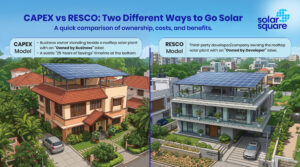
- CAPEX (Corpus Funding): Your society pays for the system using its own corpus fund. You own the system from day one, and every unit of electricity it generates cuts straight into your common area bill. That means all the savings stay with your society; nothing goes anywhere else. This option gives you the best long-term returns and gets you closest to a zero common-area electricity bill. However, it requires the largest upfront commitment to install solar panels on flats.
- SolarSquare’s ZIP (Zero Investment Plan): This is SolarSquare’s zero-investment solar loan. Your society gets solar installed with no upfront payment at all. The government subsidy covers the initial cost, and the rest gets spread out as EMIs (Equated Monthly Installments) over 6 to 60 months. Your society still owns the system right from day one, and your savings turn positive almost immediately.
- OPEX (Third-Party Investment): OPEX is a third-party fund that installs and maintains the system on your rooftop. Your society only pays for the electricity you actually use, usually at a rate lower than what the grid charges. There are no upfront costs and no maintenance to worry about. Since your society doesn’t own the system, your savings end up smaller than what you’d get with CAPEX or ZIP.
You can read more about these financing schemes in our blog on CAPEX vs RESCO Solar Financing: Which One Should You Choose?
ROI and Payback Period for Installing Solar in Housing Society
Installing solar panels for residential buildings in India can save lakhs, and even crores, of rupees by bringing common-area electricity bills down to zero or near zero. The average payback time for solar panels for housing societies is 2 to 3 years. Their solar payback time depends on the common-area electricity tariff, lift and water-pump consumption, available rooftop space, and how much solar electricity is used on the premises.
Here is a snapshot of housing societies and establishments where we installed rooftop solar systems, along with the savings they have generated to date.
| Name of the Housing Society / Commercial Establishment and System Capacity Installed | When Was the Solar Energy System Commissioned? | Breakeven Period | Solar Savings |
| Housing Society – Godrej Infinity Housing Society: 400 kW Solar System | June 2024 | 1.4 years | Savings till April 2026: Rs. 2,07,90,000 (two crore seven lakh ninety thousand) |
| Housing Society – Ganga Ishanya: 235 kW Solar System | February 2024 | 2.18 years | Savings till April 2026: Rs. 1,44,98,437 (One crore forty-four lakh ninety-eight thousand four hundred thirty-seven) |
| Housing Society – Ganga Ishanya: 40 kW Solar System | October 2024 | 2.11 years | Savings till April 2026: Rs. 17,01,600 (Seventeen lakh one thousand six hundred.) |
| Commercial Establishment – Enpro Industries: 855 kW | Commissioned between July 2019 – Dec 2020 in three phases | 1.07 years | Savings till April 2026: Rs. 16,37,26,875 (Sixteen crore thirty-seven lakh twenty-six thousand eight hundred seventy-five) |
| Commercial Establishment – JSW Group: 520 kW | June 2021 | 1.02 years | Savings till April 2026: Rs. 7,12,44,000 (Seven crore twelve lakh forty-four thousand) |
| Commercial Establishment – Uma Industries: 110 kW | March 2024 | 1 year | Savings till April 2026: Rs. 64,96,875 (Sixty-four lakh ninety-six thousand eight hundred seventy-five) |
Best Practices for Choosing a Solar Company for Your Housing Society
When hundreds of homes depend on one rooftop system, there’s no room for guesswork. The system sizing needs to be exact, structural calculations need to hold up, and the subsidy paperwork needs to go through without errors. Here’s what your society should look for, and what good practice actually looks like in action.
Look for real experience at society scale
Installing for a housing society is a different job from installing on a single home. Ask any solar company you’re considering how many societies they’ve actually worked with, and at what scale.
SolarSquare has installed 20 MW of capacity across 500+ housing societies in India, including Raheja Vistas CHS in Mumbai, an 810kW system that’s the largest subsidised housing society solar project under PM Surya Ghar in the country. They’ve also executed large installations at Lodha Aqua CHS (500 kW), L&T South City Bangalore (500 kW), Hyde Park CHS (425 kW), and 24K Opula Apartments (308 kW). A company with this kind of range, from individual homes to 800+ kW society projects, brings the engineering depth your project actually needs.
Check the mounting structure, not just the panels
Your panels are only as strong as what’s holding them up. Ask what mounting structure a solar company uses, and whether it’s built for your region’s weather. SolarSquare uses WindPro Mount™, an IIT-Bombay-approved structure made from virgin steel, protected by an 80-micron hot-dip galvanized coating, and built to stay intact in winds up to 170 km/hr.
Ask for a written performance guarantee
Most vendors talk about expected savings. Few put a number behind it. Ask specifically whether a solar company backs their generation estimate in writing, and what happens if your system underperforms. SolarSquare is India’s first solar company to offer a generation guarantee with a money-back commitment, paying ₹8 per unit for any shortfall against the promised output.
Confirm what after-sales support actually includes
A system that isn’t maintained loses efficiency quietly, year after year. Ask for the specifics: how many visits, over what period, and what each visit covers. SolarSquare includes 5 years of maintenance with monthly visits, covering 24/7 remote monitoring, breakdown support, deep panel cleaning, and full electrical, structural, and mechanical inspections.
Check how the system holds up in extreme weather
For a shared rooftop asset covering hundreds of homes, storm resilience isn’t optional. Ask your solar company for their actual track record during severe weather, not just a claim. SolarSquare has maintained a 99.91% storm-safety record over the past two years, built on WindPro Mount™ structures engineered to BIS (Bureau of Indian Standards) standards.
Ask about leakage protection
Installation work on a shared roof carries real risk if it’s not done properly. Ask what method a vendor uses to seal mounting points, and whether there’s a warranty backing it. SolarSquare uses HILTI Airtight chemical anchoring to seal drilled holes against moisture, backed by a ₹1 lakh water-leakage warranty for the first year.
Run any solar company you’re evaluating through these six checks. A company that can answer all of them clearly, in writing, is showing you exactly the kind of accountability a shared society asset actually needs.
If you’re planning to install rooftop solar in your society and looking for a reliable partner, you can book a free solar consultation call with SolarSquare today.
Frequently Asked Questions
Can a housing society get a subsidy for solar panels in India?
Under PM Surya Ghar Muft Bijli Yojana, group housing societies and RWAs can claim ₹18,000 per kW for common facilities, including EV charging, up to 500 kW capacity, calculated at 3 kW per registered house.
What’s the difference between common area and individual flat solar in a society?
Common area solar powers shared facilities like lifts and lighting, billed to the society’s connection. Individual flat solar is a separate arrangement for one resident’s own flat, requiring individual metering and society permission.
Who decides on solar installation in a housing society?
The managing committee typically initiates the process, but a formal resolution and resident consensus are usually needed too, especially since the subsidy application requires committee documentation.
How is a housing society solar system financed?
You can take common routes, including using the society’s corpus fund, taking a loan in the society’s name, collecting a one-time per-flat contribution from residents, or opting for a RESCO model with zero upfront cost.
Does an older building need a special assessment before solar installation?
Yes, an older building needs a special assessment before solar installation. A structural assessment confirms whether the roof can safely bear the added weight of panels and mounting structure, which matters more for older buildings than newer RCC construction.
Who maintains a housing society’s solar system after installation?
This should be clearly assigned, either to a committee member or a managing agency, with a structured original agreement, so maintenance doesn’t get neglected over time.


 Previous Article
 20 min