

 2 Reads
 12 mins


The Odisha solar subsidy can take up to ₹1,38,000 off a 3 kW rooftop system in 2026. That is ₹ 78,000 from the Centre under the PM Surya Ghar: Muft Bijli Yojana, plus up to ₹60,000 from the Odisha government.
Sounds simple, until you start searching. One site says Odisha gives no state support, another promises the full ₹1.38 lakh, and a few still quote last year’s prices. If you live in Bhubaneswar, Cuttack, Berhampur, or Sambalpur and just want a straight answer before spending lakhs on a system, that gets frustrating fast.
So here is the straight answer. This guide shows what the solar subsidy in Odisha is worth for 1 kW, 2 kW, and 3 kW systems, who is eligible, which documents you need, how the application works step by step, and how long the money really takes to arrive.
Odisha Solar Subsidy 2026 at a Glance
Here’s the short version before we get into the details. Skim this table, then read on for the fine print that decides whether you actually receive the money.
| Point | What to know |
| Main scheme | PM Surya Ghar: Muft Bijli Yojana (PMSG: MBY), run by the Ministry of New and Renewable Energy (MNRE) |
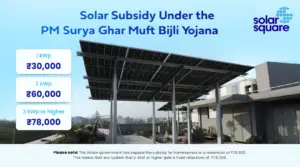
| Central subsidy | ₹30,000 for 1 kW, ₹ 60,000 for 2 kW, ₹ 78,000 for 3 kW and above |
| Odisha state top-up | ₹25,000 for 1 kW, ₹50,000 for 2 kW, up to ₹60,000 for 3 kW and above |
| Maximum combined benefit | ₹1,38,000 for a 3 kW home system |
| Who can apply | Residential electricity consumers with a grid connection |
| How it is paid | Directly to your bank account, after installation and net meter commissioning |
| Where to apply | National Portal for PM Surya Ghar |
What Is the Odisha Solar Subsidy?
There isn’t one single “Odisha subsidy”. What households call the solar subsidy in Odisha is really two layers of financial support stacked together: a central one from the Government of India and a top-up from the state. This section explains each layer so you know where the money comes from.
Central Subsidy Under PM Surya Ghar
Launched with an outlay of ₹75,021 crore, PM Surya Ghar aims to put rooftop solar on one crore homes by financial year 2026-27. The money you receive is called Central Financial Assistance (CFA). It is a fixed amount linked to your system size, not a percentage of what you pay your installer. Applications and tracking all happen on the official PM Surya Ghar portal, and the scheme rules sit with MNRE.
Odisha Govt Solar Subsidy (State Top-Up)
Odisha added its own support on top of the central amount. The state set aside ₹495 crore for this top-up in its financial year 2026-27 budget, routed through the Odisha Akshaya Shakti Bikash Yojana (OASBY).
A quick word of caution. Some national websites still say Odisha offers no additional state subsidy. Those pages were last updated in late 2025 and haven’t caught up. For the latest position, check with the Odisha Renewable Energy Development Agency (OREDA), which is the state nodal agency for rooftop solar.
How Much Is the Rooftop Solar Subsidy in Odisha?
This section lays out the exact amounts by system size, shows what happens above 3 kW, how this might affect 1kw solar panel price in Odisha with subsidy, and gives you a simple way to work out your own number.
Subsidy by System Size
| System size | Central subsidy | Odisha state top-up | Total subsidy |
| 1 kW | ₹30,000 | ₹25,000 | ₹55,000 |
| 2 kW | ₹ 60,000 | ₹50,000 | ₹1,10,000 |
| 3 kW | ₹ 78,000 | ₹60,000 | ₹1,38,000 |
| Above 3 kW | ₹ 78,000 | Up to ₹60,000 | Up to ₹1,38,000 |
The state’s slab works out as ₹25,000 for the first kW, ₹25,000 for the second, and ₹10,000 for the third. That is why the 3 kW figure is ₹60,000 and not ₹75,000.
What If You Install More Than 3 kW?
You can install a system above 3kW. The subsidy simply stops growing. The central amount is capped at ₹78,000, and the state top-up tops out at ₹60,000, so a 3kW solar panel price in Odisha with subsidy has the same deductions as a 5 kW system would have. Bigger systems still make sense if your consumption is high, but plan for the extra cost to come out of your own pocket.
Odisha Solar Subsidy Calculator: Work It Out Yourself
You don’t need a fancy tool. Use this three-step method, or run the same numbers on the portal’s own calculator.
- Pick your rooftop solar system size (1 kW, 2 kW, or 3 kW and above).
- Add the central and state amounts from the table above.
- Subtract the total from your installer’s quote. What’s left is your net cost.
Who Is Eligible for the Solar Panel Subsidy in Odisha?
Not everyone who installs solar gets the subsidy, so it pays to check the rules first. The following are the eligibility requirements for the solar panel subsidy in Odisha:
- You are a residential consumer with a valid electricity connection from an Odisha distribution company (DISCOM).
- You have a suitable, shadow-free roof that you own or have the right to use.
- You install a grid-connected rooftop system.
- Your installer is empanelled on the national portal.
- Your panels and inverter meet the approved list and BIS (Bureau of Indian Standards) requirements.
- You haven’t already claimed a rooftop solar subsidy for the same connection.
The four DISCOMs in Odisha are TPCODL (Tata Power Central Odisha Distribution Limited), TPNODL (Tata Power Northern Odisha Distribution Limited), TPSODL (Tata Power Southern Odisha Distribution Limited), and TPWODL (Tata Power Western Odisha Distribution Limited). Which one you deal with depends on your district.
Documents Required for the Odisha Solar Subsidy
Missing paperwork is one of the most common reasons applications stall. Keep these ready before you register, and the process moves much faster.
- Recent electricity bill (it carries your consumer number)
- Aadhaar card
- Proof of ownership or right to use the roof
- Bank account details with a cancelled cheque (the account should be in your name)
- Passport-size photograph
- Photo of the proposed rooftop space
Make sure the name on your electricity bill matches your Aadhaar and bank account. A simple mismatch can hold up the subsidy payment.
Odisha Solar Subsidy Process: Step by Step
The application runs online, but several steps depend on your DISCOM and installer. This section walks through the journey in order, so you know what happens next at every stage.
Step 1: Register on the National Portal
Go to pmsuryaghar.gov.in, choose Odisha as your state, pick your DISCOM, and enter your consumer number. Register before you talk to any installer so the application is in your name from day one.
Step 2: Apply for Rooftop Solar
Log in with your consumer number and mobile number, then submit the rooftop solar application. Pick the system capacity based on your bills and the roof space you have.
Step 3: Wait for DISCOM Feasibility Approval
Your DISCOM checks whether your connection can take the system. Reports from installers suggest this stage commonly takes a couple of weeks, though it varies. According to the information published for Odisha, a separate technical feasibility study isn’t required for systems up to 10 kW.
Step 4: Choose an Empanelled Vendor
Pick an installer from the portal’s state-wise vendor list. Check the empanelment on the portal itself, not just on a brochure. Compare at least two or three quotes on panel brand, inverter, warranty, and after-sales support.
Step 5: Installation
The vendor surveys your roof, designs the system, and installs it. The physical installation of a home system often takes only a day or a few days. Scheduling and materials are usually what take longer.
Step 6: Net Meter Installation and Inspection
Your DISCOM installs a net meter, which records both what you draw from the grid and what you send back. It then inspects the system and issues a commissioning report. This is the step where delays most often creep in.
Step 7: Submit Bank Details
Once the system is commissioned, upload your bank details and a cancelled cheque on the portal.
Step 8: Receive the Subsidy
The central subsidy is credited to your bank account through Direct Benefit Transfer (DBT). Ask your installer or OREDA how the Odisha state top-up is claimed and credited against your application, as the procedure can differ from the central payment.
How Long Does the Odisha Solar Subsidy Take?
This is the question people care about most, and the honest answer is “it depends on the queue”. Below is a realistic picture based on the scheme’s stated process and what installers report. This section also explains why some applications take longer than others.
| Stage | Typical time (indicative) |
| Portal registration and application | 1 to 2 days |
| Vendor survey and installation | A few days to 2 weeks, depending on scheduling |
| Net meter installation and inspection | About 1 to 4 weeks |
| Central subsidy credit after commissioning report | Around 30 days as per the scheme’s stated window |
| End-to-end | Roughly 6 to 12 weeks in smooth cases, longer if DISCOM queues |
Why Do Some Applications Get Delayed?
The following are some of the reasons why your STSE subsidy of PM Surya Ghar Muft Bijli Yojana application gets rejected or delayed:
- Name or consumer number mismatch between documents
- Bank account not linked or not in the applicant’s name
- Net meter queues at the DISCOM
- Non-compliant equipment or a non-empanelled installer
- Incomplete commissioning report upload
Net Metering in Odisha
Net metering is what turns your rooftop plant from a power source into a money saver. This section explains how it works and what the rules allow.
With net metering, any extra electricity your panels produce during the day goes back to the grid. Your DISCOM credits those units against your consumption, so your bill falls. Odisha’s net metering framework, set under the Odisha Electricity Regulatory Commission (OERC), covers systems from 1 kWp to 500 kWp. Your DISCOM handles the meter installation and inspection.
Financing: Loans for Rooftop Solar
Because the subsidy comes after installation, you’ll need to pay upfront or borrow. This section covers the solar loan option under the scheme.
PM Surya Ghar is paired with collateral-free loans for residential rooftop solar, offered through public sector banks. For example, the State Bank of India (SBI) Surya Ghar loan is available for eligible applicants. Check the loan limit, interest rate, and repayment terms directly with the bank, since they can change. If you choose an Equated Monthly Instalment (EMI) route through an installer, compare the total cost with a bank loan.
Common Mistakes to Avoid
Most subsidy problems are avoidable. Keep this short checklist handy.
- Paying an installer before registering on the portal
- Picking a vendor only on price, without checking empanelment
- Ignoring shading on the roof
- Not asking for ALMM (Approved List of Models and Manufacturers) compliance proof in writing
- Assuming a bigger system means a bigger subsidy
- Skipping the DISCOM approval and net meter steps
Is Rooftop Solar Worth It in Odisha?
For most households with steady daytime usage, yes. Your payback depends on three things: your net cost after subsidy, your monthly units consumed, and your DISCOM tariff. Divide your net cost by your yearly bill savings to get a rough payback period. After that, you’re effectively generating free electricity for the rest of the system’s life. Panels typically carry long performance warranties, so ask for the details in writing.
The subsidy is generous, but the process has a lot of moving parts: portal registration, DISCOM approvals, compliant equipment, net metering, and paperwork. SolarSquare is a residential rooftop solar company that looks after the journey end to end, from system design and installation to financing support and after-sales service.
Frequently Asked Questions
How much solar subsidy is available in Odisha in 2026?
Eligible residential consumers can get up to ₹ 78,000 from the central government and up to ₹60,000 from the Odisha government, which adds up to ₹1,38,000 for a 3 kW system.
Does Odisha give a state subsidy on top of PM Surya Ghar?
Yes. Odisha provides additional state support of ₹25,000 for 1 kW, ₹50,000 for 2 kW, and up to ₹60,000 for 3 kW and above, on top of the central subsidy. Confirm the current terms with OREDA.
What is the subsidy for 1 kW, 2 kW, and 3 kW solar in Odisha?
The combined subsidy is ₹55,000 for 1 kW, ₹1,10,000 for 2 kW, and ₹1,38,000 for 3 kW. You can use the following table as the solar subsidy in Odisha calculator:
| System size | Central subsidy | Odisha state top-up | Total subsidy |
| 1 kW | ₹30,000 | ₹25,000 | ₹55,000 |
| 2 kW | ₹ 60,000 | ₹50,000 | ₹1,10,000 |
| 3 kW | ₹ 78,000 | ₹60,000 | ₹1,38,000 |
| Above 3 kW | ₹ 78,000 | Up to ₹60,000 | Up to ₹1,38,000 |
How do I apply for the rooftop solar subsidy in Odisha?
Register on pmsuryaghar.gov.in with your consumer number, apply for rooftop solar, get DISCOM approval, choose an empanelled vendor, complete installation and net metering, then submit your bank details.
Is the subsidy paid before or after installation?
The solar subsidy is paid after your rooftop solar system has been installed and commissioned. You pay the installer first, and the subsidy is credited to your bank account once the system is commissioned and verified.
How long does it take to receive the Odisha solar subsidy?
The central subsidy is stated to be credited within about 30 days of the commissioning report. End to end, many households see roughly 6 to 12 weeks, depending on DISCOM approvals and net meter installation.
Can I get a subsidy for a 5 kW system?
You can install 5 kW, but the central subsidy stays capped at ₹78,000 and the state top-up at ₹60,000, so the subsidy is the same as for 3 kW.
Is the subsidy available for commercial or industrial buildings?
The PM Surya Ghar subsidy is meant for residential consumers. Commercial and industrial users follow different policies.


 Previous Article

 18 min