

 3139 Reads
 16 mins




Electricity bills in Karnataka climb higher almost every year, with tariffs rising by 3-6% annually. For homes with multiple fans, a refrigerator, a geyser, and a couple of air conditioners, that annual tariff hike translates to a hefty chunk of money taken away every month. The good news is that with abundant sunshine year-round, a rooftop solar system is a practical way to reduce hefty electricity bills by at least 90%.
To make that switch affordable, the government offers a solar subsidy in Karnataka through the PM Surya Ghar Muft Bijli Yojana, capped at ₹ 78,000 for 3 kW or higher-capacity systems. More than 40 lakh households across India have already installed rooftop solar under this scheme, and the solar energy subsidy in Karnataka will be offered only until the government solarizes 1 crore homes nationwide.
Once that target and budget are exhausted, the current subsidy on a solar power plant in Karnataka will no longer be available, making 2026 the best time to go solar.
Read on to explore the total rooftop solar subsidy in Karnataka that homeowners can get, how to apply for it, eligibility criteria and relevant documentation, and the mistakes that can make you lose the subsidy for solar panels in Karnataka.
How Much is the Solar Subsidy in Karnataka in 2026?
The solar panel subsidy in Karnataka for homes comes entirely from the PM Surya Ghar Muft Bijli Yojana scheme, and the amount depends on the size of the system you install. The scheme uses a tiered structure.
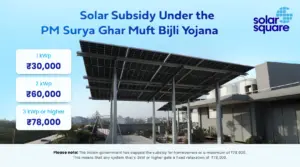
- You get ₹ 30,000 per kW for the first 2 kW
- Then, you get ₹ 18,000 for the third kW
- The total solar power plant subsidy in Karnataka under the PM Surya Ghar Muft Bijli Yojana is capped at ₹ 78,000 for systems of 3 kW or above.
The table below lays out the solar power subsidy in Karnataka by capacity.
| Solar System Size | PM Surya Ghar Muft Bijli Yojana Solar Rooftop Subsidy in Karnataka |
| 1 kW solar system | ₹ 30,000 |
| 2 kW solar system | ₹ 60,000 |
| 3 kW solar system | ₹ 78,000 |
| 4 kW solar system | ₹ 78,000 |
| 5 kW solar system | ₹ 78,000 |
| 10 kW solar system | ₹ 78,000 |
Does Karnataka Offer an Additional State Subsidy?
No, Karnataka does not provide a separate state top-up for residential rooftop solar panel systems. The central government’s PM Surya Ghar scheme is the only financial assistance available to homeowners and housing societies.
However, the Karnataka government subsidies for solar power are not limited to electricity-generating photovoltaic panels alone.
- The Karnataka Renewable Energy Development Limited, or KREDL, runs separate state-level programs for other solar products, and a solar water heater subsidy in Karnataka falls under that track.
- KREDL administers the solar water heater subsidy in Karnataka for eligible categories such as individuals, self-help groups, and farmer clubs, and the amount varies by system capacity and applicant type.
- Since the subsidy for a solar water heater in Karnataka changes from time to time, you should confirm the current rate with KREDL or an MNRE-approved supplier before buying.
What is the Soura Gruha Yojane (SGY)? BESCOM’s Own Rooftop Scheme
Many homeowners still search for the Soura Gruha Yojane, an earlier scheme implemented by BESCOM under MNRE guidelines. That solar rooftop subsidy in Karnataka offered a ~40% percentage-based benefit for systems up to 3 kW. However, it is no longer active.
As we explained earlier, the PM Surya Ghar Muft Bijli Yojana is effectively the only solar rooftop Yojana in Karnataka for homeowners and housing societies that install a grid-tied solar system.
What is the Role of DISCOMs in Solar Installation in Karnataka?
You do not apply to a central office for your subsidy. The work is carried out through your local electricity distribution company, known as a DISCOM, which handles applications, feasibility approvals, site inspections, net-meter or smart meter installation, and billing settlements within its area.
Karnataka has five of them, and the one that serves your address is the one you deal with.
- BESCOM: It covers Bengaluru urban and rural, Tumakuru, Chitradurga, Davangere, Ramanagara, Kolar, and Chikkaballapura.
- HESCOM: It covers Hubballi, Dharwad, and most of north-western Karnataka.
- MESCOM: It covers Mangaluru and the coastal and Malnad districts, such as Dakshina Kannada, Udupi, and Shivamogga.
- CESCOM: It covers Mysuru, Mandya, Hassan, and Chamarajanagar.
- GESCOM: It covers Kalaburagi and the north-eastern districts, including Bidar, Raichur, Ballari, and Koppal.
What Has Changed in the Rules for a Subsidy for Solar in Karnataka?
Effective from July 1, 2025, the Karnataka Electricity Regulatory Commission rebranded rooftop solar as Distributed Solar PV, or DSPV, and introduced more flexible net metering options for residential and industrial consumers.
Two of these changes matter the most if you are installing rooftop solar this year.
- There’s no mandatory battery storage requirement: KERC rejected proposals that would have forced consumers to install battery-based solar systems, citing the high costs they entail. You can opt for a smart meter or simply retrofit your existing meter with a communication module, which keeps your upfront cost lower.
- Faster BESCOM timelines: DISCOMs now have to finalize group and virtual net metering agreements within 15 days of receiving an application. This reduces the long waits that frustrated earlier applicants.
The reforms also allow you to relocate your solar plant within the same DISCOM area without renegotiating your power purchase agreement.
Who is Eligible for a Solar Subsidy in Karnataka?
The Karnataka government solar subsidy under the PM Surya Ghar Muft Bijli Yojana is intended for residential consumers, and the conditions to qualify are simple. Before you apply for the solar system subsidy in Karnataka, run through the checklist below to make sure you are covered.
- You must be an Indian citizen with an active electricity connection in your name with your city’s DISCOM.
- You must have the ownership of the roof/property where the plant will be installed.
- You must choose only made-in-India, ALMM-approved solar panels.
- You have never benefited from a subsidy for systems up to 3 kW before.
Gruha Jyothi + Solar: What Happens to Your Free 200 Units?
Karnataka’s Gruha Jyothi scheme provides domestic consumers with free electricity for up to 200 units per month. That leads many homeowners to ask a fair question. If the power is already free, why install solar panels at all?
The answer comes down to how much energy you actually use, and three points settle it.
- Gruha Jyothi only covers the first 200 units: The moment your monthly consumption crosses that limit, you pay the full retail tariff on the entire bill. And most homes running multiple air conditioners easily cross the 200-unit mark. That’s where solar power generated by panels comes into the picture, shielding you from rising electricity tariffs by generating free electricity using solar radiation. Any surplus you generate during the day is exported to the grid for credit through net metering.
- You own the asset for around 25 years: Free-power schemes depend on government policy and can change with budgets and elections. A rooftop solar system stays yours for two decades and shields you from both tariff hikes and future policy shifts.
- Your usage pattern determines the value: If your consumption is below 200 units per month, your payback period will be longer, and solar may be less urgent. For high-consumption homes, the savings start from the first bill.
Solar Water Pump Subsidy for Karnataka Farmers Through the PM-KUSUM Scheme
The Karnataka government solar pump subsidy falls under a separate central program, PM-KUSUM Yojana, and operates differently from the rooftop scheme under the PM Surya Ghar Muft Bijli Yojana.
The Pradhan Mantri Kisan Urja Suraksha Evam Utthaan Mahabhiyan, or PM-KUSUM, is a central MNRE scheme that helps farmers move away from diesel and grid-dependent irrigation by supporting solar water pumps and solar power plants on farmland.
Component A of PM-KUSUM allows farmers to set up small solar plants on barren land, which is the primary route for a farm-level solar power plant subsidy in Karnataka.
Under Component B of the scheme, farmers can install standalone off-grid solar pumps. A solar pump set subsidy in Karnataka is offered on pumps up to 7.5 HP.
The cost is shared between a central subsidy of ~30%, 50% state subsidy, and a small farmer contribution of ~20%.
- The 5 HP solar water pump price in Karnataka before this subsidy can be in the range of ~₹ 3 lakh* to ~₹ 3.5 lakh*.
- The Karnataka solar pump subsidy has been increasing steadily, with the government announcing 40,000 off-grid pump sets under Component B.
*Please note: The 5 HP solar water pump price in Karnataka listed in the section above is just an indicative range, based on standard market estimates. The actual cost can vary based on the brand, GST inclusion or exclusion, pump type, promotional offers, and even your city. SolarSquare does not provide solar water pumps or facilitate solar installation for farmers. We install rooftop solar at homes, housing societies, and commercial and industrial buildings.
The current phase of the scheme is ongoing, with a further phase planned. So, farmers looking at the solar water pump subsidy in Karnataka should check the latest state window before applying.
Documents Needed for a Solar Subsidy in Karnataka?
When applying for a solar system subsidy for homes in Karnataka under the PM Surya Ghar Muft Bijli Yojana, you must keep the following documents handy:
- Latest electricity bill copy
- Aadhaar card copy
- Proof of roof ownership
- Copy of a cancelled cheque for the subsidy transfer
How to Apply for a Solar Subsidy in Karnataka in 2026?
Follow these steps to claim a solar subsidy in Karnataka under the PM Surya Ghar scheme:
- Step 1 – Access the solar portal: Open the PM Surya Ghar Muft Bijli Yojana National Portal for rooftop solar and click the rooftop solar application section.
- Step 2 – Register yourself: Select your state, district, and DISCOM from the available dropdowns. Then, create an account using the Customer Account number on your electricity bill.
- Step 3 – Fill in your details: Share your name and age, and enter the relevant numbers from your most recent electricity bill.
- Step 4 – Add your banking details: Upload the required supporting documents, provide your bank account information, and attach a copy of a cancelled cheque.
- Step 5 – Finalize an empanelled vendor: Review the list of DISCOM-approved installers on the portal and choose the vendor you want to hire.
- Step 6 – Review, sign, and upload the agreement: Go through the installer agreement, sign it, and upload the signed version to the portal.
- Step 7 – DISCOM installs the net meter: After your rooftop solar system is installed, DISCOM installs a bi-directional net meter or smart meter.
- Step 8 – Collect your commissioning certificate: The DISCOM runs an inspection of the solar system and then issues the Solar Commissioning Certificate.
- Step 9 – File for the subsidy: Return to the portal, log in, and upload the solar commissioning certificate to file the subsidy claim.
- Step 10 – Subsidy is credited to your account: Once verification is complete, the central subsidy is deposited directly into your registered bank account within 30 days.
What’s the Cost of Rooftop Solar in Karnataka with Subsidy?
Here’s a snapshot of the estimated cost of going solar in Karnataka’s Bangalore in 2026:
| Solar System Size | Cost of Rooftop Solar in Karnataka’s Bangalore without Subsidy as of 17 August 2026 (Starting Price for Base Variant)* | Solar Subsidy in Karnataka | Cost of Rooftop Solar in Karnataka’s Bangalore with Subsidy as of 17 August 2026 (Starting Price for Base Variant)* |
|---|---|---|---|
| 2 kW solar system | ~₹ 2.13 lakh | ₹ 60,000 | ~₹ 1.53 lakh |
| 3 kW solar system | ~₹ 2.6 lakh | ₹ 78,000 | ~₹ 1.82 lakh |
| 4 kW solar system | ~₹ 2.93 lakh | ₹ 78,000 | ~₹ 2.15 lakh |
| 5 kW solar system | ~₹ 3.83 lakh | ₹ 78,000 | ~₹ 3.05 lakh |
| 10 kW solar system | ~₹ 6.5 lakh | ₹ 78,000 | ~₹ 5.72 lakh |
*Please note that prices are subject to change. The above-mentioned solar panel price in Bengaluru is indicative as of 17 August 2026 for the SolarSquare Blue 6ft variant. The final cost of installing a rooftop solar system depends on your DISCOM charges, city, product variant opted for, panel type, inverter type, mounting structure height, type of after-sales service, savings guarantee, roof height, type of solar system, etc.
Solar Savings in Karnataka for Homeowners
You can use SolarSquare’s free solar savings calculator to find approximate solar savings you can make in your city.
For demonstration, we’ve created this table that outlines the ROI and solar savings you can expect in Bangalore.
| Solar System Size | Solar Savings in Bangalore Over 25 Years* | Return on Investment (ROI) |
|---|---|---|
| 2 kWp | ~₹ 6.5 lakh | 3.2x |
| 3 kWp | ~₹ 9.73 lakh | 4.3x |
| 4 kWp | ~₹ 12.97 lakh | 5x |
| 5 kWp | ~₹ 16.23 lakh | 4.3x |
| 10 kWp | ~₹ 32.4 lakh | 4.7x |
*Please note: While calculating savings, we have considered an annual tariff escalation of 3% and an annual solar plant degradation rate of 1%. The actual final savings from a solar PV system depend on the types of solar panels you’ve installed and their efficiency, the intensity of sunlight your rooftop receives, the orientation of the panels and tilt angle, the pollution level and weather conditions in your city, the temperature, shadow on the roof, impact of dirt/dust, and how well you maintain your panels after installation.
What are the Benefits of a Solar Subsidy in Karnataka?
The biggest advantage of a solar subsidy in Karnataka is affordability. It makes rooftop solar installations cheaper by ₹ 78,000 for systems of 3 kW or more. Additionally, since the subsidy is not a loan, you don’t have to repay it. This directly shortens the payback period.
Let’s understand all the advantages of a solar subsidy in Karnataka in detail:
- It cuts your upfront cost directly: The subsidy removes up to ₹ 78,000 from what you pay for a home PV system, so you need far less capital to get started.
- It shortens your payback period: Because you recover a large part of the cost from the government, the system pays for itself in just 3-5 years.
- It is a grant, not a loan: The Central Financial Assistance carries no repayment and no interest. You keep the full amount, unlike financing, where you pay back everything you borrow.
- It reaches you as cash in your bank account: The money is paid by direct benefit transfer straight to your account after commissioning. You can use that amount to part-prepay the rooftop solar loan if you took one.
- It puts solar within reach of middle-income homes: By lowering the entry cost, the subsidy makes rooftop solar affordable for households that would otherwise find the full price hard to justify.
Common Mistakes that Can Make You Ineligible for a Solar Subsidy in Karnataka
A few avoidable errors can cost you the subsidy entirely, and most of them happen early in the process.
Keep these in mind so your claim goes through cleanly.
- Installing before approval: If you start installation before your DISCOM grants feasibility approval, your application can be rejected. Always wait for the green light.
- Hiring a non-empanelled vendor: The subsidy is valid only when an approved, DISCOM-registered vendor installs your system.
- A bank account that is not Aadhaar-seeded: Since the subsidy is paid by direct benefit transfer, an account that is not linked to your Aadhaar will cause the payment to fail.
- Applying under the wrong consumer category: A commercial or industrial connection cannot claim the residential PM Surya Ghar Muft Bijli Yojana subsidy, and a name mismatch between the property owner and the consumer record can also hold up your claim.
Conclusion
Going solar in Karnataka has become more accessible, thanks to the ₹ 78,000 solar subsidy in Karnataka (for systems of 3 kW or higher capacity) under the PM Surya Ghar Muft Bijli Yojana. However, this help will be offered only until 1 crore homes are solarized under the scheme. The government has set March 31, 2027, as the date to achieve the target.
It makes 2026 the best time to go solar in Karnataka, while you can still do so at discounted rates. For any further details you need regarding rooftop solar installation, you can book a free solar consultation call with SolarSquare.
FAQs
How much subsidy do I get for a 3 kW system in Karnataka?
You can get a subsidy of ₹ 78,000 in Karnataka for installing a 3 kW grid-tied rooftop solar system.
Is a battery mandatory for rooftop solar under the new rules?
No, KERC rejected mandatory battery storage on cost grounds when it introduced the DSPV reforms in 2025. You can choose a smart meter or retrofit your existing meter, which keeps your installation costs lower.
Can apartment residents or RWAs claim the subsidy in Karnataka?
Yes, housing societies and RWAs can claim ₹ 18,000 per kW as subsidy for a solar power plant in Karnataka, for systems up to 500 kW, capped at ₹ 90 lakh.
Is the subsidy paid upfront or as reimbursement?
A subsidy for rooftop solar in Karnataka is a reimbursement. You pay the full project cost first, and the subsidy is transferred directly to your Aadhaar-linked bank account after installation and DISCOM inspection, usually within 30 days of commissioning.
Is there any subsidy for commercial buildings in Karnataka?
No, there is no subsidy for industrial or commercial buildings in India. The PM Surya Ghar Muft Bijli Yojana is strictly for residential consumers.
Is there a solar subsidy for off-grid solar systems in Karnataka?
For homes, the PM Surya Ghar Muft Bijli Yojana subsidy applies only to grid-connected systems with net metering. So, off-grid residential systems are not covered. However, an off-grid solar pump subsidy in Karnataka is offered to farmers under the PM-KUSUM scheme.
Which DISCOM should I apply under if I am not in Bengaluru?
You apply under the DISCOM that serves your area.
- HESCOM covers the Hubballi and Dharwad belt
- MESCOM covers Mangaluru and the coastal districts
- CESCOM covers the Mysuru region
- GESCOM covers Kalaburagi and north-eastern Karnataka.


 Previous Article
 11 min