

Cold storage is a temperature-controlled facility used for fruits, vegetables, dairy, meat, and pharmaceuticals before they reach the market. Keeping these goods fresh means running refrigeration compressors every single day of the year, which pushes up the electricity bill. On top of that, higher commercial tariff rates make it the most power-consuming setup any business runs.
Here’s how solar panels for cold storage help bring that cost down:
- Solar generates power through the day, right when compressors are drawing the most load
- Large rooftops or open land at most facilities leave plenty of room for a sizeable system
- Higher commercial tariffs mean every unit of solar power saves you more
- Battery backup can extend that coverage into non-daylight hours too
This guide covers solar cold storage price, savings, subsidies, and the checks to do before you install. It also covers the small solar cold room units used on farms.
Why Solar Panels for Cold Storage Work So Well
Solar panels for cold storage work well because the peak demand for electricity occurs primarily during the day. Installing solar panels ensures that maximum electricity is generated precisely when your compressors need it most.
- The load is large and steady
Some buildings consume electricity in peaks and troughs, heavy at certain hours, almost nothing at others. On the other hand, cold storage is different; refrigeration is constant. This means nearly everything solar generates gets consumed on-site, so you are not wasting units or getting a fraction of the benefit.
- Sun and heat arrive together
When solar generation and power consumption happen at the same time, you use the electricity directly. You do not need expensive solar battery storage to hold it and release it later. On a hot afternoon, compressors work harder, which aligns with the time when panels also peak. So, the extra cooling demand is met by extra solar power. This is why solar panels for cold storage often use most of the power they make on site.
- Grid power costs a lot
Commercial tariffs run from ₹6 to ₹15 per unit in most states. Every unit your solar plant makes is a unit you do not buy. A solar cold storage owner also gets a steadier power cost, while grid tariffs keep rising.
What Is a Solar Cold Storage System?
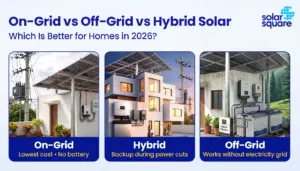
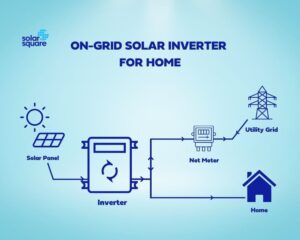
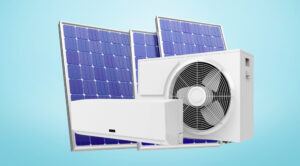
A solar cold storage system is a cold store that gets some or all of its power from solar panels. There are three common types based on the grid configuration. One is a rooftop solar plant on a grid-connected cold store; another is a solar cold room (off-grid); and a hybrid with battery.
| Type | Best for | Typical size | How it works |
| Rooftop plant on a grid-connected cold store | Existing and new commercial cold stores | 50 kW to 1 MW | This system is connected to the grid and primarily used to offset daytime electricity bills. It takes power from the grid at night. |
| Solar-powered cold room | Farm gates, FPOs (Farmer Producer Organisations), village hubs | 5 to 10 MT | Panels run the unit, with thermal backup for nights and cloudy spells |
| Hybrid with battery | Sites with a weak grid or heavy night load | Varies | The system is connected to the grid and backup storage. Stored power covers some night load. A battery adds about 40% to cost |
The MNRE (Ministry of New and Renewable Energy) has released draft guidelines outlining design, specifications, performance, and testing procedures for solar cold storage systems with thermal energy storage (TES) backup.
The guidelines include the standardised parameters for 2 MT (Metric tonnes), 5MT, 10MT, and 20MT capacity storage with minimum operating temperatures of -5°C, 1°C, and 4°C.
Source: Powerline.net
How a solar cold room works
A solar cold room is an insulated chamber cooled by a compressor that runs on solar energy. The solar panels power the compressor during the day, and a thermal store keeps the chamber cold through the night and cloudy spells. The system does not depend on the power grid, making solar-powered cold storage ideal for villages with weak or no power supply.
Solar Cold Storage Price in India (2026)
The solar cold storage price depends on the type. A rooftop plant on an existing cold store costs about ~₹29,000 to ₹50,000 per kW. A 50kW solar-powered cold room costs roughly ~₹20 lakh to ₹30 lakh. You can check the estimated cost of a commercial solar power plant in India below:
| Size of Industrial Solar Energy Systems | Estimated Cost of Commercial Solar Power Plants in India in 2026* |
| 50 kW | ~₹20 lakh to ~₹30 lakh |
| 100 kW | ~₹35 lakh to ~₹50 lakh |
| 200 kW | ~₹60 lakh to ~₹1 crore |
| 300 kW | ~₹90 lakh to ~₹1.50 crore |
| 500 kW | ~₹1.50 crore to ~₹ 2.50 crore |
| 1 MW | ~₹3 crore to ~₹5 crore |
*Please note that prices are subject to change. The above-mentioned commercial solar installation cost is indicative, and not fixed. The final commercial solar panel cost can vary based on the type of solar panels you use (imported and DCR (Domestic Content Requirement) solar panels have a cost variation of ~30%), type of solar inverter you choose (string inverters and optimisers have a cost variation of ~10-15%), type of solar industrial system, whether or not you use a battery energy storage system (it increases the final cost by almost 40%), mounting structure height, type of after-sales service, roof height, etc.
How Much Can Solar Panels for Cold Storage Save?
Let’s take an example of a 100kW solar panel cold storage system under stated assumptions. It combines annual electricity savings with the first-year Accelerated Depreciation (AD) tax benefit to illustrate the potential ROI and simple payback period. Actual returns will vary based on tariff, generation, project cost, and tax position.
| Parameter | Value* |
| System Capacity | 100 kW |
| Total Project Cost | ~₹36 Lakhs |
| Annual Generation | ~1.2-1.4 Lakh Units |
| Average Commercial Tariff | ~₹9/unit |
| Annual Electricity Savings | ~₹10.8-12.6 Lakhs |
| AD Tax Benefit (Year 1, 25% tax rate) | ~₹3.6 Lakhs |
| Effective Year-1 ROI | ~40-42% |
| Simple Payback Period | 2.9-3.3 Years |
Once the ~3-3.3 year payback period is complete, the system will generate ~₹ 10.8-12.6 lakh in annual electricity savings for the remaining 20+ years of the system’s life
*Disclaimer: The figures above are illustrative estimates based on the stated assumptions and should not be treated as guaranteed returns. Actual project cost, generation, electricity savings, AD tax benefit, ROI, and payback period can vary depending on the type of roof (RCC or tin sheds), inverter technology, number of buildings, location, tariff, system design, financing, taxes, and system performance.
ROI and Payback Period for Solar Cold Storage
For commercial and industrial cold storage in India, payback typically falls in the 3-4-year range. The payback for solar warehouses and logistics parks is almost similar.
The payback for a solar cold storage system is usually faster than other commercial solar applications, including commercial buildings, IT parks, and educational institutions. This is possible due to higher commercial tariffs and the accelerated depreciation benefit.
Since these systems run for around 25 years, that leaves 20+ years of reduced operating costs after payback. ROI improves further if your business can actually use the depreciation benefit against its taxable income.
Is There a Subsidy for Solar-Powered Cold Storage?
There’s no direct subsidy for commercial cold storage. The PM Surya Ghar subsidy is available for residential purposes, so cold storage facilities aren’t eligible for it. Solar panels for cold storage can get NHB (National Horticulture Board) and MIDH (Mission for Integrated Development of Horticulture) support instead, plus a tax benefit.
NHB and MIDH Support
The government of India, through the National Horticulture Board (NHB), offers a scheme for construction, expansion, and modernisation of cold storage. This is also known as the cold storage subsidy scheme.
They provide capital investment linked to bank credit to entrepreneurs, companies, cooperatives, and FPOs. For general locations, they provide 40% (subsidy percentage) of the eligible project cost. For hilly, north-eastern, and difficult areas, they offer 55% of the eligible project cost. The maximum storage capacity is 5,000 MT per project.
Source: nhb.gov.in
For stores up to 5,000 MT, MIDH gives a credit-linked, back-ended subsidy of 35% in general areas, with a higher rate in hilly and scheduled areas. Back-ended means you receive it after the project is done and the loan is in place.
Tax Benefit and Financing
Accelerated depreciation on solar panels is a tax benefit for businesses. Businesses can claim 40% accelerated depreciation each year on the remaining value (also known as Written Down Value) of the solar plant under the Income Tax Rules. It allows a business to claim a higher deduction on the cost of a commercial solar plant in the early years after installation.
- In Year 1, the business claims 40% depreciation on the full cost of the solar plant.
- In Year 2, it claims 40% depreciation on the value left after Year 1.
- In Year 3, it again claims 40% depreciation on the reduced value left after Year 2.
Source: Depreciation Under Income Tax Act, Income Tax Department Official Website
You can also pick a solar loan or a RESCO (Renewable Energy Service Company) model with no upfront cost.
You can take solar loans from banks, NBFCs (Non-Banking Financial Companies), and green energy lenders, who offer project financing for C&I solar, typically covering 70-80% of the project cost.
Under the RESCO model, a third-party developer finances, installs, owns, and operates the solar system on the business’s premises. The business pays nothing upfront; instead, it purchases the solar electricity generated at a pre-agreed tariff rate based on the PPA agreement, typically ~₹6 to ~₹10 per kWh, compared to the ₹6-₹15/unit it currently pays the DISCOM (Distribution Company).
Conclusion
Solar cold storage makes sense because the load is steady, the sun is strong when cooling demand peaks, and grid power is costly. Solar panels for cold storage cost about ₹29,000 to ₹50,000 per kW, and most stores recover that in 3 to 4 years.
Compare the solar cold storage price you are quoted with your own bill. Check your roof, and ask about NHB or MIDH support and tax benefits. Small farms can compare the solar-powered cold storage price of a 5 MT or 10 MT solar-powered cold room with MIDH support. For a clear number, book a free consultation with SolarSquare.
Frequently Asked Questions
What is the solar cold storage price in India?
A rooftop plant costs about ~₹29,000 to ₹50,000* per kW. A 50kW solar-powered cold room costs roughly ~₹20 lakh to ₹30 lakh.
*Please note that prices are subject to change. The above-mentioned commercial solar installation cost is indicative and not fixed. The final commercial solar panel cost can vary based on the type of solar panels you use (imported and DCR solar panels have a cost variation of ~30%), type of solar inverter you choose (string inverters and optimisers have a cost variation of ~10-15%), type of solar industrial system, whether or not you use a battery energy storage system (it increases the final cost by almost 40%), mounting structure height, type of after-sales service, roof height, etc.
How long do solar panels for cold storage take to pay back?
The solar cold storage payback is usually about 3 to 4 years in India. Factors such as higher tariffs, accelerated depreciation, and a strong daytime load can also shorten the time. The plant then keeps saving for 20 years or more after that.
Can solar power run a cold storage 24×7?
If you are installing on-grid solar panels, solar covers the daytime load, and the grid covers the night. You can also use battery or thermal storage to run longer on solar.
Is there a subsidy for solar-powered cold storage?
Under NHB’s cold storage scheme, you can avail a credit-linked, back-ended subsidy at 40% of the capital cost of the project in general areas and 55% in case of hilly and scheduled areas for a maximum storage capacity of 5000 MT per project. MIDH (Mission for Integrated Development of Horticulture) gives a credit-linked, back-ended subsidy of 35% in general areas, with a higher rate in hilly and scheduled areas for stores up to 5,000 MT.
Does a solar cold room need a battery?
Not always. A small solar powered cold room can use thermal storage to stay cold at night. Grid-connected solar cold storage systems often skip batteries and use the grid after sunset. That keeps the upfront cost lower, which matters for most owners.