India’s installed solar capacity crossed 164 GW by July 2026, up from just about 3 GW in 2014, making the country the third-largest solar producer in the world, behind only China and the United States. The transformation was possible due to government support through policies, infrastructure development, manufacturing expansion, and citizen participation.
Initiatives such as solar parks, rooftop solar, commercial solar, and solarised agriculture pumps are supporting solar energy in India. It is no longer just a government scheme sitting in a policy document. It now powers homes, farms, offices, and factories across the country. Rooftops in small towns carry solar panels today, not just industrial plants in the desert.
This blog looks at where solar energy in India stands right now, how it is actually being used on the ground, and what the future of solar energy in India looks like as the country pushes ahead with its India renewable energy goals.
The Current Status of Solar Power in India
India’s solar journey did not happen overnight. A decade ago, solar power barely registered as a serious part of the country’s energy mix. Today, it leads.
As of mid-2026, India’s installed solar capacity has crossed ~164 GW. That is more than the entire installed power capacity of many mid-sized countries. Also, India is the third-largest producer of solar power in the world, behind only China and the United States.
Here is a quick snapshot of where things stand:
Energy Source | Installed Capacity (2026)* |
Solar Power | ~164.59 GW |
Wind Power | ~58.14 GW |
Hydropower (Large and Small) | ~57.24 GW |
Bio Power | ~11.75 GW |
Nuclear Power | ~8.78 GW |
* Disclaimer: Please note that the figures are approximate, based on data released by the Ministry of New and Renewable Energy on 9 August, 2026.
A few numbers worth sitting with:
- India has crossed 300GW of non-fossil fuel-based installed electricity generation capacity as of July 2026.
- Rajasthan and Gujarat alone host over half of all new solar capacity added in the country, largely because of flat, sun-drenched land and government support.
- Rooftop solar installations have increased after the launch of PM Surya Ghar Muft Bijli Yojana, which offers direct subsidies to households.
None of this happened overnight. It is the outcome of years of steady policy support, affordable solar panels, and a shift in how Indians think about where their electricity comes from.
How India Got Here: The Policies Behind the Growth
India’s solar power is still new, and the country uses only a small part of what it could actually produce.
The International Solar Alliance was started by India and France together. It wants to build one big global power grid, often called “one world, one sun, one grid.” The idea is simple: countries in daylight can send power to countries in the dark, and later, it can work the other way around too.
The government has also rolled out several incentives to help grow solar power in India. The PM KUSUM scheme is one example. It helps farmers install solar panels on land they aren’t using for crops, giving them a new source of income.
There are two more rules worth knowing: the Renewable Generation Obligation (RGO) and the Renewable Purchase Obligation (RPO). Both push industries to use more renewable energy, like solar, while still growing their business.
Solar power works best in places that get more sunlight through the year. That’s why states like Rajasthan and Gujarat are some of the best spots in India to set up solar power plants.
Solar Energy Uses in India
Solar power in India is not just about installing solar panels in the field. It is now part of daily life. You find it in homes, farms, factories, and even streets.
Residential Rooftop Solar
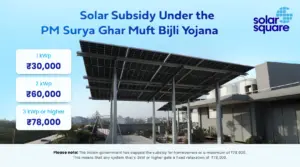
The demand for residential rooftop solar has increased due to electricity rates and government support. More homeowners are putting solar panels on their roofs and cutting their electricity bills. With net metering, bills can even drop up to 90%. Under PM Surya Ghar Muft Bijli Yojana, you can avail a subsidy up to Rs. 78,000 for a 3 kW or above system size. This is a big reason most people have switched in the last two years.
Commercial and Industrial Solar
Offices, malls, warehouses, and factories consume a lot of power. Most of these places are turning to solar to save money. Some large businesses build solar plants far from their site. This is called open-access or captive solar. The power still reaches their business. It means less reliance on the grid and more stable power costs.
Solar in Agriculture
Farmers are going solar as well. Under the PM-KUSUM scheme, many farmers have swapped diesel water pumps for solar ones. This saves fuel money and cuts pollution. In addition, solar fencing is also common now. It keeps wild animals away from crops and works even in fields with no grid connection.
Solar Water Heating and Street Lighting
Solar is not limited to electricity. Nowadays, solar water heaters are common in homes and hotels, especially in cooler states. They cut down on electric geysers. In addition, solar street lights are common in villages too. They work well in areas where the grid is unreliable.
Utility-Scale Solar Parks
States like Rajasthan and Karnataka have large-scale solar parks. Some are among the biggest in the world. They send power straight into the national grid. These parks are a major reason India is close to its capacity targets.
Types Of Renewable Energy Resources In India
Solar leads the pack, but India’s renewable energy story isn’t a one-source story.
Wind energy
Wind energy is one of the most rapidly expanding clean energy sources. It is also gaining popularity in India. Generally, the windy shores of Tamil Nadu and Andhra Pradesh are the perfect sites for the installation of large wind turbines. The National Institute of Wind Energy aims to study India’s capacity and find new places to install wind turbines.
Hydroelectric Energy
India also has a huge dependence on hydroelectric energy. Considering both small and large hydroelectric power plants, they jointly produce 25 percent of the total energy from renewable sources of power.
But such large-scale projects must only be done after a suitable Environmental Impact Assessment (EIA). Such assessments are important so that these projects don’t affect the livelihood of the people living nearby or cause destruction to the local ecology.
However, small run-of-the-river projects must be increasingly encouraged by authorities.
Tidal energy
With a long coastline, India also has great potential to harness the tidal energy of the ocean. Sadly, not many suitable projects have been developed to generate power from tides. Proper planning and surveys are required before venturing into its use.
Geothermal Energy
Geothermal Energy is another source that has become quite popular in the world. However, unlike solar power in India, geothermal energy has been harnessed in only a few places.
Waste To Energy
With the population explosion, there is also an explosion in the amount of waste coming from each household. This waste can be suitably converted into energy through gasification, pyrolysis, or incineration.
Many schemes by the Government of India aim to convert waste into a useful substance to create a functional circular economy.
Economic and Environmental Benefits of Solar Power in India
Solar power in India isn’t just good for the planet. It’s good for the wallet too. That’s why more people are choosing it.
On the economic side, solar has created many jobs. This includes manufacturing, installation, and repair work. As India builds more solar factories under the PLI (Production-Linked Incentive) scheme, lakhs of new jobs are expected. For most homes, a solar system pays for itself in four to six years. After that, the power is nearly free. Panels usually last 20 to 25 years.
There’s a bigger picture too. India imports a lot of oil and coal. Every unit of solar power depends only on the sun. This helps the country save money and rely less on other nations for energy.
The environmental side is simpler to see. Solar power doesn’t burn fuel. So it doesn’t release the harmful gases that coal plants do. India’s Central Electricity Authority says solar has already helped avoid tens of millions of tonnes of carbon emissions each year. As more solar comes online, this number will only grow. For a country often listed among the most polluted, this matters a lot.
The Future of Solar Energy in India
If the last decade was about proving solar could actually work at scale in India, this next one is about pushing that scale even further. Here’s where things are headed.
India’s renewable energy goals point to 500 GW of non-fossil fuel capacity by 2030, with solar expected to carry the biggest share of that number. To get there, the government’s PLI (Production Linked Incentive) scheme is pushing Indian companies to actually manufacture solar cells and modules at home, instead of importing most of it, especially from China. It’s a real step toward a supply chain that doesn’t depend so heavily on the outside world.
Solar has always had one obvious problem: it stops working the moment the sun goes down. That’s changing fast. More solar plants are now being paired with battery storage, so the power generated during the day doesn’t just disappear at sunset, it sticks around for when people actually need it at night. Extra solar power that would otherwise go unused is also increasingly being redirected to produce green hydrogen, a genuinely clean fuel with real potential to power heavy industries and long-haul transport in the years ahead.
On the home front, PM Surya Ghar Muft Bijli Yojana aims to bring solar to a crore households, and adoption is expected to keep climbing steadily. This growth won’t stay limited to metro cities anymore.
And through all of this, costs keep dropping. Solar panels and batteries have gotten dramatically cheaper over the last ten years, and most experts expect that trend to continue. Which really just means one thing: going solar keeps making more and more financial sense, for households and businesses alike.
Conclusion
India’s renewable energy capacity is enormous. However, it has not been used up to its potential. Out of all the other power sources, Solar power in India has the maximum growth potential. Still, it remains underutilised.
The main reasons behind the under-utilisation of solar power in India include hefty initial investment and capital-intensive technology.
Proper research must be carried out to use the various renewable energy sources to walk toward the path of sustainable development.
If you’ve been putting off the decision, this is a good time to stop waiting and start finding out what solar could actually save you. SolarSquare helps homeowners across 35+ Indian cities go solar with zero-investment plans, full support with PM Surya Ghar subsidies, and installation handled from start to finish by trained professionals. Book a free consultation with SolarSquare and get a clear picture of your savings before you commit to anything.
Frequently Asked Questions
What type of renewable energy does India rely on the most?
Solar is the renewable source India relies on the most, with an installed capacity of ~164 GW as of mid-2026. This is more than half of the country’s total renewable energy mix.
What is the best renewable resource for India?
Solar power is currently India’s strongest renewable resource, both in terms of installed capacity and long-term growth potential, given the country’s high number of sunny days and falling equipment costs.
How much of India’s electricity comes from renewable sources today?
India’s total renewable energy capacity, including large hydro, stood at ~291 GW by June 2026, and this share continues to rise as new solar and wind projects come online.
Is rooftop solar actually worth it for Indian homeowners?
For most households with a steady electricity bill, rooftop solar pays for itself within ~3- 5 years through savings on power costs, and subsidies under schemes like PM Surya Ghar bring down the initial investment considerably.
What is India’s target for renewable energy by 2030?
India aims to reach 500 GW of installed non-fossil fuel capacity by 2030, with solar power expected to account for the largest share of that growth.