

One thing most solar installers probably never told you. A standard rooftop solar panel is held in place by bolts. Each bolt takes a few seconds to remove with a regular wrench. Do the math, a small team can strip an entire 3kW system off your terrace in under fifteen minutes, in the dark, in near-complete silence.
No alarm goes off. No sensor triggers. Your phone doesn’t buzz. You find out the next morning, or three weeks later, when your electricity bill stops making sense.
The fastest way to cut your risk is to swap standard bolts for anti-theft ones that need a special key, add a basic motion-sensor light or CCTV pointed at the panels, and note down every serial number so you can actually prove ownership if something goes missing. None of this costs much, and together it makes your system a lot less tempting to walk off with.
Solar panel theft in India is rising in direct proportion to solar adoption, and adoption is moving fast. As per the estimate, India had over 12 GW of rooftop solar installed, with millions more systems going up every month under PM Surya Ghar Muft Bijli Yojana. Each of those rooftops carries equipment worth ~₹ 2 lakh or more, left outdoors and unattended every night, with no lock on it by default.
The market for stolen panels is thriving precisely because panels are almost impossible to identify once removed. No unique marking, no built-in tracker, no way to prove ownership without a serial number you probably never wrote down.
This guide is about closing that gap with practical, affordable, India-specific steps that most solar owners have never been told. The best time to secure your solar system is the day it gets installed. The second-best time is right now.
Why Solar Panels Are Getting Stolen in India?
The most important reason behind the rising of solar panel theft in India includes the expense and the vulnerability of solar panels and their equipment. Let’s discuss both factors in depth.
Think about how easy it is to undo the bolts used to hold those panels sitting on your roof. Each panel costs between ~₹20 and ~₹ 21* (DCR-Mono-PERC). A standard 3 KW solar system requires at least 8 to 10 panels. Also, along with these expensive panels, we have nearly ~₹ 2 lakh worth of solar equipment outdoors, unguarded.
Now think about it from a thief’s perspective.
A stolen panel has no IMEI number like a phone, no GPS chip like a car. Once it leaves your roof, it looks identical to every other panel in the city. Selling it is as simple as a WhatsApp message to a local dealer. Within 48 hours, your panel is generating electricity on someone else’s rooftop, and there is no way to track it.
High reward. Low risk. No traceability. That’s what makes solar an increasingly attractive target.
In rural and semi-urban India, where many people are installing solar under government subsidy schemes, the situation is even more vulnerable. Panels are sometimes installed on farmhouses, boundary walls, or school rooftops that sit empty for long stretches. In some reported cases, entire arrays were dismantled overnight without anyone noticing until morning.
In addition to the solar panels and their equipment, one thing is still unnoticed. Thieves are not only focused on the bigger part; they also look for small opportunities. The DC cable wire used in the whole system carries several kilograms of metal and copper. Copper prices have risen ~30% in five years. They can also target your cables, which are faster to cut, lighter to carry, and sold at any scrap dealer without a single question.
So, when you think about protecting your solar investment, think about the whole system, including panels, inverter, wiring, and the junction boxes connecting them.
*Please note: The per-watt solar panel price listed above is an indicative range and can change based on the manufacturer, module wattage, order size, location, and market conditions.
7 Practical Ways for Solar Panel Theft Protection
The seven most effective ways for solar panel theft protection are given below:
#1 Use Anti-Theft Bolts from Day One
The best day to protect your solar system is the day when we are installing it. Most companies use standard M8 hex bolts to hold solar panels in place. The worst part is that any hardware store wrench can remove them in under 15 seconds.
We can use anti-theft bolts (also called tamper-resistant or security fasteners) to secure the panels. These bolts require a specialised tool to unscrew, which most opportunistic thieves simply won’t have. Studies show that by using these bolts, the disassembly time can be increased by over 400%, which is often enough to make a thief give up entirely.
When you’re getting your solar equipment installed, ask your installer specifically about anti-theft mounting hardware.
At SolarSquare, we use the Japanese Poka-yoke technique, which simply means an error-free technique. We use a prefabricated structure during installation, for which we don’t require any welding on the roof. Also, we use Everlock fastening solutions (nuts, washers, fasteners), which require a special tool to screw and unscrew.
The prefabrication reduces human error during installation, and the Everlock fastening solution makes the system more secure.
#2 Install a Solar-Specific Alarm System
Like your car alarm systems, you can also install modern solar alarm systems. These systems are monitored by the electrical circuits of the panels. When someone tries to disconnect or tamper with panels, the circuit breaks, triggers the alarm, and optionally, sounds a siren on the roof. It can also send an alert to your phone.
Some alarm systems also come with a vibration detector. The vibration detector alarm can catch someone attempting to unscrew mounting hardware before they’ve made any real progress.
In India, we can use GSM (Global System for Mobile Communications)-based solar alarm systems that come in the range of ~ ₹ 3,000- ₹ 8,000*. It has features including mobile tracking using your number. It needs no subscription and no third-party monitoring centre. There are various brands like Risco, Crow, and locally assembled GSM alert kits available on many platforms.
#3 Set Up a CCTV Camera Pointed at the Array
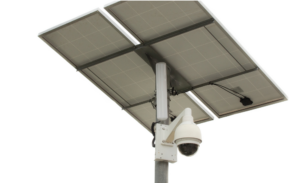
Installing a camera is the safest option to prevent solar theft. Even a dummy camera can reduce the chance of casual theft. On the other hand, a real IP camera connected to your home Wi-Fi can actually help. You can get live footage, motion alerts on your phone, and the recording if anything goes wrong.
For rooftop solar setups, a weatherproof camera with night vision and a 90-120° field of view is ideal. It can cost between ~₹ 2,500 and ₹ 6,000* for a solid entry-level option from brands like CP Plus, Godrej, TrueView, and more. These brands are widely available and serviceable across India. Point it to cover the full panel array, not just one corner.
#4 Register Your Panel Serial Numbers
Every solar panel has a unique serial number printed on a sticker on the back of the frame. This takes ten minutes and costs nothing to take photographs of all of them and store them securely in a cloud folder or email. Yet almost nobody does that.
If panels are even stolen and recovered by police, you can get those panels if matched with the serial numbers you have. If you have the serial numbers of the panels, that is the only way to prove your ownership.
You should ask your installer for the panel spec sheet, which has the list of serial numbers. They might not provide you with it until you ask.
#5 Install Motion-Sensor Lights on the Terrace
Most rooftop solar thefts happen at midnight because the roof is dark, quiet, and more accessible. If you invest in a motion-activated LED flood light, it can change the whole scenario. The moment someone steps onto your terrace, the light blazes on. The lights can astonish the intruder, alert neighbours, and make them nervous about continuing the risk.
A decent outdoor motion sensor light can cost between ~₹ 800 and ₹2,000*. It can be managed on your regular home wiring. If your terrace has no power point, a small solar-powered motion light works just as well. This is genuinely one of the highest-return security investments you can make.
#6 Use Real-Time Performance Monitoring
A real-time performance monitoring system is a tracking device that reflects how much solar electricity your system generates, the amount of energy consumed at home, sent to the grid, and stored in the battery. It also detects performance issues with panels and inverters and sends timely alerts.
This one doubles as a security tool and a maintenance tool. If your output suddenly drops to zero on a sunny afternoon, one of three things has happened: a technical fault, a power outage, or someone has disconnected your panels.
Real-time monitoring ensures you will get an alert within minutes if something is wrong. Solar Square’s monitoring system lets you track power generation data, basic calculations and error checks, data analysis, and much more. People rarely frame monitoring apps as a security feature, but this is one of the most practical early-warning systems you have available to you as a solar owner.
#7 Talk to Your Neighbours and Building Society
This sounds old-fashioned, but it works. In apartment buildings and gated societies, a quick conversation with your building security guard or RWA (Resident Welfare Association) means there are more eyes on the terrace. You don’t need a formal security committee; just a WhatsApp message asking people to flag any unusual activity on the roof is often enough.
In independent houses, a neighbourhood WhatsApp group or a word with the night watchman serves the same purpose. Community awareness is free, immediate, and surprisingly effective.
*Please note: The GSM, motion sensor lights, and CCTV camera prices mentioned above are indicative estimates based on publicly available market data as of 2026. Actual GSM, motion sensor lights, and CCTV camera prices can vary significantly based on the brand or manufacturer. These rates are intended for general informational purposes only and should not be treated as an official quotation or offer. SolarSquare does not manufacture, sell, or offer GSM, motion sensor lights, and CCTV cameras. We do not earn commission or revenue from any vendors, nor do we endorse any specific brand.
Best Alarm & Monitoring Solutions for Indian Rooftop Owners
The solar system is already a heavy investment for most homeowners. At this point, investing more money might not be possible for people with a limited budget. This is one of the reasons why people skip this mandatory step of preventing their solar panels from theft. Here’s a quick snapshot of what’s worth considering, depending on your budget:
Budget | Suggested product | Features |
| Under ~₹ 5,000 | GSM Solar Tamper Alarm | A basic but effective system that sends an SMS to your phone the moment the panel circuit is interrupted. Easy to install, no monthly fee. Available on Amazon India and IndiaMart. |
| ~₹5,000-₹15,000 | IP Camera + Motion Alert Setup | A single IP camera with cloud storage and motion alerts covers your full array and gives you live access from anywhere. Pair it with a motion light for maximum deterrence. |
| ~₹15,000-₹30,000 | Full IoT Security Kit | It is a combined form of a solar monitoring app, a GSM alarm, an IP camera, and smart motion sensors. This level of setup is ideal for larger systems or homes in areas where theft incidents have been reported locally. |
*Please note: The GSM solar tamper alarm, IP camera + motion alert setup, IoT Security Kit prices mentioned above are indicative estimates based on publicly available market data as of 2026. Actual prices can vary significantly based on the brand or manufacturer. These rates are intended for general informational purposes only and should not be treated as an official quotation or offer. SolarSquare does not manufacture, sell, or offer IoT Security Kit. We do not earn commission or revenue from any vendors, nor do we endorse any specific brand.
Solar theft insurance and vetting installers for security
Most comprehensive solar insurance policies in India cover theft along with fire, lightning, and storm damage. It is worth checking that your policy explicitly names theft as a covered peril, not just “damage.” You must ask or look for the following factors :
- Ask for the sum insured to reflect current replacement cost as panel and inverter prices shift over time. Also, under-insuring means you get less than you need if something does go wrong.
- You must look for things like anti-theft bolts that need a special tool to remove, cable trays that hide wiring runs, motion-sensor lighting around the array, and CCTV coverage angled at the rooftop access points.
- Ask how they secure the site during installation, what deterrents they include by default, and whether they can share references from other warehouse or industrial clients.
A serious installer will have clear answers here. Vague reassurances are usually a sign they have not thought this through, and neither should you sign off on it without pushing for specifics.
How SolarSquare Keeps Your Investment Safe from Theft
SolarSquare believes that security starts at installation. The team follows structured installation standards that include proper mounting, cable management, and advice on hardware security at the point of setup. Let’s dive into how SolarSquare is the best company when it comes to security:
#1 Japanese Poka Yoke Technique:
The Poka-Yoke technique is originally a Japanese manufacturing concept meaning mistake-proofing. But when applied to solar installation, it has a very useful side effect. It makes your panels extremely difficult for a thief to quietly remove.
Most local installers loosely bolt the mounting structure together on-site with basic nuts and bolts. A thief with a standard wrench can undo that in minutes.
SolarSquare does it differently. SolarSquare’s WindPro Mount is an advanced mounting solution that guarantees the strength and stability necessary to stormproof your solar panel installations. The structure is pre-fabricated in factories using precision manufacturing techniques and then secured to your home’s RCC slab using superior chemical anchoring. The panels and structure are then assembled on-site and tightened to the correct torque. It is hard for them to dismantle as each bolt is fastened to an exact, engineered specification, not just hand-tightened.
#2 Structuring Cables Using Conduit Pipes:
Cables are the most commonly stolen part of the whole solar system. Usually, the copper wiring or loose exposed cables hanging from a rooftop are easy targets for thieves. With the rising cost of copper and other metals, these thefts are common nowadays.
SolarSquare routes all cables neatly inside conduit pipes. These are hard protective tubes that enclose the wiring from the panel to the inverter. Both AC and DC cables are properly fitted inside conduit pipes to transmit electric current safely.
First, cables inside conduit pipes are hidden from plain sight. A thief scouting your rooftop won’t see loose, easy-to-grab wires dangling around. There’s nothing obvious to target.
Second. If someone tries to break open the pipe, they need to trace the full cable run and then cut through, all without making noise or getting caught. That’s much riskier and time-consuming.
#3 SolarSquare Monitoring App:
SolarSquare monitoring app is the most direct theft-protection tool. The app provides live energy generation tracking so you can monitor your solar plant’s performance in real time, along with historical reports.
Your solar system generates a predictable amount of power every day based on sunlight. If someone tampers with, disconnects, or steals even one panel or a cable, the output drops immediately. That drop shows up on your app in real time.
The Bottom Line
Your solar system is a 25-year investment worth lakhs of rupees. Protecting it doesn’t have to be complicated or expensive. A combination of tamper-resistant bolts, a basic alarm, a monitoring app, and a CCTV camera can cover you comprehensively for under ~₹ 15,000-₹ 20,000 total. That’s less than 10% of what most systems cost, and it gives you genuine peace of mind for the entire life of your installation.
Don’t wait until something goes missing. Set it up right the first time.
Want a solar system that’s built to last, right from day one? SolarSquare installs with tamper-resistant fittings and genuine components as standard, and our team can walk you through the right security add-ons for your rooftop. Book a free consultation and go solar the safe way.
Frequently Asked Questions
Do solar panels get stolen?
Yes, solar panel theft cases are rising in direct proportion to solar adoption in India. These are most common in urban areas, independent houses, and locations where the visibility is low at night. The most common reason behind solar theft is the resale value of the panels and equipment, and the vulnerability of the whole system. Panels are easy to remove with basic tools, quick to resell, and nearly impossible to identify after the fact.
How do I protect my solar panels from theft?
There are various ways to protect solar panels from theft. Some cost-effective methods include using anti-theft mounting bolts and a motion-sensor terrace light. Together, these two will cost ~ ₹ 4,000. These can work against ease of physical removal and darkness. If your budget is higher than this, you can install an IP camera or solar alarms. One of the underestimated ways includes registering your panel serial numbers, which costs nothing. This can help you to get your panel back if thieves get caught.
Will a solar alarm system drain my solar power or affect system performance?
No. A well-designed solar tamper alarm draws minimal standby power, typically less than 1-2W. It has no measurable effect on your system’s output. Most GSM-based alarm units have their own small backup battery so they continue working even if your main system loses power, which is actually an added layer of protection.
Can SolarSquare’s monitoring app detect theft?
It can detect the consequences of theft. If a panel or the inverter is disconnected, your system output will drop to zero or fall abnormally. The app will flag this immediately. The monitoring app is not a security alarm. It can only help with real-time monitoring means you’ll know within minutes that something is wrong, rather than discovering it days later.
Does my home insurance cover stolen solar panels?
Some home insurance companies cover solar panels in case of theft. They cover it under household structure or as separately declared assets. The coverage depends on insurance and policies. It’s important to explicitly declare your solar system to your insurer and confirm it’s covered. Note that most policies require you to have taken “reasonable precautions”, meaning a basic level of security hardware can also determine whether a claim is honoured.