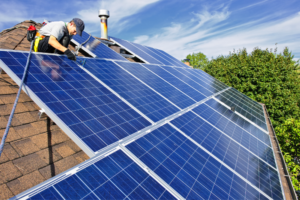


Installing rooftop solar sounds great on paper. It can lower electricity bills by up to 90% for homes, support a clean environment, and has government support through subsidies. Then why doesn’t everyone switch to solar?
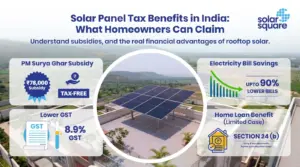
One of the biggest barriers to investing in a solar system is the high upfront cost of installation. The government offers a subsidy under the PM Surya Ghar Muft Bijli Yojana, which is capped at ₹ 78,000 for systems equal to or above 3 kW. Making the remaining payment upfront is exactly what makes some homeowners second-guess their decision to go solar. This is where rooftop solar EMI (Equated Monthly Instalment) changes the game.
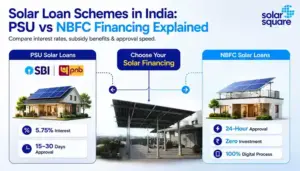
Solar panel on EMI options, including PSU (Public Sector Undertaking) and NBFC (Non-Banking Financial Company) loans, are designed specifically for rooftop solar systems for homes. You can also opt for rooftop solar financing in India through a personal loan or SolarSquare’s zero-investment option (offering 90% of the loan value) through an NBFC. The no-cost EMI is available for a 6-12-month tenure at an interest rate of 12%. You can also choose PSU loans with interest rates between 5.75% and 9% for a tenure of 10 years.
On top of that, government-backed options like PM Surya Ghar Muft Bijli Yojana make the installation affordable. They help through subsidies and by lowering interest rates on EMIs. But should you only look for low interest rates?
The cheapest interest rate is not always the best. Bank loans can turn into a long process. You end up visiting the branch multiple times, and before anything gets approved, officials might even show up for a home visit. All of that just makes the process feel longer and more tiring than it needs to be.
SolarSquare’s entire financing process is digital: no branch visits, no waiting around for someone to inspect your home, and in most cases, your loan gets approved within 24 hours. When it comes to solar financing, speed and convenience matter just as much as your credit score, sometimes even more.
This guide breaks down why solar panel EMIs matter, the financing options available to you, how government schemes fit into the picture, and why SolarSquare’s 5-year zero investment scheme with multiple EMI options, ranging from 6 months to 60 months, makes going solar easier than you might think.
What is a Solar EMI?
A Solar EMI works similarly to a home or car loan, where a vendor sponsors you so that you don’t have to pay the entire cost of solar installation at once. The term EMI refers to Equated Monthly Instalment, which is a fixed amount you pay every month.
Instead of paying ~₹2 to ₹3 lakhs (or more) all at once for a solar installation, you can spread the cost over 6, 12, 36, 48, or even 60 months. Each month, you have to pay a small, predictable amount without burdening your pockets. In addition, government schemes like the PM Surya Ghar Muft Bijli Yojana provide subsidies ranging from ₹ 30,000 for 1kW to ₹ 78,000 for 3kW or above system size. This helps consumers reduce their upfront installation costs to a huge extent.
Going solar is one of the best decisions a homeowner can make. However, the initial investment, which can run into lakhs of rupees, often discourages people from taking the plunge.
A standard 3 KW rooftop solar system in India costs between ~₹ 2.27 lakh * in Pune, ~₹ 2.25 lakh in Bhopal, ~₹ 2.17 lakh * in Lucknow, and ~₹ 2.6 lakh * in Bangalore (before subsidy). The expense may go much higher for bigger homes or businesses. For most middle-class families, the additional expense that is hard to justify is huge, even if the long-term savings are obvious.
*Please note the prices are subject to change. The above-mentioned cost of solar installation for a 3 kW on-grid solar system is indicative as of 07 October 2026 for the SolarSquare Blue 6ft variant. The final solar plate price depends on your DISCOM (Distribution Company) charges, product variant opted for, panel type, inverter type, mounting structure height, type of after-sales service, savings guarantee, roof height, etc.
How Does SolarSquare Make Rooftop Solar Affordable?
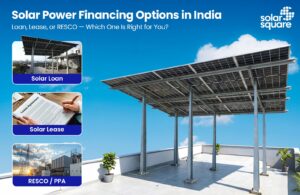
SolarSquare is the #1 rooftop solar company in India as listed on the PM Surya Ghar Muft Bijli Yojana National Portal, based on over 50,000 installations. We are making solar accessible by providing financing options. We offer NBFC-backed solar panel EMI options including a 6 & 12-month zero-cost EMI scheme, a 36-month EMI scheme, and a 5-year EMI scheme. You can also take PSU or personal loans. To know more about the financing by SolarSquare, you have to first understand who can apply for these loans, along with the mandatory documents.
Conditions before applying for any loans at SolarSquare:
- For the zero-cost EMI scheme, you will have to pay 10% to 30% of the system’s cost upfront. The EMI will be eligible for the remaining amount. You have to pay the rest over the next 6 months.
- Your age should be less than 62
- Your credit score should be more than 650
- You should be employed. If you are a business owner, your minimum monthly income should be Rs 20,000
- If you have taken any other EMIs, the sum of existing and new EMIs should be less than 60% of your monthly income.
- Retired people can take a 5-year or lower tenure EMI scheme in the name of a blood relative.
Mandatory documents required for SolarSquare EMI schemes:
- Your PAN card
- Your Aadhaar card
- Your Electricity bill
A rooftop solar loan is a scheme offered by PSU banks and NBFCs. They provide funds for the installation and purchase of a residential solar PV system. Most public sector banks have a separate category for solar loan in India. These loan schemes are backed by the PM Surya Ghar Muft Bijli Yojana. The EMI schemes provided by NBFCs and PSUs are discussed below:
#1. Zero Investment Solar Loan:
SolarSquare’s zero-investment solar loan is an NBFC-backed rooftop solar financing scheme. We provide a solar loan interest rate of 12% for 6 to 12 months tenure. Homeowners can take this loan for 6 months to 60 months. We also provide 6 months of zero-cost EMI, which means there will be no interest amount if you pay the remaining amount in the next 6 months.
| Key Aspects | Details |
| Loan type | NBFC-backed solar loan |
| Solar loan interest rate | 12 % (for 6-12 months) |
| EMI tenure available | 6 to 60 months |
| Maximum loan amount | There’s no upper limit. It depends on your credit score. The loan can finance even 100% of the project cost. |
| Documents required | PAN, Aadhaar, latest electricity bill |
| Loan approval | Within 24 hours |
| Out-of-pocket investment as a down payment | None, as the PM Surya Ghar subsidy replaces the upfront out-of-pocket investment. |
#2. PSU Loans
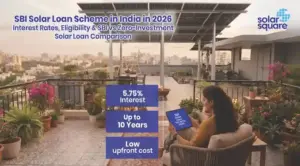
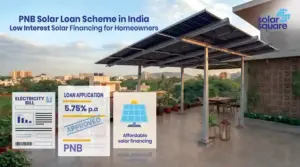
Public sector banks offer low interest rates; their interest rates range between 5.75% and 9% depending on the loan amount. Banks like SBI, PNB, Bank of Baroda, Canara Bank, and Union Bank offer some of the cheapest solar loan in India. These banks often build the PM Surya Ghar subsidy right into your loan structure. So instead of the ₹ 78,000 landing separately in your bank account, it just gets adjusted within the loan itself. You can check more details about top solar schemes in India.
You can check the table below for different bank offers, including interest rates, tenure, and maximum loan value.
| PSU Banks and NBFCs | Interest Rates | Tenure | Max Loan Value |
| SBI solar loan |
| 10 years | ₹ 6 lakh |
| PNB solar loan |
| 10 years | ₹ 6 lakh |
| Canara Bank solar loan |
| 10 years | ₹ 6 lakh |
| Union Bank solar loan | 5.75% p.a. EBLR @ 2.25% | 10 years | Up to ₹ 2 lakh per borrower |
| Bank of India solar loan |
| 10 years | ₹ 6 lakh |
| Bank of Baroda solar loan |
| 10 years | ₹ 6 lakh |
#3. Personal Loan
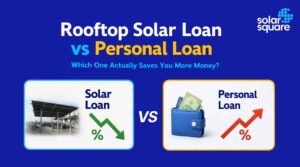
The third option, and honestly the least ideal one, is taking a personal loan from the bank. Since it’s not tied to any specific purpose, the bank doesn’t really factor in whether you’re using it for a wedding, a car, or anything else. They simply look at your income and credit profile to decide how much you can borrow.
Some private banks, including Kotak Mahindra, HDFC, ICICI, SBI, and Axis Bank, provide loans with an interest rate of 15-18% based on the customer profile.

5 Ways Solar Panel on EMI Makes Rooftop Solar Affordable
Still weighing your options for rooftop solar, even with EMI plans on the table? Here’s the thing: solar panel EMI does a lot more than just remove the upfront cost. It gives you predictable monthly payments, real savings from day one, and a much easier way to finally make the switch.
You can check the five ways in which rooftop solar EMI is making clean energy affordable:
- Reducing upfront cost: The biggest fear or barrier while going for solar is giving up your savings of almost ~₹ 2-2.5 lakh in one go. Solar panel EMI eliminates this barrier. Now you can install solar with a small down payment. The rest will come out of your monthly budget, just like any other household expense.
- The savings start from the first Month: The minute your solar system is installed and switched on, it starts generating solar electricity and reduces your overall grid electricity bill. The best part is that you do not need to wait for the entire paid-off system to get benefits. From the first month, your solar savings help offset your EMI, sometimes covering it almost entirely.
- Predictable EMI cost: Unlike the electricity bill, which fluctuates based on electricity usage and tariff hikes, your solar panel on EMI does not. Once you fix the EMI cost, it remains fixed until your tenure. In addition, the free solar electricity and your total energy cost become far more predictable and manageable.
- Government subsidy still apply: Even if a customer is on an EMI plan, the government provides a subsidy to them. As per PM Surya Ghar Muft Bijli Yojana, customers can avail a subsidy of up to ₹ 78,000 for a 3 kW or higher-capacity solar system. This can benefit your loan principal or your monthly installments. The EMI and government subsidy make the overall process even more affordable.
- You build a valuable asset over time: Unlike your electricity bill (which disappears the moment you pay it), your solar EMI builds equity in something real. By the end of your tenure, you own a fully paid-off solar system that continues generating free power for 20+ more years. That’s an asset worth lakhs that adds value to your property.
Who should consider installing rooftop solar on EMI?
If you are someone whose monthly electricity bill is ~₹ 2,500 or more, solar on EMI certainly makes financial sense. The savings you generate will cover a maximum portion of your monthly installments from Day 1.
Middle-income homeowners with high electricity bills but no savings to invest in solar, or someone who has moved in and doesn’t want another big-ticket expense, can opt for solar EMI. It lets them start cutting their electricity costs right away, without having to wait months or years to save up the full amount first.
Small business owners who want to cut overheads without tying up working capital in solar assets can also take rooftop solar EMI. This way, the money that would’ve gone into a lump sum payment stays free for inventory, staffing, or whatever the business actually needs to grow.
People who prefer predictable fixed monthly costs over variable electricity bills or who want to go green should go for solar EMI.
Solar EMI vs Paying the Entire Amount Upfront
People usually get confused about whether they should pay the entire amount or take solar EMI options while installing. Both options are valid. They just suit people with different financial situations. If you’ve got the savings sitting idle anyway, paying upfront gets you faster payback and skips the interest altogether. But if that money’s better used elsewhere, or simply isn’t available right now, EMI lets you start saving on your electricity bill without waiting to save up first.
There’s no universal right answer here; just make sure it should make sense for your own cash flow. Someone sitting on a fixed deposit earning modest interest might come out ahead paying upfront. Someone who needs to dip into an emergency fund or delay going solar altogether is usually better off spreading the cost through EMI instead.
Check the comparison between solar panel EMI and paying the entire amount upfront in the table below:
| Factor | Solar EMI | Upfront Payment |
| Initial Cost | Zero or minimal down payment | Full amount (~₹ 2-3L+)* |
| Monthly Outflow | Fixed EMI (partially offset by savings) | Zero EMI; only maintenance costs |
| Total Cost Paid | Same as upfront (Zero Cost EMI) or slightly more (with interest) | Lowest total cost |
| Savings Start | Day 1 | Day 1 |
| Best For | Those without large savings or who prefer liquidity | Those with savings who want maximum ROI |
| Government Subsidy | Applicable | Applicable |
| Ownership of System | Yes (you own it) | Yes (you own it) |
*Please note the prices are subject to change. The above-mentioned cost of solar installation is valid for a 3 kW on-grid solar system. The cost range is indicative as of 12 August 2026 for the SolarSquare Blue 6ft variant. The final solar plate price depends on your DISCOM charges, product variant opted for, panel type, inverter type, mounting structure height, type of after-sales service, savings guarantee, roof height, etc.
Things You Must Consider Before Choosing a Solar Plan
If you are ready to take rooftop solar EMIs or any solar financial plans, you should keep some important factors in mind. A little homework can save you from a lot of headaches later. Some of the things you must consider before choosing solar plans are given below:
- Monthly electricity bills: Customers whose average monthly bill is between ~₹ 2,000–2,500/month can go for solar EMI options. If the customer’s electricity bill is higher, they can expect their solar savings to offset the solar EMI faster.
- Roof size and sunlight Intensity: Before installing rooftop solar systems, the most important factor is the shadow-free space on the roof. You should ensure that you have at least 100 to 150 sq. ft. of shadow-free south-facing roof space. For any further details, you can book a free solar consultation call with SolarSquare.
- Loan tenure and interest rate: As per the zero investment scheme by SolarSquare, the net investment is nearly zero. We take an equal amount of subsidy as a down payment and make sure the monthly savings are either bigger or equal to the EMI cost. For standard solar loan in India, interest rates vary (typically 5.75% and 9%). Always calculate the total amount you’ll pay over the tenure, not just the monthly installment.
- Subsidy eligibility: As per PM Surya Ghar Muft Bijli Yojana, customers can get a subsidy up to ₹ 30,000 for 1 kW, ₹ 60,000 for 2 kW, and ₹ 78,000 for 3 kW PV systems or above. Before enrolling in any schemes or subsidies, you should check your eligibility for your finalized system size.
- Net metering connection: Net metering allows you to provide the excess solar power to the grid and get a reduction in the bill. Before installing solar at your home, make sure your local electricity distributor (DISCOM) supports net metering for your area.
- After-sales support and warranty: Solar panels come with 25-year performance warranties. Make sure your installer provides robust after-sales service, because panels need periodic cleaning and inverters need replacement over time.
Final Thoughts
Solar systems have always been the thing you consider a safe, greener option. But when it comes to the cost, you take a step back. You tell yourself that someday, when you’ve saved up enough, when technology gets cheaper, or when the time feels right, you’ll go solar. That someday has come, and it’s now.
With rooftop solar EMI plans, the financial math has completely changed. You no longer need to choose between paying for solar and paying your other bills. Instead, your solar system starts saving you money from Day 1; your EMI replaces a chunk of your electricity bill, and at the end of the tenure, you own a 25-year clean energy asset worth lakhs.
Ready to make the switch? SolarSquare makes it simple. Get a free rooftop assessment and a customised EMI plan that fits your budget. Book your free consultation with SolarSquare today
Frequently Asked Questions
Is solar available on EMI?
Yes, you can install rooftop solar on EMI. You can avail SolarSquare’s 6-month zero-cost EMI scheme, a 36-month EMI scheme, and a 5-year EMI scheme. With 6-month zero-cost EMI, there’s no interest charged at all, which means you pay exactly what the system costs, just spread over 12 to 60 months.
What is Solar EMI? Is it different from a regular personal loan?
A solar panel on EMI is a fixed monthly payment plan to install a rooftop solar system. Just like an EMI on a phone or a car, it provides the facility to install solar today and pay in installments. The Solar EMI is completely different from a regular personal loan. Once you install a solar system, it starts generating electricity from Day 1, so your monthly savings on electricity bills immediately start offsetting the EMI amount.
Will I still get the government subsidy if I go solar on EMI?
Under PM Surya Ghar Muft Bijli Yojana, you can avail a subsidy of up to ₹ 78,000 (for 3kW or above system size. When you take loans from the PSU banks, the subsidy is not transferred directly to you. Instead, it’s adjusted against the loan amount. SolarSquare handles the entire subsidy application and paperwork on your behalf.
Does taking a solar panel on EMI affect my CIBIL score or credit rating?
Like any loan or EMI product, a solar finance plan does appear on your credit profile, but it works in your favor if you pay on time. Regular, on-time EMI payments can actually improve your CIBIL(Credit Information Bureau (India) Limited) score over the tenure. There is no negative impact from simply applying or getting approved. SolarSquare works with trusted banking partners and NBFCs who follow standard, transparent lending practices.
What happens if I want to sell my house before the solar EMI tenure ends?
In most cases, the solar system (and any remaining EMI liability) can be transferred to the new owner as part of the property transaction, or you can choose to close the loan early.
Is SolarSquare’s Zero Cost EMI really zero interest, or are there hidden charges?
It is genuinely zero interest, not a marketing trick. With SolarSquare’s Zero Cost EMI, the total amount you pay across all your installments equals the original price of the solar system. SolarSquare absorbs the financing cost through its banking partnerships; it is not passed on to you. There are no hidden processing fees buried in the fine print and no prepayment penalties if you want to close early. Before you sign, SolarSquare will walk you through the complete cost breakdown.