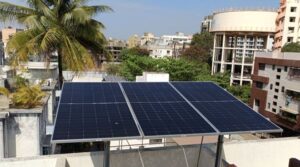
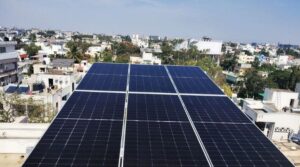
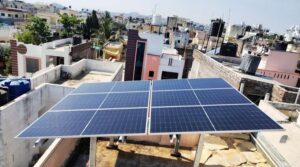
The solar panel cost for 2 BHK homes in India can range from ~₹ 2.17 lakh* to ~₹ 3.83 lakh* before the PM Surya Ghar Muft Bijli Yojana subsidy.
- A 3 kilowatt (kW) on-grid solar system starts at ~₹ 2.17 lakh* in Nagpur to ~₹ 2.6 lakh* in Bangalore.
- A 5 kW on-grid solar system starts at ~₹ 3.33 lakh* in Nagpur to ~₹ 3.83 lakh* in Bangalore.
After the applicable subsidies, the indicative starting price falls to ~₹ 1.09 lakh* in Lucknow to ~₹ 1.82 lakh* in Bangalore for 3 kW and ~₹ 2.22 lakh* in Delhi to ~₹ 3.05 lakh* in Bangalore for 5 kW.
*DISCLAIMER (Prices are subject to change): The above-mentioned solar panel cost for 2 BHK homes for on-grid solar systems is indicative as of 01 September 2026 for the SolarSquare Blue 6ft variant. The final price of a solar panel for homes depends on your DISCOM (distribution company) charges, city, the product variant you choose, panel type, inverter type, mounting structure height, after-sales service, savings guarantee, roof height, etc.
But why such a wide cost range for homes with the same number of rooms, you ask? Well, two families can live in identical 2 BHK homes but consume very different amounts of electricity.
- A household with one air conditioner (AC) and moderate appliance use may consume around 4,200-4,350 units annually and need a 3 kW solar system in India.
- A home with two ACs, two geysers, and several large appliances may consume around 7,000-7,250 units and require a 5 kW solar system in India.
This guide explains how much solar panels for your home cost in 2026, unit generation, roof space, subsidies, and 25-year savings from 3 kW and 5 kW on-grid solar systems to help you estimate the right rooftop solar system for your 2 BHK home.
What Is the Solar Panel Cost for a 2 BHK in India?
The 2 BHK solar panel price in India depends mainly on the required system capacity. Moreover, government subsidies can reduce the effective solar panel installation cost considerably.
Here’s a snapshot of the cost of 3 kW and 5 kW solar systems for a 2 BHK home in India before and after subsidy:
| 2 BHK Usage Profile | Likely System Capacity | Indicative Cost Before Subsidy (Starting Price, Indicative for Base Variant) as of 01 September 2026* | Indicative Cost After Subsidy (Starting Price, Indicative for Base Variant) as of 16th September, 2026* |
| Moderate yearly consumption (4,200-4,350 units) | 3 kW | ~₹ 2.17 lakh in Nagpur to ~₹ 2.17 lakh in Lucknow, ~₹ 2.4 lakh lakh in Delhi, and ~₹ 2.6 lakh lakh in Bangalore | ~₹ 1.39 lakh in Nagpur to ~₹ 1.09 lakh in Lucknow, ~₹ 1.32 lakh in Delhi, and ~₹ 1.82 lakh in Bangalore |
| High yearly consumption (7,000-7,250 units) | 5 kW | ~₹ 3.33 lakh in Nagpur to ~₹ 3.33 lakh in Lucknow, ~₹ 3.3 lakh in Delhi, and ~₹ 3.83 lakh in Bangalore | ~₹ 2.55 lakh in Nagpur to ~₹ 2.25 lakh in Lucknow, ~₹ 2.22 lakh in Delhi to, and ~₹ 3.05 lakh in Bangalore |
*DISCLAIMER (Prices are subject to change): The above-mentioned solar panel cost for 2 BHK flats for on-grid solar systems is indicative as of 01 September 2026 for the SolarSquare Blue 6ft variant. The final 2 BHK solar panel price depends on your DISCOM charges, city, chosen product variant, panel type, inverter type, mounting structure height, after-sales service, savings guarantee, roof height, etc.
How Much Subsidy Is Available for a 2 BHK Solar System?
Solar subsidy depends on the rooftop system’s capacity, not the home’s size or number of appliances. Under the Pradhan Mantri (PM) Surya Ghar Muft Bijli Yojana, eligible residential consumers receive ₹ 78,000 in subsidy for 3 kW or higher solar systems.
The central subsidy is tiered as follows:
- For 1 kWp: ₹ 30,000
- For 2 kWp: ₹ 60,000
- For 3 kW and higher: ₹ 78,000
Since a 2 BHK may require a 3 kW or 5 kW system, the available central subsidy will be ₹ 78,000 in most Indian states.
Who Can Qualify for the Subsidy?
Homeowners can claim the subsidy when they meet the applicable eligibility conditions:
- Install made-in-India panels that comply with the Approved List of Models and Manufacturers (ALMM) and the Domestic Content Requirement (DCR).
- Install a grid-tied solar system on a roof legally associated with the residential property.
- Hold an active electricity connection in their name with the local DISCOM.
- They must not have previously received a subsidy for a system of up to 3 kW.
Can State Subsidies Reduce the Cost Further?
Yes, they can. Certain state governments provide financial assistance in addition to the central subsidy. The benefits applicable to the cities covered in this guide are as follows:
- Delhi state subsidy: ₹ 30,000 for systems of 3 kW or higher capacity
- Uttar Pradesh state subsidy for Lucknow residents: ₹ 30,000 for systems of 2 kW or higher capacity
Therefore, qualifying residents of Delhi and Lucknow can receive a total subsidy of ₹ 108,000 on a 3 kW or 5 kW system. In the other cities covered here, where only the central subsidy applies, the grant is ₹ 78,000.
For more details on different state-level subsidy schemes, you can check out our blog on Different Types of Government Solar Panel Subsidy Schemes in India in 2026.
Does a 2 BHK Need a 3 kW or 5 kW Solar System?
A 3 kW photovoltaic (PV) system is generally suitable for a moderately consuming 2 BHK. A 5 kW system, on the other hand, may be required when the household regularly uses two ACs, electric geysers, and other high-consumption appliances.
Calculate the final capacity based on annual electricity use.
When Is a 3 kW System Suitable for a 2 BHK Home?
A 3 kW solar system may suit a 2 BHK home with moderate electricity use, especially where major appliances such as the AC and geyser are used for limited hours rather than extensively throughout the day.
The right fit still depends on the household’s actual annual electricity consumption, so the previous 12 months of electricity bills should be checked before finalizing the system size.
When Can a 2 BHK Require a 5 kW System?
A 5 kW solar system may be more suitable for a 2 BHK with heavier electricity use, such as a home with multiple ACs, geysers, and other high-consumption appliances used regularly.
In such homes, the higher system capacity helps match the greater electricity requirement. The final size should still be based on annual consumption rather than the number of appliances alone.
3 kW vs 5 kW Rooftop Solar System for a 2 BHK Home
This comparison can help you decide which solar panel capacity best fits your solar power needs.
| Factor | 3 kW Rooftop Solar System* | 5 kW Rooftop Solar System* |
| Usage profile | Moderate | High |
| Indicative annual consumption | 4,200-4,350 units | 7,000-7,250 units |
| Indicative annual generation | 4,200-4,350 units | 7,000-7,250 units |
| Shadow-free roof area | ~300 square feet | ~500 square feet |
| Suitable AC usage | One AC with moderate use | Two ACs with regular use |
*These are indicative profiles. Electricity bills and a professional roof assessment provide a more reliable basis for choosing between 3 kW and 5 kW.
How Can You Calculate the Right Solar Capacity for Your 2 BHK Home?
Calculate the required solar capacity from your home’s annual electricity consumption, not its carpet area or number of bedrooms. Review the previous 12 months of electricity bills and divide the annual units consumed by the estimated annual generation from 1 kW of solar.
Use these two steps:
- Step 1 – Calculate annual electricity consumption: Add the units shown on your electricity bills for the previous 12 months. Account for seasonal loads such as ACs, geysers, and coolers.
- Step 2 – Convert consumption into solar capacity: A 1 kW rooftop system generates ~1,400-1,450 kilowatt-hours (kWh), or units, annually.
Here’s a simple formula that can be used to calculate the required solar capacity:
| Required solar capacity in kW = Annual electricity consumption ÷ Annual generation from 1 kW |
Examples: Solar Capacity for Moderate and High-Use 2 BHK Homes
The table below shows how annual electricity consumption can translate into different solar system capacities for two typical 2 BHK usage profiles.
| Factor | Moderate-Use 2 BHK | High-Use 2 BHK |
| Annual electricity consumption | ~4,200 units | ~7,000 units |
| Air conditioners | 1 | 2 |
| Fans | 2-3 | 3 |
| Refrigerator | 1 | 1 |
| Geyser | 1 | 2 |
| LED lights | 4-5 | 4-5 |
| LED TV | 1 | 1 |
| Washing machine | 1 | 1 |
| Chimney | None | 1 |
| Microwave | None | 1 |
| Vacuum cleaner | None | 1 |
| Dishwasher | None | 1 |
| Mobile and laptop chargers | Multiple | Multiple |
Based on the formula (required solar capacity in kW = annual electricity consumption ÷ annual generation from 1 kW), a 3 kW solar system will suit a 2 BHK consuming 4,200 units (4,200 units ÷ 1,400 units) and a 5 kW solar system will suit a 2 BHK consumption 7,000 units (7,000 units ÷ 1,400 units).
Why Should You Use Electricity Units Instead of the Bill Amount to Size a Solar System?
Electricity units provide a more reliable basis for solar sizing because the bill amount includes fixed charges, taxes, adjustments, and state electricity subsidies. Two homes consuming the same number of units may pay different amounts because their tariffs, subsidy benefits, and DISCOM charges differ.
An electricity bill may include:
- Energy charges
- Fixed or demand charges
- Electricity duty
- Meter charges
- Fuel adjustment charges
- Previous balances
- Government electricity subsidies
You may use the bill amount for an initial estimate. However, annual units provide a more accurate basis for sizing solar for a 2 BHK house.
How Much Electricity Can 3 kW and 5 kW Solar Systems Generate?
A 3 kW rooftop system may generate approximately 4,200-4,350 units annually, while a 5 kW system may generate around 7,000-7,250 units. Actual production depends on the location, available sunlight, roof conditions, equipment, system losses, and maintenance.
What Factors Affect Solar Generation?
Several site and system conditions determine how much electricity the panels generate. The most critical ones are listed below:
- Solar irradiation in your city
- Panel efficiency and technology
- Roof orientation
- Panel tilt angle
- Shadows from buildings, trees, and water tanks
- Weather and cloud cover
- Temperature
- Dust and pollution
- Inverter efficiency
- Cleaning and preventive maintenance
- System downtime
The solar generation figures in this guide are annual estimates, not guaranteed production for every property.
What Counts as Usable Roof Space?
The total terrace area may differ from the usable solar area. Water tanks, staircase rooms, parapet walls, neighboring buildings, trees, and antennas can create shadows or block panel placement.
The layout must also leave adequate space between panel rows and provide safe access for cleaning, inspection, and repairs.
Can an Apartment Owner Install a Solar Panel for a 2 BHK Flat?
Installing a solar panel for a 2 BHK flat usually requires permission from the resident welfare association (RWA) or housing society because the terrace is a common area.
The society may install rooftop solar for common areas such as lifts, pumps, lighting, and other common loads. Individual installations and virtual or group net-metering arrangements depend on roof rights and applicable state regulations.
For more details, you can check out our blog on Solar for Apartment Buildings.
What Is Included in the Rooftop Solar Cost?
The quoted cost of home solar should cover the complete installed system, not just the modules. A comprehensive quotation includes panels, inverter, mounting structure, cables, protection equipment, installation, testing, and commissioning. The exact inclusions depend on the selected package.
A standard quotation may cover:
- Solar panels
- Solar inverter
- Mounting structure
- Alternating current distribution box (ACDB)
- Direct current distribution box (DCDB)
- Surge protection device (SPD)
- AC and direct current cables
- Earthing and lightning protection
- Connectors, conduits, and other accessories
- Installation and commissioning
- Monitoring system
- Applicable warranties and after-sales support
Which Expenses May Be Charged Separately?
Quotations usually exclude waterproofing, roof strengthening, additional cable length, difficult lifting work, load enhancement, customized civil work, or certain net-metering charges.
Battery storage is also separate from the standard cost of an on-grid system. Request an itemized quotation so you can compare complete project costs.
What Factors Affect the Solar Panel Cost for a 2 BHK Home?
Solar power for a house costs different for different homes, depending on system capacity, equipment, roof design, location, and service coverage. Two systems with the same rated capacity may have different prices because their panels, inverters, mounting structures, safety components, warranties, and installation requirements differ.
The main cost factors include:
- Solar system capacity
- Panel technology, wattage, and efficiency
- String inverter or microinverters
- Mounting-structure height
- Roof type and condition
- Building height
- Wind-load requirements
- City and transportation costs
- DISCOM and net-metering charges
- Cable length
- Maintenance coverage
- Savings guarantee
- Additional civil or electrical work
Which Type of Solar System Is Suitable for a 2 BHK?
An on-grid home solar system is suitable for an urban 2 BHK with a dependable electricity connection. It costs less because it does not require batteries. A hybrid solar system may suit homeowners who need backup, while an off-grid solar system is intended mainly for areas with unreliable grid access.
- On-grid rooftop solar system: It connects to the utility grid and can use net metering. It does not require a battery energy storage system and can qualify for the residential subsidy. However, it shuts down during a grid outage for anti-islanding safety.
- Hybrid rooftop solar system: It combines solar panels, grid connectivity, and battery storage. It can support selected loads during outages but costs more because it requires a hybrid inverter and batteries.
- Off-grid rooftop solar system: It operates independently of the electricity grid and requires battery storage. It is generally suitable for locations where the grid is unavailable or highly unreliable.
For most urban homes focused on reducing electricity bills, an on-grid system is the practical choice as it offers the best return on investment (ROI) and has the quickest payback period.
How Much Can a 2 BHK Save with Rooftop Solar?
Long-term savings depend on the system’s capacity, actual generation, local electricity tariff, tariff escalation, panel degradation, and maintenance.
Here’s a snapshot of how much money can be saved by installing a 3 kW and a 5 kW solar system across different Indian cities:
| City | Savings From a 3 kW Solar System Over 25 Years for a 2 BHK Home* | Savings From a 5 kW Solar System Over 25 Years for a 2 BHK Home* |
| Nagpur | ~₹ 18.35 lakh | ~₹ 37.83 lakh |
| Delhi | ~₹ 7.13 lakh | ~₹ 12.93 lakh |
| Lucknow | ~₹ 7.37 lakh | ~₹ 12.93 lakh |
| Bangalore | ~₹ 9.73 lakh | ~₹ 16.23 lakh |
*DISCLAIMER: While calculating savings from rooftop solar in 2 BHK homes, we have considered an annual tariff escalation of 3% and an annual plant degradation rate of 1%. The actual final savings from solar for a 2 BHK house depend on the types of solar panels you’ve installed and their efficiency, the intensity of sunlight your rooftop receives, the orientation of the panels and tilt angle, the pollution level and weather conditions in your city, the temperature, shadow on the roof, impact of dirt/dust, and how well you maintain your panels after installation.
You can also use SolarSquare’s free solar savings calculator to check the estimated savings you can get for your home in your city.
Why Choose SolarSquare for Your 2 BHK Rooftop Solar System?
SolarSquare is India’s #1 home solar company with 1,98,738 kWp of rooftop solar installed across 60,253 properties as of 01 September 2026, as listed on the PM Surya Ghar Muft Bijli Yojana National Portal for Rooftop Solar.
Here’s why 15000+ homes have rated us 4.8 on Google:
- We’re India’s first and only solar company to offer a savings guarantee with a money-back promise, calculated at ₹8 per unit.
- Our IIT-Bombay-approved, proprietary mounting structure, the WindPro Mount™, is tested to withstand wind speeds of up to 170 kmph and features an 80-micron HDGI (hot-dip galvanized iron) coating.
- We offer a 5-year after-sales servicing plan that covers continuous remote system monitoring, monthly preventive servicing visits, professional panel cleaning, technician support during breakdowns, electrical safety inspections, mounting structure and mechanical health checks, and assistance with equipment warranty claims.
- With 10+ years in business, we have helped our customers receive ₹ 300 Crore in subsidies.
Book a free solar consultation call with our experts today.
Frequently Asked Questions
Is rooftop solar worth it for a 2 BHK home?
Yes, rooftop solar can be worthwhile for a 2 BHK home with consistent electricity consumption, sufficient shadow-free roof space, and a suitable grid connection. Its financial value depends on choosing the correct capacity and comparing the net installation cost with realistic long-term bill savings.
How many solar panels are required for a 2 BHK house?
The number depends on the system capacity and individual panel wattage. For example, if you’re installing a 3 kW solar system using a 600-watt module, you’ll need 5 panels. If you use the same 600-watt module for a 5 kW solar system, you’ll need ~9 panels.
Can I run 2 ACs on a 3 kW solar system?
Usually, no. A 3 kW solar system can power a single 1.5-ton AC. If you have two 1.5-ton ACs at home, a 5 kW solar system is more suitable.
Will an on-grid solar system work during a power cut?
No. A standard on-grid system automatically shuts down during an outage because of anti-islanding safety requirements. A hybrid solar system with appropriately sized battery storage is required if you want selected appliances to continue operating during a power cut.
How much roof space does a 2 BHK solar system require?
Every 1 kW of rooftop solar requires ~100 square feet of shadow-free space. Therefore, a 3 kW system needs ~300 square feet, while a 5 kW system needs ~500 square feet. Panel wattage and mounting design can also affect the final layout.