
 14262 Reads
 13 mins


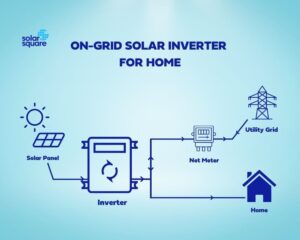
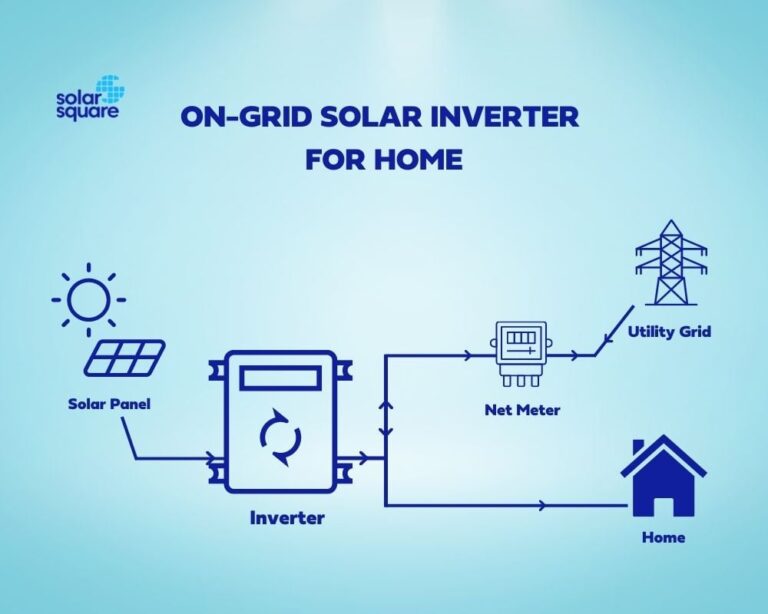
An on-grid solar inverter, as the name suggests, is connected to the grid. It shuts down during a power cut even when your rooftop solar panels are producing electricity in broad daylight. This comes as a surprise to many homeowners, but the shutdown is intentional. It happens because of an important safety feature called anti-islanding.
Anti-islanding disconnects a rooftop on-grid solar system from the utility grid when grid power fails.
- This prevents solar electricity from flowing into damaged or de-energized power lines and helps protect utility workers performing repairs.
- During normal grid operation, an on-grid solar inverter allows you to use the electricity generated by your panels, export surplus power to the grid, and draw additional electricity from the grid whenever solar generation falls short.
The on-grid inverter also handles DC-to-AC conversion, grid synchronization, MPPT (maximum power point tracking), and the overall compatibility of your rooftop solar plant with the grid.
This guide explains what an on-grid solar inverter is, how it works, how to size one correctly for your home, panel oversizing and clipping issues, string and microinverters, on-grid solar inverter prices in India in 2026, and the factors to consider before buying one.
What is an On-Grid Solar Inverter?
An on-grid solar inverter is a grid-connected inverter that converts the DC electricity produced by rooftop solar panels into AC electricity suitable for your home appliances and the utility grid. Unlike a conventional home inverter, it works without a battery and remains connected to the grid during normal operation.
Key Components and Functions of an On-Grid Inverter
An on-grid solar inverter performs several functions to ensure efficient solar generation and grid compatibility. These include:
- DC-to-AC conversion: Converts solar-generated DC electricity into AC electricity.
- MPPT: Helps the solar panels operate at an efficient power-producing point.
- Grid synchronization: Matches the inverter’s output to the utility grid’s voltage and frequency.
- Anti-islanding: Disconnects the inverter when grid supply fails.
- Monitoring: Wi-Fi, GSM, or app-based monitoring can track solar generation and inverter performance.
How Does an On-Grid Solar Inverter Work?
An on-grid solar inverter continuously manages the electricity generated by your solar panels and synchronizes it with the utility grid.
Here’s how an on-grid solar inverter works in simple steps:
- Solar panels generate DC electricity: Sunlight falling on the panels produces direct current.
- The inverter tracks available solar power: Its MPPT function identifies an efficient operating point for the connected panels.
- It converts DC into AC: The inverter changes solar-generated DC electricity into AC electricity that your home can use.
- It synchronizes with the grid: The inverter matches its output to the grid’s voltage and frequency before supplying power.
- When solar generation exceeds consumption: Your home uses the required solar electricity first, while the surplus passes through the bidirectional net meter and can be exported to the grid under the applicable solar net metering arrangement in your city/state. Net metering records electricity imported from and exported to the grid. The applicable billing and settlement rules depend on your state and DISCOM.
- When solar generation is lower than consumption: The inverter supplies the available solar electricity, while the grid provides the shortfall.
Does an On-Grid Solar Inverter Work During a Power Cut?
No, an on-grid solar inverter shuts down when grid supply fails, even when the panels are producing electricity.
This happens because of anti-islanding, which is a safety function that prevents solar electricity from continuing to flow into grid lines during an outage. It protects utility workers repairing damaged or de-energized lines.
What Size On-Grid Solar Inverter Do You Need?
Choosing the right size on-grid solar inverter depends directly on your required solar plant capacity. The plant capacity can be calculated using your monthly electricity consumption and average bill.
Here’s a step-by-step sizing logic and calculation:
- Step 1 – Determine monthly consumption: Divide your average monthly bill by your local electricity tariff per unit. For example, if your average monthly bill is ~Rs. 3,000 and the grid electricity rate is Rs. 10 per unit, you consume ~300 units per month (3,000 ÷ 10).
- Step 2 – Determine the plant capacity: Generating 300 units per month requires roughly a 3 kW rooftop solar system*.
- Select inverter size: As a rule of thumb, your inverter capacity should ideally match your PV system capacity on a 1:1 ratio or stay within a ±10% window to align with the nearest standard manufactured inverter rating.
*Please note: We have considered that a 1 kW solar system generates 1,400-1,450 electricity units a year to reach the plant capacity required in the section above. This can vary significantly based on factors such as pollution levels and irradiance in your area. For example, a solar system in Delhi will generate fewer units than one in a less polluted area. So, treat these figures as approximate ranges. Actual inverter size can only be determined by solar professionals after a thorough evaluation of your roof.
Popular Capacities for On-Grid Solar Inverters for Homes
While on-grid solar inverter ratings generally range from 2 kVA to 20 kVA, not every continuous integer (like 1, 2, 3, 4, 5…) is produced by manufacturers. In addition to standard whole-number sizes, manufacturers may offer intermediate sizes such as 3.3 kVA and 3.6 kVA.
Here’s a snapshot of the most popular capacities for homes:
- Single-phase inverters: They’re usually available in 2, 3, 4, 5, and 6 kVA capacities, and are ideal for small-to-medium homes.
- Three-phase inverters: They’re mostly available in 5, 6, 8, 10, 12, 15, and 20 kVA capacities. A 20 kVA setup is reserved for large homes with massive electricity bills ranging from ~Rs. 20,000 to Rs. 50,000.
Can Solar Panel Capacity Be Higher Than Inverter Capacity?
Yes, solar panel (DC) capacity can be higher than inverter (AC) capacity. This is known as DC overloading or oversizing.
However, there are critical technical performance thresholds and regulatory limits to consider:
- Manufacturer overloading limits (1.4x to 1.5x): Inverter manufacturers allow DC overloading up to 1.4 to 1.5 times of the inverter’s rated capacity. For example, on a 5 kVA solar inverter, you can technically connect up to 7.5 kWp of solar panels.
- The clipping loss threshold (>25% / 1.25x): Exceeding a 25% overload (1.25x) leads to clipping loss (generation loss). On a 5 kVA inverter, if panel capacity goes above 6.25 kWp, the panels produce peak DC power that exceeds the inverter’s maximum output ceiling. This causes the excess generated energy to be clipped and lost.
- Discom (grid utility) regulations (10% to 15%): Local electricity distribution companies (Discoms) impose strict utility restrictions. They generally cap panel overloading within a ±10% to 15% window (or a maximum of 15% overload) of the sanctioned load. Under a 15% Discom restriction, a 5 kVA inverter should not exceed ~5.75 kWp of connected panels.
What Types of On-Grid Solar Inverters Are Used for Homes?
The two types of solar inverter architectures used in India are string inverters and microinverters. Both convert solar-generated DC electricity into AC, but they implement the conversion differently.
- String inverter: A string inverter connects multiple solar panels in series to form one or more strings. DC power from those panels travels to a central inverter, which converts it to AC.
- Microinverters: Microinverters move the conversion process to the module level. Instead of sending the combined DC output of a string to one central inverter, each solar panel has an individual microinverter. This means each panel can perform its own MPPT independently.
Here’s a side-by-side comparison of both types:
Feature | String Inverter | Microinverter |
Inverter location | One central location for the connected panel strings | Beneath, behind, or close to panels |
MPPT | 2-4 | Per panel |
Operating life | ~8 years | ~25 years |
Cost | Lower upfront inverter cost | Higher upfront cost |
Shading performance | One weak module can affect string production depending on design | Better isolation of module-level mismatch |
Installation complexity | Fewer inverter units and simpler centralized servicing | More rooftop electronics and AC connections |
Inverter efficiency* | ~97.5-98.5% | ~96-97% |
Overall system efficiency* | Good | Better when shading, orientation differences, or panel mismatch are present |
Is it better for partial shading? | Usually no | Usually yes |
Is it better for unshaded roofs? | Often the more economical option | Added cost may deliver less benefit |
*DISCLAIMER: The conversion efficiency of the inverter and the energy yield of the complete rooftop solar system are different measures. Most microinverter products commonly publish efficiencies around 96% to 97%. A string inverter may have higher conversion efficiency on paper, but module-level MPPT can improve total energy yield when panels experience shading, different orientations, or mismatches.
Home On-Grid Solar Inverter Specifications Explained
The most useful on-grid inverter specifications can be found in the manufacturer’s datasheets. They tell you whether the inverter can accept the proposed PV array, operate within its voltage and current limits, convert electricity efficiently, withstand the installation environment, and comply with grid-safety requirements.
The following example uses the 3 kVA solar inverter specifications.
Specification | Explanation |
Maximum PV input power | 4.5 kWp |
Maximum DC input voltage | 550/600V |
MPPT voltage range | 150-480V |
Number of MPPTs | 1 |
Maximum input current per MPPT | 20amp |
Grid frequency | 50 Hz |
Maximum efficiency | 97.1% |
Operating temperature | -25°C to +60°C |
Anti-islanding | Yes |
Communication | Wi-Fi/GSM/app monitoring |
Warranty | ~8 years |
Applicable standards | BIS/grid-specific requirements |
Please note: The specifications above are indicative examples for a 3 kVA on-grid solar inverter and should not be treated as standard specifications for every 3 kVA model. Actual values can vary by inverter brand and model, product series, single-phase or three-phase configuration, maximum supported PV capacity, DC voltage and current limits, number and range of MPPTs, efficiency, protection rating, operating temperature range, cooling design, communication and monitoring features, built-in safety protections, warranty terms, and applicable BIS, DISCOM, or other grid-compliance requirements. Manufacturers may also revise product specifications over time. Always check the latest datasheet for the exact inverter model proposed for your solar installation.
What’s the On-Grid Solar Inverter Price in India in 2026?
The on-grid solar inverter price in India in 2026 can range between ~Rs. 6 to ~Rs. 8 per watt*.
*DISCLAIMER (VERY IMPORTANT): The per-watt on-grid solar inverter price in India listed above is an indicative range and should not be treated as a final quotation. The actual price can vary based on the inverter’s capacity, type, single-phase or three-phase configuration, brand and model, number of MPPTs, efficiency, DC input and overloading capability, monitoring and communication features, IP rating, warranty and extended warranty options, applicable safety and grid-compliance requirements, after-sales service coverage, etc. Prices may also differ depending on GST, dealer or distributor margins, location, product availability, ongoing discounts or offers, protection devices, communication dongles, installation, or commissioning charges.
What are the Benefits of On-Grid Solar Inverters?
An on-grid solar inverter suits homeowners living in areas where grid supply is stable and power outages are infrequent.
Its key benefits include:
- No battery required: The inverter uses the utility grid to balance electricity demand rather than relying on battery energy storage systems.
- Surplus electricity can be exported: Excess solar generation can flow to the grid under the applicable metering arrangement.
- Automatic power management: The inverter adjusts continuously as solar generation and home consumption change.
- Performance monitoring: Wi-Fi, GSM, or app-based monitoring can help track generation and system performance.
- Suitable for reliable-grid locations: It works particularly well for reducing electricity bills in areas with infrequent power outages.
What are the Limitations of On-Grid Solar Inverters?
An on-grid solar inverter has fewer storage-related components, but its connection to the utility grid creates two limitations:
- No backup during power cuts: Anti-islanding shuts the inverter down when grid supply fails.
- Dependence on grid: The inverter needs utility voltage and other grid parameters to stay within its permitted operating range before it can remain connected and function normally.
Factors to Consider When Buying On-Grid Solar Inverters
The right inverter should match both your rooftop solar plant and the conditions at your home.
Before choosing one, check the following factors:
- Solar plant capacity: Keep the inverter capacity close to the solar plant capacity, ideally at a 1:1 ratio, with a ±10% adjustment where required to match the nearest standard inverter rating.
- Sanctioned load: Ensure the proposed inverter complies with your sanctioned grid load and DISCOM requirements.
- Roof conditions: Choose a string inverter for a plain, unshaded roof. Consider microinverters only when shading or multiple roof orientations are significant.
- MPPT range and count: Check that the inverter suits the voltage and layout of your solar strings.
- DC voltage and current limits: Confirm compatibility with the selected solar panel types.
- Efficiency: Compare how efficiently suitable models convert DC electricity into AC.
- Safety and compliance: Check BIS standards and grid-specific requirements.
- Monitoring: Look at the available Wi-Fi, GSM, or app-based monitoring features.
- Warranty and service: Compare warranty duration, local service availability, and after-sales support.
Conclusion
An on-grid solar inverter is a strong fit when your priority is to reduce grid electricity use and your home has a reliable power supply with infrequent power cuts. The bigger decision is choosing the right capacity and configuration for your rooftop solar system, rather than simply picking the inverter with the highest efficiency or lowest price.
Before finalizing one, make sure its capacity matches your solar system, its DC limits suit the connected panels, and the model complies with your sanctioned load and DISCOM requirements.
For help sizing your rooftop solar system and selecting an inverter that suits your home, book a free consultation call with SolarSquare.
FAQs
How to increase the lifespan of an on-grid solar inverter?
Install the inverter in a well-ventilated area and maintain the clearances recommended in its operating manual. Keep the unit free of dust, check the cooling fans regularly, and perform preventive maintenance every month or quarter.
Can you convert an on-grid inverter to a hybrid inverter?
No, a standard on-grid inverter cannot be converted into a hybrid inverter. If you need battery storage or backup during outages, you need equipment designed for hybrid operation.
How long does an on-grid solar inverter last?
A residential string inverter can last for ~8 years. The final lifespan depends on product quality, heat exposure, installation conditions, electrical stress, and maintenance.
Does an on-grid solar inverter need a battery?
No. An on-grid solar inverter works without a battery and uses the utility grid to balance electricity supply and demand. The grid provides power when solar generation is insufficient.
What size inverter do I need for a 3 kW solar system?
A 3 kW solar system usually needs a 3 kVA inverter. A 1:1 ratio between PV plant capacity and inverter capacity is standard practice, with limited adjustments as needed to match available inverter ratings.
Can a single-phase on-grid inverter be used with a three-phase connection?
Yes. Most DISCOMs allow a single-phase on-grid inverter to be connected to a three-phase connection. The solar input should be connected to the phase carrying the highest household load, while the final arrangement should comply with local DISCOM requirements.
What is the difference between an on-grid solar inverter and a normal home inverter?
An on-grid solar inverter works with solar panels and the utility grid, exports surplus electricity, and shuts down during a grid outage. A normal home inverter, on the other hand, uses battery power to run selected appliances during a power cut.
What is the on-grid solar inverter efficiency and why does it matter?
Inverter efficiency shows how much DC solar electricity is converted into usable AC power. For example, a 97.1% maximum efficiency means only a small share is lost during conversion, helping improve overall energy yield.


 Previous Article
 22 min