

What keeps a home’s lights, fans, and other appliances running even when there is no electricity grid to rely on? An off-grid solar inverter, working with solar panels and batteries, makes this possible. It converts direct current (DC) electricity from the panels or batteries into alternating current (AC) electricity for household use. Unlike conventional on-grid inverters, it can supply power independently of the utility grid.
However, choosing the right off-grid solar inverter involves more than selecting a suitable power rating. It must handle the electricity demands of your appliances, including sudden increases during startup, and work with adequate battery storage to supply power when sunlight is unavailable.
This guide explains the off-grid solar inverter working principle, sizing, battery and panel requirements, prices, benefits, limitations, and buying factors to consider before making a purchase.
What is an Off-Grid Solar Inverter?
An off-grid solar inverter is designed to supply electricity independently of the utility grid. It works with solar panels, a built-in solar panel charge controller, and a battery bank to store solar electricity and supply power after the sun goes down.
You can think of it as a more solar-focused version of the battery UPS systems commonly used in Indian homes. Many modern solar PCUs (power conditioning units) combine the inverter and solar charge controller into a single unit.
Current products offer features such as MPPT (maximum power point tracking), pure sine wave output, and configurable solar, battery, and grid-priority modes.
Off-Grid Solar Inverter vs Off-Grid Solar System
The terms may sound similar, but they refer to different things. The off-grid solar inverter is a single piece of equipment, whereas the off-grid solar system is the complete power setup.
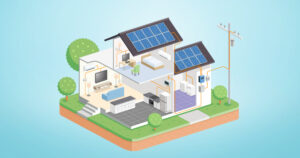
A residential rooftop off-grid solar system includes solar panels, an off-grid solar inverter, rechargeable solar batteries, mounting structures, cables, isolators, and protection devices.
This difference matters when comparing costs.
An off-grid solar inverter may appear affordable on its own. However, the complete off-grid solar system costs considerably more because sufficient battery storage and panel capacity are also required.
How Does an Off-Grid Solar Inverter Work?
An off-grid solar inverter coordinates solar generation, battery charging, and the supply of alternating current (AC) electricity to household appliances. It automatically uses the available solar and stored battery energy according to the system’s design and operating settings.
Here’s a step-by-step breakdown of the off-grid solar inverter working principle:
- Solar panels generate DC electricity: When sunlight falls on the solar panels, they produce direct current (DC) electricity.
- The charge controller regulates solar power: The DC electricity from the panels passes through the off-grid inverter’s built-in MPPT solar charge controller. It regulates the incoming voltage and current so the battery can charge safely and efficiently.
- Solar energy charges the battery bank: The battery stores the electricity produced during daylight hours. This stored energy becomes especially important at night and during periods when solar generation is insufficient to meet the home’s needs.
- The inverter converts DC electricity into AC electricity: Batteries store electricity as DC power. The inverter converts the DC electricity into AC electricity that fans, lights, refrigerators, televisions, air conditioners, and other appliances can use.
- The inverter balances solar and battery power: During the day, available solar energy supports household loads and charges the battery according to the system’s operating logic. If solar generation falls below demand or stops after sunset, the battery supplies the shortfall until it reaches its permitted discharge limit.
Wondering ‘how does an off-grid solar system work’, not just the inverter? Check out our detailed blog on off-grid solar systems.
What Happens When the Battery Becomes Low?
If there is no solar generation (such as during the night) and your battery bank is fully depleted, the inverter will shut down. Because you are completely disconnected from the utility grid, you will experience a blackout until the sun rises to recharge the batteries.
What Happens When the Battery Is Fully Charged?
Once your batteries reach 100% capacity, the solar panels will generate only as much power as your real-time load demands. Any extra power that the panels could generate is throttled by the inverter and wasted, as there is no grid to export this excess energy to.
What Happens During Several Cloudy or Rainy Days?
Off-grid solar systems account for periods when the solar array cannot produce enough energy. This reserve period is known as autonomy. It refers to the duration the battery bank can support planned loads without receiving normal solar replenishment.
For example, a system may be designed with around 1.5 to 2 days of autonomy to account for periods of poor sunlight.
Increasing autonomy further can require a much larger battery bank, which raises cost and may leave a considerable amount of storage underused during normal sunny periods. This is why an off-grid solar system should be sized around local weather conditions, household consumption, and the number of backup hours or days you genuinely need.
Is an Off-Grid Solar Inverter Right for Your Home?
Since an entire off-grid solar system can be too expensive, an off-grid solar inverter is recommended only if your home is in a highly remote area with no grid connectivity.
The right choice largely depends on how reliable the electricity supply is in your area:
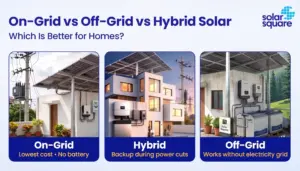
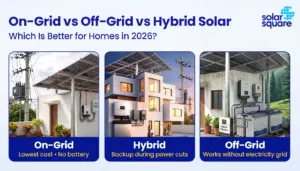
- If you have access to the grid but it’s unreliable, with frequent, prolonged power cuts, a hybrid solar inverter is the smarter and more economical choice.
- If you live in an area with a highly reliable grid, on-grid solar inverters are the most economical option.
While off-grid solar inverters are cheaper upfront, the massive battery bank required for autonomy makes the overall system cost much higher than a hybrid solar system.
What Size Off-Grid Solar Inverter Do You Need?
Choosing off-grid inverter capacity requires you to calculate the maximum load that may run at the same time. However, sizing an off-grid solar inverter cannot be based solely on the nominal wattage of your appliances. It must account for surge (peak) power.
If you sum up the standard running power of your appliances but ignore startup surges, your inverter will trip the moment multiple heavy loads turn on simultaneously.
Here are two simple examples that explain this:
- Geysers: A standard geyser might have a nominal power of 1.2 kW (kilowatt), but the inductive coil causes it to peak between 1.5 kW and 1.8 kW when switched on.
- Air conditioners: When the compressor of a 1-ton or 1.5-ton AC kicks in, it can draw 1.5x to 2x its normal running power.
That’s why an off-grid solar inverter must be sized large enough to handle the combined peak inductive load of all appliances that might run at the same time.
Practical Inverter Sizing Example
The following example explains the sizing process. It is an illustrative calculation, not a final system recommendation. Actual appliance wattage, compressor starting current, inverter power factor, surge duration, and manufacturer specifications must be checked before selecting equipment.
Here are the assumptions we’ve used in this example:
| Appliance | Quantity | Assumed Running Load |
| Regular ceiling fans | 4 | 300W |
| LED lights | 5 | 100W |
| Refrigerator | 1 | 250W |
| 1-ton AC | 1 | 1,000W |
| Total running load | 1,650 W |
For this example, let’s assume that the refrigerator briefly reaches ~750 W (watts) during startup and the AC reaches ~2,000 W.
If both start at roughly the same time:
- Fans and lights = 400 W
- Refrigerator startup = 750 W
- AC startup = 2,000 W
Potential peak load = 400 + 750 + 2,000 = 3,150 W
If you use a 3 kVA (kilovolt-ampere) inverter for this load capacity, it will trip under the combined surge if prolonged more than 5-10 seconds. Hence, you might need to size up to a 4 kVA or 5 kVA inverter to safely handle this peak inductive load.
However, this does not automatically mean you need a specific 4 kVA or 5 kVA model.
Before selecting a model, check the following:
- First, select an inverter with a continuous real-power output that covers the 1,650 W running load and a documented surge capability that exceeds the expected 3,150 W peak.
- Then, check watts, not just VA or kVA. This matters because kVA and usable watts are not always equivalent.
How Much Battery Capacity Do You Need for an Off-Grid Solar Inverter?
Battery sizing relies heavily on your nighttime load and desired autonomy. Because homes consume ~70% of their power after the sun goes down, batteries must store this bulk energy and an extra buffer for cloudy or rainy days.
Practical Battery Sizing Example
This example builds on an assumed household requirement. It is meant to demonstrate the calculation only. Battery chemistry, inverter efficiency, BMS limits, local weather, and the homeowner’s actual load profile can change the final requirement.
Let’s take the following assumptions to calculate the battery size needed:
- Daily electricity requirement: 10 kWh
- Required autonomy: 1.5 days
- Lithium battery usable depth of discharge: 85%
- Assumed battery/inverter round-trip efficiency: 90%
- Battery-bank voltage: 48 V
First, calculate the energy required for 1.5 days: 10 kWh × 1.5 = 15 kWh of usable energy.
Now, we account for the assumed 85% usable depth of discharge and 90% delivery efficiency: Required nominal storage = 15 ÷ (0.85 × 0.90) ≈ 19.6 kWh
For a 48 V battery bank: 19,600 Wh ÷ 48 V ≈ 408 Ah =~400 Ah
So, under these assumptions, the design would need approximately 19.6 kWh of nominal battery storage, or ~400 Ah at 48 V.
Can an Off-Grid Solar Inverter Work Without a Battery?
No. In an off-grid solar system, the battery serves as the mandatory storage device and voltage anchor for the entire system. Without it, the inverter cannot balance rapidly fluctuating solar generation with the variable power demands of your home appliances, leading to immediate system shutdowns.
How Many Solar Panels Do You Need for an Off-Grid Inverter?
In an off-grid PV (photovoltaic) system, solar panels are your only source of power. Therefore, your panel array must be large enough to perform two tasks simultaneously during daylight hours:
- Power all the appliances you are currently running.
- Replenish the massive battery bank you depleted the night before.
That’s why you cannot size your panels based solely on the inverter’s kVA rating. Instead, sizing is dictated by your total daily energy consumption, local sun hours, and inherent efficiency losses.
Example of Solar Panels Needed for an Off-Grid Inverter
The following calculation uses simplified assumptions to explain the method. It is not a site-specific solar design. The final array must also satisfy the inverter’s maximum PV power, MPPT voltage, current, and open-circuit voltage limits.
Let’s take the following assumptions:
- Daily electricity requirement: 10 kWh, or 10,000 Wh
- Overall usable system yield after assumed losses: 75%
- Peak sun hours used for this example: 5 hours per day
- Panel rating: 600 W
- Panel degradation factor: 90% over 15-20 years
First, account for the assumed system losses:
Required solar generation = 10,000 Wh ÷ (0.75 x 0.90) ≈ 14,815 Wh/day
Next, calculate the required array capacity: 14,815 Wh ÷ 5 hours ≈ 2,963 W =~3 kW
Using 600 W panels: 3000 W ÷ 600 W ≈ 5 panels
Important note on inverter limits: Once you calculate the total panel capacity needed, you must verify it against your off-grid inverter’s specification sheet. The inverter’s built-in MPPT charge controller has a maximum PV input limit. While you can usually oversize the array by 10% to 20% of the inverter’s kVA rating, if your panel requirement strictly exceeds the inverter’s input limit, you must upgrade to a larger inverter to handle the solar generation.
What Types of Off-Grid Solar Inverters Are Used for Homes?
Off-grid solar systems utilize string-type inverters. Microinverters are not used in off-grid setups.
When selecting an off-grid solar inverter, you will encounter the following two charge controller technologies:
- MPPT (Maximum Power Point Tracking): It continually adjusts the operating point of the solar array to extract maximum power from the panels as conditions change. Most modern off-grid inverters have built-in MPPTs.
- PWM (Pulse Width Modulation): It uses a simpler charging approach but is an outdated technology.
What’s the Off-Grid Solar Inverter Price in India in 2026?
The off-grid solar inverter price in India in 2026 can range from ~₹10 to ~₹14 per watt*. However, actual retail prices depend on capacity, inverter technology, battery voltage, features, and brand.
*DISCLAIMER (VERY IMPORTANT): The per-watt off-grid solar inverter price in India listed above is an indicative range and should not be treated as a final quotation. The actual price can vary based on the inverter’s capacity, brand and model, number of MPPTs, efficiency, IP (ingress protection) rating, warranty and extended warranty options, battery type and capacity, after-sales service coverage, GST (Goods and Services Tax), dealer or distributor margins, location, product availability, ongoing discounts or offers, protection devices, communication dongles, installation, or commissioning charges.
Which Component Usually Has the Biggest Effect on Off-Grid Solar System’s Cost?
The component-wise cost of an off-grid solar system changes with the size of the solar plant and battery bank. For a 3 kW system with 5 kWh (kilowatt-hour) battery storage, the battery accounts for the largest share. In a 5 kW system with the same 5 kWh battery capacity, solar panels become the largest cost component.
Here is an indicative component-wise cost breakdown:
| Component | 3 kW / 5 kWh System | 5 kW / 5 kWh System |
| Solar panels | ~22-26% | ~30-34% |
| Battery | ~31-35% | ~24-28% |
| Inverter | ~24-28% | ~18-22% |
| Wiring | ~6-10% | ~4-8% |
| MMS (module mounting structure) | ~4-8% | ~6-10% |
| Balance BOS + services | ~1-5% | ~6-10% |
Please note: These percentages are indicative and can vary with equipment specifications, battery technology, installation requirements, mounting structure, location, and other balance-of-system costs.
Is There a Government Subsidy for Off-Grid Solar Systems in India?
No. The central subsidy under the PM Surya Ghar Muft Bijli Yojana applies strictly to grid-connected solar systems (on-grid and hybrid) that utilize net metering. Off-grid PV systems do not qualify for this government subsidy as they are completely independent of the grid.
What Are the Benefits of Off-Grid Solar Inverters?
The main advantage of off-grid solar is its ability to generate and store electricity without relying on an available utility connection. That makes it particularly useful where grid infrastructure itself is the problem.
Key benefits include:
- Energy independence: A correctly sized off-grid rooftop PV system can continue supplying power to designed loads without the utility grid.
- Suitable for remote properties: It can serve homes, farmhouses, and other sites where a utility grid is unavailable or extremely unreliable.
- Greater control over essential loads: You can design the system around the appliances and backup duration that matter most.
These benefits depend heavily on correct sizing. Independence is useful only when the solar array and battery bank can support the actual consumption pattern.
What are the Limitations of Off-Grid Solar Inverters?
The same battery storage that gives off-grid solar independence also leads to high cost and design challenges.
A homeowner should consider all these drawbacks before choosing complete grid independence:
- High initial cost: Large battery banks make off-grid solar systems considerably expensive.
- Finite backup: Once stored energy is depleted, a standalone PV system cannot supply power until solar generation resumes.
- Weather dependence: Several low-generation days can reduce the autonomy buffer.
- Unused solar potential: When batteries are full and loads are low, surplus potential generation cannot simply flow into the public grid.
- Battery aging and replacement: Batteries have a finite service life. So, there’s replacement cost as well.
What Should You Check Before Buying an Off-Grid Solar Inverter?
Before buying an off-grid solar inverter, assess the inverter, battery bank, solar array, and household load as one connected system. Selecting each component separately can result in inadequate power, unnecessary battery costs, or compatibility problems.
Check the following factors:
- Simultaneous running load: Calculate the total wattage of the appliances that may operate together.
- Startup surge: Account for the higher starting demand of air conditioners, refrigerators, pumps, and other motor-driven appliances.
- Continuous output in watts: Confirm that the inverter’s usable real-power output covers the expected running load. Do not select it from the kVA rating alone.
- Surge capacity and duration: Check how much peak power the inverter can supply and how long it can maintain that output.
- Battery compatibility: Match the inverter’s battery-voltage range, charging settings, current limits, and communication requirements with the selected battery.
- Required autonomy: Choose the battery bank according to the backup hours or days genuinely required.
- Solar-input limits: Ensure the array’s wattage, voltage, current, and open-circuit voltage remain within the inverter’s MPPT specifications.
- Protection features: Check for suitable overload, short-circuit, thermal, surge, and battery protections.
- Warranty and service support: Reliable after-sales service is especially important when the off-grid system is the property’s only electricity source.
- Complete system cost: Compare the inverter, battery, panels, protection devices, installation, and future battery-replacement costs rather than judging the system by inverter price alone.
Conclusion
An off-grid solar inverter is most suitable for a property that cannot rely on an electricity-grid connection. Its success depends on whether the complete solar system can support the household’s running load, startup demand, daily electricity consumption, and required backup duration.
If grid electricity is already available, compare on-grid and hybrid solar systems before investing in a large off-grid battery bank. The best option depends on whether your priority is bill savings, power backup, or complete independence from the utility grid.
Book a free solar consultation call with SolarSquare to assess your electricity use, roof conditions, and backup requirements before selecting a rooftop solar system.
Frequently Asked Questions
Which is better, an off-grid or a hybrid solar system?
A hybrid solar system makes more sense when your home already has grid electricity, and you also want battery backup. It can use solar, batteries, and grid power, depending on the system configuration. An off-grid solar system becomes more useful in remote and rural locations where grid supply is unavailable.
Which solar is better, on-grid or off-grid?
On-grid solar systems are best for saving money and reducing electricity bills, while off-grid PV systems are best for remote areas requiring total independence from grid infrastructure.
Can an off-grid solar inverter run an AC?
Yes. An appropriately designed off-grid solar system can run an air conditioner. However, you need to account for the AC’s power draw, startup behavior, daily operating hours, battery capacity, and solar generation. Do not choose the inverter solely from the AC’s tonnage.
How long will an off-grid inverter run on battery power?
This depends entirely on your battery bank sizing. Properly sized off-grid PV systems are usually built to provide 1.5 to 2 days of autonomy.
Can I convert an on-grid solar system into an off-grid system?
No, you normally cannot convert an on-grid solar system into a reliable off-grid installation simply by adding batteries. Standalone operation requires an inverter architecture capable of forming and maintaining an independent AC supply, along with compatible batteries, protection equipment, controls, and wiring.
What is the best battery for an off-grid solar inverter in India?
Lithium-ion (specifically lithium iron phosphate) batteries are the best choice due to their deep depth of discharge and 10-15 year lifespan. Tall tubular lead-acid batteries, on the other hand, remain a popular choice for buyers on a strict upfront budget.
What appliances can an off-grid solar inverter run?
An off-grid solar inverter can run all common household appliances such as lights, fans, TVs, laptops, refrigerators, water pumps, and even air conditioners. What it can support depends on the inverter’s continuous and surge capacity, battery size, and available solar power. High-load appliances such as ACs, geysers, and pumps require careful sizing because they consume more power or draw higher startup current.