
 2 Reads
 6 mins


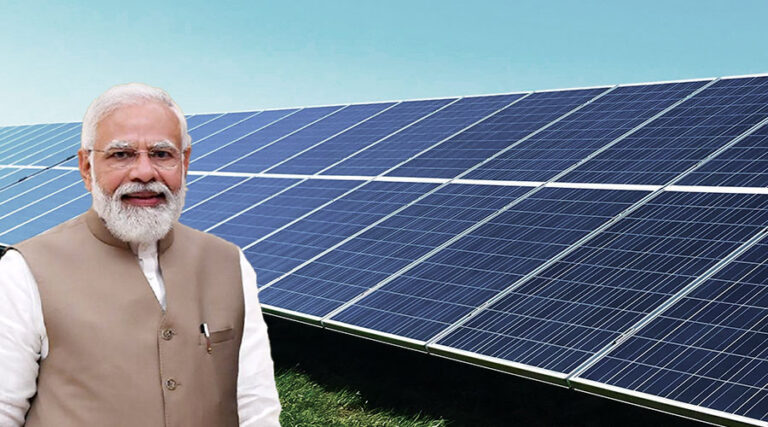
The Government of India has set a target of 1 crore households running on rooftop solar by 2027 under PM Surya Ghar: Muft Bijli Yojana. To popularise rooftop solar among homeowners and hit this target, the government offers homeowners financial assistance through Central Financial Assistance (CFA), disbursed via the National Portal for Rooftop Solar- pmsuryaghar.gov.in.
The scheme is managed by the Ministry of New and Renewable Energy (MNRE), with state DISCOMs acting as implementation partners for feasibility approval, net metering, and inspection.
As of August 2026, PM Surya Ghar Muft Bijli Yojana has benefited over 50 lakh households, commissioned 14.8 GW of rooftop capacity, and disbursed ₹28,024 crore in subsidy via Direct Benefit Transfer (DBT), as reported by PIB.
What is the National Portal for Rooftop Solar?
The original National Solar Portal (solarrooftop.gov.in) was launched by PM Narendra Modi on 30 July 2022 under Rooftop Solar Programme Phase II. In February 2024, it was migrated into the PM Surya Ghar: Muft Bijli Yojana portal at pmsuryaghar.gov.in, which is now the official National Portal for Rooftop Solar and the National Portal for Rooftop Solar Subsidy for all residential applications.
Any Indian consumer, or their chosen solar installer, can apply for net metering and subsidy directly on this national portal. Once the system is installed and commissioned, the subsidy is credited to the consumer’s bank account, typically within 30-45 days of DISCOM inspection.
How much subsidy can homeowners get when applying on the National Portal for Rooftop Solar Subsidy?
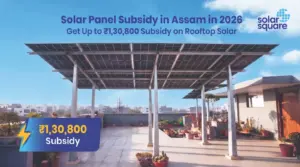
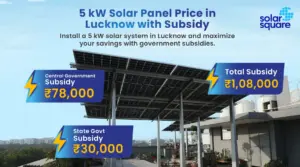
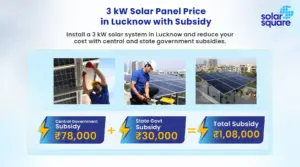
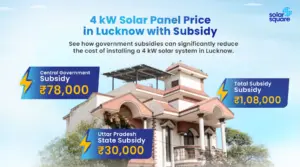
Under the PMSGY subsidy scheme, homeowners planning to install a residential rooftop solar system at their homes are eligible for a subsidy of ₹ 78,000 (capped at 3 kW and above). The following is the complete subsidy structure:
| System Capacity | Applicable Subsidy |
| 1 kW | ₹ 30,000 |
| 2 kW | ₹ 60,000 |
| 3 kW and above | ₹ 78,000 (capped) |
This works out to a 60% subsidy on the system cost for the first 2 kW, and 40% on the next 1 kW, with the subsidy capped at 3 kW capacity regardless of system size.
Note: These figures are per MNRE/PM Surya Ghar guidelines as reported in 2026.
CFA is released only after DISCOM inspection and successful commissioning, and does not apply retrospectively.
Why is the National Portal for Rooftop Solar a game-changer for residential solar?
Consumers are no longer dependent on a state-specific subsidy programme; any customer across every state and union territory can apply through the single National Portal for Rooftop Solar. Subsidy is disbursed directly to the consumer’s bank account under a Direct Benefit Transfer (DBT) model.
PM Surya Ghar also offers multiple solar financing options. The portal facilitates collateral-free loans of up to ₹2 lakh for residential rooftop solar systems, with concessional interest rates linked to the RBI repo rate. As of July 2026, the concessional rate was 5.75% per annum (repo rate + 50 basis points), with a repayment tenure of up to 10 years. Loans are processed through participating public-sector banks via the JanSamarth platform.
Source: Ministry of New and Renewable Energy (MNRE), Government of India / PIB- PM Surya Ghar: Muft Bijli Yojana, 28 July 2026
What is the process of applying for subsidy on the National Portal for Rooftop Solar?
Applying for a subsidy is a straightforward, fully online process once you know the sequence. Here’s exactly how a residential consumer moves from registration to receiving the subsidy in their bank account through the National Portal for Rooftop Solar.
- Consumers can register and apply directly at pmsuryaghar.gov.in.
- Alternatively, SolarSquare or your chosen solar company can handle the end-to-end application and subsidy process on your behalf.
- Consumers can choose any solar company empanelled with their DISCOM.
- Application progress can be tracked live on the National Portal for Rooftop Solar.
- Bank account details must be updated on the portal; subsidy is credited directly after commissioning.
- Solar companies are required to provide 4-5 years of after-sales and maintenance service for TOPCon and Mono PERC panels, respectively.
SolarSquare manages end-to-end applications, from net metering to subsidy disbursal, for all its customers.
Are there any conditions for availing subsidy under this scheme?
Before you apply, it helps to know exactly what qualifies and what doesn’t. The National Portal for Rooftop Solar Subsidy comes with two non-negotiable conditions that determine whether your application clears DISCOM approval.
Two conditions apply.
- You can only choose solar companies empanelled with your state DISCOM.
- Subsidy is available only on systems using ALMM (Approved List of Models and Manufacturers) List-I modules. From 1 June 2026, cells inside those modules must also come from ALMM List-II manufacturers for newly commissioned net-metering projects.
Why is this scheme a milestone for the solar industry?
Under the National Portal for Rooftop Solar, adoption continues to accelerate through hassle-free online applications, real-time tracking, and faster subsidy disbursement. Solar companies benefit from simplified empanelment and upfront payment from consumers, rather than waiting on DISCOM fund releases, improving cash flow and encouraging more industry participation.
Conclusion
India is firmly in the decade of home solarisation. With the National Portal for Rooftop Solar making applications easier to track and the government targeting 1 crore solar-powered households by 2027, going solar is becoming simpler and more affordable for Indian homeowners.
If you’re ready to apply on the National Portal for Rooftop Solar, SolarSquare handles the entire journey for you, from checking your eligibility and filing your application to installation, net metering, and following up on your subsidy disbursal. Get a free solar consultation with SolarSquare today.
Frequently Asked Questions
Can I apply for both state and national solar subsidy together?
In most states, only the National Portal for Rooftop Solar subsidy applies. Uttar Pradesh, Rajasthan, and Delhi are notable exceptions, where residents can combine the central subsidy with an additional state-level subsidy for a larger total benefit; check your state DISCOM for current top-up schemes.
Is the National Solar Portal the same as PM Surya Ghar?
Yes. The original National Solar Portal (launched in 2022) was migrated into the PM Surya Ghar: Muft Bijli Yojana portal in February 2024, which now serves as the National Portal for Rooftop Solar.
Is the subsidy the same for every state, or does it vary?
The central CFA amount (up to ₹ 78,000) is uniform nationwide. Some states layer on their own additional top-up subsidies, so the final benefit can vary depending on where you live.
Do I need to pay any fee to apply on the National Portal for Rooftop Solar?
No. MNRE advises consumers not to pay extra charges for applying through the portal or for net metering beyond the fees prescribed by the DISCOM. If a vendor asks for additional charges, report it to MNRE.
What documents do I need to apply on the National Portal for Rooftop Solar?
Identity proof, address proof, a recent electricity bill or consumer number, proof of house ownership, and bank account details for the subsidy credit.


 Previous Article
 9 min
9 min