

 1042 Reads
 22 mins




Did you know that 10 million agricultural pumps in India run on Diesel, making agriculture the 2nd-largest consumer of Diesel in the country? On top of that, crop irrigation alone consumes ~20% of India’s electricity, most of it subsidized for rural consumers, which has strained DISCOM finances for years.
This situation makes it hard for India to meet its 500 GW non-fossil target by 2030 without solarizing agriculture at scale. What really stops solar adoption at the village level is the availability of a loan.
This is exactly where the NABARD and REC solar loan schemes come into play.
- NABARD is the apex bank for agriculture and rural development. It refinances cooperative banks, RRBs, and Small Finance Banks, enabling them to lend to farmers and rural households at lower rates for solar water pumps and rooftop systems.
- REC is a Maharatna NBFC under the Ministry of Power: It funds large-scale solar projects directly and acts as the implementation agency for the PM Surya Ghar Muft Bijli Yojana.
The most important thing to know is that neither of these rural solar financing schemes gives loans directly to farmers or households. Instead, they help banks offer solar loans for agriculture by providing cheaper funds and clear rules on loan amounts, interest rates, repayment periods, and eligibility.
This blog walks you through what each of these farm solar loan schemes in India does, where the money flows, and where a farmer or rural household should apply to get a solar loan.
Do NABARD and REC Give Solar Loans to Farmers Directly?
No, they don’t. While both these rural solar financing schemes are built to benefit farmers and rural households, neither NABARD nor REC lends to them directly. The actual loan comes from a bank.
Here is what each one does.
- NABARD refinances banks: The farmer’s loan comes from a cooperative bank, an RRB, an SFB, or a commercial bank. NABARD’s scheme is a refinancing arrangement that allows banks to offer cheaper rates to farmers.
- REC lends to utilities, CPSEs, state DISCOMs, and large solar developers: REC is the nodal agency for the PM Surya Ghar Muft Bijli Yojana, but the actual rooftop solar loans for homes come from SBI, Canara, BoB, or another partner PSU bank.
Simply put, agri-solar financing in India operates through these schemes, not directly. Farmers usually receive the loan through a bank or a partner agency, not directly from the NABARD or REC solar loan schemes.
NABARD and REC Solar Schemes at a Glance
Here’s a snapshot of the NABARD and REC solar loan schemes:
| Parameter | NABARD Solar Scheme | REC Solar Financing Scheme |
| What it is | Refinance and capital subsidy schemes that make agri and rural solar loans cheaper at banks. | A mix of project finance for big solar projects and a nodal role for the PM Surya Ghar Muft Bijli Yojana scheme. |
| Who runs it? | A government-owned apex bank for agriculture and rural development, set up under the RBI Act. | A government-owned non-banking finance company (NBFC) under the Ministry of Power. |
| Who does it lend to? | Cooperative banks, RRBs, SFBs, and commercial banks | Utilities, DISCOMs, CPSEs, and large RE developers |
| Does it lend to farmers directly? | No | No |
| Does it lend to households directly? | No | No |
| Where does the farmer or household actually obtain the loan? | From their local bank (cooperative, RRB, or commercial), which has been refinanced by NABARD. | From a public sector bank (SBI, Canara, Union, BoB, etc.) under the PM Surya Ghar Muft Bijli Yojana. |
| What subsidies are linked to these schemes? |
| Central Financial Assistance under the PM Surya Ghar Muft Bijli Yojana (capped at Rs. 78,000 for systems of 3 kW or more for households) |
| Where farmer/household applies | At local bank (PSB, cooperative, RRB) | At the PM Surya Ghar portal + chosen bank |
| Is the scheme still active in 2026? | Yes, Special Refinance Scheme has been extended to 30 September 2026 | Yes, the PM Surya Ghar Muft Bijli Yojana runs till FY 2026-27 |
NABARD Solar Loan Schemes Explained
NABARD has been involved in rural financing since 1982, and its role in solar started earlier than many people think. It began supporting solar in the early 2010s, when off-grid solar lights were common in rural areas.
Today, NABARD supports a wider range of solar projects, including solar pumps, rural rooftop solar, and solar-powered farm feeders. This support reaches borrowers through cooperative banks, Regional Rural Banks, Small Finance Banks, and commercial banks.
What is NABARD?
NABARD stands for the National Bank for Agriculture and Rural Development. It was established by an Act of Parliament in 1981 to consolidate India’s rural credit and rural development institutions under a single apex body.
Its main role is to finance, supervise, and develop the rural credit system. Simply put, it funds the banks that farmers and rural businesses actually borrow solar loans from.
Here is what NABARD does in practice.
- It refinances rural and cooperative banks: NABARD provides low-cost capital to RRBs, cooperative banks, SFBs, and commercial banks, enabling them to lend to farmers and rural businesses at lower interest rates.
- It builds rural infrastructure funds: NABARD manages large funds that support rural infrastructure, such as irrigation, roads, and solar pumps. A few examples are the Rural Infrastructure Development Fund and the Micro Irrigation Fund.
NABARD has no branches that a borrower can walk into. There is no such product as a direct NABARD solar subsidy loan that a farmer can apply for at NABARD’s office. The loan a farmer receives always comes from their local bank. NABARD refinances that bank, making sure the money is available at a rate the farmer can afford.
NABARD’s Active Solar Financing Programs
NABARD solar financing for rural India currently works through three main programs, each targeting a different segment of rural and agri solar. Together, they cover standalone solar pumps for farmers, residential rooftop solar in rural households, and solarization linked to micro-irrigation.
- Long-term refinance for agri solar: This program supports loans for standalone solar pumps, solarizing grid-connected pumps, and setting up solar plants on barren or unused farmland. Banks lending against any of these solar loan schemes for farmers can access NABARD refinance at concessional rates. This is the main channel for solar loans for agriculture in rural India today.
- Special Refinance Scheme for solar rooftop: This program supports rooftop solar for homes in rural areas. At present, it is routed through Small Finance Banks. NABARD can refinance 50% of the project cost or 95% of the bank loan, whichever is lower. The scheme is available until 30 September 2026 or until the funds are exhausted.
- Micro Irrigation Fund (MIF): This is a Rs. 10,000 crore fund primarily used for drip and sprinkler irrigation systems. Since October 2024, it has also supported solar pump financing. Loans under this route receive a 3% interest rate benefit, which helps reduce costs for borrowers.
NABARD Solar Refinance Terms
Here are NABARD’s refinance terms that directly shape the interest rate the bank can offer to the farmer or household, the size of the loan the bank can sanction, and how long it takes for the bank actually to receive the refinance through NABARD after loan disbursal.
- Interest rate: It starts at around 4.5% per year. The latest revision came into effect on 17 August 2025.
- Loan support: NABARD can refinance up to 95% of the bank’s loan amount or 50% of the project cost, whichever is lower. The exact amount depends on the scheme.
- Loan period: The minimum period is 18 months. For long-term refinancing, the term can be up to 15 years.
- Repayment: Banks usually repay the principal amount every quarter.
NABARD also has an Automatic Refinance Facility, or ARF. This allows banks to claim refinancing after they have granted the loan, without waiting for approval on each case.
Who NABARD Lends To
The eligible institutional borrowers are listed below.
- Cooperative banks, including state cooperative banks, district central cooperative banks, and primary agricultural credit societies.
- Regional Rural Banks (RRBs)
- Small Finance Banks (SFBs), which carry the Special Refinance Scheme for rooftop solar.
- Commercial banks, both public and private sector.
Who Ends Up With the Solar Loan at the Bank?
Rural solar financing schemes backed by NABARD are accessible to the following groups.
- Individual farmers who borrow from cooperative banks, RRBs, or commercial bank rural branches.
- Farmer Producer Organizations (FPOs), SHGs, and JLGs that access pooled financing.
- Panchayats and Water User Associations, especially for community solar pumps or micro-irrigation.
- Small and micro rural enterprises, including agri-allied businesses like dairy and cold chain.
- Rural households for residential rooftop solar via SFBs under the Special Refinance Scheme
Please note: Eligibility is checked by the bank, not by NABARD. Public and private sector corporations are not eligible under the capital subsidy route.
REC Solar Loan Schemes Explained
REC Limited, formerly known as Rural Electrification Corporation, is one of India’s oldest power finance companies. It was set up in 1969 to fund rural electrification. Today, it is a Maharatna company under the Ministry of Power.
The REC renewable energy financing scheme supports large renewable energy projects and government solar programs. It does not give solar loans directly to households or farmers.
This section explains what REC is and who eventually benefits from it.
What REC Is and What It Doesn’t Do?
REC is a government-backed power sector finance company. It funds projects across the electricity sector, including power generation, transmission, distribution, and renewable energy. It is a subsidiary of Power Finance Corporation, and both work under the Ministry of Power.
But REC does not directly provide solar loans to households.
For example, if a household installs rooftop solar under the PM Surya Ghar Muft Bijli Yojana, REC may support the scheme at a higher level. But the actual loan still comes from a partner bank.
Here are a few numbers that show RECs scale:
- Its loan book was around Rs. 5.67* lakh crore as of March 2025.
- Its renewable energy exposure is around Rs. 55,980* crore in 2026.
- It aims to reach Rs. 3 lakh crore* in renewable energy lending by FY30.
Source: REC Limited FY 2025-26 Report
What REC Does in Solar Financing?
REC’s solar financing work falls into three main areas. Each one supports the solar sector in a different way. However, REC does not give solar loans directly to households or farmers.
- Nodal agency for the PM Surya Ghar Muft Bijli Yojana: REC has been appointed by MNRE as the National Programme Implementing Agency for PM Surya Ghar Muft Bijli Yojana. This is the rooftop solar scheme that aims to solarize 1 crore households in India.
- Credit support for the rooftop mission: REC has set aside Rs. 1.2 lakh crore, so banks and government companies have enough funds to support the rooftop solar scheme. Its board has also approved an initial Rs. 15,000 crore credit line for eight government-owned companies, namely, NTPC, NHPC, EESL, PowerGrid, SECI, THDC, SJVN, and NEEPCO. These companies work as RESCOs under the scheme.
- Finance for large renewable energy projects: REC gives loans directly to large renewable energy developers for utility-scale solar, wind, and hybrid projects. These are big projects that supply power to the grid.
Who REC Lends To
The eligible institutional borrowers are listed below.
- State DISCOMs and power utilities
- CPSEs acting as RESCOs under the PM Surya Ghar Muft Bijli Yojana, including NTPC, NHPC, EESL, PowerGrid, SECI, THDC, SJVN, and NEEPCO
- Large RE developers for utility-scale solar and wind hybrid projects
- State Electricity Boards and rural electric cooperatives
- Non-power infrastructure, including roads, airports, and metros, which REC has been allowed to finance since 2022-23
Who Ends Up With the Solar Loan at the Bank
The list below shows who can get solar loans through banks and programs that REC supports.
- Homeowners: Households can borrow from public sector banks like SBI, Canara Bank, Union Bank, and PNB to install a rooftop solar system.
- Housing societies and RWAs: They can take loans for shared rooftop solar systems used for common areas.
- Commercial rooftop users: Businesses can obtain rooftop solar loans if the project size meets the bank’s lending criteria.
- PM-KUSUM Component A landowners: Landowners can borrow against the income they expect to receive from selling solar power under a power purchase agreement (PPA). Very large projects may receive REC funding directly, but most farmer-level loans go through public-sector banks.
Government Schemes That Drive Most of The Lending
NABARD and REC solar loan schemes do not give loans directly to farmers or households. Instead, the funds flow through two major government solar schemes run by MNRE, i.e., the PM-KUSUM Yojana for Agri Solar and the PM Surya Ghar Muft Bijli Yojana for residential rooftop solar.
- PM-KUSUM Yojana: This supports solar projects for agriculture, such as solar pumps and farm-based solar power.
- PM Surya Ghar Muft Bijli Yojana: This supports rooftop solar for residential households.
Let’s explore both schemes in detail.
#1. PM-KUSUM Yojana for Agri Solar
PM-KUSUM is the central government’s main solar scheme for farmers. Its full name is Pradhan Mantri Kisan Urja Suraksha evam Utthaan Mahabhiyan.
The scheme was launched in March 2019 to add 34,800 MW of solar capacity in the agriculture sector. It has central government support of Rs. 34,422 crore, making it one of the largest channels for agri-solar financing in India. Many solar pump loans that banks refinance through NABARD are linked to this scheme.
PM-KUSUM has three main components:
- Component A: This supports small solar power plants of 500 kW to 2 MW on barren or unused farmland through farm solar loan schemes in India. The farmer can either set up the plant or lease the land to a developer. The electricity is sold to the DISCOM through a long-term power purchase agreement.
- Component B: This supports standalone solar pumps for farmers. In most states, pumps up to 7.5 HP are covered. In special category regions, pumps up to 15 HP are covered.
- Component C: This supports solarizing existing grid-connected farm pumps, but can also be done for individual pumps or at the feeder level.
The subsidy structure is simple in most states:
- Central government: 30%
- State government: 30%
- Farmer: 10%
- Bank loan: 30%
In special category states and regions such as the North East, J&K, Himachal Pradesh, Uttarakhand, Ladakh, and island UTs, the central government share goes up to 50%. The farmer contributes 20%, and the loan amount changes accordingly.
The bank loan portion is where NABARD refinancing comes in. When cooperative banks, Regional Rural Banks, and public sector banks give loans for PM-KUSUM solar pumps, they can get refinancing from NABARD at lower rates.
#2. PM Surya Ghar Muft Bijli Yojana for Residential Rooftop Solar
PM Surya Ghar Muft Bijli Yojana is the central government’s residential rooftop solar scheme. It was launched in February 2024 with a target of 1 crore household installations by FY 2026-27 at a total approved budget of ~Rs. 75,000 crore.
The scheme is run by MNRE, with REC serving as the National Programme Implementing Agency.
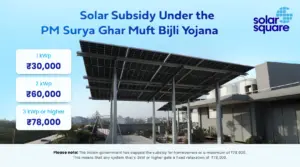
Central Financial Assistance is structured by solar system size.
- 1 kW system: Eligible for a Rs. 30,000 subsidy.
- 2 kW system: Eligible for a Rs. 60,000 subsidy.
- 3 kW and above: Eligible for a Rs. 78,000 subsidy, the maximum permissible.
Households can also take a collateral-free loan to fund the remaining cost.
- Loans up to Rs. 2 lakh: They are available at ~7% per annum for systems up to 3 kW.
- Loans up to Rs. 6 lakh: They are available at 8.4% to 10.8% for 3 to 10 kW systems,
Participating banks include SBI, Canara Bank, Union Bank, BoB, PNB, Indian Bank, Central Bank, and IOB.
REC’s role is as the National Programme Implementing Agency. It does not lend directly to households. Instead, its Rs. 1.2 lakh crore fund helps banks offer rooftop solar loans at lower costs.
How Do Rural Borrowers Access These Schemes? The Practical Channel Guide
Farmers and rural households do not get loans directly from NABARD or REC. The loan comes from a bank, or in some cases, through a developer-led model.
The table below shows which scheme to choose and where to start applying.
| Scheme | Your Entry Point |
| NABARD Special Refinance Scheme (Rooftop Solar) | Your local RRB, SFB, or district cooperative bank |
| NABARD Solar Pump or Agri-Solar Refinance | District Central Cooperative Bank or Regional Rural Bank |
| PM Surya Ghar loan (REC-managed) | A partner PSU bank, or the PM Surya Ghar Portal |
| PM-KUSUM Component B/C | State DISCOM portal or Krishi Vigyan Kendra, plus a partner bank like SBI, PNB, or a cooperative bank |
| PM-KUSUM Component A | State DISCOM or State Renewable Energy Development Agency (REDA) |
Challenges with NABARD and REC Solar Schemes
NABARD and REC solar loan schemes have created real support for rural solar financing. The problem usually starts when the loan reaches the bank and the borrower.
Even when funds are available, many rural borrowers still face delays, rejections, and paperwork issues. Banks may hesitate to approve small rural loans, and many borrowers struggle with documents.
Here are the most common challenges:
- Bank rejections: Banks may reject small rural solar loan applications, even when NABARD refinance is available. The most common reasons for rejection include unpaid KCC dues, land records in a deceased family member’s name, weak credit history on farm loans, or incomplete vendor paperwork.
- DISCOM payment delays: Under PM-KUSUM Component A, farmers or developers sell solar power to DISCOMs. If DISCOMs delay payments, banks may see the project as risky.
- Small farm sizes: Many Indian farmers own small plots. For them, the cost and return of a solar pump or small solar project can be difficult to manage.
- Long application timelines: PM-KUSUM and PM Surya Ghar loans are expected to move quickly, but in practice, approvals and disbursals can take longer.
What’s Changing in 2026 and Beyond
NABARD and REC are both increasing their focus on solar renewable energy. NABARD is moving further into climate finance and rural energy projects. REC is planning to give more loans for renewable energy and rooftop solar.
Over the next 18 to 24 months, rural borrowers may get better financing options and smoother access to solar loans. Here are the key changes to watch:
- NABARD’s agritech and climate fund: NABARD has planned a Rs. 1,300 crore fund for agritech and climate startups. This may support startups working on solar irrigation and rural energy solutions.
- REC’s renewable energy expansion: REC aims to increase its renewable energy lending to Rs. 3 lakh crore by FY30. Rooftop solar and energy storage are expected to be important focus areas.
- PM-KUSUM 2.0: The government is working on a redesigned version of the PM-KUSUM scheme. It may include pooled financing for small farmers, community solar irrigation, and irrigation-as-a-service models.
- Agrivoltaics adoption: Agrivoltaics involves installing raised solar panels above farmland so crops can still grow beneath them. This can help farmers earn from both farming and solar, making small plots more attractive for lenders.
Step-by-Step Application Guide
The process to apply for solar loans for agriculture differs depending on whether you are a rural household installing rooftop solar or a farmer installing a solar pump. Both processes are listed below, with the documents and decision points called out at each stage.
DISCLAIMER: The steps listed in the sections below are indicative and may vary by state, bank, DISCOM, and scheme route. Actual requirements can change based on the borrower’s profile, land or property documents, bank credit checks, vendor empanelment status, subsidy rules, state portal process, and local DISCOM inspection timelines. Please confirm the latest process with your bank, state nodal agency, or DISCOM before applying.
For Rural Households (NABARD SRT / PM Surya Ghar)
This route is for rural households that want to install rooftop solar. You can use it through the PM Surya Ghar Muft Bijli Yojana or through NABARD’s Special Refinance Scheme via a Small Finance Bank.
The steps are as follows.
- Choose your channel: Visit your nearest RRB, Small Finance Bank, or district cooperative bank and ask for a solar rooftop loan under the NABARD Special Refinance Scheme.
- Submit your documents: Carry Aadhaar, house ownership documents like a sale deed or property tax receipt, a recent electricity bill, and a vendor quote for the proposed system.
- Loan sanction and installation: Once the loan is sanctioned, an empanelled vendor begins installation. The vendor handles equipment supply, mounting, wiring, and inverter setup.
- DISCOM inspection: The local DISCOM inspects the installation and approves it for grid connection.
- Net meter installation: After approval, the DISCOM installs a net meter or a smart meter that records both the power you draw and the surplus you feed back to the grid.
- Subsidy credit: The Central Financial Assistance under PM Surya Ghar is credited to your bank account within 30 days of commissioning.
For Farmers Applying for a Solar Pump
This route is for farmers who want to install a solar pump under PM-KUSUM Component B or Component C. The steps are as follows.
- Register on the state portal: Visit your state’s PM-KUSUM portal. The list of state portals is available on the MNRE portal.
- Submit your documents: Upload land ownership documents like the 7/12 extract or khasra-khatauni, Aadhaar, and your bank details.
- Receive provisional selection: The state nodal agency reviews the application and issues a provisional selection letter with the approved pump specification.
- Approach the bank: Take the selection letter to an RRB, SBI Agri branch, or cooperative bank to apply for the loan.
- Deposit your share: Pay your 10% contribution. The bank disburses the 30% loan amount. The 60% subsidy from central and state governments is released to the vendor or routed via the bank, depending on the state’s process, once the pump is commissioned.
- Vendor installation: A state-approved vendor supplies and installs the pump.
- Commissioning and repayment: Once the pump is commissioned and handed over, repayment of the 30% loan component begins as per the agreed schedule.
Conclusion
NABARD and REC solar loan schemes support rural solar financing in India, but they do not give loans directly to farmers or households. Their role is to help banks offer solar loans by providing cheaper funding.
- If you are a farmer looking for a solar pump loan, your first stop is a district cooperative bank, an RRB, or an SBI Agri branch under PM-KUSUM.
- If you are a rural household looking for a rooftop solar loan, your first stop is a public sector bank.
NABARD and REC solar loan schemes will work behind the scenes to ensure your bank can offer the loan at a rate that works for you.
For residential consumers looking to install rooftop home solar systems that last for at least 25 years, lower electricity bills by 90%, and give guaranteed savings with a money-back promise, you can book a free solar consultation call with SolarSquare. It’s a no-obligation call, meaning you don’t have to buy from us just because you booked the call. You buy only if you are satisfied.
FAQs
What is the interest rate on a NABARD-refinanced solar pump loan?
NABARD gives refinance to banks at ~4.5% per year. But farmers do not directly obtain solar loans for agriculture from NABARD. The farmer’s actual interest rate is usually higher because the bank adds its own margin. The final rate depends on the bank, the scheme, and the borrower’s profile.
Which bank should farmers approach for a solar loan?
Solar loan schemes for farmers can be availed at the District Central Cooperative Bank, the Regional Rural Bank, or an SBI Agri branch.
Is PM Surya Ghar a NABARD or REC scheme?
It is neither. PM Surya Ghar Muft Bijli Yojana is an MNRE scheme.
- REC is the National Programme Implementing Agency for PM Surya Ghar. This means REC helps manage funding and works with partner government companies and banks. But it does not directly lend to households. The actual rooftop solar loan comes from the bank.
- NABARD does not have a direct role in PM Surya Ghar Muft Bijli Yojana. However, it runs a separate rooftop solar refinance scheme through Small Finance Banks.
Who is eligible for PM-KUSUM Yojana?
Individual farmers, groups of farmers, cooperatives, panchayats, Farmer Producer Organizations, and Water User Associations are eligible. The exact eligibility, however, varies by component.
- Component A needs barren or fallow land.
- Component B is for individual farmers without a grid connection.
- Component C is for farmers with existing grid-connected pumps.
What is the cost of a 5HP solar pump in Kusum Yojana?
A 5 HP solar pump in India can cost between Rs. 3 lakh and Rs. 4 lakh in 2026. Under PM-KUSUM, the farmer pays ~10% of this (Rs. 30,000 to Rs. 40,000). The remaining 90% is covered by a central subsidy (30%), a state subsidy (30%), and a bank loan (30%) that the farmer repays over time.
Please note: SolarSquare does not provide solar pumps or operate under the PM Kusum Yojana. We currently focus on rooftop solar installations for homes, housing societies, and businesses and industries.
How much subsidy does a farmer get for a solar pump under PM-KUSUM?
A farmer can get 60% of the benchmark cost as a subsidy (30% central + 30% state). In special category states like the North East, J&K, Himachal Pradesh, Uttarakhand, Ladakh, and the island UTs, the central share is 50%, and the state share is 30%, taking the total subsidy to 80%.
Can a farmer producer organization (FPO) or village panchayat access solar financing under these schemes?
Yes, FPOs and panchayats can apply under Component A of the PM-KUSUM scheme to set up small solar plants. They can also apply under Component B or C on behalf of their member farmers.
- The loan comes through a bank.
- NABARD refinance can support banks that lend to FPOs and panchayats.
- Some state solar loan schemes for farmers may also offer FPOs higher subsidies to encourage group-based solar projects.


 Previous Article
 11 min