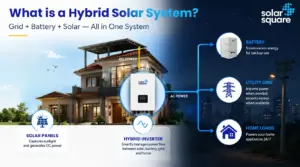
A well-sized hybrid or off-grid solar system can take care of all your home energy needs if you size them with the right battery size and type. Which brings us to the most sought-after question of 2026: lithium-ion vs lead-acid batteries, which of the two is better for rooftop solar systems? While lead-acid batteries have been around longer, lithium-ion batteries are the preferred choice for solar energy storage.
They offer faster charging and discharging rates (0.5C to 1C) compared to lead-acid batteries, which means your solar panels can feed energy into the battery more efficiently during peak sunlight hours. Moreover, lithium-ion batteries let you use about 80-90% of their stored energy each time, while lead-acid batteries only let you use about 50-60% without causing damage. The trade-off? The cost of lithium-ion batteries starts from 1.2x the cost of lead-acid batteries.
So what makes lithium-ion the go-to pick for rooftop solar systems despite their higher price tag? Here’s a quick snapshot:
- They last 10 to 15 years, while lead-acid batteries need replacement every 3 to 5 years.
- A single lithium-ion battery delivers 3,000 to 6,000 cycles compared to just 1,000-1,500 cycles for lead-acid batteries.
- They weigh 4-5x less than a lead-acid battery unit.
- They come with a Battery Management System (BMS) that protects against overheating, overvoltage, and any other safety risk.
So, yes, while the upfront cost of a lithium-ion battery is higher, when you zoom out and look at the full picture, it becomes a smarter investment for a rooftop solar panel system for homes.
You won’t need to replace it every 3-5 years like lead-acid batteries, you get to use almost all of the stored solar energy instead of just half, and the built-in BMS (Battery Management System) offers protection against overheating, overcharging, and all other safety risks, making maintenance simpler.
In this blog, we’ll provide a detailed lead-acid vs lithium-ion battery comparison, including lifespan, cost, rate of charging, applications, safety, pros, and cons. Whether you’re installing your first rooftop solar system or upgrading an existing PV system, this guide will help you pick the right battery with complete confidence.
TL;DR Summary Box: Which Battery Does Not Need Water for Maintenance?
Lithium-ion batteries do not require water because they are sealed and do not lose liquid during operation, unlike a few variants of lead-acid batteries, which need periodic water refilling. That’s just one of the many reasons lithium-ion batteries are preferred for storing solar energy. They also offer faster charging, higher cycle life, and a longer lifespan compared to lead-acid batteries.
Here are the main topics covered in this blog in detail:
| Main Topics | Key Takeaways |
| What is a lithium-ion battery? | It is a rechargeable solar battery that stores solar energy using fast-moving lithium ions, resulting in faster charging, higher efficiency, and longer lifespan. |
| What is a lead-acid battery? | It is a solar battery that stores solar energy using lead plates and sulfuric acid, resulting in slower charging, lower efficiency, and shorter lifespan. |
| Lithium-ion battery cost vs lead-acid battery cost | The cost of lithium-ion batteries can start from 1.2x the cost of lead-acid batteries. However, they turn out to be cheaper over time due to longer lifespan and fewer replacements.
|
| Lithium-ion vs lead-acid battery life: which of the two lasts longer? | Lithium-ion batteries last 10-15 years, while lead-acid batteries last only 3-5 years. |
| Lead-acid battery vs lithium-ion battery weight and size comparison | Lithium-ion batteries are 4-5x lighter and need 3-4x less space than lead-acid batteries for the same capacity. |
| Lithium-ion vs lead-acid batteries maintenance comparison | Lithium-ion batteries require very little maintenance, while a few variants of lead-acid batteries need regular water refilling, cleaning, and checks. |
| What are the applications of lithium-ion batteries? | They are used in solar energy storage systems and EVs where fast charging, high efficiency, and compact size are important. |
| What are the applications of lead-acid batteries? | They are used in UPS systems and starting batteries for vehicles. |
| Which is better, a lithium-ion or a lead-acid battery? | Lithium-ion batteries are better for solar systems due to faster charging, higher efficiency, longer lifespan, and low maintenance. |
| Load bearing capacity | Lithium-ion batteries handle heavy-load appliances better because they can deliver power more efficiently and maintain stable performance under higher demand. Lead-acid batteries are less suitable for heavy-load devices as they discharge faster, lose efficiency under high load, and may need a larger battery bank for the same usage. |
*Please note: The prices mentioned above are indicative and may vary depending on factors like battery brand, capacity, seller location, purchase quantity, installation charges, warranty terms, market fluctuations in raw material costs, applicable government duties or taxes, and battery chemistry variant, such as Lithium Iron Phosphate (LFP) or Nickel Manganese Cobalt (NMC) in lithium-ion batteries and flooded, tubular, or valve-regulated lead-acid (VRLA) in lead-acid batteries.
What are the Two Most Popular Solar Rechargeable Batteries?
Solar rechargeable batteries, as the name suggests, are energy storage units that get charged using the electricity that solar panels generate during the day. Instead of sending all that solar power back to the grid, these batteries store it so you can use it at night, on cloudy days, or during power cuts.
The two most widely used solar rechargeable batteries in India are lithium-ion and lead-acid.
- Lithium-ion batteries: They use lithium compounds (like lithium iron phosphate or nickel manganese cobalt) as the cathode and graphite as the anode. When the battery charges, lithium ions move from the cathode to the anode through an electrolyte, and they travel back when discharging.
- Lead-acid batteries: They use lead dioxide as the cathode, sponge lead as the anode, and sulfuric acid as the electrolyte. During discharge, both plates react with sulfuric acid to form lead sulfate, and this reaction reverses when charging.
Let’s understand more closely what these two batteries are and how they work.
What is a Lithium-ion Battery?
A lithium-ion battery used in solar systems is made of three main parts: a positive plate, a negative plate, and a separator filled with electrolyte between them. The separator keeps the plates apart but allows tiny particles called lithium ions to move back and forth.
When solar panels generate solar electricity, the battery charges by moving lithium ions from the positive plate to the negative plate. When you use the stored power, these ions move back to the positive side, creating electricity.
The key advantage lies in how easily these ions move. The materials inside lithium-ion batteries are light and highly conductive. As a result, lithium ions can travel quickly with less resistance.
Because of this structure:
- The battery charges faster during sunlight hours
- It can deliver power quickly when needed
- It uses energy more efficiently with minimal loss
- It has a high energy density, which helps it support heavy-load appliances more efficiently.
As a result, lithium-ion batteries work very well in solar systems, where quick charging and reliable power supply are important.
What is a Lead-acid Battery?
A lead-acid battery contains lead plates (positive and negative) placed inside sulfuric acid, which acts as the electrolyte. When the battery charges, a chemical reaction takes place between the lead plates and the acid. When it discharges, this reaction reverses to produce electricity.
However, this structure makes the process slower and less efficient. The movement of energy depends on heavier materials and slower chemical reactions, rather than fast-moving ions. Because of this:
- The battery charges more slowly
- It cannot release energy as quickly
- It loses more energy during use
- It does not have a high energy density
Hence, lead-acid batteries are less efficient for solar systems, especially when compared to lithium-ion batteries.
Lithium-ion vs Lead-acid Batteries: A Detailed Comparison
Lithium-ion outlasts lead-acid batteries, delivers more cycles, takes 3-4x less space for the same capacity, and charges in 1-2 hours compared to 10-20 hours for traditional lead-acid. The one area where lead-acid batteries hold an advantage is the upfront cost, coming in at Rs. 8,000* to Rs. 12,000* per kWh compared to Rs. 15,000* to Rs. 20,000* per kWh for lithium-ion.
*Please note: The prices mentioned above are indicative and may vary depending on factors like battery brand, capacity, seller location, purchase quantity, installation charges, warranty terms, market fluctuations in raw material costs, applicable government duties or taxes, and battery chemistry variant, such as Lithium Iron Phosphate (LFP) or Nickel Manganese Cobalt (NMC) in lithium-ion batteries and flooded, tubular, or valve-regulated lead-acid (VRLA) in lead-acid batteries.
Here’s a tabulated snapshot of the lead-acid vs lithium-ion battery comparison.
| Parameter | Lead-acid Batteries | Lithium-ion Batteries |
| Lifespan | 3-5 years | 10-15 years |
| Lasts for how many cycles? | 1,000-1,500 cycles | 3,000 to 6,000 cycles |
| Weight | 4-5x heavier than a lithium-ion battery of the same capacity. | 4-5x lighter than a lead-acid battery of the same capacity. |
| Size | Takes 3-4x more space | Takes 3-4x less space |
| Applications |
|
|
| Cost | Rs. 8,000* to Rs. 12,000* per kWh | Rs. 15,000* to Rs. 20,000* per kWh |
| Depth of Discharge (DoD) | 50-60% recommended | 80-90% recommended |
| Charging speed (rate of charging) | Lead-acid batteries charge and discharge slowly. Traditional lead-acid batteries can take 10-20 hours to fully charge. | Lithium-ion batteries support higher charging rates of 0.5C and 1C. It means they can charge fully in as little as 1-2 hours, making them much faster and more efficient than lead-acid batteries. |
| Maintenance needs | It requires regular maintenance, including refilling water (in flooded lead-acid batteries), cleaning terminals, and periodic checks to ensure proper performance. | It is a sealed battery and does not need water refilling or frequent maintenance. |
| Safety | Lead-acid batteries do not have a built-in Battery Management System (BMS) and can pose risks like acid leakage, gas release, and overheating if not properly maintained. | It is equipped with a Battery Management System (BMS) that protects against overcharging, overheating, short circuits, and all other types of safety risks. |
| Pros | Low upfront cost and simple technology | Higher efficiency, faster charging, longer lifespan, compact size, higher load-bearing capacity due to higher energy density, lower cost of long-term ownership, and no maintenance required. |
| Cons | Lower efficiency, lower load-bearing capacity due to low energy density, slow charging, shorter lifespan, bulky size, and requires regular maintenance. | Higher upfront cost |
*Please note: The prices mentioned above are indicative and may vary depending on factors like battery brand, capacity, seller location, purchase quantity, installation charges, warranty terms, market fluctuations in raw material costs, applicable government duties or taxes, and battery chemistry variant, such as Lithium Iron Phosphate (LFP) or Nickel Manganese Cobalt (NMC) in lithium-ion batteries and flooded, tubular, or valve-regulated lead-acid (VRLA) in lead-acid batteries.
Lithium-ion Battery vs Lead-acid Battery Cost Comparison
The cost of lithium-ion batteries starts from 1.2x the cost of lead-acid batteries. While this higher upfront price may seem like a disadvantage, it is the result of advanced technology and materials used in lithium-ion batteries which gives them a longer life and a superior performance.
Here’s a snapshot of how much each type costs:
- Cost of lithium-ion batteries: Rs. 15,000* to Rs. 20,000* per kWh
- Cost of lead-acid batteries: Rs. 8,000* to Rs. 12,000* per kWh
*Please note: The prices mentioned above are indicative and may vary depending on factors like battery brand, capacity, seller location, purchase quantity, installation charges, warranty terms, market fluctuations in raw material costs, applicable government duties or taxes, and battery chemistry variant, such as Lithium Iron Phosphate (LFP) or Nickel Manganese Cobalt (NMC) in lithium-ion batteries and flooded, tubular, or valve-regulated lead-acid (VRLA) in lead-acid batteries.
Lithium-ion vs Lead-acid Battery Life Comparison
The lifespan of a battery refers to how many years it can be used before its performance drops significantly. Lithium-ion batteries can last for 10 to 15 years, while lead-acid batteries usually last only 3 to 5 years.
This difference in lifespan comes down to how each battery is built and how it handles charging and discharging over time.
- Lithium-ion batteries can handle deeper discharge without damage: This increases their stress handling capacity.
- They experience less wear during charging and discharging: It helps them maintain performance for longer.
- A built-in Battery Management System (BMS): It protects against overheating, overcharging, and other safety risks, improving durability.
Lead-acid batteries, on the other hand, degrade faster because sulfate builds up inside when they are not fully charged regularly, reducing their ability to store energy over time.
Lead-acid Battery vs Lithium-Ion Battery Depth of Discharge (DoD) Comparison
Depth of Discharge (DoD) refers to how much of a battery’s total capacity you can use safely before recharging it. For example, if a battery has a DoD of 50%, it means you should only use half of its stored energy to avoid damage.
Here’s how lithium-ion and lead-acid batteries compare:
- Lead-acid battery: 50-60% DoD recommended
- Lithium-ion battery: 80-90% DoD recommended
This means lithium-ion batteries allow you to use almost the full capacity, while lead-acid batteries require you to leave a large portion unused.
Depth of discharge directly affects battery lifespan and usable energy.
- Using a battery beyond its recommended DoD can reduce its lifespan
- Higher DoD means you get more usable energy from the same battery
- Lower DoD means you need more batteries to get the same output
In simple terms, a battery with higher DoD is the best solar battery as it gives you more value in real-world use.
Lead-acid Battery vs Lithium-ion Battery Weight and Size Comparison
Weight and size refer to how heavy a battery is and how much space it takes for the same energy capacity (kWh). Both these factors are extremely critical in residential rooftop solar systems where installation space on the roof is limited and load-bearing capacity has to be kept in mind.
Here’s how both batteries compare:
- A lead-acid battery is 4-5x heavier.
- A lithium-ion battery of the same capacity weighs 4-5x less.
- In terms of size, a lead-acid battery takes up 3-4x space of a lithium-ion battery with the same kWh capacity
- A lithium-ion battery is more compact, allowing you to store 3-4x more energy in the same space.
Because they are lighter, more compact, and store more energy in the same space, lithium-ion batteries are:
- Easier to install and handle
- Put less load on rooftops and structures
- Better suited for homes with limited space
Lithium-ion vs Lead-acid Batteries Charging Speed Comparison
Charging speed or rate of charging refers to how quickly a battery can be charged and made ready for use.
Here’s how lead-acid and lithium-ion batteries compare in terms of charging rates:
- Lead-acid batteries: Traditional lead-acid batteries can take around 10-20 hours to fully charge
- Lithium-ion batteries: They support higher charging rates of 0.5C and 1C, allowing them to fully charge in as little as 1-2 hours
Here’s why a lithium-ion battery charges faster when compared to lead-acid batteries:
- Lithium-ion batteries allow faster movement of ions, resulting in quick energy transfer.
- They can handle higher charging currents safely without damaging the battery.
- A built-in Battery Management System (BMS) controls the charging process and prevents overheating.
Lead-acid batteries, on the other hand, rely on slower chemical reactions, which limit how fast they can charge.
Lithium-ion vs Lead-acid Batteries Maintenance Comparison
Lithium-ion batteries require very little maintenance because they are sealed and do not lose liquid while working. They do not need water refilling, and there is no need for regular manual checks to keep them functioning properly.
A few variants of lead-acid batteries, on the other hand, require regular maintenance to ensure proper performance and lifespan. Their usual maintenance includes:
- Periodic refilling with distilled water (in flooded types)
- Cleaning battery terminals
- Checking for corrosion
Lead-acid batteries also need proper ventilation as they release gases during charging. Depending on usage, these checks may be needed every few weeks to a few months, and neglecting maintenance can reduce battery life.
Lithium-ion vs Lead-acid Batteries Applications Comparison
Lithium-ion batteries are used with residential as well as commercial rooftop systems to store solar energy for later use. They’re primarily preferred in solar systems for energy storage because they can offer faster charging and longer backup. They are also used in electric vehicles (EVs), where compact size and high efficiency are important.
Lead-acid batteries, on the other hand, are used in UPS systems for homes and offices, in ICE vehicles, and as starting batteries in vehicles. They are suitable for basic backup needs where cost is a priority and the power requirement is not very high.
Lead-acid batteries are less preferred for solar energy storage due to several limitations:
- They have lower usable capacity, which means you cannot use the full stored energy.
- They charge slowly, making it harder to store enough energy during limited sunlight hours.
- They require regular maintenance, including refilling water in a few variants and periodic checks.
- They are bulky and heavy, making roof installation more difficult.
- They have a shorter lifespan, leading to more frequent replacements.
Which is Better, a Lithium-ion or a Lead-acid Battery?
A lithium-ion battery, despite its higher upfront cost compared to lead-acid batteries, is the better choice for rooftop solar systems in housing societies, homes, and commercial buildings because it offers faster charging, higher efficiency, a longer lifespan, and minimal maintenance.
The advantage of being the preferred choice for both off-grid PV systems and hybrid solar systems comes from several performance and design benefits:
- They have up to 80-90% usable capacity compared to just 50-60% in lead-acid, which means more usable power from the same battery.
- They can charge fully in 1-2 hours, allowing better use of limited solar radiation during the day.
- They last for 10-15 years, reducing the need for frequent replacements and lowering long-term cost.
- They take up 3-4x less space than a lead-acid battery of the same capacity would take, making them ideal for rooftops and compact installations
- They have a built-in BMS for safety, offering protection against overcharging, overheating, short circuits, and all other types of safety risks.
What are the Pros and Cons of Solar Batteries?
Solar batteries, both lead-acid and lithium-ion, help store excess solar energy generated by panels during the day so you can use it when needed. However, the performance, cost, and maintenance requirements can vary significantly depending on the type of battery you choose.
Each of the two comes with its own set of advantages and limitations which you must consider before you make a purchase.
Pros and Cons of Lithium-ion Batteries
Lithium-ion batteries are fast to charge and last longer than lead-acid batteries. But these aren’t the only benefits of using lithium-ion batteries to store solar energy. Let’s have a look at all the main pros (advantages) of lithium-ion batteries:
- High usable capacity of up to 80-90%
- Fast charging within 1-2 hours, making better use of available sunlight
- Longer lifespan of 10-15 years, reducing replacement frequency
- Compact and lightweight, saving space and reducing load on the roof
- Built-in BMS for safety and performance control
The main limitation of lithium-ion batteries is their higher upfront cost compared to lead-acid batteries. However, over time, this cost is offset because lithium-ion batteries last longer, deliver more usable energy per charge, and do not need frequent replacement, reducing the overall cost of ownership.
Pros and Cons of Lead-acid Batteries
The main benefit of using lead-acid batteries is that they are cheaper than lithium-ion batteries. They cost Rs. 8,000* to Rs. 12,000* per kWh, which lower than the what lithium-ion batteries cost, i.e., Rs. 15,000* to Rs. 20,000* per kWh.
So, why aren’t they as widely used or recommended for solar energy storage, you ask? That’s because, despite their lower upfront cost, they tend to cost a lot more in the long run, as they need replacement every 3-5 years.
To better understand this, let’s look at a simple example.
- If you install a lead-acid battery today, you will need to replace it every 3-5 years.
- So, even if you start with a lower cost of around Rs. 8,000* to Rs. 12,000* per kWh, the total cost over time can go up to Rs. 16,000* to Rs. 36,000* per kWh due to repeated replacements.
In comparison, a lithium-ion battery costing Rs. 15,000* to Rs. 20,000* per kWh lasts the entire 10-15 years without needing replacement.
*Please note: The prices mentioned above are indicative and may vary depending on factors like battery brand, capacity, seller location, purchase quantity, installation charges, warranty terms, market fluctuations in raw material costs, applicable government duties or taxes, and battery chemistry variant, such as Lithium Iron Phosphate (LFP) or Nickel Manganese Cobalt (NMC) in lithium-ion batteries and flooded, tubular, or valve-regulated lead-acid (VRLA) in lead-acid batteries.
Now, let’s have a look at the main cons of a lead-acid battery:
- Low usable capacity of 50-60%, limiting actual energy usage
- Slow charging rate of 10-20 hours, reducing efficiency in solar systems
- Short lifespan of 3-5 years, leading to frequent replacements
- Bulky and heavy, requiring more space and structural support
Why Choose SolarSquare to Install Rooftop Solar Systems at Home?
Kyunki, mehengi bijli se muft bijli tak ka safar aasaan banaata hai, SolarSquare.
Here’s a snapshot of all the services that make us the #1 home solar installation company in India.
- Proven Storm-Safety Record of 99.91%
Over the last two years, our solar installations have maintained a 99.91% storm-safety success rate, even during cyclonic wind speeds of up to 170 km/hr, making us one of the most reliable solar installation professionals in the entire country.
- Cyclone-Resistant Mounting Structures Designed for Extreme Winds
Solar panels are only as strong as the structure holding them. That’s why SolarSquare uses WindPro Mount™, a mounting structure designed for extreme Indian weather.
Here’s why WindPro Mount™ stands strong:
- Built for high-wind zones: Approved by IIT Bombay, the structure remains stable at wind speeds up to 170 km/hr, offering protection during severe storms and cyclonic weather.
- Rust-resistant premium steel: Manufactured from high-quality virgin steel, the structure resists corrosion.
- Long-life galvanization: An 80-micron hot-dip galvanized iron coating protects the steel for decades. Even with a 3-micron gradual surface wear, the structure retains strength well beyond 25 years.
- Roof-safe anchoring: Installations use HILTI chemical anchoring technology that seals drill points completely, preventing water seepage. In the rare case of leakage, SolarSquare offers a one-year water leakage warranty worth Rs. 1 lakh.
- Everlock washer protection: It prevents nuts and bolts from loosening for 25 years, keeping the solar structure firmly locked in place. Their corrosion-proof design, tested through a 1,000-hour salt spray test, adds another layer of long-term protection against weather damage.
- Savings Guarantee with a Money-Back Promise
Before installation, you receive a projected solar energy generation estimate. If your system underperforms compared to that estimate, SolarSquare compensates you at Rs. 8 per unit for the shortfall.
This savings guarantee with a money-back promise makes SolarSquare the only solar company in India to tie accountability to system performance directly.
- Five Years of Structured System Maintenance
A solar system needs consistent care to perform year after year. Our 5-year Annual Maintenance Plan focuses on long-term efficiency, not one-off servicing.
Over five years, your system receives monthly service visits, each with a defined purpose.
Here’s what this includes:
- Remote performance tracking: Continuous digital monitoring flags irregularities early, often before you notice any drop in output.
- Fast on-site resolution: If an issue arises, trained technicians visit your home to fix it directly, minimizing downtime.
- Specialized panel cleaning: We use professional-grade tools and solutions to remove dust, grime, bird droppings, and residue without damaging the surface of the panels.
- Full system health checks: Each visit covers wiring integrity, safety components, mounting stability, and mechanical condition to keep the system reliable across all seasons.
Conclusion
Although their starting cost is 1.2x the cost of lead-acid batteries of the same capacity, lithium-ion batteries are safer and more cost-effective for solar energy storage in the longer run. They last 10-15 years, offer a higher cycle life of 3,000 to 6,000 cycles, and are 4-5x lighter than lead-acid batteries of the same capacity.
Most importantly, lithium-ion batteries have an in-built BMS (Battery Management System) which offers protection against overheating, short circuits, overcharging, and all other types of safety risks.
If you’re planning to go solar and are confused about the right battery size and type for your home, you can book a free solar consultation with SolarSquare to resolve your doubts.
FAQs
Which battery lasts longer, lithium-ion or lead-acid?
Lithium-ion batteries last a lot longer than lead-acid batteries. They have a lifespan of 10-15 years, compared to just 3-5 years for lead-acid batteries.
Which is the biggest disadvantage of a lithium-ion battery?
Their higher upfront cost compared to lead-acid batteries is a concern, but mainly for homeowners who are not aware that, in the long run, lithium-ion batteries turn out to be more cost-effective. That’s because they don’t need to be replaced for 10-15 years. Lead-acid batteries, on the other hand, need replacement every 3-5 years.
Can a lithium battery last 15 years?
Yes, tier-1 lithium batteries from reputable manufacturers can last up to 15 years easily.
Can a lithium battery catch fire when not in use?
Whether in use or not, it is extremely rare for a lithium-ion battery to catch fire under normal conditions. This is because it has a built-in Battery Management System (BMS) that protects against overheating, overcharging, and short circuits. With proper installation and quality components, this risk is further minimized, making lithium-ion batteries the safest option available for everyday use.
The charging current can also be controlled through the inverter, which adds another layer of safety. Many batteries also come with an embedded MCB, or a separate MCB can be installed to cut off the circuit in case of an electrical fault.
With proper installation, quality components, and these safety protections in place, lithium-ion batteries are among the safest options for everyday solar use.