

Batteries are, hands down, the most expensive part of a rooftop solar system. A good lithium battery bank can add anywhere from ₹ 72,000-₹ 1,50,000 (indicative prices) in India, depending on its capacity, brand, features, and operating capabilities. So when your installer quotes you a hybrid inverter, the first question that comes to mind is obvious: do I actually need to buy the battery right now?
No, you don’t necessarily need to buy a battery right away. If you don’t need backup power during grid outages, you can start with a hybrid inverter without a battery and add one later if your energy needs change. In this configuration, it draws power from your solar panels first and pulls additional units required from the grid whenever solar isn’t available.
But “does it work” and “is it the right choice for me” are two different questions. A hybrid inverter without a battery is, in practice, an on-grid inverter with some unused hardware sitting inside it. Whether paying extra for that hardware is worth it depends entirely on your plans.
This guide breaks down exactly how a hybrid solar inverter without a battery functions, what you gain and lose compared to a battery-backed system, and what the rules look like for homeowners in India installing solar under the PM Surya Ghar Muft Bijli Yojana framework.
What Is a Hybrid Inverter?
A hybrid inverter is a solar inverter that’s built to manage power from three sources at once:
- Solar panels
- The electricity grid
- Battery
It converts the Direct Current (DC) electricity generated by your solar panels into Alternating Current (AC), which is what your home’s appliances actually run on.
What makes it hybrid is the built-in Maximum Power Point Tracking (MPPT) charge controller and battery management logic in a single unit; normally you’d need a separate charge controller and inverter. Because of this, a hybrid inverter can be installed two ways:
- With a battery: For backup power during outages and time-of-day energy shifting
- Without a battery: Functioning close to a standard on-grid (grid-tied) solar inverter, but keeping a battery-ready slot for later
Can a Hybrid Solar Inverter Work Without a Battery?
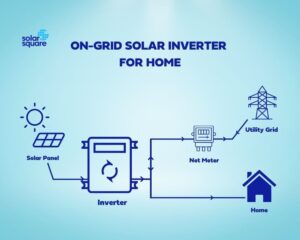
Yes. Most hybrid solar inverters are designed to run out of the box in a battery-less, grid-tied configuration. In this mode, the solar hybrid inverter without a battery does three things:
- Converts DC power from your solar panels into usable AC power
- Sends that power straight to your home’s active loads (lights, fans, ACs, appliances) as it’s generated
- Exports any surplus that your home doesn’t use, in real time, to the grid through your net meter/smart meter
There’s no storage step in between. If your panels are generating 4 kW of units and your home is drawing 2 kW worth of units, the extra 2 kW goes out to the grid; it isn’t banked inside the inverter for later. That’s the core trade-off of a hybrid inverter without battery: full solar benefit while the sun is up, zero storage once it’s down.
However, some hybrid inverter systems can continue powering selected loads during a grid outage. Anti-islanding protection first isolates the solar system from the utility grid, after which a compatible inverter can supply its backup circuit using available solar power and, where applicable, battery power. Any solar generation that cannot be used by the loads or stored in the battery is throttled rather than exported to the unavailable grid.
How a Hybrid Solar System Without Batteries Actually Behaves
A hybrid solar system without batteries usually behaves like a grid-tied system, where solar powers daytime loads, the grid covers any shortfall, and surplus solar is exported. During an outage, behavior depends on the inverter’s backup capability.
Here’s a detailed snapshot of how hybrid solar behaves without batteries:
| Condition | What happens |
| Daytime, sun available, grid up | Solar powers your loads directly; surplus exported to grid via net meter |
| Daytime, solar generation < household load | Shortfall is drawn from the grid automatically |
| Night time | Inverter draws 100% power from the grid (no stored solar to fall back on) |
| Grid outage, daytime | Most battery-less hybrid setups shut down. Some models with dedicated PV-only backup/EPS capability can continue powering limited loads directly from solar. |
| Grid outage, nighttime | No power at all from the solar system |
This last point is the one most homeowners misjudge. Because the unit is technically a hybrid inverter, many people assume it’ll power the fridge during an afternoon outage. It won’t, not without a battery physically connected. The anti-islanding shutdown applies regardless of how much sunlight is hitting your panels at that moment.
Here’s a complete, concise section you can add to the article:
What to Check Before Buying a Hybrid Inverter Without a Battery?
Check battery compatibility, solar and load capacity, backup functionality without storage, grid-interaction features, efficiency, warranty, and whether you can add a battery later without replacing the inverter. Before buying a hybrid inverter without a battery, check these key factors:
- Battery Compatibility: Make sure the inverter supports the type and capacity of battery you may want to add later. Check the manufacturer’s recommended battery models and voltage range.
- Solar and Load Capacity: Choose an inverter that can handle your solar panel capacity and household load. Avoid sizing it only for your current needs if you expect your electricity consumption to increase.
- Backup Without a Battery: A hybrid inverter generally cannot provide backup power during a grid outage without an energy-storage source. Check the manufacturer’s specifications to understand what happens when the grid goes down.
- Battery-Ready Features: If you plan to add a battery later, check whether the inverter supports seamless battery integration or requires additional equipment or configuration.
- Efficiency and Operating Modes: Compare conversion efficiency and available operating modes, such as solar-first, grid-first, and battery-priority modes, where applicable.
- Warranty and After-Sales Support: Check the inverter warranty, service network, replacement policy, and availability of technical support in your area.
- Future Expansion: Consider whether the inverter can support your planned solar or battery capacity in the future. Buying an appropriately sized system now can help avoid replacement costs later.
What a Hybrid Inverter Without Battery Can and Cannot Do
A battery-less hybrid inverter can manage solar and grid power, but it cannot provide backup during outages without a battery or other energy-storage source. With the mechanics covered, the following table is a straight side-by-side of what actually changes and what stays the same, once you remove the battery from a hybrid setup.
| Capability | Hybrid Inverter WITH Battery | Hybrid Inverter WITHOUT Battery |
| Powers home during the day from solar | Yes | Yes |
| Reduces electricity bill via solar savings | Yes | Yes |
| Exports surplus solar via net metering | Yes | Yes |
| Powers home during grid outage | Yes (from battery) | Limited with some inverters/models |
| Powers home at night from stored solar | Yes (from battery) | No (grid only) |
| Peak shaving | Yes | No |
| Add battery later without inverter change | Already installed | Yes, if the future battery is compatible with the inverter |
| PM Surya Ghar subsidy eligible | Yes (ALMM-compliant panels) | Yes (ALMM-compliant panels) |
In battery-less mode, a hybrid inverter delivers the same bill savings and net metering benefits as a plain on-grid inverter, but none of the backup protection. A hybrid inverter can keep essential appliances running through a grid outage only when a battery is actually connected; strip the battery out, and that advantage disappears entirely.
Hybrid Inverter Without Battery vs Hybrid System With Battery vs Standard On-Grid Inverter
A battery-less hybrid offers future battery flexibility, a battery-backed hybrid provides backup power, while a standard on-grid inverter focuses on lower cost and efficient grid-connected solar. It helps to see all three setups side by side rather than in isolation, since hybrid solar without a battery often gets confused with a plain on-grid inverter, when it actually sits somewhere in between.
| Feature | On-Grid (String) Inverter | Hybrid Inverter Without a Battery | Hybrid Inverter With a Battery |
| Grid-tied / net metering | Yes | Yes | Yes (with separate backup circuit) |
| Battery-ready for future upgrade | No | Yes | Already installed |
| Power during outage | No | No | Yes, on backed-up circuits |
| Upfront cost | Lowest | Moderate | Highest |
| Best suited for | Areas with a very stable grid, tight budget | Areas with a reasonably reliable grid, plan to add battery later | Frequent outage zones, or homes wanting to offset their electricity bill |
Why Battery-Less Hybrid Makes Strategic Sense
A battery-less hybrid inverter can reduce upfront costs while keeping the option to add battery storage later, making it a flexible choice for homes with limited backup needs.
Cost is usually the deciding factor for most buyers, so it’s worth laying out the actual math behind deferring the battery purchase rather than skipping storage capability altogether.
The battery is typically the single largest line item in a storage-backed rooftop solar system. Deferring that purchase while still installing a hybrid (rather than a basic on-grid) inverter is a financially rational middle path.
A battery-less hybrid solar system can make strategic sense if you want lower upfront cost today while keeping the option to add battery storage later without replacing the inverter. The logic comes down to cost, flexibility, and avoiding unnecessary equipment replacement later.
Here is why some homeowners choose this route:
- Lower upfront cost: The battery is one of the most expensive components in a storage-backed rooftop solar system. Deferring it reduces the initial investment while still allowing you to install a hybrid inverter.
- Future battery compatibility: A hybrid inverter can manage power between the solar panels, home, grid, and battery. Once a compatible battery is added, the inverter can begin managing charging, discharging, and backup operation without needing to be replaced.
- Potentially lower battery cost later: Battery prices, particularly for lithium-based storage, have generally declined over time. Waiting can therefore mean buying similar storage capacity later at a lower cost, although future prices cannot be guaranteed.
- Avoids paying for two inverters: If you install a standard on-grid inverter now and later want battery backup, the existing inverter may need to be replaced or additional equipment may be required. Starting with a hybrid inverter can avoid that upgrade path.
What Happens During a Power Cut with a Battery-Less Hybrid Inverter?
A battery-less hybrid inverter will usually stop supplying power during a grid outage. However, some compatible models can continue powering limited loads directly from solar after safely isolating the home from the grid.
What happens during an outage therefore depends on the inverter design:
- Most battery-less hybrid inverters shut down: Without a battery, many hybrid inverters behave much like standard grid-tied inverters. When the grid fails, they stop supplying AC power even if the panels are producing electricity.
- Anti-islanding prevents power from reaching the grid: When a grid outage is detected, the inverter must disconnect the solar system from the utility network. This prevents electricity from being fed into grid lines while utility workers may be repairing them.
- Some models can create a separate backup supply: Certain hybrid inverters can isolate the home from the grid and continue supplying selected loads directly from available solar generation, even without a battery.
- Solar-only backup has limitations: Without a battery to stabilize and supplement the supply, available power depends on current solar generation. Clouds or a sudden increase in household load can reduce or interrupt the backup supply.
For this reason, homeowners should not assume that choosing a hybrid inverter automatically provides backup during a power cut. If reliable outage backup is a priority, the system should be designed with a compatible battery rather than relying on solar-only operation.
The practical verdict: don’t count on a battery-less hybrid inverter for power-cut protection. Its daytime solar savings are real and dependable; its backup capability without a battery is not. If backup power is your priority, budget for the battery.
How to Set Up a Hybrid Inverter Without a Battery in 4 Simple Steps?
Once you’ve settled on going battery-less, getting the setup right the first time avoids costly rework later. Here’s the sequence to follow with your installer.
- Step 1: Size the solar array to your daytime load: For battery-less use, panel capacity should roughly match your typical daytime consumption, since there’s no storage to absorb excess generation for later use.
- Step 2: Get net metering approval from your DISCOM: If you want credit for surplus power, net metering approval from your DISCOM is required. Without it, the inverter should be configured for zero-export instead, so it doesn’t push unmetered power onto the grid.
- Step 3: Configure battery-less / solar-priority mode: This is typically a single setting in the inverter’s configuration menu, set during installation and commissioning.
- Step 4: Leave room for the battery: Ask your installer to plan cable routing and reserve space for a future battery bank at installation time. This costs nothing extra now but saves a significant amount of retrofit work if you add storage later.
Hybrid Inverter Without Battery: Cost in India
A hybrid inverter without a battery typically costs ₹72,000-₹1,50,000 in India, depending on capacity, brand, features, and whether it supports on-grid, off-grid, or backup operation.
Cost is usually the deciding factor, so before finalizing anything, get a same-day, itemized quote comparing a hybrid inverter (battery-less) against a plain on-grid inverter for your exact system size.
A hybrid inverter in battery-less mode costs only the inverter itself, with no battery purchase required on day one. As a rule of thumb, hybrid inverters carry a moderate price premium over an equivalent-capacity on-grid inverter, reflecting the additional MPPT and battery-management hardware built in but left unused until a battery is added. The following are the prices for an inverter used in an on-grid system:
| Hybrid Inverter Capacity | Approx. Price Without Battery* | Approx. Price With Battery* |
| 3 kW | + ₹72,000 | + ₹161,000 |
| 4 kW | + ₹72,000 | + ₹161,000 |
| 5 kW | + ₹72,000 | + ₹161,000 |
| 10 kW | + ₹150,000 | + ₹240,000 |
*DISCLAIMER (VERY IMPORTANT): The solar inverter price in India listed above is an indicative range and should not be treated as a final quotation. The actual price can vary based on the inverter’s capacity, type, single-phase or three-phase configuration, brand and model, number of MPPTs, efficiency, DC input and overloading capability, monitoring and communication features, IP rating, warranty and extended warranty options, applicable safety and grid-compliance requirements, after-sales service coverage, GST, dealer or distributor margins, location, product availability, ongoing discounts or offers, protection devices, communication dongles, installation, or commissioning charges, etc.
The difference between grid-tied and hybrid inverter systems follows the same principle.
- A grid-tied inverter depends on the utility network and has no integrated battery management
- A hybrid inverter combines grid connectivity with battery storage and backup capability.
Advantages of a Hybrid Inverter Without Battery
Skipping the battery isn’t just a cost-cutting move; it comes with a few genuine practical upsides that make it the right call for a lot of Indian homes.
- Lower upfront cost: You skip the single most expensive component of a solar-plus-storage system (batteries typically account for a large share of total system cost)
- Full net metering eligibility: Export credits work exactly as they would with any grid-tied solar system
- Future-proof: Because the inverter already has the MPPT and battery management circuitry, you can add a compatible battery later without replacing the inverter
- Simpler maintenance: No battery cycling, no battery health monitoring, no battery replacement cost every 8-10 years
- PM Surya Ghar subsidy eligible: An eligible grid-connected rooftop solar installation can qualify for PM Surya Ghar Central Financial Assistance even if no battery is installed. The CFA is based on eligible rooftop solar capacity and applicable scheme conditions. A battery is not required to claim the residential rooftop solar subsidy.
Limitations of a Solar Hybrid System Without Batteries
Going battery-less isn’t free of trade-offs, and knowing these upfront avoids the “why doesn’t my hybrid inverter give me backup” surprise later.
- No backup during power cuts: The anti-islanding safety shutdown applies regardless of sunlight availability
- Night-time energy is supplied by the grid: Without a battery, your home draws electricity from the grid after sunset. Under net metering, excess solar exported during the day can offset these imports on your electricity bill.
- Export dependent on DISCOM approval: Your Distribution Company (DISCOM) needs to sanction net metering before you can bank surplus units
- Wasted generation on some models: A small number of budget inverters without a “grid-tied, battery-less” mode explicitly supported may curtail output when there’s no battery to buffer sudden load changes; always confirm this in the datasheet before buying
Is a Hybrid Inverter Without Battery Worth It in India?
It depends heavily on two things: how reliable your local grid is, and whether you’re planning to add a battery energy storage system (BESS) down the line. So where does that leave you? The right answer isn’t universal.
Choose a hybrid inverter without battery if:
- Your area has a fairly stable electricity supply with infrequent outages
- You want to keep upfront costs down while leaving the door open for storage later
- You’re mainly trying to cut your monthly electricity bill through self-consumption and net metering, not build outage resilience
Consider adding a battery instead if:
- You live in a region with frequent or long power cuts
- You run critical loads (work-from-home setups, security systems) that can’t tolerate downtime
- You want energy independence beyond daylight hours
For many rooftop solar customers in states with reliable grid supply, solar net metering can offer better returns without a battery. Exported solar power earns bill credits, while avoiding battery costs can help keep the solar payback period shorter.
PM Surya Ghar, Net Metering & ALMM: What Applies to a Battery-Less Hybrid Setup
If you’re installing a hybrid solar inverter without a battery in India, three regulatory pieces matter:
- Net metering registration: Mandatory with your local DISCOM to receive export credits, and also a requirement for claiming the PM Surya Ghar subsidy. You can check eligibility and apply through the PM Surya Ghar Muft Bijli Yojana National Portal for Rooftop Solar.
- ALMM compliance: Under the Ministry of New and Renewable Energy’s (MNRE) Approved List of Models and Manufacturers (ALMM) order, solar panels used in net-metering and PM Surya Ghar projects must be sourced from ALMM-listed manufacturers. You can verify official updates on the MNRE website.
- Anti-islanding certification: Your inverter (with or without a battery) must carry IEC 62116 anti-islanding compliance and relevant BIS certification to be eligible for DISCOM commissioning.
Net metering rules, capacity caps, and application fees vary by state and DISCOM, so it’s worth checking your specific state electricity regulatory commission’s net metering regulation before finalizing system size. Whether you need a straightforward net-metered system or a hybrid setup with backup for outage-prone areas, getting the sizing, inverter choice, and DISCOM paperwork right the first time makes all the difference to your savings.
SolarSquare designs and installs rooftop solar systems across India, end-to-end. We provide hybrid solar systems in Uttar Pradesh, South India, Pune, and Delhi NCR (except Delhi). Get a free rooftop solar consultation from SolarSquare and find out what system, with or without a battery, makes the most sense for your home.
Frequently Asked Questions
What’s the difference between a hybrid inverter and a normal on-grid inverter if there’s no battery attached?
Functionally, they behave almost the same in day-to-day operation. The key difference is that a hybrid inverter already has the internal MPPT and battery management hardware needed to add a battery later, without swapping the inverter itself.
Can I add a battery to my hybrid inverter later if I start without one?
In most cases, yes; this is one of the main reasons homeowners choose a hybrid inverter over a basic on-grid inverter. Confirm compatible battery voltage, chemistry, and capacity limits with your inverter’s datasheet before purchase.
Does a battery-less hybrid inverter still need net metering?
Net metering isn’t required for the inverter to function, but it is required if you want credit for the surplus power you send to the grid. Without it, unused solar power is simply exported for free or, in some configurations, curtailed. New metering is required.
Is a solar hybrid inverter without battery cheaper than one with battery backup?
Yes, significantly. Batteries are typically the single largest cost component in a storage-backed solar system, so skipping the battery brings the upfront cost much closer to that of a standard on-grid system.
Can a hybrid inverter work without both a battery and the grid?
Generally, no. A hybrid inverter needs either the grid or a battery/other energy-storage source to maintain power when solar generation is insufficient.
During sunny hours, some hybrid inverters can power connected loads directly from solar without a battery or grid. But after sunset or when solar output is too low, a battery or grid connection is required.