

A power cut often makes the need for battery backup immediately clear. Essential appliances such as fans, lights, refrigerators, and Wi-Fi routers may all need to keep running, but the right battery size depends on how much electricity these appliances use and how long the backup is expected to last.
Solar battery sizing for home use is therefore not simply about choosing a larger battery. The system needs enough usable capacity to support the required load without leaving you with unnecessary storage that increases the overall cost. Battery chemistry, depth of discharge (DoD), inverter efficiency, outage duration, and the way you plan to use stored solar energy can all influence the final requirement.
This guide explains how to calculate the right battery capacity for your home, how to estimate the number of batteries you may need, and how factors such as usable capacity, appliance load, inverter compatibility, and solar recharge affect the final sizing decision.
What Is Solar Battery Sizing for Home?
Solar battery sizing for a home means deciding how much battery capacity you need to store the electricity generated by your rooftop solar panels. It depends on your daily power usage, the appliances you want to run, and how many hours of backup you need.
Before calculating the battery capacity your home needs, it is important to understand the two specifications that determine how much energy a battery can store and how much power it can supply at one time. These are measured in kilowatt-hours (kWh) and kilowatts (kW).
Capacity vs Power Rating (kWh vs kW)
Battery capacity is measured in kilowatt-hours (kWh), which is the amount of energy stored. Think of it as the size of the fuel tank. The power rating is measured in kilowatts (kW), which is how much load the battery and inverter can run at the same time. Think of it as how wide the tap is.
You should also check whether the capacity specified by the manufacturer is the rated capacity or usable capacity.
- Rated capacity is the total energy the battery can store.
- Usable capacity is the portion of that energy available for discharge within the manufacturer’s recommended operating limits.
For example, a 10 kWh battery with 90% usable capacity can provide approximately 9 kWh of energy for regular use. This is where Depth of Discharge (DoD) becomes important. DoD indicates how much of the battery’s total capacity can be discharged. A higher DoD generally means more of the stored energy is available for use.
When calculating backup requirements, use the usable battery capacity, not just the rated capacity, to estimate how much energy you can draw from the battery.
Both capacity and power rating matter in case of solar battery backup. A 10 kWh battery with a small inverter can store plenty of energy but may trip when your air conditioner (AC) and water pump start together.
Why Getting Battery Sizing Wrong Costs You
Batteries are often one of the most expensive components added to a rooftop solar setup, so choosing the right capacity matters.
An oversized battery can increase the upfront cost of rooftop solar without providing any additional value, while an undersized battery may not deliver the required backup duration. Repeatedly discharging a battery beyond its recommended operating range can also affect its long-term performance.
Proper home solar battery sizing helps balance backup requirements, battery life, and overall system cost.
What Decides Your Battery Size?
Before deciding the battery size, first decide what you want the battery to do. A battery used only during power cuts is sized differently from one used every day to store excess daytime solar for evening or night use. Some homes may want both, which means the battery must cover regular energy shifting while still keeping enough capacity available for backup.
1. How You Plan to Use the Battery
Start with what you want the battery to do. The table below shows indicative ranges only. Your own load calculation will decide the final number.
| Goal | What it typically runs | Indicative battery size |
| Essential backup | Lights, fans, fridge, Wi-Fi, phone charging | About 4-6 kWh |
| Comfort backup | Essentials plus TV, water pump, and an inverter AC for a few hours | About 8-12 kWh |
| Whole-home backup | Multiple ACs, geyser, kitchen appliances | 15 kWh and above |
Indicative ranges derived from the worked example below. Actual needs vary by household.
2. Your Daily Load
Your electricity bill can give you an initial estimate of your household’s daily electricity consumption. Divide the monthly electricity consumption in units by 30 to calculate the approximate daily usage.
However, when sizing a battery specifically for power backup, focus on the appliances you want to keep running during an outage and the electricity they are expected to consume during that period.
3. Outage Duration
If power cuts in your area last two hours, you don’t need a battery sized for a full day. If you live where electricity outages stretch across a night, size your battery backup for those hours. Keep a simple log for a month before you decide.
4. Battery Chemistry
Battery chemistry affects how much of the rated capacity can actually be used and how much stored energy is ultimately available to power your appliances. Two important factors are depth of discharge (DoD) and efficiency.
- Depth of discharge (DoD) refers to the percentage of a battery’s total capacity that can be used before recharging is recommended. Lithium iron phosphate (LFP) batteries generally support a higher DoD than lead-acid batteries, which means a larger share of their rated capacity is usable.
- Efficiency refers to the amount of stored energy that remains available after losses during charging, discharging, and power conversion. Higher losses mean the battery must be sized slightly larger to deliver the same usable energy.
The exact DoD and efficiency values vary by battery and system, so use the manufacturer’s specifications when calculating the required capacity.
Some battery systems also let you keep a minimum state of charge or backup reserve. For example, you may choose to keep part of the usable battery capacity available for a power cut instead of using it for normal evening consumption. If backup is important, this reserved capacity should also be considered while sizing the battery.
How to Calculate Solar Battery Size: Step by Step
Once you know which appliances you want to support and how long they need to run, you can calculate the battery capacity required for your home. The process involves estimating the electricity demand of your selected loads, adjusting for depth of discharge and system efficiency, and then matching the result to an available battery size.
The steps below show how to calculate the requirement in kilowatt-hours (kWh), convert it to ampere-hours (Ah) where needed, and determine how many battery modules may be required.
Step 1: List Your Appliances and Daily Energy Use
For each appliance, multiply watts by hours of use to get watt-hours (Wh), then divide by 1,000 for kWh. Solar panel wattage is printed on the appliance label. Star-rated appliances also carry a label under the Bureau of Energy Efficiency (BEE) programme, which helps you compare consumption.
Understand the basic formula here:
Daily energy use = Appliance wattage × Hours used ÷ 1,000
For example, if a 10 W LED bulb runs for 5 hours:
- 10 W × 5 hours = 50 Wh
- 50 ÷ 1,000 = 0.05 kWh (units)
Here is an example for a typical 3 BHK (bedroom, hall, kitchen) home:
| Appliance | Rating × Hours | Energy per day |
| 6 LED bulbs | 6 × 10 W × 5 h | 0.3 kWh |
| 4 ceiling fans | 4 × 60 W × 8 h | 1.9 kWh |
| Refrigerator | Actual daily use, with the compressor cycling | 1.2 kWh |
| Wi-Fi router | 15 W × 24 h | 0.4 kWh |
| TV and set-top box | 100 W × 4 h | 0.4 kWh |
| Laptop and phone charging | Combined | 0.3 kWh |
| Water pump | 750 W × 0.5 h | 0.4 kWh |
| Essential total | ≈ 4.9 kWh | |
| Add: 1.5-ton inverter AC | About 1,200 W average × 4 h | +4.8 kWh |
| Total with AC | ≈ 9.7 kWh |
Wattages and run-times are illustrative. Replace them with your own appliance labels and habits.
Does This Mean You Need a 9.7 kWh Battery?
Not necessarily. This is where battery sizing comes in.
You need to decide which appliances you want to run on battery power and for how long. If you only want backup for lights, fans, Wi-Fi, and the refrigerator, your battery can be smaller than one designed to run an AC as well.
You must also account for battery efficiency and the amount of capacity you can actually use.
Remember: Daily electricity consumption tells you how much energy you need. Battery capacity tells you how much energy you can store. They’re related, but they’re not the same thing.
Step 2: Apply the Solar Battery Sizing Formula
There are two ways to size a battery, depending on what you need it for:
- Full day or multiple days of autonomy: use your daily energy requirement.
- Backup only during power cuts: calculate the energy your selected appliances use during the expected outage period instead of the whole day.
Most grid-connected homes fall into the second group, so we’ll start there. Both methods use the same adjustment for DoD and system efficiency. System efficiency covers the energy lost in the inverter and during charging. A figure around 90% is a reasonable planning assumption, though your inverter’s datasheet gives the real number.
Method 1: Sizing for a Specific Outage Duration
Here is the formula:
Required usable energy (kWh) = Average load of selected appliances (kW) × Outage hours
Battery capacity (kWh) = Required usable energy ÷ (DoD × System efficiency)
For example, if the appliances you want to keep running draw an average of 0.5 kW and a typical outage lasts 4 hours:
- Required usable energy = 0.5 kW × 4 hours = 2 kWh
- With 90% DoD and 90% system efficiency: 2 ÷ (0.9 × 0.9) = about 2.5 kWh
The same 0.5 kW load gives different results for different outage lengths:
| Outage duration | Required usable energy | Battery capacity (90% DoD, 90% efficiency) |
| 3 hours | 1.5 kWh | About 1.9 kWh |
| 4 hours | 2 kWh | About 2.5 kWh |
| 6 hours | 3 kWh | About 3.7 kWh |
These are illustrative values. Use the average load of your own selected appliances and your own outage log.
Method 2: Sizing for a Full Day of Backup
Here is the formula:
Battery capacity (kWh) = (Daily energy × Days of backup) ÷ (DoD × System efficiency)
For a full day of backup, the 4.9 kWh essential-load example from Step 1 would require about 6 kWh. Using one day of backup, 90% DoD (LFP) and 90% efficiency:
- Essentials only: 4.9 ÷ (0.9 × 0.9) = about 6 kWh
- Essentials plus AC: 9.7 ÷ 0.81 = about 12 kWh
Now compare lead-acid, with roughly 50% DoD and 80% efficiency, for the same essentials: 4.9 ÷ (0.5 × 0.8) = about 12.3 kWh. The same home needs about double the nameplate capacity. That gap is why chemistry changes your sizing so much.
Step 3: Convert kWh to Ampere-Hours (Ah)
Many battery datasheets, especially lead-acid ones, quote capacity in Ah. The conversion is: Ah = (kWh × 1,000) ÷ Voltage.
- 6 kWh at 48 V is about 125 Ah
- 6 kWh at 12 V is about 500 Ah
Always compare batteries in kWh. Ah only means something when you know the voltage.
The battery-bank voltage must also be compatible with the inverter and overall system design, so do not choose between 12 V, 24 V, or 48 V systems based only on the Ah figure.
Step 4: Calculate How Many Batteries You Need
Once you know the total battery capacity required, divide it by the usable capacity of one battery or battery module:
Number of batteries = Required battery capacity ÷ Usable capacity of one battery
For example, if your home requires 12 kWh of usable battery capacity and each battery module provides 5 kWh of usable capacity, the number of batteries needed is this: 12 ÷ 5 = 2.4. Since you cannot install 2.4 batteries, you would round up to 3 battery modules, giving you 15 kWh of usable capacity.
Always use the battery’s usable capacity, rather than only its nominal capacity, when making this calculation. Also check how many modules the inverter and battery management system (BMS) support.
Step 5: Round Up to Real Products
Solar batteries come in fixed capacity options, so your calculated requirement may not exactly match an available product. Choose the next suitable capacity above your requirement rather than rounding down. If you expect your electricity use to increase in the future, check whether the battery system supports additional compatible modules.
Using a Solar Battery Size Calculator (and Its Limits)
A solar battery size calculator can help estimate the battery capacity required based on inputs such as appliance load, backup duration, depth of discharge, and system efficiency. However, the result is only an initial estimate because factors such as appliance start-up surges, battery operating limits, inverter compatibility, and actual solar generation can affect the final system size.
You can also create a basic solar battery bank calculator in a spreadsheet to compare different load and backup scenarios before selecting a battery.
Build Your Own Solar Battery Bank Calculator in a Spreadsheet
You don’t need special software. Create five columns: appliance, watts, hours per day, kWh per day, and priority. Sum the kWh column, then add one cell for the formula above with DoD and efficiency as editable inputs. Change the DoD cell to compare lithium-ion vs. lead-acid battery in seconds.
What Any Calculator Cannot See
A solar battery bank calculator won’t know your appliance start-up surges, how shaded your roof is, how hot your battery room gets, or your state’s net metering rules. Treat its answer as a starting estimate, then get a site visit before you buy.
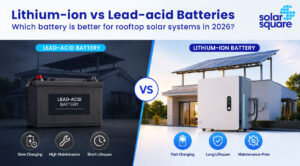
Lithium vs Lead-Acid Batteries: How Battery Chemistry Changes the Suitable Battery Size
Chemistry affects both how big your battery must be and how long it lasts, so it deserves its own comparison. Lithium (LFP) is now the common choice for home systems, but lead-acid still shows up in budget builds.
Here’s a side-by-side comparison of both:
| Factor | Lithium (LFP) | Lead-acid |
| Usable capacity (DoD) | 80-90% recommended | 50-60% recommended |
| Battery size needed for the same usable energy | Takes 3-4x less space | Takes 3-4x more space |
| Maintenance | It is a sealed battery and does not need water refilling or frequent maintenance. | It requires regular maintenance, including refilling water (in flooded lead-acid batteries), cleaning terminals, and periodic checks to ensure proper performance. |
| Lifespan of Solar Battery | 10-15 years | 3-5 years |
| Upfront cost | ₹ 15,000* to ₹ 20,000* per kWh | ₹ 8,000* to ₹ 12,000* per kWh |
Compare warranty terms and cycle ratings on each manufacturer’s datasheet before deciding.
Battery capacity also reduces gradually with use and age. When comparing batteries, check whether the warranty specifies how much capacity the battery is expected to retain after a certain number of years or cycles, especially if maintaining a particular backup duration is important.
Read the detailed comparison between lithium ion vs. lead-acid battery in SolarSquare’s blog.
Beyond the Battery: What Else Affects Your Battery Backup?
A battery never works alone. Your inverter, your panels, and your local rules all decide whether the capacity you calculated is usable. These are the parts that most often get missed.
Hybrid Inverter and Net Metering
A standard grid-tied solar inverter shuts off during a power cut for safety, so solar panels alone won’t keep your lights on. To run on battery during outages, you need a hybrid solar inverter. Rules for hybrid setups with net metering are set by each state’s electricity regulatory commission, so check your state’s regulations and your distribution company’s (DISCOM’s) process before you decide.
Your Solar Panels Must Refill the Battery
A large battery is useful only if the solar array can recharge the energy you use from it. What matters here is not the total electricity your solar panels generate, but the surplus solar generation left after your daytime household consumption is met.
For example, suppose you use 5 kWh from the battery overnight. If your solar system generates 12 kWh the next day but the home consumes 8 kWh during solar hours, only about 4 kWh remains available to recharge the battery. In that case, the battery may not return to full charge that day. Charging losses make the shortfall slightly larger, because not every unit of surplus ends up stored.
Solar generation also changes with weather and season, so do not size the battery only around your best-generation months. On a cloudy or monsoon day, generation can fall close to your daytime consumption, leaving little or no surplus to recharge from. Check whether the solar array can reasonably replenish your expected battery use during lower-generation periods as well. If it can’t, you have two options: reduce the loads you back up, or choose a larger solar array.
The PM Surya Ghar portal has a solar calculator you can use to estimate generation for your location.
Does PM Surya Ghar Muft Bijli Yojana Cover the Battery?
The PM Surya Ghar: Muft Bijli Yojana subsidy is calculated on your rooftop solar capacity. The Ministry of New and Renewable Energy (MNRE) has clarified that residential solar systems with battery storage and hybrid inverters can still apply for Central Financial Assistance (CFA). However, the battery itself does not add to the subsidy amount. Before applying for the subsidy, check the latest MNRE guidelines and the PM Surya Ghar portal for the current eligibility and technical requirements.
Common Solar Battery Sizing Mistakes to Avoid
Most sizing errors are small decisions made without checking the numbers.
Watch for these:
- Copying a neighbor’s battery size: Their loads and outage hours are not yours.
- Ignoring start-up surges: Pumps and ACs draw much more when they switch on, so check the inverter’s surge rating as well as the battery.
- Forgetting efficiency and DoD: Skipping them is how a “10 kWh” battery ends up delivering far less.
- Planning for whole-home backup on day one: Start with essentials and choose a system that lets you add capacity later.
- Sizing the battery without the panels: Storage you can’t recharge is dead weight.
Get Your Battery Size Right with SolarSquare
Now you have the formula, the example, and the pitfalls. Real homes have shading, surge loads, and DISCOM rules that no formula captures, and a mistake there is expensive to fix later.
Choosing the right battery size depends on your household’s electricity use, backup requirements, and the way your solar system is designed. SolarSquare can assess your electricity bills, essential loads, and rooftop solar setup to recommend a battery capacity that suits your home and budget. Book your free consultation with SolarSquare.
Frequently Asked Questions
How do I calculate battery capacity for a home solar system?
List your essential appliances and their daily kWh, then divide by (DoD × efficiency). For example, 4.9 kWh of daily load at 90% DoD and 90% efficiency needs about 6 kWh of battery capacity.
How long will a 10 kWh solar battery last?
You can use this formula to calculate how long a solar battery lasts:
Backup duration (hours) = Usable battery capacity (kWh) ÷ Average load (kW).
For example, if a battery provides 9 kWh of usable energy and the appliances running during the outage draw an average of 0.5 kW, the theoretical backup time is about 18 hours. Actual backup can vary because of system losses, changing appliance loads, and battery operating limits. Running high-power appliances such as an AC at the same time will reduce the backup duration significantly.
What size solar battery do I need to run an AC?
An inverter AC at roughly 1.2 kW average draws about 4.8 kWh over four hours. Add that to your essential load and size from there, and make sure the inverter can handle the AC’s start-up surge.
What is the difference between Ah and kWh?
Ampere-hours (Ah) and kilowatt-hours (kWh) describe battery capacity in different ways. Ah indicates how much electrical charge a battery can deliver, but the figure only becomes meaningful when the battery voltage is also known. kWh, on the other hand, measures the total amount of energy the battery can store and is therefore more useful when comparing batteries with different voltages.
You can convert Ah to kWh using the following formula:
kWh = (Ah × Battery voltage) ÷ 1,000
For example, a 100 Ah battery operating at 48 V stores approximately 4.8 kWh of energy.
How long does a home solar battery last?
It depends on chemistry, usage, and temperature. The most reliable indicator is the manufacturer’s warranty and rated cycle count on the datasheet.
Can I add more solar batteries later if my backup needs increase?
Yes, some battery systems are designed to allow additional modules to be added later. However, expansion depends on the battery model, inverter compatibility, battery management system (BMS), and the manufacturer’s installation requirements. Do not assume that any battery of the same capacity can simply be connected to an existing system. If future expansion is important, choose a modular battery system and confirm its expansion limits before installation.
Can a large solar battery run several high-power appliances at the same time?
Not necessarily. Battery capacity in kWh tells you how much energy is stored, but it does not tell you how much power the system can deliver at one moment. To run appliances such as an air conditioner, water pump, geyser, or induction cooktop together, check the battery’s continuous and peak discharge power as well as the inverter’s continuous and surge ratings. Both must be high enough for the combined load.