

 709 Reads
 17 mins


Electricity is among the highest operating costs for factories, manufacturing units, warehouses, cold storages, and processing plants in India. Since most factory machines run during the day, they rely heavily on expensive grid power during peak working hours. This makes electricity a direct production cost. Because electricity tariffs increase almost every year, this expense continues to rise. And when factories cannot pass this extra cost on to customers, their profit margins start shrinking.
An industrial solar rooftop system turns that equation around.
It converts unused factory roof space into a power-generating asset that runs your machinery on solar electricity, replacing costly grid power. Sized correctly, in the best case scenario, it can offset a large share of your daytime consumption and reduce your electricity bills by 60% to 70%.
How much you actually save depends on several factors, such as the electricity tariff in your city, the system size your roof can accommodate, available shadow-free space, sanctioned load, net metering rules in your state, and whether you fund the system through a CAPEX or RESCO/OPEX model.
This guide walks you through how the savings work, what a commercial rooftop solar system costs, how to size one for your factory, and a real case study on ROI and solar power generation in factories across India.
What is an Industrial Solar Rooftop System?
An industrial solar rooftop system is a high-capacity solar plant installed on the roof of a factory or industrial building to generate electricity for on-site use. It uses high-efficiency solar panels to convert sunlight into power that runs machinery, lighting, and equipment through the day, cutting the amount of expensive grid electricity the industry has to buy.
These systems are built for scale. Capacities can range from 50 kW to 100 kW plants generating solar power for small businesses to several megawatts for large manufacturing plants, depending on the factory’s load profile and available roof area.
Here are the key components of an industrial solar rooftop system:
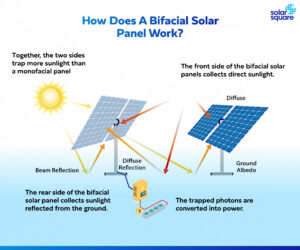
- Solar panels: They capture sunlight and convert it into electricity. High-efficiency Mono PERC, TOPCon, and bifacial solar panels generate more power from the same roof area, which matters when space is the limiting factor.
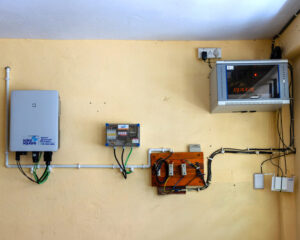
- Solar inverter: The inverter converts the DC power produced by the panels into the AC power that machines and equipment use.
- Mounting structures: These hold the panels at the right tilt and orientation and keep the array secure against wind and weather.
- AC/DC cables: These carry power safely from the panels to the inverter and onward to your distribution board, sized to minimize losses.
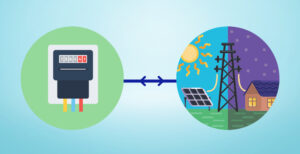
- Net meter: This bidirectional meter records how much power you draw from the grid and how much surplus solar energy you export back, which helps with billing adjustments under solar net metering.
- Safety equipment: Surge protection, earthing, fuses, and isolators protect the system, the building, and the people working around it.
- Monitoring system: Remote monitoring tracks generation in real time and flags faults early. So, a drop in output gets caught before it eats into savings.
How Industrial Solar Rooftop Cuts Factory Electricity Costs by 60% to 70%?
An industrial solar rooftop system cuts costs by generating power on-site at a far lower rate than the grid charges. Every unit your panels produce during the day replaces a unit you would otherwise buy from the DISCOM at a higher rate.
Over the system’s 25-year life, that spread, combined with net metering and protection against tariff hikes, reduces bills by 60% to 70% (as a best case scenario) for daytime-heavy operations.
Let’s find out in detail how bill reduction happens when a factory installs rooftop solar.
#1. Solar Replaces Expensive Grid Electricity
Without solar, factories buy almost all their power from the grid, and for industrial users, that grid power is expensive. An industrial solar rooftop system changes the source of that power.
- When the sun is up, and your panels are generating power, your machines run on solar rather than drawing electricity from the grid.
- Every unit your panels produce is a unit you no longer buy from the electricity board.
The more of your daytime consumption the solar system covers, the smaller your monthly grid bill gets. The savings you make over 25 years happen because you stop paying the grid for power you can now generate yourself on a roof that was sitting empty anyway.
#2. Daytime/ Off-Peak Self-Consumption Increases Savings
When you consume solar power the moment it is generated, you avoid the variable charges that make up the bulk of an industrial bill. These include the energy charge, electricity duty, wheeling charges, FAC charges, and tax on sale.
- Factories that run mostly in daylight hours can offset a very large share of this variable component.
- That self-consumption is where most of the 60%-70% savings come from.
- Fixed demand charges tied to your sanctioned load stay in place, which is one reason a well-sized system trims the bill heavily but doesn’t make it exactly zero.
#3. Net Metering or Net Billing Can Improve Utilization
When solar panels generate more than the factory needs at any moment, that surplus does not go to waste. Depending on your state policy, net metering lets you export surplus power to the grid and adjust it against later consumption, while net billing pays you a set rate for what you export.
Both models improve how much value you extract from the PV system, especially on weekends or low-production days. The exact benefit varies by state. Therefore, the net metering policy in your DISCOM area significantly influences the final savings.
#4. Solar Reduces Exposure to Tariff Hikes
Grid electricity prices in India usually go up by 3-6% every year. Fuel price changes can also make power costs less predictable, especially for businesses that depend on grid power or diesel backup.
With an industrial rooftop solar system producing free power, you can fix a large part of your power cost for up to 25 years. This means your business is less affected by yearly electricity price hikes. You also depend less on the grid and get better control over your energy costs.
#5. CAPEX and OPEX Models Make Savings Flexible
You do not need to choose between solar and protecting your working capital.
- Under the CAPEX model, you buy and own the system, capture the full savings, and claim the accelerated depreciation tax benefits.
- Under the OPEX model, a developer installs and owns the system on your roof, and you pay for the power you consume, usually at tariffs way less than the grid tariffs, with no upfront cost.
What Determines Whether Your Factory Saves 30% or 70%?
Shadow-free space on the roof, the daytime load profile of your company/factory, generation performance, and whether or not you use battery backup are the most critical factors that determine whether solar will cut your bills by 30% or a whopping 70%.
Let’s understand how.
- Availability of shadow-free space: Shadow-free space matters because you need it to fit the system that can offset the majority of your load. If your usable roof is too small or shaded, the system size would be smaller, which caps how much of your bill you can offset.
- Daytime load profile: Your hourly consumption pattern matters. A factory that runs production throughout the day aligns well with solar generation and offsets most of its load. On the contrary, a 24×7 operation draws power heavily at night, too, when panels produce nothing. So, the bill offset will be on the lower side here.
- Generation performance: The solar panel technology you choose, the irradiance levels at your location, and the panels’ orientation and tilt angle are crucial factors that affect output. Since south-facing panels receive near-perpendicular sunlight, they generate the most power, increasing your savings by offsetting grid power requirements.
- Battery or hybrid setup: If you add battery storage, you can use stored solar power at night and offset after-dark consumption, too. Therefore, for a factory that runs 24/7, a hybrid solar system is better, as it will extend the savings beyond daylight hours.
Case Study on Solar Generation and ROI That Factories Get From Rooftop Solar
To illustrate the lifetime savings and payback of an industrial rooftop solar system, here are actual numbers from a 1 MW solar system installed by SolarSquare at a manufacturing industry in Jaipur.
- The Jaipur plant is a 1 MW solar system that the company set up for ~Rs. 3,20,03,840.
- It turned positive in 2023-24, the fourth year of operation, which was the point at which it had earned back its entire investment.
Here are the plant details:
| Year | Actual Generation (kWh) | Solar Revenue | Cumulative Cashflow |
| 2020-21 | 5,53,859 | ~Rs. 44,03,179.05 | ~Rs. -2,76,00,660.95 |
| 2021-22 | 14,67,271 | ~Rs. 1,17,38,168 | ~Rs. -1,58,62,492.95 |
| 2022-23 | 13,87,018 | ~Rs. 1,11,65,494.9 | ~Rs. -46,96,998.05 |
| 2023-24 | 13,01,746 | ~Rs. 1,04,79,055.3 | ~Rs. 57,82,057.25 |
| 2024-25 | 12,61,752 | ~Rs. 1,01,57,103.6 | ~Rs. 1,59,39,160.85 |
| 2025-26 | 7,10,130 | ~Rs. 50,77,429.5 | ~Rs. 2,10,16,590.35 |
DISCLAIMER: The figures mentioned above are illustrative estimates. Actual generation and savings vary by location, city, system size, system technology, vendor pricing, and prevailing policies.
Why Factories Are Ideal for Industrial Solar Rooftop Systems?
Factories tend to tick every box that makes solar work well, which is why adoption across manufacturing has moved quickly.
- Large unused roof space: Factory and warehouse roofs are wide and mostly flat, offering the clear, shadow-free area a large PV system needs.
- High daytime power consumption: Production runs during daylight hours, so generation and demand align, and most of the solar output gets used on-site.
- High commercial and industrial tariffs: Industrial consumers pay premium grid rates, so every unit replaced by solar saves more than it would for a household.
- Rising pressure to reduce operating cost: Since electricity is one of the biggest expenses and power prices keep increasing every year, reducing the electricity bill directly improves profit.
What Size Industrial Solar Rooftop System Does a Factory Need?
An industrial rooftop solar system can reduce your electricity bill by up to 70%, but only when it is designed according to your factory’s power use. The system should match the amount of electricity your factory needs during working hours. This is very important because only the right system size yields greater savings.
- If the plant is too big, you may spend more than needed.
- If it is too small, you will not save as much as you can.
The factors listed below must be considered when planning a rooftop solar installation at commercial and industrial sites:
- Monthly electricity units consumed: Your monthly electricity use shows how much power your business needs. It helps decide the estimated size of the solar system you should install.
- Daytime consumption as a share of the total: Solar panels generate power only during the day. So, you need to check how much electricity your site uses during daylight hours. The more power you use during the day, the more you can save with solar.
- Peak demand: Peak demand means the maximum electricity your site uses at one time. For example, your factory may use normal power most of the day, but when several machines, motors, chillers, or compressors run together, power use suddenly becomes very high. That highest point is called peak demand. Knowing this helps the solar installer plan the system properly, so solar power can support your site during the hours when electricity use is highest.
- Available roof area: Your roof space decides how large your solar system can be. The system must fit within the usable roof area available at your site.
- Roof strength and orientation: Your roof should be strong enough to support the solar panels safely. The roof’s direction also matters because it affects how much sunlight the panels receive.
- Shadow analysis across the day and seasons: Nearby buildings, water tanks, and equipment cast shadows that move throughout the day and shift with the seasons. Mapping them keeps panels off shaded spots that would drag generation down.
- Sanctioned load: Sanctioned load is the power limit approved by your electricity provider. It affects how large a solar system you are allowed to connect to the grid.
- State net metering or captive rules: Each state sets its own rules on how much you can install, how much you can export, and how it is adjusted against your bill.
- Future machinery and expansion plans: If you plan to add more machines, production lines, or storage capacity later, your future power use should also be considered. Planning for this now can help you avoid major changes later.
Sample System Sizing Guide for Factories
The table below gives indicative system sizes against different consumption bands. These are starting points, and your actual size should come only from a site-specific load study.
| Normal + Off-Peak Consumption | Indicative Solar Size |
| 25,000 to 40,000 units | 215.5 kW to 344.8 kW |
| 50,000 to 80,000 units | 431 kW to 689.7 kW |
| 1,00,000 to 1,50,000 units | 862 kW to 1.3 MW |
DISCLAIMER: These system sizes are indicative and not fixed. The right industrial solar rooftop capacity for your factory depends on your daytime load, the share of consumption that occurs during daylight hours, the available shadow-free area on the roof, irradiance levels, and your state’s net metering or captive rules. Your actual system size should come from a proper site survey and load study done by professionals.
What is the Cost of Industrial Solar Rooftop Systems in India?
The cost of industrial solar rooftop systems ranges between ~Rs. 30,000* per kW and ~Rs. 50,000* per kW. The table below shows indicative 2026 pricing across different system sizes.
| Solar System Size | Cost of Industrial Solar Rooftop Systems in India in 2026 |
| 50 kW | ~Rs. 15 lakh to ~Rs. 25 lakh |
| 100 kW | ~Rs. 30 lakh to ~Rs. 50 lakh |
| 200 kW | ~Rs. 60 lakh to ~Rs. 1 crore |
| 300 kW | ~Rs. 90 lakh to ~Rs. 1.50 crore |
| 500 kW | ~Rs. 1.50 crore to ~Rs. 2.50 crore |
| 1 MW | ~Rs. 3 crore to ~Rs. 5 crore |
*Please note that prices are subject to change. The cost of industrial rooftop solar systems listed in the section above is indicative, and not fixed. The final solar panel cost for commercial PV systems can vary based on the type of solar panels you use (DCR solar panels are up to ~30% costlier than imported modules), type of solar inverter you choose (string inverters and optimizers have a cost variation of ~10-15%), type of solar industrial system, whether or not you use a battery energy storage system (it increases the final cost by almost 30%), mounting structure height, type of after-sales service, roof height, etc.
What Payback Period and ROI Can Factories Expect?
For a CAPEX system, the payback period is usually 3 to 5 years. Where it lands within that range depends on a few things.
- A larger project and a higher tariff both shorten the payback period, since the savings per unit are higher.
- The type of installation also matters, as an RCC roof and a metal roof incur different structural and mounting costs.
- How the project connects to your supply also plays a part. A behind-the-meter system feeds power straight into the factory for self-consumption, so every unit offsets grid power at your full tariff. On the other hand, a net-metered system exports surplus to the grid at a rate set by your state, which is below the retail tariff.
After payback, the system keeps generating free power for the remaining 20 years of its life.
Here’s a table that shows the expected lifetime savings and ROI for industrial rooftop solar systems.
| Solar System Size | Lifetime Savings From Industrial Solar Rooftop Systems Over 25 Years* | Return on Investment (ROI/IRR) |
| 50 kW | ~Rs. 1.5-2 Cr | 22-24% |
| 100 kW | ~Rs. 2-2.5 Cr | 22-28% |
| 200 kW | ~Rs. 7 Cr | 35-43 % |
| 300 kW | ~Rs. 10 Cr | 31-40 % |
| 500 kW | ~Rs. 22 cr | 38-48% |
| 1 MW | ~Rs. 28 – 30 Cr | 25-38 % |
*Please note: The lifetime savings and ROI figures listed above are indicative estimates and not guaranteed returns. While calculating lifetime savings and IRR, we have considered a tariff escalation rate of 3% YoY, an annual plant degradation rate of 1% in the 1st year (0.45% YoY from year 2 onwards), the plant’s maintenance cost, and an AD of 40% YoY. Actual final savings and ROI depend on your electricity tariff and how fast it rises over the years, the generation your site achieves based on irradiance level, orientation and tilt angle, panel performance, whether the system is set up behind the meter or net metered, the quality of panels, inverters, and other materials used, maintenance and plant uptime, and the financing model you choose.
What are the Benefits of Industrial Rooftop Solar Systems?
Here are the multiple advantages of installing industrial solar rooftop systems in India in 2026:
- Tax benefits and accelerated depreciation: Businesses can reduce their taxable income by claiming 40% depreciation in the first year if the system runs for more than 180 days in that financial year. This helps recover part of the cost faster and improves cash flow.
- Lower electricity bills: The core benefit is a direct, lasting cut in your monthly power cost by up to 70%.
- GST benefits: Some businesses may be able to claim GST input credit on the solar system. This can reduce the actual installation cost.
- Green energy compliance: Solar helps your business show that it uses clean energy. This is becoming important for companies that export goods, as many international buyers now check carbon footprint before working with suppliers.
- Lower carbon footprint: Every unit of solar power displaces grid power, reducing your emissions and supporting both compliance and brand goals.
Here’s how much carbon an industrial solar rooftop system can offset over 25 years:
| Solar Plant Size | Equivalent to How Many Full-Grown Trees? | Carbon it Offsets Over 25 Years |
| 100 kW | 3,920 full-grown trees | ~26 lakh kg |
| 200 kW | 7,840 full-grown trees | ~52 lakh kg |
| 300 kW | 11,760 full-grown trees | ~78 lakh kg |
| 400 kW | 15,680 full-grown trees | ~1.03 crore kg |
| 500 kW | 19,600 full-grown trees | ~1.29 crore kg |
Conclusion
An industrial solar rooftop system can turn one of your biggest and most unpredictable business costs into a stable and manageable expense. For factories that run mainly during the day, pay high electricity tariffs, and have enough roof space, solar can be a strong investment. Many businesses recover their cost in 3 to 5 years and continue to benefit from low-cost power for over two decades after that.
The best way to start is with a site feasibility study. This study checks your electricity load, roof space, tariff, and expected generation to show how much your factory can save. Book a free solar consultation with SolarSquare to get a custom savings and payback estimate for your factory.
FAQs
What makes a factory rooftop suitable for solar?
A good solar roof has enough shadow-free space for the system you need, a strong structure that can support the load, and safe access for installation and cleaning. Proper drainage, low corrosion risk, suitable orientation and tilt, and a well-ventilated room for the inverter and electrical equipment are other requisites that help the system perform and last.
What mistakes should factories avoid while installing a rooftop solar system?
The common ones are oversizing or undersizing the system against actual load, choosing the lowest-cost EPC without checking quality, ignoring roof strength and safety, skipping a check of state net metering rules, and overlooking ongoing operations, maintenance, and monitoring.
How to choose the right industrial rooftop solar EPC partner?
Look for a partner with a track record on industrial projects, quality components backed by proper warranties, in-house engineering for structural and shadow analysis, and after-sales operations and maintenance. A strong EPC will base your system size on a real load study rather than a roof-area guess, and will stay accountable for generation after commissioning.
Does industrial rooftop solar need batteries?
Batteries are not mandatory. A standard grid-connected system without batteries works well for factories that run mainly during the day, since generation matches consumption. Batteries make sense when you run a significant nighttime load or want backup and greater grid independence.
How much roof area is needed for an industrial solar rooftop system?
Roof area depends on system size. As a rule of thumb, a 50 kW system requires ~350 square metres of shadow-free roof area.
How long does an industrial rooftop solar system last?
A tier-1 industrial solar rooftop system that’s maintained well throughout its life lasts for 25 years. Even after 25 years, it can continue to generate power at ~80% of its original capacity.
Do factories get a government subsidy for solar?
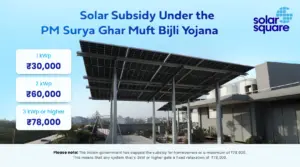
No, commercial and industrial consumers do not receive a subsidy, which is reserved for residential consumers under the PM Surya Ghar Muft Bijli Yojana. Factories instead benefit from 40% accelerated depreciation and GST input credit where applicable.


 Previous Article
 23 min