

 75 Reads
 12 mins



In 1883, Charles Fritts built the world’s first solar cell by coating selenium with a thin layer of gold, and this crude, roughly 1% efficient device sparked a technology that now powers millions of Indian homes. Solar energy has since become one of the most effective forms of renewable energy available to us today. Solar panels are built specifically to absorb the sun’s rays and convert them into usable electricity. But have you ever wondered how solar panels are made, or who actually built the very first one? There’s a genuinely interesting backstory behind it.
From that first crude selenium cell producing barely any usable power, solar technology has come a long way, now serving everything from telecommunication equipment and remote sensing to everyday residential and commercial power needs. From that first crude selenium cell producing less than a volt, to the sleek, high-efficiency rooftop solar, the journey of solar technology says a lot about how far renewable energy has come, and how much further it’s likely to go. Let’s walk through what a solar panel actually is, how it works, how it’s made, and everything worth knowing before you consider going solar yourself.
What Is a Solar Panel?
Solar panels are built from silicon wafers layered with dopant materials. This layering creates a p-n junction that helps generate electrical current when exposed to sunlight. In simple terms, a solar panel takes light from the sun, which is made up of tiny particles called photons, and converts that light into electricity.
Charles Fritts built his original solar panel using what’s known as the photovoltaic effect, a process that produces electric current when a material is exposed to light. But it wasn’t until 1954 that Bell Labs developed the modern version of the solar panel we recognise today.
That very first selenium-cell solar panel was just a quarter-inch thick and produced a mere 0.5 volts of power. Compare that to a modern solar panel, built from around 20 layers of electrode material and capable of producing over 200 volts.
How Does A Solar Panel Work?
The amount of solar energy that hits the Earth’s surface every day is genuinely enough to power the entire world. A solar panel’s job is to capture that energy and convert it into usable electricity.
Solar energy is technically a form of electromagnetic radiation. A solar panel captures this radiation and converts it into solar power through its photovoltaic cells. These cells absorb the sun’s energy, which creates an electrical charge, and that charge is what makes electricity flow.
A single panel is made up of many individual PV cells, with silicon placed beneath a non-reflective layer of glass. These cells collect photons from sunlight and convert them into electricity.
So, how is electricity made from solar energy, exactly? What comes out of the panel initially is DC power, direct current. Since most homes and appliances run on AC, alternating current, a solar inverter steps in to convert that DC power into usable AC power for your home.
What Are The Types of Solar Panels
There are three main types of solar panels available today:
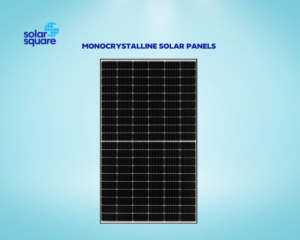
- Monocrystalline Solar Panels: These are the oldest of the three types. Making a monocrystalline panel involves a single, pure layer of crystalline silicon, cut from silicon wafers. They tend to be the most efficient option available.
- Polycrystalline Solar Panels: These are made by combining several fragments of silicon crystal together, rather than using a single pure crystal. They’re generally less efficient at generating electricity compared to monocrystalline panels, but come at a lower cost.
- Thin-Film Solar Panels: These panels are thin and flexible, built using layers of materials like amorphous silicon or cadmium telluride. They need more surface area and generally show lower efficiency compared to crystalline panels.
Power Generation From a Solar Panel
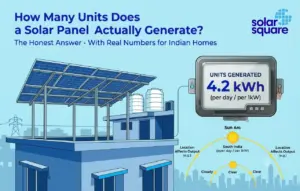
Several factors affect how much energy a solar panel actually produces on any given day. On average, a 1 kW solar panel can produce close to ~4 units (kWh) of energy daily.
A single 370-watt solar panel, for instance, can typically generate anywhere between 1.4 and 1.9 units of electricity in a day, enough to comfortably run things like a television and a couple of phone chargers. The exact output depends heavily on the panel’s quality and how much direct sunlight it actually receives.
How Are Solar Panels Made?
A solar panel is an electrical device, mostly used on residential rooftops, commercial buildings, industrial plants, solar farms, and more. It converts sunlight directly into electricity using the photovoltaic effect.
A solar cell is a semiconductor device mainly responsible for generating electricity. It is usually made with silicon that converts sunlight into an electric current.
Solar panels are made of multiple interconnected solar cells enclosed in protective layers on a rigid frame. It requires advanced semiconductor technology, high-quality raw materials, and precision machinery.
The basic functions of a solar panel or PV module include absorbing sunlight, converting photons into electrical energy, generating DC power for certain devices (inverters), and supporting renewable electricity generation.
Making a solar panel requires silicon wafers and a series of steps performed in order. The step-by-step process is discussed below:
Step 1: Raw Silicon Purification
Most solar panels are made up of silicon. Silicon is inexpensive, as it is the second most abundant element on Earth after oxygen. To get the purest form of silicon, we use quartz sand (SiO2) and heated in an arc furnace at nearly 2000°C to remove oxygen and produce metallurgical-grade silicon. To make it purer (up to 99.99%), we further do chemical vapor deposition.
Step 2: Converting Silicon into Ingots:
Here, we convert the purest form of silicon into ingots by melting hundreds of kilograms of silicon rock at very high temperatures to get a desired shape. We usually use a cylindrical furnace to form ingots and add boron in the process to provide positive electron polarity to silicon.
There are two types of silicon cells formed. Monocrystalline cells are made with a single crystal of silicon. It has high efficiency in converting solar energy into electricity; hence, it costs more.
Polysilicon cells are formed through multiple silicon crystals and have low efficiency.
Step 3: Wafer slicing and cleaning:
Silicon ingots are sliced into thin wafers using a diamond wire saw machine. It makes sure the wafers are 150-180 microns thick, almost like paper. Through this process, we can create mono- and poly-wafers. To remove debris and saw damage, we treat these wafers with chemicals. This helps to reduce light reflection and improve absorption efficiency.
Step 4: Doping (forming a P-N junction)
In the solar panel making process, forming a P-N junction is the most important step to create electrical polarity. For the p-type layer, we add boron, and for the N-type layer, we diffuse phosphorus. This forms a P-N junction required to allow current to flow.
Step 5: Anti-reflection coating:
Once the doping process is completed, an anti-reflective coating of Silicon nitride (SiNx) is applied, as it can help to reduce sunlight reflection up to 30% and increase power output. The coating can be done through various methods like spin coating, spraying or vapour deposition.
Step 6: Solar cell testing and cell stringing:
Each solar cell goes through testing and classification before being converted into panels. Each cell is tested for open-circuit voltage, maximum power, short-circuit voltage, and overall efficiency. After the cells pass the tests, Photovoltaic cells are connected in series and parallel using copper ribbons. For commercial purposes, solar panels generally have 48, 60, and 72 PV cells. Manufacturers use auto stringer machines to connect them.
Step 7: Layering process and lamination:
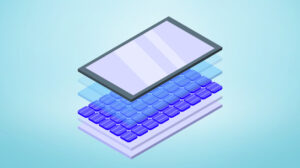
Solar panels are made by combining solar cells in an arrangement. Each solar cell string is layered among multiple layers. The layer stacking sequence will be tempered solar glass, EVA sheet, solar cell strings, again an EVA sheet, and backsheet (Tedlar/TPT/PVDF). Creating a weather-proof sealed module and creating vacuum lamination helps.
This entire process, from a raw silicon wafer to a fully functional panel, typically takes place across large, automated production lines, which is exactly why the cost of solar panels has fallen so dramatically as manufacturing scale has grown over the past decade.
How Much Do Solar Panels Cost in India?
The price of a solar panel depends heavily on its type, efficiency, and brand, and unlike a few years ago, prices have dropped significantly as manufacturing has scaled up across the country.
| Panel type | Price per watt | Efficiency |
| Polycrystalline panels | ~Rs. 23 to ~Rs. 35* per watt | Low |
| Monocrystalline panels (Mono PERC) |
| ~22.5% |
| TOPCon panels |
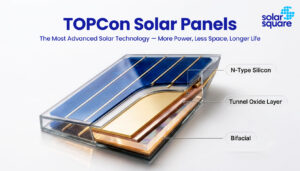
| ~25-26% |
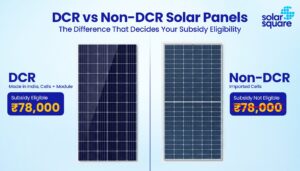
For a complete, fully installed 3 kW residential system, panels, inverter, mounting structure, and labour included, expect to pay somewhere between ~Rs. 2.10 lakh and Rs. 2.47 lakh* before subsidy. After the PM Surya Ghar Yojana subsidy of up to Rs. 78,000, that net cost typically comes down to roughly Rs. 1.05 lakh to Rs. 1.69 lakh*, depending on the components and installer you choose.
*Disclaimer: Prices are subject to change. The above-mentioned cost of solar for a 3 kW on-grid solar system is indicative as of 19th August 2026 for the SolarSquare Blue 6ft variant. The final solar plate price depends on your DISCOM charges, product variant opted for, panel type, inverter type, mounting structure height, type of after-sales service, savings guarantee, roof height, etc. Also, while calculating savings from a solar system for homes, we have considered an annual tariff escalation of 3% and an annual plant degradation rate of 1%
*Please note: The per-watt solar panel price listed above is an indicative range and can change based on the manufacturer, module wattage, order size, location, and market conditions. The price range can vary by ±10 %- 12% based on the brand, location, promotions, and availability.
Pros and Cons of Solar Panels
Like any big investment, solar panels come with real upsides and a few honest trade-offs. Here’s a straightforward look at both sides, so you know exactly what you’re signing up for before you install one.
Pros of Solar Panels
- Reduction in electricity bills: This is the single biggest advantage. Solar panels genuinely help cut down your ongoing electricity costs, often significantly.
- Environmentally friendly: Solar energy is a clean power source, powered entirely by sunlight, with no pollution or harmful emissions tied to its generation. It plays a real role in reducing your overall carbon footprint.
- Low long-term maintenance: Once installed, solar panels need very little upkeep beyond occasional cleaning and periodic inspection.
- Protection from rising tariffs: Once your system is installed, your major energy cost stays largely fixed, shielding you from year-on-year electricity price hikes.
Cons of Solar Panels
- Installation costs can be high: The upfront cost of installing a solar system is a genuine consideration, even though it’s dropped considerably in recent years.
- Dependence on weather: Since solar panels rely on sunlight, they naturally produce less electricity on cloudy or heavily overcast days.
- Roof suitability matters: Not every roof is equally suited for solar; shading, orientation, and structural strength all play a role in how well a system performs.
Why Isn’t Solar Energy More Popular Yet?
A few real reasons hold solar back from being as widely adopted as it could be:
It’s somewhat dependent on weather and sunlight availability
- Awareness and access to reliable installers still vary by region
- The upfront installation cost, while falling, is still a genuine barrier for some households
That said, the advantages continue to outweigh these challenges by a wide margin, and solar adoption in India keeps growing steadily year after year.
Conclusion
Charles Fritts built the very first solar panel at a time when the world had barely any awareness of what solar energy could actually do.
More than a century later, solar panels have become a genuinely practical technology, capable of harnessing the sun’s energy to generate real electricity and meaningfully bring down household electricity bills. If you’ve been on the fence, this might just be the right time to make the switch yourself.
Understanding how solar panels are made and what goes into pricing them is a great first step, but choosing the right installer is what actually determines whether your system delivers on its promise. SolarSquare designs every rooftop system around your home’s specific roof and sunlight conditions, uses only BIS and ALMM-certified panels, and backs every installation with a written savings guarantee, so you’re not just buying panels; you’re buying real, measurable savings for the next 25 years. Ready to see what solar could save you? Book a free consultation with SolarSquare today and get a custom solar estimate built specifically for your home.
Frequently Asked Questions
How do solar panels work?
Solar panels absorb the sun’s energy and convert it into direct current (DC) electricity. A solar inverter then converts this DC power into alternating current (AC), the kind of electricity your home actually runs on.
How do I know if a solar panel will fit on my roof?
You’ll need a roof area that’s largely free of shade. As a general rule, around 100 square feet of shadow-free space is needed to install a 1 kW rooftop solar system. It’s best to have a professional assess whether your roof is both strong enough and large enough for the system you’re considering.
How long does a solar panel last?
A well-built solar panel typically lasts around 25 years. Solar panels are also fairly durable, built to withstand heavy snowfall, strong winds, and hail without significant damage.
What are the main types of solar panels available today?
The three primary types are monocrystalline, polycrystalline, and thin-film panels. Monocrystalline panels offer the highest efficiency, polycrystalline panels are more budget-friendly, and thin-film panels are lightweight and flexible but need more space to generate the same output.
How are solar panels made step by step, in simple terms?
Silicon gets cut into thin wafers and treated with a dopant like phosphorus; a metal layer is added through heat treatment to form an electrical connection, and finally, protective layers of aluminium, silicon, and plastic are added to guard the panel against corrosion and weather damage before it goes through quality testing.


 Previous Article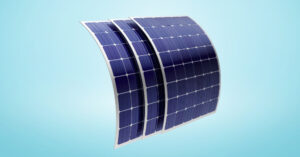
 11 min







![10 kW Solar Panel Price in India [With and Without a Subsidy]](https://cdn.solarsquare.in/blog/wp-content/uploads/2025/07/18165650/10-KW-solar-panel-300x167.webp)