

 4 Reads
 10 mins


Did you know? The core technology behind solar panels wasn’t invented in a lab by a team of engineers chasing clean energy. It was discovered, almost by accident, by a 19-year-old physicist named Edmond Becquerel in 1839
Most people assume solar panels are a fairly recent invention, something that showed up alongside smartphones and electric cars. The truth is far stranger; the history of solar energy stretches back almost 200 years, to a curious teenager fiddling with electrodes in his father’s laboratory, who noticed something no one could yet explain.
From a young French scientist’s strange observation in 1839 to solar panels now lining rooftops across India, the journey has never been a straight line. A quick look at the milestones along the way:
- 1839: A 19-year-old French physicist, Edmond Becquerel, accidentally discovers the photovoltaic effect while fiddling with electrodes in his father’s lab.
- 1954: Bell Labs unveils the first practical silicon solar cell, but at the cost of hundreds of dollars per watt, it’s little more than a lab novelty.
- 1958: Solar powered the Vanguard 1 satellite in orbit, proving it could work where nothing else could.
- 1970s: The oil crisis forces the world to take solar seriously as an energy source, not just a space gadget.
- 2000s onward: Massive solar manufacturing scale-up (mostly in China) sends prices crashing by more than 99%, turning solar from niche to mainstream.
In this blog, we’ll walk through the full timeline, the discovery, the breakthroughs, the price and efficiency story, India’s own chapter in this history, and where solar is headed next.
What is the History of Solar Panels: The Discovery Era (1839-1883)
Solar power was not invented by a single person, but was pieced together over more than 40 years by several scientists. They had no idea that they were working on the same idea.
It started in 1839, with a 19-year-old French physicist named Edmond Becquerel. He was experimenting with metal electrodes dropped into a conducting solution. He noticed something odd. Exposing the setup to light produced a small electric current. He couldn’t fully explain it. But he had just discovered what we now call the photovoltaic effect, which is the foundation of solar energy.
Then in 1873, English electrical engineer Willoughby Smith found that selenium was photoconductive. Its electrical properties changed when light hit it. Three years later, in 1876, William Grylls Adams and Richard Evans Day built on this work. They showed that selenium could generate electricity when exposed to sunlight, without any moving parts.
That set the stage for the real milestone. In 1883, American inventor Charles Fritts built the first practical solar cell. He coated selenium with an extremely thin layer of gold, which converted only about 1% of sunlight into electricity. Fritts installed his selenium panels on a New York City rooftop, arguably the world’s first rooftop solar installation.
The Theoretical Breakthrough: Einstein Explains Why It Works
For decades, scientists knew the photovoltaic effect existed; they just couldn’t fully explain why light produced electricity. That changed in 1905, when Albert Einstein published a paper explaining the photoelectric effect, the underlying physics of how light particles, photons, knock electrons loose from a material’s surface.
This gave scientists an actual theoretical framework to work from. Instead of stumbling onto solar cells by accident, researchers could now deliberately improve them. This is a big, often-overlooked chapter in the historical background of solar energy, the moment solar stopped being pure trial and error.
The Silicon Breakthrough: Bell Labs, 1954
In 1940, Bell Labs researcher Russell Ohl was studying semiconductors when he accidentally created a p-n junction, a boundary between two differently treated pieces of silicon, and noticed it produced a measurable current when exposed to light. He patented this in 1946.
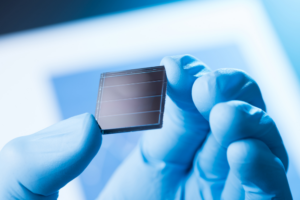
Fourteen years after Ohl’s discovery, three Bell Labs scientists, Daryl Chapin, Calvin Fuller, and Gerald Pearson, turned this into something genuinely usable. On April 25, 1954, they demonstrated the first practical silicon solar cell, about 6% efficient, six times better than Fritts’ selenium cell from 71 years earlier. They called it the “Bell Solar Battery,” and showed it off by powering a toy Ferris wheel and a small radio transmitter.
This is really the true invention of solar power as you understand it today. This was the moment solar technology became efficient enough to be useful.
Solar Goes to Space
Once silicon solar cells existed, the next question was where to actually use them. The answer, somewhat unexpectedly, was space.
In 1957, the first practical application of a silicon solar cell was surprisingly down-to-earth. It powered a telephone repeater station in rural Americus, Georgia. But the real turning point came in 1958, when the United States launched the Vanguard I satellite, powered by a solar panel generating roughly one watt. It was the first satellite to run on solar power, and it proved that solar cells could work reliably for years in one of the harshest environments imaginable.
The Price Story: From $300 a Watt to Under 50 Cents
Solar panel prices have fallen by more than 99% since they first became commercially available. In 1956, when solar panels were first sold for niche commercial use, they cost roughly $300 per watt. Today, panel prices sit well under ~$0.50 per watt (~₹21-₹24 for DCR TOPCon, and ~₹18 for non-DCR TOPCon* per watt in India).
That decline didn’t happen overnight. It took seven decades of manufacturing scale, material science improvements, and increasing global competition, most sharply since the 2000s, once countries like China began mass-manufacturing panels at a scale nobody had attempted before.
| Era | Approx. Price per Watt | What Drove the Change |
| 1956 | ~$300 | First niche commercial availability |
| 1970s | ~$100 | Oil crisis sparks interest in alternatives |
| Today | Under $0.50 | Continued scale, efficiency gains |
This is really the core of the cost of solar panels’ history, and it’s the single biggest reason rooftop solar went from a rich person’s hobby to something an ordinary Indian household can genuinely afford today.
Source: EnergySage (pricing)
*Please note: The per-watt solar panel price listed above is an indicative range and can change based on the manufacturer, module wattage, order size, location, and market conditions.
The Efficiency Story: From 1% to Over 47%
Fritts’ original 1883 selenium cell converted roughly 1% of sunlight into electricity. Bell Labs’ 1954 silicon cell pushed that to about 6%. From there, progress kept climbing: monocrystalline and polycrystalline silicon cells through the late 20th century, then newer technologies like PERC, TOPCon, and heterojunction cells commonly used in today’s residential panels, regularly hitting 22-26%* efficiency.
In laboratory settings, using multi-junction cells that stack several light-absorbing layers, efficiency records have now crossed 47%, an almost unimaginable jump from Fritts’ 1% cell 140 years earlier. The newest chapter in this efficiency race involves perovskite solar cells, a newer crystal-structure material that’s shown rapid efficiency gains in research settings and is increasingly being paired with silicon in tandem cells to push past what silicon alone can achieve.
Source: U.S. Department of Energy, Solar Energy Technologies Office, “The History of Solar,” energy.gov
* Please note: The efficiency range mentioned above is a combined range for PERC, TOPCon, and HJT. The efficiency of PERC is up to 22.5% for mono PERC panels, 25-26% for TOPCon, and more than 26% for HJT.
India’s Own Solar Timeline
India’s modern solar push began in earnest on January 11, 2010, when the Ministry of New and Renewable Energy launched the Jawaharlal Nehru National Solar Mission, under the country’s National Action Plan on Climate Change. The original target was ambitious for its time: 20,000 MW of grid-connected solar by 2022. That target was later revised sharply upward to 100,000 MW, reflecting just how fast solar costs were falling globally.
Source: Ministry of New and Renewable Energy, Government of India, mnre.gov.in
In 2015, India took this further onto the world stage. The International Solar Alliance was founded, with India as a co-founder and permanent headquarters in Gurugram, bringing together sun-rich countries around the world to accelerate solar adoption collectively.
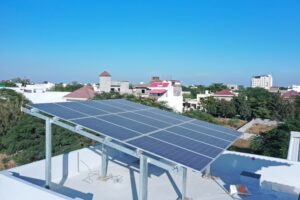
Through the 2010s and into the 2020s, India’s solar capacity kept climbing, driven by falling global panel prices, aggressive state and central policy support, and growing domestic manufacturing. That momentum led directly to 2024’s PM Surya Ghar Muft Bijli Yojana, a national push to put rooftop solar on a crore Indian households, backed by direct subsidy support of up to ₹78,000 for 3kW or above system size.
What’s Next: The Next Chapter of Solar History
A few genuinely interesting developments are shaping where solar goes next.
- Perovskite-silicon tandem cells stack a newer perovskite layer on top of traditional silicon, aiming to push past 34%* efficiency while keeping manufacturing costs reasonable, a technology still maturing but showing real promise in lab and early pilot settings.
- Floating solar plants are placing panels directly on reservoirs and lakes, saving valuable land while also reducing water evaporation.
- Agrivoltaics combines solar generation with farming, letting crops grow underneath elevated solar panels on the same plot of land, a genuinely clever way to avoid the land-use trade-off that’s held solar back in some regions.
*Please note: Lab efficiency of perovskite-on-silicon tandem cells: ~34% and lab efficiency of pure single-layer (single-junction) perovskite solar cells: ~26%.
Conclusion
Solar panels aren’t new, hyped technology. They’re the result of ~200 years of slow, occasionally accidental, scientific progress, from Becquerel’s strange 1839 observation to Bell Labs’ 1954 breakthrough to the panels now common across Indian rooftops.
What’s changed isn’t the core idea. It’s the price and the efficiency, both of which took decades of patient work to get right. If you’re considering solar for your own home today, you’re not adopting some experimental new gadget. You’re joining a timeline that’s been building toward this exact moment since the 19th century.
Curious what this history looks like on your own rooftop? Book a free consultation with SolarSquare and see what today’s chapter of solar could mean for your home.
Frequently Asked Questions
Who really invented the solar panel?
There’s no single inventor. Edmond Becquerel discovered the photovoltaic effect in 1839, Charles Fritts built the first practical cell in 1883, and Bell Labs created the first efficient silicon solar cell in 1954.
When were solar panels first used commercially?
Solar panels became commercially available for niche use in 1956, priced at roughly $300 per watt. Early adoption was slow and limited to specialised applications like space satellites and remote telecommunications equipment, where cost mattered less than reliability.
Why did solar panels take so long to become affordable?
Manufacturing silicon solar cells was expensive and slow for decades. Prices only began dropping sharply once global manufacturing scaled up, particularly from the 2000s onward, driven largely by mass production in countries like China and steady efficiency improvements.
What is the most efficient solar panel technology today?
Commercial residential panels today typically reach 22-26%* efficiency using TOPCon or heterojunction technology. In lab settings, multi-junction cells have crossed 47% efficiency, while perovskite-silicon tandem cells are an emerging technology showing strong future potential.
* Please note: The efficiency range mentioned above is a combined range for PERC, TOPCon, and HJT. The efficiency of PERC is up to 22.5% for mono PERC panels, 25-26% for TOPCon, and more than 26% for HJT.
How has India’s solar journey differed from the rest of the world?
India’s solar push began later, with the 2010 National Solar Mission, but moved faster once global prices fell. Programs like PM Surya Ghar Muft Bijli Yojana now focus specifically on residential rooftop adoption at massive scale, a more homeowner-focused approach than many other countries took.


 Previous Article
 19 min