

 1318 Reads
 18 mins


For years, installing rooftop solar above 10 kW has been an easy decision for large homes, small housing societies, and businesses in Maharashtra. Solar prices kept falling, electricity tariffs kept rising by 3-6%, and PV systems above 10 kW delivered long-term savings.
From April 1 2026, that calculation changed.
MSEDCL (Maharashtra State Electricity Distribution Company Limited) now applies a grid support charge (GSC) to rooftop solar consumers with a sanctioned load above 10 kW. For FY 2026-27, the GSC is Rs. 1.96 per unit for LT consumers and Rs. 1.42 per unit for HT consumers, calculated on total solar generation.
However, it doesn’t mean that systems above 10 kW don’t make financial sense in Maharashtra.
Solar systems above 10 kW are still worth it in Maharashtra, but the savings need to be checked after adding this new charge.
In this guide, we explain what changed in Maharashtra from April 1 2026. You’ll learn the grid support charge (GSC) rates published by MERC (Maharashtra Electricity Regulatory Commission) for LT and HT consumers, who pays GSC, what the charge can cost for different system sizes, and how to protect your solar returns.
What Grid Support Charges Actually Are?
A grid support charge is a per-unit fee that MSEDCL applies to the solar electricity generated by your system.
It is not a tax on your income, solar asset, or electricity bill savings. Instead, it’s a charge linked to grid usage, because even solar consumers continue to depend on the grid for backup power and energy adjustment.
The important part is how the charge is calculated.
GSC applies to your total solar generation, not just the surplus units you export to the grid. It means that even if you use most of your solar power directly during the day, the charge is still calculated on the total units generated by the system.
What Changed in Maharashtra’s Solar Billing Rules from April 1 2026?
Before April 1 2026, MSEDCL applied a 12% banking deduction on exported solar units. When you exported surplus solar to the grid and drew it back later, only 88 of every 100 exported units were available for adjustment. The remaining 12% was lost. That 12% banking deduction was removed from April 1, 2026.
Every unit you export to the grid now stays fully usable for adjustment.
However, in its place, MSEDCL has introduced grid support charges (GSC) for consumers with a sanctioned load above 10 kW.
- For LT consumers: The GSC is Rs. 1.96 per unit on total solar generation for this financial year.
- For HT consumers: The GSC is Rs. 1.42 per unit on total solar generation for this financial year.
If you install a rooftop solar system below 10 kW in Maharashtra but your sanctioned load is above 10 kW, you still pay grid support charges.
Why Were Grid Support Charges Introduced in Maharashtra?
MERC, Maharashtra’s electricity regulator, introduced grid support charges to address a cost issue caused by the growth of rooftop solar in Maharashtra.
Even after installing solar, consumers continue to depend on the grid. They draw power at night, during cloudy weather, and whenever their solar system does not generate enough electricity.
- Clearly, DISCOM still has to maintain the poles, wires, transformers, and backup supply needed to serve these consumers.
- At the same time, solar consumers buy fewer units from the grid, which reduces the DISCOM’s revenue.
Grid support charges are meant to recover part of this cost from solar consumers with a sanctioned load greater than 10 kW who continue to use the grid as a backup.
What Else Changed Under the 2026 MERC Order?
Grid support charges are only one part of the 2026 MERC order. If you are planning to install a solar system of more than 10 kW or already have one, three other changes can also affect your savings.
- Time-of-day (TOD) tariff: MSEDCL now prices grid electricity based on the time of use. Power is cheaper during daytime hours and costlier in the evening, especially from 5 PM to midnight. It makes daytime consumption more valuable. The more solar power you use while your panels are generating, the less you depend on expensive evening grid power.
- Same-slot banking: For commercial and industrial rooftop solar consumers, banked solar power can now be adjusted only within the same time slot. For example, solar power exported during the day can be drawn back only during the day. It cannot offset evening or night consumption. This matters because many businesses generate surplus solar power during the day but consume more electricity in the evening. Under same-slot banking, that mismatch can reduce savings.
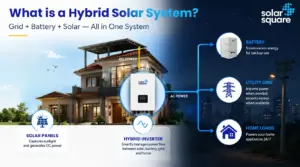
- Storage through batteries (BESS): Because of time-of-day tariffs and same-slot banking, battery energy storage systems (BESS) become more useful. A battery can store surplus solar power during the day and release it in the evening, when grid electricity is more expensive. This can increase savings, but it also raises the upfront cost of solar installation, as hybrid solar systems are expensive.
How Much Are Grid Support Charges?
MERC has published the Grid Support Charge rates for the five-year control period. This means you can estimate the cost in advance rather than treating it as unknown.
The rates below, for both LT and HT consumers, are taken from the MERC order. They are charged in rupees per unit and apply to total solar generation.
| Financial Year | GSC Rate in Maharashtra for LT Consumers | GSC Rate in Maharashtra for HT Consumers |
| FY 2025-26 | Rs. 1.88/unit | Rs. 1.40/unit |
| FY 2026-27 | Rs. 1.96/unit | Rs. 1.42/unit |
| FY 2027-28 | Rs. 1.93/unit | Rs. 1.38/unit |
| FY 2028-29 | Rs. 2.10/unit | Rs. 1.55/unit |
| FY 2029-30 | Rs. 2.32/unit | Rs. 1.77/unit |
What This Means in Rupees for Different System Sizes
The table below shows the estimated yearly grid support charge for common solar system sizes, along with the expected savings after GSC. Solar generation is shown as a range because actual output can vary based on your location, roof direction, shading, panel quality, and system maintenance.
| System Size | Annual Generation (est.) | Annual GSC Cost for LT Consumers | Annual Electricity Savings (@ Rs. 20/unit MSEDCL LT) | Net Annual Saving After GSC |
| 10 kW | 14,000 to 14,500 units | Rs. 27,440 to Rs. 28,420 | Rs. 2,80,000 to Rs. 2,90,000 | Rs. 2,52,560 to Rs. 2,61,580 |
| 25 kW | 35,000 to 36,250 units | Rs. 68,600 to Rs. 71,050 | Rs. 7,00,000 to Rs. 7,25,000 | Rs. 6,31,400 to Rs. 6,53,950 |
| 50 kW | 70,000 to 72,500 units | Rs. 1,37,200 to Rs. 1,42,100 | Rs. 14,00,000 to Rs. 14,50,000 | Rs. 12,62,800 to Rs. 13,07,900 |
| 100 kW | 1,40,000 to 1,45,000 units | Rs. 2,74,400 to Rs. 2,84,200 | Rs. 28,00,000 to Rs. 29,00,000 | Rs. 25,25,600 to Rs. 26,15,800 |
Assumptions used in this table: While calculating the numbers in this table, we have assumed annual solar generation of 1,400 to 1,450 units per kW, the current LT grid support charge rate of Rs. 1.96 per unit on total solar generation, and electricity savings at Rs. 20 per unit based on the MSEDCL LT tariff. Your actual savings may change depending on your tariff category, slab rate, sanctioned load, location, shading, and daytime usage. For a more accurate estimate, replace Rs. 20 per unit with your own effective electricity rate.
The bigger impact of GSC in Maharashtra is on the payback period, because the system now takes slightly longer to recover its upfront cost.
For a 10 kW LT consumer, the impact may look like this:
- Payback without GSC: ~3 to 3.5 years
- Payback with GSC at Rs. 1.96 per unit: ~4 to 4.2 years
- Extra payback time because of GSC: ~1 to 1.5 years
So, GSC does change the financial planning for a solar system above 10 kW.
While payback will be slightly longer, the system will still recover its cost within a reasonable period and continue generating savings far greater than the grid electricity tariffs you would pay if you do not go solar in Maharashtra.
Who Has to Pay the Grid Support Charges in Maharashtra?
Grid support charges apply to all net metering consumers in Maharashtra with a sanctioned load above 10 kW.
This includes both existing solar users and new solar installations. So, if your sanctioned load is above 10 kW, GSC applies to you from April 1 2026, regardless of whether you are a residential, commercial, industrial, or institutional consumer.
Who is Exempt (Not Affected) from Grid Support Charges in Maharashtra?
Most rooftop solar users in Maharashtra do not have to pay grid support charges. This is important because many smaller consumers may worry about GSC even though it does not apply to them.
All consumers with a sanctioned load of 10 kW or below are exempt from GSC. This covers most residential solar users in Maharashtra, since a small household usually has a much lower sanctioned load.
The official numbers also show how limited the charge is.
- According to MSEDCL, only 44,246 out of its 3.17 crore consumers currently come under GSC, which is ~0.14% of its consumer base.
- In the residential solar segment, 6.57 lakh out of 2.37 crore consumers have installed rooftop solar, and almost all of them have a sanctioned load below 10 kW.
The 10kW Threshold: Sanctioned Load vs Solar System Size
The 10 kW limit is based on your sanctioned load, not the size of your solar system.
- Sanctioned load is the electricity load approved by MSEDCL for your connection. You can find this number on your electricity bill.
- Solar system size, on the other hand, refers to the capacity of the panels installed on your roof.
This distinction is important because GSC is linked to sanctioned load. So, before assuming that the charge applies to you, check the sanctioned load mentioned on your MSEDCL bill.
What Existing Solar Consumers Should Check
If you already have a rooftop solar system in Maharashtra, do not assume GSC applies automatically. Check the following details on your electricity bill and your solar generation data.
- Sanctioned load: GSC applies only if the sanctioned load is above 10 kW.
- Consumer category: Note whether you are an LT or HT consumer, because the GSC rate is different for both.
- Solar capacity: Record your installed solar system size. This helps you estimate your yearly generation.
- Monthly generation: GSC is calculated on the units your system generates, so your monthly generation will decide the actual cost impact.
How Are Grid Support Charges Calculated?
Grid support charges are calculated on the total solar power your system generates.
Here’s a simple formula you can use to calculate it:
Grid support charge = Total solar generation × applicable GSC rate |
For example, if an LT consumer’s solar system generates 14,000 units in a year, the GSC will be calculated at the LT rate of Rs. 1.96 per unit for this financial year.
So, the annual GSC will be: 14,000 units × Rs. 1.96 = Rs. 27,440.
Old vs New Solar Billing: Practical Example
Let’s take the example of an LT consumer with a 20 kW solar system in Maharashtra.
Assume the system generates 28,000 units in a year. Out of this, the consumer uses 14,000 units directly and exports 14,000 units to the grid.
The table below shows how the same solar generation would be treated under the old rules and the new rules.
| Particulars | Before April 1 2026 | After April 1 2026 |
| Total solar generation | 28,000 units | 28,000 units |
| Solar used directly | 14,000 units | 14,000 units |
| Solar exported to grid | 14,000 units | 14,000 units |
| Banking deduction on exported units | 12% | 0% |
| Units lost due to banking deduction | 1,680 units | 0 units |
| Exported units available for adjustment | 12,320 units | 14,000 units |
| GSC rate for LT consumers | Not applicable | Rs. 1.96 per unit |
| GSC calculated on | Not applicable | Total solar generation |
| Annual GSC payable | 0 | Rs. 54,880 |
As you can deduce from the table above:
- Under the old rules, the consumer did not pay GSC but lost 1,680 exported units due to the 12% banking deduction.
- From April 1, 2026, the full 14,000 exported units remain available for adjustment. However, the consumer now pays GSC on the full 28,000 units generated by the system.
Is a Solar System Over 10 kW Still Worth It in Maharashtra?
As unbelievable as it might sound, installing a solar system above 10 kW still makes financial sense in Maharashtra for most consumers, even after grid support charges.
Here are the scenarios where a PV system above 10 kW will make financial sense for you despite GSC:
- Your daytime consumption is high: Solar gives the best returns when you use the power while your panels are generating it. The more solar power you use directly during the day, the less grid electricity you need to buy.
- Your grid tariff is much higher than GSC: GSC slightly reduces solar savings, but it is usually much lower than the grid tariff you are avoiding. For example, if your effective MSEDCL LT tariff is ~Rs. 20 per unit and the GSC is Rs. 1.96 per unit, the savings gap is still large.
However, export-heavy systems need better planning. The removal of the 12% banking deduction helps, but GSC, time-of-day tariffs, and same-slot banking can affect the final savings. The system may still save money, but the payback period needs to be verified using actual generation and usage data.
You can use SolarSquare’s free solar savings calculator to check the expected savings and ROI from rooftop solar in your city.
Impact of GSC on Housing Societies in Maharashtra
Housing societies are more likely to cross the 10 kW sanctioned load limit because their common-area connection usually powers lifts, water pumps, corridor lights, security systems, and clubhouse loads. So, if a society installs rooftop solar for common-area electricity, GSC will most likely apply.
That said, GSC does not automatically make solar unattractive for societies. The impact depends on the society’s common-area tariff, system size, and daytime usage.
Here’s the simple way to look at it:
- GSC reduces savings marginally but does not eliminate them: GSC is an added cost to total solar generation, so the society’s net annual savings will come down slightly.
- The tariff gap matters a lot: If society pays around Rs. 20 per unit for common-area electricity and GSC is Rs. 1.96 per unit, every unit of solar still saves far more than the charge applied to it.
- A well-sized solar system can still deliver strong returns: Societies should avoid oversizing and instead size the solar system around common-area daytime power consumption, sanctioned load, and expected annual generation.
Impact of GSC on MSMEs, Shops, and Commercial Consumers
For businesses, GSC is only one part of the impact. The bigger question is when the business uses electricity. That is why, when using solar power for businesses and shops, commercial consumers and MSMEs should consider GSC, time-of-day tariffs, and same-slot banking.
Why MSMEs May Feel the Impact of GSC More?
MSMEs may feel the change more if they use a large part of solar electricity in the evening.
- Under time-of-day tariffs, power is costlier from 5 PM to midnight.
- Same-slot banking limits how much daytime solar offsets evening usage.
So, a business that generates solar during the day but consumes heavily in the evening needs a closer payback calculation.
When Solar Still Works Well for Businesses?
Despite GSC, rooftop solar in Maharashtra still works well for businesses that use most of their electricity during daylight hours. In these cases, the system generates power at the same time the business needs it, so dependence on grid power decreases.
This is especially true in the following scenarios:
- The business runs maximum load during the day, such as in workshops, clinics, small factories, and shops that open in the afternoon.
- Most of the solar power is used directly rather than exported to the grid.
- The system is sized around the actual daytime load, not just the maximum available roof space.
Moreover, industrial rooftop solar can lower power bills by up to 70%. The avoided grid tariff is much higher than the GSC, so the per-unit savings remain strong even after the grid support charge.
Four Ways to Protect Your Returns From Solar
GSC and the new tariff rules can reduce your savings, but the impact is not fixed. A lot depends on how you size the system and when you use electricity.
Here are four ways to protect your returns:
- Right-size the system to your daytime load: GSC applies to total solar generation, so oversizing can hurt returns if too much power gets exported. Match the system size to your daytime usage, not just your roof space.
- Shift more consumption to solar hours: Run heavy appliances, pumps, machinery, or common-area loads during the day wherever possible. This helps you use more solar power directly and avoid costlier evening grid power.
- Consider battery storage only if evening usage is high: A battery can store daytime solar for evening use, but it also adds upfront cost. It makes more sense for users with heavy evening or night-time consumption.
- Do not blindly chase the 10 kW limit: Staying below the threshold can help if your actual load is small. But if your electricity needs are higher, restricting your system size solely to avoid GSC may reduce your savings more than the charge itself.
Checklist Before Installing Solar Above 10 kW in Maharashtra
Before you install a solar system above 10 kW in Maharashtra, check the project from three angles:
- Your electricity bill
- Your site readiness
- The final financial return
Here’s a table that breaks down the most critical checklists that you must consider:
| Billing Checklist | Technical Checklist | Financial Checklist |
| Check your sanctioned load to confirm whether GSC applies to your connection. | Confirm the right system size based on available roof space, electricity use, and expected generation. | Estimate the total system cost, including panels, inverter, mounting structures, installation, and approvals. |
| Confirm your consumer category because LT and HT consumers have different GSC rates. | Estimate annual generation based on location, roof direction, shading, and panel quality. | Check subsidy eligibility, if any, based on your consumer category and system size. |
| Review monthly electricity consumption to understand how much solar power you can actually use. | Check the inverter capacity to ensure it matches the proposed solar system size. | Calculate annual GSC cost using expected generation and the applicable GSC rate. |
| Check your daytime usage pattern, as direct daytime consumption yields better returns. | Run a shadow analysis to ensure that trees, nearby buildings, tanks, or lift rooms do not reduce output. | Calculate payback after GSC, not just the payback shown before the new charge. |
| Check expected exports, as export-heavy systems require closer payback modelling. | Confirm net meter compatibility so exported units can be recorded and adjusted correctly. | Estimate 25-year savings after including GSC, maintenance, degradation, and tariff changes. |
Most Common Myths about Grid Support Charges in Maharashtra
Here are four common myths buyers should avoid:
- Solar systems above 10 kW are no longer worth it: A well-sized system can still save a lot even after GSC.
- GSC applies only on exported units: It applies to total solar generation, including the units you use directly.
- Removing the 12% banking deduction always improves savings: It helps, but the final impact depends on your export, self-consumption, and GSC costs.
- Staying below 10 kW is always better: It only helps if your actual load is small. Undersizing can reduce savings if you still need to buy costly grid power.
Conclusion
Grid support charges have only changed the math for PV systems above 10 kW in Maharashtra. The charge takes a small share of your savings and adds about a year to your payback. The removal of the 12% banking deduction returns some of that on the export side.
To reduce impact on savings, size the system around your daytime load, use solar as it is generated, and check your tariff category. A system above 10 kW will still pay for itself in a few years and run for two more decades.
SolarSquare installs rooftop solar across 29 cities in India, with systems built to last 25 years and backed by a generation guarantee with a money-back promise. If you are planning a system above 10 kW in Maharashtra and want the payback calculated for your specific load and tariff, book a free solar consultation call with SolarSquare.
FAQs
Is GSC the same as a solar tax?
No, grid support charge is not a tax. It is a fee for using the electricity grid while also generating your own solar power. Even after installing solar, you still depend on the grid at night, during cloudy weather, and when your system does not generate enough power. GSC is meant to recover part of that grid support cost from larger solar consumers.
Does GSC apply if I consume all my solar myself?
Yes, under net metering, GSC is charged on your total generation, so it applies even to the units you use entirely on site.
Will the electricity duty definitely be added on top?
Electricity duty is a standard levy on regular grid electricity consumption. It already appears on electricity bills for consumers with or without solar. GSC is a solar-specific charge for eligible rooftop solar consumers, while electricity duty is a government levy. Whether it’s also applied to rooftop solar/self-generated units depends on the final state rules.
Should I delay my installation because of GSC?
No, GSC only marginally increases the payback period, but solar still beats full grid tariffs for daytime users. Solar savings far exceed what you’d lose to escalating grid tariffs over 25 years if you do not adopt solar.
Does going fully off-grid avoid GSC?
Yes, it will, because GSC applies only to grid-connected net-metering systems. The catch is that the batteries needed to go fully off-grid are expensive. So, going completely off-grid rarely pays for itself on charge avoidance alone.
How does the TOD tariff interact with solar above 10 kW in Maharashtra?
The time-of-day tariff makes daytime grid power cheaper and evening power costlier. This suits solar, because your panels generate during the cheaper daytime window. The more of your load you run in daylight, the more the tariff works in your favor.


 Previous Article
 40 min