

 4 Reads
 17 mins


If you’re thinking about a rooftop solar panel system for your home, you probably have a dozen questions and no idea who to trust. How much roof space do you need? What happens during a power cut? Does the PM Surya Ghar Muft Bijli Yojana subsidy actually reach your bank account?
Rooftop solar is a photovoltaic (PV) system containing solar panels on your roof or terrace that generates electricity for your home and sends the surplus to the grid. In India, residential buyers can get Central Financial Assistance (CFA) of up to ₹78,000 under the PM Surya Ghar: Muft Bijli Yojana, provided they use a registered vendor and domestically made modules.
This guide collects the most common rooftop solar questions and answers in one place. Every scheme rule, subsidy figure, and warranty norm below comes from official government sources.
FAQs(Frequently Asked Questions) About Output, Weather and Power Cuts: Start Here
These first three questions are about how rooftop solar behaves in real life. They’re where buyers most often get unrealistic expectations, from salespeople or from the internet.
1. Will a rooftop solar system work during cloudy weather and rain?
Yes, rooftop solar panels keep generating in clouds and rain, but at reduced output. The drop depends on how thick the cloud is. A thin haze costs you far less than a heavy monsoon downpour.
Solar panels respond to scattered light as well as direct sun, so they don’t switch off when the sun goes behind a cloud. The Ministry of New and Renewable Energy (MNRE) notes that daily generation depends on temperature and solar irradiance, among other factors, and isn’t the same every day.
What this means in practice:
- Thin cloud or haze: Output dips a little.
- Thick, heavy cloud or storm: Output can fall sharply for those hours.
- Rain itself: It doesn’t harm the panels, and it washes off dust that would otherwise cut output.
- Over a full year: The weather is already built into a good generation estimate, so a few grey days don’t ruin the maths.
Here’s the part many buyers miss. In states with net metering, surplus units from sunny months are credited against your bill. So a strong summer helps cover a weaker monsoon.
2. How much electricity will a rooftop solar system generate?
A 1 kW system typically generates around 1,400 to 1,450 units a year, based on SolarSquare’s estimates for cities like Delhi and Gwalior. That’s roughly 3.8 to 4 units a day on average.
MNRE’s own FAQ is more generous for a good day. It says 1 kW can generate 4 to 5.5 units on a clear, sunny day. The yearly figure is lower because it averages in cloudy days, shorter winter days, and dusty periods.
Here’s what that looks like by system size, using SolarSquare’s Gwalior estimates:
| System size | Approximate units per year* | Approximate units per month* |
| 3 kW | 4,200 to 4,350 | 350 to 363 |
| 4 kW | 5,600 to 5,800 | 467 to 483 |
| 5 kW | 7,000 to 7,250 | 583 to 604 |
*These are city-specific estimates, not guarantees. Your output depends on your location.
Several things push your real number up or down:
- Your city’s sunlight: more irradiance means more units.
- Shadows: even a small shadow on one panel can drag down a string of panels.
- Heat: panel output slips as temperature rises. The official specification requires a power temperature coefficient of -0.4% per °C or better.
- Dust and dirt: dirty panels generate less.
- Installation quality: the scheme requires a Performance Ratio (PR) of 75% at commissioning. This is a measure of how much of the theoretical output the plant actually delivers.
3. Will my solar system work during a power cut?
A standard on-grid rooftop solar system will not work during a power cut. The inverter shuts down automatically when the grid fails. That’s a safety feature, not a fault.
Official technical specifications require islanding protection. If the grid goes down, your inverter must stop feeding power into it. Otherwise, electricity could flow into lines that line workers believe are dead.
So even at noon, with the sun blazing, your on-grid system stays off until the grid returns.
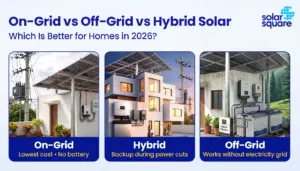
Here’s how the main options compare to each other:
| System type | During a power cut | Subsidy eligibility |
| On-grid (net metered) | Switches off for safety | Eligible |
| Hybrid (grid plus battery) | Battery can supply backup | Eligible, subject to regulatory approval; subsidy is based on module capacity only |
| Off-grid solar system | Runs on battery | Not eligible |
For more details on the type of solar system suited for your home, you can check out our blog, On-Grid vs Off-Grid vs Hybrid Solar Systems: Which is Better for Homes in India in 2026?
If outages are frequent where you live, think carefully about whether a battery-backed setup is worth the extra cost and complexity. Backup time depends on battery size, charge level, and what you connect to it. Many homes find that a modest inverter-battery for essentials, alongside on-grid solar for savings, covers the need.
FAQs About Rooftop Solar Sizing, ROI and Payback
This is the money section. Once you know what a system generates, you can work out what size to buy and whether it pays off.
4. What size solar system do I need for my home?
Pull out your last 12 electricity bills and total the units. Then use this simple method:
- Add up your yearly units (or multiply your monthly average by 12).
- Divide by roughly 1,400, which is the approximate yearly output of 1 kW.
- Round to a practical system size.
| Monthly units | Yearly units | Approximate size |
| 150 | 1,800 | 1.3 kW, so plan for about 2 kW |
| 250 | 3,000 | About 2 kW |
| 360 | 4,320 | About 3 kW |
| 500 | 6,000 | About 4 kW |
| 700 | 8,400 | About 6 kW |
SolarSquare notes that most Indian homes need at least 2 kW to become properly energy independent, which is why we don’t sell 1 kW systems.
How many panels is that? Divide your system size by the panel’s wattage. A 3 kW system with 550 W panels needs about 6 panels (3,000 ÷ 550 ≈ 5.5, rounded up). Panel ratings vary, so your installer will confirm the exact count.
Money is where most first-time buyers get stuck. This section covers what drives the price of a rooftop solar system in India, how the central subsidy is calculated, and how loans fit in.
5. How do I calculate the ROI (return on investment) on rooftop solar?
Work out your net cost after subsidy, estimate your yearly bill savings, and compare the two. ROI is your yearly savings divided by your net cost, and a full lifetime view adds up 25 years of savings.
Here’s the method, step by step:
- Gross system cost: the quote from your installer.
- Subtract subsidy: the central subsidy is up to ₹78,000 (full rules in Question 7). Subtract any state subsidy too.
- Net cost: this is what you actually invest.
- Yearly generation: system kW × about 1,400 units.
- Yearly savings: yearly units × your per-unit tariff from your bill.
- Simple annual ROI: yearly savings ÷ net cost.
Worked example (illustrative only, not a SolarSquare quote): Say a 3 kW system with a gross cost of ₹2,00,000 and a tariff of ₹7 per unit.
| Item | Calculation | Result |
| Net cost | ₹2,00,000 − ₹78,000 | ₹1,22,000 |
| Yearly generation | 3 × 1,400 | 4,200 units |
| Yearly savings | 4,200 × ₹7 | ₹29,400 |
| Simple annual ROI | ₹29,400 ÷ ₹1,22,000 | About 24% |
6. What is a good solar payback period for homes?
There’s no official benchmark. As a rule of thumb, a payback of around 4 to 6 years is considered healthy for a home system, because the panels are designed to last about 25 years.
Payback is simple: net cost ÷ yearly savings. In the example above, that’s ₹1,22,000 ÷ ₹29,400, or about 4.1 years. With 3% tariff growth and 1% degradation, it lands at about 4 years.
What moves your payback:
| Factor | Effect on payback |
| Your tariff slab | Higher per-unit cost means faster payback |
| Central and state subsidy | Lowers net cost |
| System size matched to usage | Oversizing wastes money; undersizing leaves savings on the table |
| Shadows and orientation | Lower generation slows payback |
| Daytime usage | More daytime use means more direct savings |
| Loan interest | Adds to the cost of the system |
Be wary of any quote promising a one-to-two-year payback. Ask what tariff, cost, and generation they assumed. A realistic payback is one you can reproduce with your own bill.
FAQs About Solar Subsidy, Cost and Roof
Once the numbers make sense, the next questions are practical: what subsidy applies, what drives the solar price, and whether your roof is ready. These questions are answered below:
7. How much subsidy do I get under PM Surya Ghar: Muft Bijli Yojana?
Eligible homeowners can receive a subsidy of up to ₹78,000 in central subsidy for systems of 3 kW or higher capacity.
This is the headline benefit of the PM Surya Ghar: Muft Bijli Yojana, launched on 13 February 2024. Here is the official structure:
| Solar System Size | Central Solar Subsidy Under the PM Surya Ghar Muft Bijli Yojana |
| 1 kWp | Rs. 30,000 |
| 2 kWp | ₹ 60,000 |
| 3 kWp or higher | ₹ 78,000 |
State top-ups: If you are a resident of Uttar Pradesh, Delhi, Chhattisgarh, Uttarakhand, or Rajasthan, you can also avail an additional state subsidy amount based on the system capacity and your respective state. You must make sure to check the city before availing any state subsidy, as these are not available in every city.
The PM Surya Ghar scheme is also extended to Group Housing Societies (GHS) and Resident Welfare Associations (RWA). Eligible GHS and RWAs can get a subsidy of ₹18,000 per kW for common facilities, including EV (electric vehicle) charging, up to 500 kW at 3 kW per flat.
Here are some critical eligibility conditions that must be met for you to receive the subsidy:
- The system must use domestically manufactured modules made from domestically manufactured cells. This is called the Domestic Content Requirement (DCR). Using non-DCR modules makes the installation ineligible.
- You must apply through the PM Surya Ghar National Portal and use a vendor registered there.
- Only grid-connected solar systems qualify. Off-grid solar systems don’t.
8. How much does a rooftop solar panel system cost?
The cost of a rooftop solar system in India depends on system size, panel and inverter quality, roof type, and your state. Here is an example of the rooftop solar prices in India for 4 different states for a 3kW solar system:
| City | Solar System Size | Cost of a Rooftop Solar System in India Before Subsidy * | Cost of a Rooftop Solar System in India After Subsidy* |
| Bangalore | 3 kW | ~₹ 2.6 lakh | ~₹ 1.82 lakh |
| Delhi | 3 kW | ~₹ 2.4 lakh | ~₹ 0.84 lakh |
| Nagpur | 3 kW | ~₹ 2.17 lakh | ~₹ 1.39 lakh |
| Lucknow | 3 kW | ~₹ 2.17 lakh | ~₹ 1.09 lakh |
*DISCLAIMER: Prices are subject to change. The above-mentioned solar panel price in India is indicative as of 16 October 2026 for the SolarSquare Blue 6ft variant. The final cost of solar panel installation depends on your city, DISCOM charges, product variant opted for, panel type, inverter type, mounting structure height, type of after-sales service, savings guarantee, roof height, etc.
9. How much roof space do I need for a solar system?
Plan for roughly 8 to 10 square metres (about 80 to 100 sq ft) of shadow-free area for every 1 kW.
So a 3 kW solar system in India needs about 240 to 300 square feet of clear space. The key word is shadow-free. A water tank, a parapet wall or a neighbor’s building can cut your output even if the roof looks big enough.
Your roof type also shapes the solar system design. The guidelines describe structures for flat roofs, tin sheds, and raised platforms:
| Roof type | What to know |
| Flat RCC (Reinforced Cement Concrete) terrace | Most common. Can use a low ballast-type structure or a raised one |
| Tin shed | Structure follows the shed’s slope and is fixed to the purlins |
| Elevated structure (terrace stays usable underneath) | Must have at least 6-8 feet of ground clearance at the lowest point to qualify for subsidy. Always ask for the wind-load design for your site before choosing height. SolarSquare offers sturdy WindPro Mount™ IIT-Bombay-approved mounting structures. The tapered C-channel provides strength that can withstand cyclonic winds up to 170 km/hr. |
A good installer will do a site survey and a shadow analysis. The guidelines actually expect a shadow analysis report for each site.
10. How does net metering work?
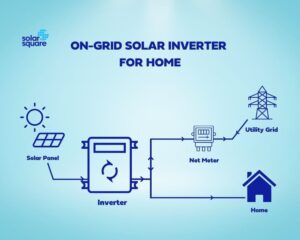
With net metering, your home uses the electricity generated by your rooftop solar system first. If your solar panels generate more electricity than your home needs at that moment, the extra units flow into the grid. When your solar system is not generating enough power, such as at night or during periods of low sunlight, you draw the remaining electricity from the grid.
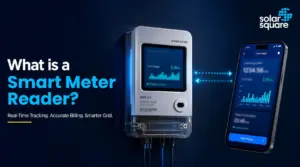
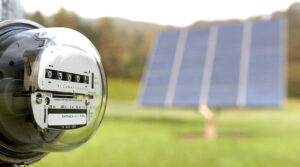
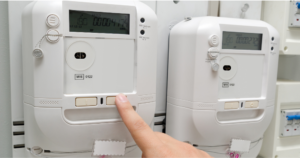
A bidirectional net meter or smart meter records both flows separately:
- The units you import from the grid
- The surplus solar units you export.
Your electricity bill is then calculated according to the net-metering rules applicable in your state.
Common Mistakes First-Time Buyers Make
Even with the rules clear, a few mistakes show up again and again. Avoiding them can save you money and months of delay.
- Oversizing for the subsidy: The subsidy stops at 3 kW. Go bigger only if your consumption justifies it, not because you expect more subsidy.
- Using a non-registered vendor: You can lose subsidy eligibility.
- Accepting non-DCR modules: This also makes you ineligible to receive the solar subsidy.
- Ignoring shadows: Even a roof with sufficient space for solar panels may deliver poor performance if nearby water tanks, walls, trees, or other structures cast shadows on the modules during the day.
- Skipping the written agreement: The government isn’t a party to vendor-consumer disputes, so your paperwork is your protection.
- Forgetting the cash-flow gap: The subsidy comes after inspection, so budget to fund the system first.
Ready to Go Solar? Talk to SolarSquare
Every home is different. Your roof, your tariff, and your DISCOM all change the answer. That’s why the best next step is a proper look at your own situation, not another generic calculator.
SolarSquare helps homeowners, housing societies, and businesses across India plan, install, and service rooftop solar systems. Our team can check your roof, size the system to your electricity bill, and guide you through the subsidy process from application to commissioning. Book your free rooftop solar consultation with SolarSquare.
Frequently Asked Questions
How many solar panels do I need for a 3 kW system?
It depends on the wattage of each panel. Divide your system size by the panel rating. For example, 3,000 W ÷ 610 W is about 4.9, so you’d round up to 5 panels. Your installer will confirm the exact count.
Can rooftop solar run my air conditioner and the rest of the house?
Yes, in the sense that solar feeds your home’s loads while the sun is up, and the grid fills the gap. It won’t power the house during a power cut unless you have a battery. Size the system by your monthly units rather than by individual appliances.
How long do rooftop solar panels last?
Rooftop systems are designed around a 25-year life. The official norms expect panel output to stay above 80% for the last 15 of those years, with structures designed for at least 25 years.
What is a rooftop solar system and how does it work?
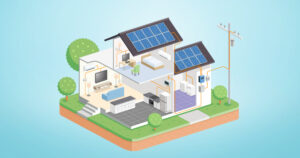
A grid-connected rooftop solar system turns sunlight into electricity using solar photovoltaic (PV) panels. An inverter then converts that direct current (DC) into alternating current (AC), the kind your home appliances use.
Here’s the everyday version. During the day, your panels generate power, and your home uses it first. If you generate more than you consume, the extra flows to the grid. When the sun goes down, you draw from the grid as usual. A net meter records both flows.
According to the official scheme guidelines from the Ministry of New and Renewable Energy (MNRE), a complete rooftop solar plant includes:
- Solar PV modules (the panels)
- An inverter
- Solar Mounting structures
- A net meter or smart meter
- Junction boxes and distribution boxes (DC and AC)
- Earthing, lightning, and solar surge protection
- Cables, drawings, and manuals
Can I install rooftop solar in a rented home or an apartment?
The person holding the electricity connection applies, and you need the right to use the roof, so talk to the owner first. For apartments, a housing society can install solar for common areas and claim ₹18,000 per kW. The society’s connection must be dedicated to common facilities.
Can I get both the central and state subsidy?
Often yes. A few states add their own subsidy on top of the central one, routed through the National Portal. Amounts differ by state, so check your state’s current offer on the official portal.
Do batteries qualify for the subsidy?
You can add a battery, but the subsidy is calculated only on the capacity of the solar modules, not the battery or the inverter size.
Can I add more panels later and still get a subsidy?
Yes, within limits. If you have already received the subsidy, you can claim more only for the balance up to 3 kW of total capacity. The guidelines give an example: a household with 1 kW expanding to 4 kW claims the extra subsidy for 2 kW, which is ₹48,000. A system that’s moved to a new location doesn’t qualify again.
Is rooftop solar worth it for an Indian home?
For most homes with decent sunlight and a regular electricity bill, yes, rooftop solar is worth it. The savings depend on your monthly consumption, your DISCOM’s (Distribution Company) per-unit tariff, and how much shadow-free roof you have.
The scheme itself is built around a clear goal. It aims to give households free or low-cost electricity up to 300 units a month.
Rather than trusting a generic payback number, run your own math:
| Step | What to do | Example (illustrative) |
| 1 | Find your system size in kilowatts (kW) | 3 kW |
| 2 | Estimate daily units. 1 kW can generate about 3.8 units on a clear, sunny day | 3 × 3.8 = 11.4 units/day |
| 3 | Multiply by 30 days | About 342 units/month |
| 4 | Multiply by your DISCOM tariff (check your bill) | Your monthly saving |
| 5 | Divide (system cost − subsidy) by your yearly saving | Your payback period |
The numbers above are illustrative. Real generation changes with temperature, sunlight and shadows, so treat the result as an estimate.
How do I choose a reliable rooftop solar vendor, and what warranty should I expect?
Pick a vendor registered on the National Portal, check their rating and feedback, and get everything in writing. The scheme sets minimum maintenance and warranty standards that any registered vendor has to meet.
Here are the official minimums to hold your vendor to:
| What | Official norm |
| Repair and maintenance | Free for 5 years from commissioning (Comprehensive Maintenance Contract, or CMC) |
| Module manufacturing-defect warranty | Not less than 5 years |
| Module power output | Above 90% in the first 10 years and above 80% over the next 15 |
| Plant performance | Performance Ratio of 75% at commissioning, maintained through the 5-year warranty |
| Mounting structure | Designed to last at least 25 years |
Use this checklist before you sign:
- Is the vendor registered on the National Portal? Check their rating and consumer feedback there.
- Are the modules DCR-compliant and listed under the Approved List of Models and Manufacturers (ALMM)?
- Did they do a proper site survey and share a shadow analysis?
- Is there a written agreement? The guidelines include a sample consumer-vendor agreement you can ask for.
- Will they hand over warranty cards for the panels and inverter?
Can I get a loan for a rooftop solar installation?
Yes. According to a PIB (Press Information Bureau) release from December 2025, nationalized banks offer collateral-free solar loans at repo rate plus 50 basis points (bps), with a tenure of up to 10 years.
That release put the rate at 6% per annum at the time. Because it’s linked to the repo rate, it can change, so ask your bank for the current rate. Loans are available through the National Portal and the Jan Samarth portal.


 Previous Article

 13 min