

You could spend Rs. 3 lakh, Rs. 5 lakh, or even more on a rooftop solar system and still wake up to one unavoidable fact every evening. The moment the sun disappears, your solar panels stop producing electricity completely. Yes, you read that right!
Solar panels do not work at night. They need sunlight to generate electricity, and moonlight is 1/400,000th the intensity of sunlight, far too weak to make any electricity. But that does not mean a solar home goes dark after sunset. Thousands of homes in India continue using the financial and practical benefits of solar every night.
- Some pull electricity from the grid against the surplus units they exported during the day through solar net metering.
- Others store daytime solar generation in a battery energy storage system and use it after dark.
In this guide, you’ll see exactly what happens to your solar system after sunset, how net metering can cover nighttime consumption without a battery, when battery storage is actually worth paying for, and where a hybrid solar system makes more sense for an Indian home.
Why Solar Panels Stop Working at Night
All types of solar panels convert light energy into electrical current through the photovoltaic effect. Photovoltaic cells in solar panels generate electricity only when particles of sunlight, called photons, strike the semiconductor material in those cells. During the day, sunlight delivers an enormous stream of photons to the panel. Their energy knocks electrons loose inside the solar cells, creating the flow of electric current that eventually powers your home.
After sunset, that energy source disappears. Without enough incoming photons, the cells cannot keep releasing electrons at a useful rate, so electricity generation falls to essentially zero. Moonlight does not change that in any practical way.
Although moonlight is reflected sunlight, it is weaker than direct sunlight. A solar panel may produce a tiny voltage under exceptionally bright moonlight, but nowhere near enough electricity to run household appliances. That is why saying solar works at night can be misleading.
The panels themselves do not generate usable electricity after dark. What can continue working at night is the wider solar power system, using electricity drawn from the grid, stored in a battery, or managed through a combination of both.
So, the real question is not how to make solar panels generate electricity without sunlight. They cannot. The useful question is where your electricity comes from after the panels stop generating.
Three mechanisms can keep a solar-powered home running after sunset, and each suits a different type of Indian household:
- Net metering– Use the grid as your overnight storage (no battery needed)
- Battery storage– Store your own surplus solar for use after dark
- Hybrid systems– Combine both, with automatic switching between solar, battery, and grid
Let’s understand each of the three options that help supply power at night in a solar-powered home in detail.
Option 1: Net Metering – The Grid as Your Free Battery
This is how most grid-connected Indian solar owners power their homes at night today, and it works remarkably well.
Net metering is a billing mechanism where your rooftop solar system powers your home first during the day, and any surplus electricity, more than your home is consuming at that moment, flows into the grid.
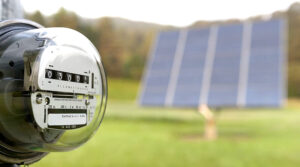
The DISCOM’s bidirectional net meter or smart meter records these exported units.
- At night, when your panels produce nothing, you draw from the grid as usual, and the meter records those imported units.
- At the end of the month, you pay only for the net difference. Think of it as a current account with your electricity company. You deposit during sunny afternoons and withdraw after sunset.
Here’s a concrete example to understand this better:
A 5 kW rooftop system in Pune on a clear summer day generates roughly 25–30 units* between 8 AM and 5 PM. If the household uses 10 units during the day, 15–20 units are exported to the grid. That credit bank covers the family’s evening and night consumption (typically 8-10 units) with units to spare, potentially zeroing out the bill entirely.
*Please note: The 25–30 units figure is an indicative estimate based on typical solar generation of around 5–6 units per kW per day under favourable summer conditions, assuming good sunlight, an appropriately oriented and unshaded rooftop system, and normal system performance. Actual generation can vary depending on factors such as location, weather, season, shading, panel orientation, system efficiency, and other site conditions. The 25–30 units mentioned above should therefore be treated as an illustrative range, not a guaranteed daily output.
However, there’s one solid catch. Net metering only works when the grid is up.
If your area experiences frequent or prolonged power outages, common in many Indian Tier 2 cities, towns, and older urban grids, net metering alone won’t give you nighttime backup during a cut.
That’s where batteries come in.
Option 2: Battery Storage – True Energy Independence At Night
Solar panels generate electricity only when the sun is shining. A battery lets you store that energy and use it later, making solar available after sunset or during a power cut. In an off-grid setup, the battery becomes the link between daytime solar generation and your nighttime electricity needs.
Think of it as your own stored supply of solar power:
- Daytime: Solar panels power your home and charge the battery with the electricity you don’t use immediately.
- Evening: Once solar generation drops, the battery supplies stored electricity to the home.
- Night: The battery continues powering essential appliances until its usable capacity runs low.
- Power cut: Because the system has its own stored energy, your essential loads can continue running without waiting for the grid to return.
- Battery depleted: In a truly off-grid system, you need enough solar generation and battery capacity to meet your remaining demand. A backup generator may be required during prolonged periods of low sunlight.
2026 indicative battery pricing in India
| Battery Capacity | Technology | Approximate Cost (Battery Only)* |
| 3.8 kWh | LFP (LiFePO4) | Rs.80,000-Rs.1.15 lakh |
| 5.12 kWh | LFP | Rs.1.3-Rs.1.65 lakh |
| 10 kWh+ | LFP (stacked/commercial) | Rs.2.5-Rs.4.0 lakh |
*Please Note: These are indicative battery-only prices and can vary depending on the brand, battery chemistry, usable capacity, warranty, installation requirements, and market conditions. The cost of the solar panels, inverter, mounting structure, wiring, installation, and other balance-of-system components is additional.
Who benefits most from battery storage?
- Homes with frequent or unpredictable power cuts that need reliable backup.
- Households with critical loads, such as medical equipment, home offices, or always-on internet.
- Remote or off-grid homes where a reliable grid connection isn’t available.
- Homeowners who want to use more of their own solar power after sunset, rather than depending on grid electricity at night.
The key advantage is simple: you generate solar power when the sun is available and store it for when you need it. You aren’t relying on the grid to give you credit for the electricity you generated; you’re physically storing that electricity for later use.
A real-world example: a family in Bangalore installed a 5 kW solar system with 10 kWh of LFP battery storage for Rs.5.8 lakh. Their monthly electricity bill fell to around Rs.1,200, mainly covering fixed charges and limited grid usage, and they were able to stop using their generator.
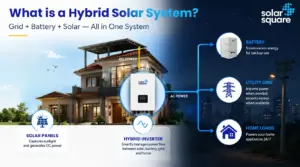
This is where battery storage differs from net metering: net metering uses the grid as a virtual storage mechanism through energy credits, while a battery stores electricity physically at your property. A system that combines battery storage with a grid connection and net metering is a hybrid solar system, which we’ll look at next.
Option 3: The Hybrid System – Best of Both Worlds
A hybrid solar system doesn’t force a choice between net metering and batteries; it uses both. The smart hybrid inverter at the center manages all three power sources (solar, battery, grid) in real time, optimizing for cost, backup availability, and generation.
Hybrid solar inverters in India start from around Rs.85,000 for a 3 kW system in 2026, with the battery cost additional. They can also charge batteries from the grid during off-peak (cheap) hours and discharge during peak (expensive) hours, turning ToD tariff arbitrage into an automatic daily routine.
At SolarSquare, every rooftop solar system we design is optimized for your specific consumption pattern, grid reliability, and ToD tariff environment.
- If battery storage makes financial and practical sense for your home, we’ll tell you.
- If net metering alone is sufficient to meet your needs, we won’t oversell you a battery you don’t need.
Get a free solar assessment from SolarSquare and see exactly what a rooftop solar system would deliver for your household, night included.
What About Cloudy Days and Monsoon?
This is a related concern worth addressing. Does solar work on cloudy days?
Solar panels do generate electricity on cloudy days, just less. On overcast days, output typically drops to 25–50% of peak capacity depending on cloud thickness.
In India’s monsoon season, panels still generate meaningfully, especially in the morning and during breaks in cloud cover.
In 2025, solar generated 9.4% of India’s total electricity, according to Ember’s Global Electricity Review 2026. Well-designed rooftop solar systems account for seasonal variation in generation when sizing the array, ensuring that even a below-average monsoon month still delivers meaningful bill savings.
FAQs
Do solar panels work at night?
No, solar panels require sunlight to generate electricity and produce zero output after dark. However, solar-powered homes run normally at night through either net metering or battery storage. The panels themselves don’t work at night; the system around them does.
Can my solar system power my home during a power cut at night?
Only if you have a battery storage system or a hybrid inverter with a battery. A standard on-grid solar system automatically shuts down during a grid outage, by design, to prevent back feeding into downed lines and endangering utility workers. If outage backup is important to you, specify a hybrid inverter and battery when designing your system.
Is now a good time to add battery storage to an existing solar system in India?
If your existing inverter is a hybrid model that supports lithium battery communication, yes, LFP battery prices have dropped 18–22% since 2023 and are expected to fall a further 8–12% annually through 2027.
If your inverter is a standard on-grid string inverter, you’ll need to replace it with a hybrid inverter firs. Check your inverter model’s specification sheet or ask your installer whether it supports lithium battery BMS communication.
What is the payback period for a solar system in India, and does adding a battery make it longer?
For a standard on-grid rooftop solar system, the payback period in India is typically 3–5 years after the PM Surya Ghar Muft Bijli Yojana subsidy, with electricity tariffs at Rs.6–10 per unit in states like Maharashtra, Karnataka, and Delhi.
Adding a battery does stretch the payback. A hybrid system with battery storage costs more upfront and incurs battery replacement costs around years 10–15, pushing the typical payback period by 1.5 to 1.7x.
Can a solar battery run an air conditioner at night?
Yes, but it requires a meaningfully sized battery. A typical 1.5-ton 3-star inverter AC can draw around 1.3-1.5 kW at rated/typical operating conditions. Running it for six hours would require roughly 8-9 kWh of electricity, before accounting for inverter and battery losses. In practice, you’d want a battery with around 10 kWh of nominal storage to comfortably cover this load .