

Choosing the wrong solar panel can make a rooftop solar system more expensive than expected. A panel may offer good efficiency and a lower price, yet still make the project ineligible for the PM Surya Ghar Muft Bijli Yojana government subsidy. This is where the difference between DCR and Non-DCR solar panels becomes important for residential installations.
- DCR stands for Domestic Content Requirement: It means that the solar cells and modules are manufactured in India according to the conditions listed under the applicable scheme.
- Non-DCR panels: They do not have to meet the domestic manufacturing requirement, and may use imported cells or modules.
The DCR classification does not tell you how much electricity a panel will generate. Power output, efficiency, and lifespan depend on the solar panel technology, manufacturing quality, and technical specifications. The DCR status affects where the panel can be used, whether it qualifies for the PM Surya Ghar Muft Bijli Yojana subsidy, and how much the complete rooftop solar system may cost.
In this guide, we compare DCR vs Non-DCR solar panels based on manufacturing origin, price, efficiency, subsidy eligibility, and suitable applications. We will also explain which type you should choose for a residential or commercial solar project.
What Is a DCR Solar Panel?
DCR stands for Domestic Content Requirement. A solar panel qualifies as DCR-compliant when both the solar cells and the complete module are manufactured in India.
These rules apply to certain government schemes, subsidies, and tender. Their purpose is to direct public spending towards solar equipment manufactured within the country.
What Makes a Solar Panel DCR-Compliant?
In order to be DCR-compliant, a panel must meet both of the following conditions:
- The solar cells must be made in India.
- The solar module must be made in India.
In simple terms, a module assembled in India using imported solar cells does not qualify as DCR-compliant.
The origin of the solar cells is especially important. A panel may carry an Indian brand name and may even be assembled at an Indian factory. However, it will still fail to meet DCR requirements when the cells used inside it are imported.
Solar panel manufacturers and installers must provide consumers with documents that confirm the origin of both the cells and the module. Merely assembling imported cells into a panel in India does not make it DCR-compliant.
Why Did India Introduce DCR Rules?
India introduced DCR requirements to support domestic solar manufacturing and reduce dependence on imported equipment.
The main objectives include:
- Increase local manufacturing: The government aims to encourage companies to manufacture solar cells and modules within India.
- Reduce import dependence: It will lower the country’s reliance on foreign solar equipment and components.
- Create jobs: It will support employment across solar cell production, module manufacturing, and related industries.
- Strengthen the supply chain: It will develop a domestic supply network that remains stable during import restrictions, price increases, or global disruptions.
- Direct government support: The government wants to ensure that subsidies and public tenders benefit Indian-made equipment.
Is DCR a Solar Panel Technology?
DCR is a policy and manufacturing-origin classification, not a panel technology. It shows whether the solar cells and modules meet the required domestic manufacturing conditions. It does not indicate the panel’s efficiency, output, lifespan, or cell technology.
A DCR-compliant solar panel may use:
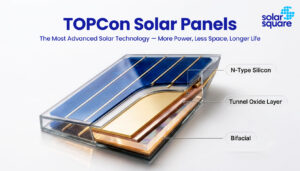
- TOPCon (Tunnel Oxide Passivated Contact) technology
- Monofacial construction
- Bifacial construction
- Different wattages and efficiency ratings
Two DCR panels can therefore have completely different performance levels. Their electricity generation, degradation rate, temperature performance, and lifespan depend on their technology, materials, and technical specifications.
What Is a Non-DCR Solar Panel?
A Non-DCR solar panel does not meet the domestic manufacturing conditions required under DCR rules. In most cases, this is because the panel uses solar cells manufactured outside India.
Non-DCR panels can be purchased and installed in projects where DCR compliance is not mandatory. However, they will not qualify for subsidies, government schemes, or tenders that specifically require domestically manufactured cells and modules.
A Non-DCR panel may:
- Use imported solar cells
- Be imported into India as a finished module
- Be assembled in India using imported cells
- Use a combination of Indian and imported components that does not meet DCR conditions
The Non-DCR label does not indicate poor quality or lower performance. Neither is a non-DCR solar panel illegal to use in India.
Can a Made in India Panel Still Be Non-DCR?
Yes, a solar panel assembled or manufactured at an Indian module factory can still be classified as Non-DCR if the solar cells inside it are imported.
The Made in India label refers to the place where the complete module is assembled.
- DCR compliance also requires the solar cells to be manufactured in India.
- When imported cells are used, the panel does not meet the domestic-content requirement, even when the final module is produced in an Indian factory.
Difference Between DCR and Non-DCR Solar Panels
The main difference between DCR and Non-DCR solar panels is the origin of their solar cells and modules. This difference affects subsidy eligibility, upfront price, and the type of projects where each panel can be used.
Here is a quick comparison:
| Parameter | DCR Solar Panel | Non-DCR Solar Panel |
| Full form | Domestic Content Requirement | Non-domestic Content Requirement |
| Solar-cell origin | Manufactured in India | May use imported cells |
| Module manufacturing | Manufactured in India | May be assembled in India or imported |
| Government subsidy | Eligible when all applicable conditions are met | Not eligible for DCR-linked subsidies |
| Upfront panel price* |
|
|
| Efficiency | Depends on model and technology | Depends on model and technology |
| Technology options | Mono PERC, TOPCon, bifacial and others | Mono PERC, TOPCon, HJT, bifacial and others |
| Best suited for | Subsidy-linked residential installations and government projects | Private commercial and industrial projects without subsidy dependence |
*Please note: The per-watt solar panel price listed above is an indicative range and can change based on the manufacturer, module wattage, order size, location, and market conditions.
Now, let’s explore DCR vs non-DCR solar panels in detail.
Difference in Government Subsidy Eligibility
DCR status becomes especially important when a buyer wants to claim the PM Surya Ghar Muft Bijli Yojana government subsidy.
DCR panels usually qualify for:
- Residential rooftop solar subsidies
- Public-sector projects
- Tenders that specify domestic content requirements
The project must still meet all other conditions of the relevant scheme.
Non-DCR panels cannot be used to claim a subsidy when the scheme specifically requires DCR-compliant equipment. Their efficiency, brand, or warranty does not change this eligibility condition.
For example, residential rooftop solar systems claiming the central subsidy under PM Surya Ghar Muft Bijli Yojana must use eligible domestically manufactured solar cells and modules.
Difference in Solar Panel Price After Subsidy
DCR solar panels usually have a higher price per watt because the domestic supply of cells and modules is more limited and production costs can be higher.
Non-DCR panels, on the other hand, are slightly cheaper because manufacturers can use imported cells or finished modules available at lower prices.
The final choice, however, should be based on the amount paid after subsidy.
For a subsidy-eligible residential project:
- The DCR panels have a higher initial price.
- The government subsidy reduces the final system cost substantially.
- The DCR PV system may become cheaper than a non-DCR system purchased without subsidy.
For a project without subsidy:
- The buyer receives no financial benefit from choosing DCR solely for subsidy purposes.
- Non-DCR panels may offer a lower upfront system cost.
- The buyer can compare panels based on price, technology, efficiency, and warranty.
This means the cheapest quotation before subsidy may not remain the cheapest after subsidy is included.
Difference in Warranty and Reliability
DCR status does not determine the quality or reliability of a solar panel.
Instead, it’s the following factors that affect the performance and lifespan of rooftop solar panels:
- Solar cell technology, such as Mono PERC or TOPCon
- Temperature coefficient
- Manufacturing quality
- Installation quality
- After-sales service
A high-quality DCR panel will always perform better than a lower-quality non-DCR panel. The same applies in the opposite direction.
Buyers should therefore compare the panel datasheet and warranty terms instead of using DCR status as a quality rating.
Difference in Best Use Cases
The suitable panel depends on the project type and the applicable scheme.
- DCR panels are suitable for: Subsidized residential rooftop solar systems for housing societies and homes, public-sector tenders, and projects with mandatory domestic-content conditions.
- Non-DCR panels are suitable for: Commercial solar installations, industrial rooftop solar projects, captive solar power plants, open-access solar projects, and residential systems where no subsidy is being claimed.
DCR vs Non-DCR Solar Panel Price Details
Here’s a side-by-side comparison of the cost of DCR vs non-DCR solar panels in India in 2026:
| Solar Panel Type | DCR Solar Panel Price* | Non-DCR Solar Panel Price* |
| Mono PERC panels | ~₹20 to ~₹21 per watt | ~₹14 to ~₹16 per watt |
| TOPCon panels | ~₹21 to ~₹24 per watt | ~₹18 per watt |
*Please note: The per-watt solar panel price listed above is an indicative range and can change based on the manufacturer, module wattage, order size, location, and market conditions.
DCR vs ALMM vs BIS: What Is the Difference?
DCR (Domestic Content Requirement), ALMM (Approved List of Models and Manufacturers), and BIS (Bureau of Indian Standards) often appear together in solar quotations, subsidy documents, and government tender. This can make them seem like different names for the same approval. However, each requirement checks a separate aspect of the solar panel.
- DCR checks where the solar cells and modules were manufactured.
- ALMM checks whether the specific model and manufacturer appear on an approved MNRE list.
- BIS checks whether the product meets the applicable Indian safety and performance standards.
The table below summarizes the difference between DCR, ALMM & BIS:
| Requirement | What it Checks | Governing Body |
| DCR | Whether the solar cells and modules meet domestic manufacturing conditions | MNRE and the applicable government scheme |
| ALMM | Whether the cell or module model and manufacturer appear on the approved list | MNRE |
| BIS | Whether the product complies with applicable Indian product standards | Bureau of Indian Standards |
Does ALMM Approval Automatically Mean a Panel Is DCR?
In most current government and subsidy-linked projects, ALMM and DCR compliance overlap closely.
A solar panel that uses a module model listed under ALMM List-I, a solar cell model listed under ALMM List-II, and cells and modules manufactured in India meet the basic domestic manufacturing conditions expected under DCR.
However, buyers need to check which ALMM list is being referred to:
- ALMM List-I confirms that the solar module model and manufacturer are approved by MNRE.
- ALMM List-II confirms that the solar cell model and manufacturer are approved by MNRE.
- DCR confirms that both the cells and modules meet the domestic manufacturing conditions of the applicable scheme.
From June 2026, projects covered by the full ALMM requirement generally have to use modules from List-I and cells from List-II, subject to the exemptions and transition provisions issued by MNRE. Therefore, a panel compliant with both lists will generally satisfy the domestic-origin requirement at the cell and module levels.
You can find out all the details about ALMM List-II in our detailed blog post on ALMM List-II Rules for Rooftop Solar.
DCR Rules for Solar Projects in India
Under the PM Surya Ghar Muft Bijli Yojana, homeowners and housing societies must follow DCR rules when claiming the Central Financial Assistance, or CFA. Consumers who choose to install rooftop solar without claiming CFA are allowed to use Non-DCR panels.
Advantages and Disadvantages of DCR Solar Panels
DCR solar panels are valuable for projects where subsidy eligibility or domestic-content compliance is required. Before choosing them, buyers should weigh their practical benefits against their higher price.
Advantages of DCR Solar Panels
Here’s a breakdown of the advantages of DCR panels:
- Eligible for DCR-linked government subsidies when all scheme conditions are met
- Accepted in government tenders and schemes that require domestic content
- Support solar cell and module manufacturing in India
Disadvantages of DCR Solar Panels
Here’s a breakdown of the disadvantages of DCR panels:
- Usually cost more per watt than comparable Non-DCR panels
- Supply may be limited for certain technologies or specifications
- Do not provide any automatic advantage in efficiency, output, or lifespan
Advantages and Disadvantages of Non-DCR Solar Panels
Non-DCR solar panels are chosen for their lower price and wider range of technologies. They work well for private projects where no DCR-linked subsidy or tender condition applies.
Advantages of Non-DCR Solar Panels
Here’s a breakdown of the advantages of non-DCR panels:
- Lower upfront price per watt
- Suitable for private commercial, industrial, and unsubsidized residential projects
Disadvantages of Non-DCR Solar Panels
Here’s a breakdown of the disadvantages of DCR panels:
- Not eligible for DCR-linked subsidies such as the PM Surya Ghar Muft Bijli Yojana
- Imported cells or modules may create greater dependence on international supply chains
How to Verify If a Solar Panel Is DCR-Compliant?
DCR compliance cannot be confirmed by looking at the panel. A DCR and Non-DCR module may look exactly the same, so buyers should verify the documents before installation.
Follow these steps:
- Ask for the DCR declaration: Request the DCR certificate or manufacturer declaration for the exact module model being supplied.
- Check the cell manufacturer: Confirm that the solar cells used in the module come from an eligible domestic manufacturer and appear in ALMM List-II, where applicable.
- Verify the module details: Match the model number, wattage, and manufacturer name on the panel with the quotation and supporting documents.
- Use official records: Cross-check the module and cell details on the relevant government or MNRE records instead of relying only on the manufacturer’s datasheet.
These checks should be completed before the panels are installed. Any mismatch between the equipment on the roof and the submitted documents can delay or invalidate the subsidy claim.
Please note that there is no additional DCR rule that applies uniformly across solar subsidy in all states. If you are claiming the PM Surya Ghar Muft Bijli Yojana central subsidy, you must meet the DCR and other equipment requirements prescribed under the central scheme.
DCR or Non-DCR: Which Solar Panel Should You Choose?
The right choice between DCR vs non-DCR solar panels depends on the rules and economics of your project.
- Choose DCR solar panels if you are claiming the PM Surya Ghar Muft Bijli Yojana subsidy. In this case, using Non-DCR panels will make the project ineligible for the central government’s financial assistance.
- Choose Non-DCR panels for commercial, industrial, or unsubsidized residential projects where no DCR condition applies. They usually offer a lower price and a wider choice of technologies.
Before making the final decision, compare the subsidy available on a DCR system with the upfront savings offered by a Non-DCR system. You should also check the panel technology, warranty, efficiency, and total installed cost.
Still unsure which option is right for your project? Book a free consultation call with SolarSquare. Our solar experts can assess your subsidy eligibility, electricity needs, and budget, and recommend the most suitable system for your property.
FAQs
Does a non-DCR panel generate more electricity?
No, the panel’s output depends on its technology, wattage, and efficiency, not its DCR status. A DCR and a Non-DCR panel of the same technology, brand, and rating will generate the same amount of electricity on the same roof.
Are Non-DCR solar panels illegal in India?
Not at all. Non-DCR panels are legal to buy and install. They are simply not eligible for DCR-linked subsidies and are not accepted in projects that require domestic content.
Can I claim the PM Surya Ghar subsidy with Non-DCR panels?
No, the PM Surya Ghar Muft Bijli Yojana central subsidy requires equipment that meets the scheme’s DCR conditions. So, a Non-DCR panel makes the claim ineligible.
Are DCR panels more expensive than Non-DCR panels?
Yes, they cost slightly more per watt. However, the final installation cost reduces significantly because of the government subsidy of up to ₹78,000 for systems of 3 kW or higher capacity.
Can DCR and Non-DCR panels be mixed in one solar system?
Technically, you can do that. But mixing a non-DCR panel with a DCR project will render you ineligible for the solar subsidy.
Can DCR panels use TOPCon or bifacial technology?
Yes, DCR is a manufacturing-origin label, not a technology limit. So, DCR panels are available in Mono PERC, TOPCon, and bifacial builds, among others.
Is DCR compulsory for net metering in India?
No, net metering by itself does not require DCR panels. Even Non-DCR panels can be connected under net metering. DCR is compulsory only when the solar system is installed under a subsidy scheme that requires domestic cells and modules.
Which projects must use DCR panels in 2026?
DCR panels are required for subsidized projects such as the PM Surya Ghar Muft Bijli Yojana subsidy and for government tenders that specifically mandate domestic content. Private projects without a subsidy can use Non-DCR panels.