

 978 Reads
 16 mins


Two solar panels can look the same from the outside. They can have the same size, design, and wattage written on the label. But over 25 years, they may not perform the same way.
The difference comes down to two things.
- The grade of the solar cells used inside the panel: Solar cells are classified into A, B, C, and D grades based on their appearance, power output, and defects.
- The certifications the panel has received: BIS, IEC, and ALMM demonstrate that the panel meets India’s safety, performance, and regulatory standards.
It’s the classification of solar cells into grades that helps manufacturers decide which cells should be used in premium high-efficiency solar panels, which can be used in lower-cost panels, and which should be rejected, reused, or scrapped.
Certifications such as BIS, IEC, and ALMM, on the other hand, show that a solar panel has been tested for safety, performance, and compliance with Indian rules. They also matter if you want to claim the PM Surya Ghar Muft Bijli Yojana solar subsidy.
This guide will help you understand what solar panel grades and certifications mean, and how to use them to make a better buying decision.
What Is the Classification of Solar Cells?
The classification of solar cells is the process of sorting cells by visual quality, electrical performance, physical defects, and usability. Manufacturers do this during production to decide which cells go into premium modules, which go into lower-cost modules, and which get set aside for testing, reuse, or recycling.
Classification here refers to quality grading, not the technology type of the solar cell.
- Monocrystalline, polycrystalline, TOPCon, and PERC describe how a cell is built.
- Grades A, B, C, and D describe how good that cell turned out.
Why Are Solar Cells Classified Before Panel Manufacturing?
A good solar cell gives a steady output, supports a longer panel life, reduces the risk of panel defects, and makes the warranty more reliable. A weak or damaged cell, on the other hand, can lower solar power generation and increase the chances of early performance loss.
Grading is important because solar cells work together inside a panel.
- They are connected in the same electrical circuit, so their current output needs to be similar.
- If one cell produces less current than the others, it can pull down the performance of the entire string.
- As a result, the panel may generate less power even if most of the cells are working well.
By sorting cells based on grade and matching their short-circuit current (Isc), manufacturers can reduce this mismatch. This helps the panel produce more stable power and perform better over its lifetime.
Solar Cell Grade vs Solar Panel Grade
Before we explain what grade A, B, C, and D mean in detail, it’s important that you first understand that a solar cell and a solar panel are not the same thing.
A solar cell is one small unit that produces electricity. A solar panel is made by connecting many cells and sealing them within a glass, frame, backsheet, and other components.
That is why cell grade and panel grade mean different things.
- A solar cell grade tells you the quality of one cell. It is based on defects, cracks, marks, and power output.
- A solar panel grade tells you how well the complete panel has been made. It depends on cell quality, cell matching, glass quality, lamination, soldering, junction box, frame, and factory testing.
Why Cells Drive Panel Cost and Quality?
Solar cells are one of the biggest cost drivers in a panel. In many cases, they account for more than half of manufacturing costs.
This is why some manufacturers try to reduce costs by using cheaper or lower-grade cells. The panel may look the same from the outside, but its long-term output can be very different.
That is why buyers should not look only at wattage, brand, or price. The quality of the cells inside the panel matters just as much.
Where Are Grades Assigned in Manufacturing?
Grading happens at two stages.
- Loose solar cells are checked before the panel is made. They are sorted based on appearance, defects, and electrical output.
- The finished panel is tested again after assembly. It undergoes checks such as EL imaging and flash testing to assess overall panel performance.
So, the final quality of a solar panel depends on the grade of the cells used inside and how well the panel was manufactured.
The A, B, C, D Grading System Explained
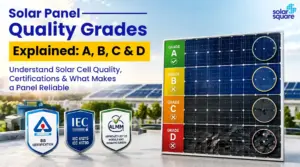
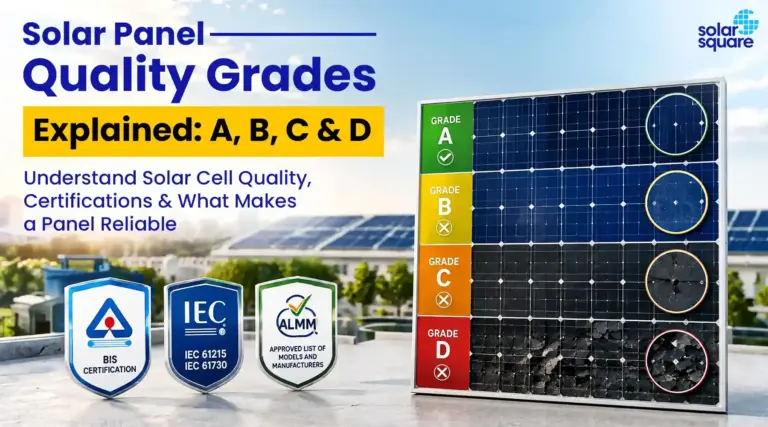
Solar cells and panels are usually classified into four grades, A, B, C, and D. Grade A is the best quality, while Grade D is usually damaged or unusable.
Before we look at each grade in detail, here is a quick comparison.
| Grade | Visual Quality | Electrical Performance | Common Defects | Best For | Should Homeowners Buy It? |
| A | Flawless appearance and uniform color | Delivers rated power, has stable output, and matches well with other cells | None | Rooftop, commercial, utility, and subsidy projects | Yes |
| B | Minor cosmetic flaws | Can deliver close to rated power, but has a higher mismatch loss or faster output drop over time | 1-2 hairline cracks, dark spots, uneven coating | Temporary or non-critical setups | Not ideal to build rooftop solar for powering homes |
| C | Clearly visible defects | Produces lower-than-rated power and may have unstable output | Chipped, broken corners, missing busbars | DIY, learning, or small non-essential uses like solar lamps | No |
| D | Broken or damaged | Very low, unreliable, or no usable power output | Fractured, unusable cells | Recycling only | No |
Now, let’s explore all the grades in detail.
#1. Grade A Solar Cells and Panels
Grade A cells are defect-free, perform as per specification, and are used in high-quality solar panels. Some manufacturers may further divide them into A+ and A- grades.
- They have no cracks, chips, major scratches, broken busbars, discoloration, or serious print defects.
- The silicon nitride coating is deposited evenly, appearing as a uniform blue across the surface.
The electrical output of Grade A cells matches the manufacturer’s specification. Cells in the same batch are also closely matched, which helps the finished panel produce steady power with low mismatch loss.
They’re mostly used in:
- Residential rooftop solar systems, which are ideal for homeowners who want steady power generation for 25 years or more.
- Commercial and industrial solar systems, which are ideal for businesses where lower generation directly affects savings and return on investment.
- Utility-scale solar plants, which are suited for large projects where thousands of panels need to perform consistently.
- Subsidy-linked rooftop projects that require approved and certified solar modules.
Among all types, grade A panels cost more, but there are clear reasons for the higher price. They use better raw materials, undergo stricter factory checks, offer more consistent output, support greater warranty confidence, carry a lower risk of early failure, and are cheaper in the long run, thanks to maximum savings from high output throughout their life.
#2. Grade B Solar Cells and Panels
Grade B cells can have electrical readings close to Grade A cells, but they usually have small physical defects that Grade A cells do not have.
- They have one or two hairline cracks
- They have a few dark spots and slight scratches
- They can have minor printing defects
- They also have uneven silicon nitride deposition, resulting in a patchy color across the surface.
At the cell level, the efficiency reading is closer to that of Grade A cells, but those 1 or 2 hairline cracks widen over years of thermal cycling on a rooftop. Over time, a Grade B panel tends to drift below its datasheet output, which is why it does not deliver the same high output throughout its life as Grade A panels, even when the spec sheet looks similar.
Here’s a quick snapshot of when grade B panels can be used and when they should be fully avoided:
| When Grade B Panels Can Be Used? | Where to Avoid Using Grade B Panels? |
| Temporary installations | Rooftop solar systems with a 25-year lifespan |
| Non-critical off-grid applications | Subsidy-linked residential systems |
| Low-budget projects where appearance does not matter | Commercial PV systems with high ROI expectations |
#3. Grade C Solar Cells and Panels
Grade C cells have visible defects and produce output below the manufacturer’s specification. At this grade, a drop in quality can directly affect the solar electricity generated by the panel.
Common Grade C defects include the following:
- Chipped cells and broken corners
- Missing busbars or fingers that carry current from the cell
- Larger scratches across the surface
- Water marks left from processing
- Power output that is clearly below specification
Installing Grade C panels on a rooftop to cover a family’s or business’s energy needs is risky. These panels deliver lower, inconsistent output, higher mismatch losses, a shorter useful life, a weak or no panel warranty, and a greater risk of hotspots and early module degradation.
Since they’re less efficient than both Grade A and Grade B panels, Grade C panels may be used for small DIY projects, learning setups, or reuse in non-critical applications. They are not suitable for building rooftop solar systems in housing societies, homes, or businesses.
#4. Grade D Solar Cells and Panels
Grade D cells are broken, badly damaged, or unusable for standard solar panel manufacturing. They are of poor quality and low efficiency, making them unsuitable for building a quality module.
Here’s why these cells should be avoided completely:
- They do not offer reliable power output, proper safety, warranty support, or long-term performance.
- They have no place in rooftop, commercial, or subsidy-linked solar projects.
However, the solar industry wastes little to no material. Grade B, C, and even D cells are therefore reused, cut into smaller pieces, or recycled for their silicon content rather than being fully scrapped. This helps manufacturers reduce waste and cost.
Is There an Official Standard for Solar Grades?
No, A, B, C, and D are industry and manufacturer-level quality labels, not regulated standards like BIS, IEC, ALMM, or MNRE approval. No official body certifies a panel as Grade A.
One manufacturer’s Grade B may not match another’s, so a grade claim only means as much as the panel manufacturing company behind it. Treat any Grade A claim as something to verify through test reports, serial numbers, warranty documents, and certifications, rather than something to take on trust.
How Manufacturers Grade Solar Panels?
Here’s a step-by-step process on how manufacturers grade solar panels into A, B, C, and D types:
- Step 1 – Visual inspection: Cells and panels are checked for cracks, color mismatch, chipped cells, poor soldering, glass defects, frame damage, backsheet issues, and cell alignment issues.
- Step 2 – Electroluminescence Testing: A current is passed through the panel in a dark room, and the panel is photographed with an infrared camera. Microcracks and dead-cell areas that the eye cannot see appear as dark breaks in the image. This is the closest thing to an X-ray for a solar panel.
- Step 3 – Flash Testing: A solar simulator flashes the panel with calibrated light and measures its actual power output under standard test conditions. Panels are then sorted by the wattage they really produce, not the wattage on the label.
- Step 4 – Binning and cell matching: Since poor matching can drag down panel output even when individual cells look fine, cells with similar current and voltage are grouped together to keep mismatch losses low.
- Step 5 – Final quality control and documentation: The panel goes through factory inspection, serial number tracking, test report generation, warranty paperwork, and packaging checks before it ships.
Solar Quality Certification: What Buyers Should Check in India?
Grading tells you about the quality of the panel. Certification tells you whether the panel has been tested, approved, and cleared for sale or subsidy-linked use in India.
Here are the main certifications you should check as a buyer.
#1. Performance Certification with Different BOMS (Bill of Materials)
A solar panel certificate is linked to a specific bill of materials, or BOM. This means the certificate applies to the exact cells, glass, encapsulant, backsheet, frame, and other parts used during testing.
If a manufacturer changes any important material later, the old certificate may not fully represent the panel being sold to you. For example, if the tested panel uses one type of backsheet but the final product uses a cheaper one, the performance may differ.
So, do not ask only whether the model is certified. Ask whether the panel you are buying matches the certified BOM.
#2. BIS Certification for Solar Panels
BIS certification shows that the solar module meets Indian safety and performance standards. It is also required for solar modules sold in India.
- The key BIS standards for solar panels include IS 14286 for design qualification and IS 16077 for safety.
- If a panel lacks valid BIS certification, it should not be considered for a serious residential, commercial, or subsidy-linked project.
#3. IEC 61215 for Design Qualification and Performance Testing
IEC 61215 checks whether the module design can survive 2-3 decades of outdoor operation. To pass, panels undergo thermal cycling, damp heat, mechanical loading, UV exposure, and hail impact.
If a panel has IEC 61215 certification, it means the design has passed tests simulating years of outdoor exposure.
#4. IEC 61730 for Safety Qualification
IEC 61730 focuses on safety. It checks whether the panel is safe from risks such as electric shock, fire, insulation failure, and mechanical damage.
This certification is especially important for commercial and large industrial rooftop systems, where safety and compliance are critical.
#5. ALMM: Approved List of Models and Manufacturers
ALMM stands for Approved List of Models and Manufacturers. It is maintained by MNRE. For solar buyers in India, ALMM matters because many government-supported and subsidy-linked solar projects require approved modules.
ALMM has two parts.
- ALMM List-I covers solar PV modules.
- ALMM List-II covers solar PV cells.
This means buyers should check not only the panel brand and model, but also whether the module and cells are covered under the approved framework.
One related rule is the Domestic Content Requirement, or DCR. Under certain government schemes, solar cells and modules must be made in India. This is especially important for homes and housing societies planning to claim the PM Surya Ghar Muft Bijli Yojana subsidy.
What Certifications Prove and What They Do Not
Certifications verify the model, not the grade of every cell inside it. A panel can hold valid BIS, IEC, and ALMM approval and still be built with Grade B cells, because those standards test design, safety, and compliance rather than sort cells into A, B, C, or D.
- Grade tells you quality level: A, B, C, or D reflects the manufacturer’s sorting by defect and output.
- Certification tells you compliance: BIS, IEC, ALMM, and DCR reflect testing, safety, regulatory approval, and scheme eligibility.
How to Identify the Grade of a Solar Panel Before Making a Purchase?
You cannot find the cell grade just by reading the label on a solar panel. But you can still spot quality issues by doing a few checks before you buy.
- Visual inspection: Check the glass for bubbles, waviness, stains, or residue. Look for uneven cell color, cracks, chips, dark spots, misaligned cells, bent frames, or air gaps between the glass and the cells.
- EL testing: Request an EL test report for the exact panels being supplied. It can reveal hidden microcracks, dead zones, broken cell areas, and defects that are not visible from outside.
- Flash testing: Ask for the flash test report linked to the panel serial numbers. It shows the actual wattage produced during factory testing and helps you compare it with the datasheet rating.
- Documents to request: The flash test report, EL test report, BIS certificate, and proof of ALMM listing for the exact model.
Why Solar Grading Affects Performance, Lifespan, and ROI?
Rooftop solar is not a short-term purchase. When panels are properly cleaned and maintained, the PV system is expected to work for 25 years or more. That is why the panel’s grade matters. A lower-grade panel may cost less at purchase, but it can affect your power generation, panel lifespan, and overall savings.
The impact usually shows up in three ways.
- Output: Lower-grade panels generate less power than promised because defective cells reduce the panel’s overall output.
- Lifespan: Small cracks or defects in lower-grade cells get worse over time, causing the panel to lose efficiency faster.
- ROI: If the panel generates less power or degrades early, your payback period becomes longer, and your total savings go down.
Why the Cheapest Graded Panel Often Costs More Across 25 Years?
A lower-grade panel saves money on day one but slowly takes back more. That’s because it generates less power, loses efficiency faster, and comes with weaker warranty support.
A Grade A panel with proper certifications, on the other hand, costs slightly more upfront but delivers better output, longer life, and more reliable savings. For a system expected to operate for 25 years or more, that difference matters.
At SolarSquare, we use only Grade A solar panels for the rooftop solar systems we install, so you do not have to worry about hidden quality issues within the panels. Every system is designed for long-term generation, and we back that with our special generation guarantee and a money-back promise. Book a free solar consultation with SolarSquare today.
FAQs
Which grade solar panel is best?
Grade A solar panels are the best because they use high-quality cells, have no major defects, and are built to give stable output for many years. They are the right choice for homes, businesses, and subsidy-linked solar projects.
Are grade B solar panels good?
Grade B cells might have an efficiency very close to Grade A cells at the beginning, but they have 1-2 small cracks and cosmetic flaws that shorten panel life. While they suit temporary or non-critical setups, they are a poor fit for long-term rooftop solar systems you expect to run at maximum efficiency for more than two decades.
What is the difference between Grade A and BIS-certified solar panels?
Grade A is a quality label for the cells. BIS certification is a mandatory safety and performance approval for the module.
Is ALMM required for all solar panels?
ALMM listing is required for government-supported and subsidy-linked projects, where you need an ALMM-listed model. For private projects, it is not always mandatory, though it remains a useful mark of confidence.
How can I check if a solar panel is original?
Match the serial number to the manufacturer’s records, ask for the flash test and EL reports for that exact panel, and verify the model against the ALMM list and BIS database. Also, inspect the panel for clean cells, uniform color, proper lamination, and no visible damage.
How to differentiate between A grade and B grade solar panels?
You may not always spot the difference by looking at the panel. Grade B panels can have hidden microcracks or dark spots. The best way to check is to ask for the EL and flash test reports.
Can a BIS-certified panel still use Grade B cells?
BIS certification checks safety and performance standards for the panel model. It does not directly certify whether every cell inside is Grade A. That is why you should also ask for the EL report, flash test report, and cell quality details before buying.


 Previous Article
 31 min