

If you’ve seen BTU charges on a commercial building’s utility bill or a BTU meter connected to a chilled-water HVAC system, the basic idea is simple: it measures how much thermal energy a system transfers.
BTU stands for British Thermal Unit, so a BTU meter measures how much heating or cooling energy a water circuit delivers. If you have ever seen a “BTU charges” line on a monthly bill from a centrally air-conditioned office, mall, or apartment complex, this is the meter behind it.
A BTU meter is also called a heat meter or energy meter. It works like an electricity meter, but for thermal energy. Without it, shared-building cooling costs are split by guesswork. With it, every tenant pays for what they use.
In heating, ventilation and air conditioning (HVAC) systems, this makes BTU metering particularly useful for chilled-water systems, district cooling, centralised air conditioning and tenant-level energy billing.
The International Organization of Legal Metrology (OIML) defines a heat meter as an instrument used to measure heat transferred in a heat-exchange circuit. Its specification describes the key sub-assemblies as the flow sensor, temperature sensor pair, and calculator.
This guide covers the meaning, formula, working principle, types, HVAC (Heating, Ventilation, and Air Conditioning) uses, and billing. The billing section is written for tenants, and the technical sections are for facility managers and engineers.
What is BTU Meter Full Form and Meaning?
This section answers the most common definitional queries: what a BTU meter is and what the term stands for.
BTU Meter Full Form
BTU = British Thermal Unit. BTU meter = British Thermal Unit meter.
One BTU is the energy needed to raise one pound of water by one degree Fahrenheit. A British Thermal Unit is a traditional unit of energy associated with heat. A BTU is approximately 1,055 joules, or about 0.293 watt-hours.
A BTU meter, meanwhile, measures thermal energy transferred through a heating or cooling circuit.
What Does a BTU Meter Measure?
A BTU meter measures the thermal energy carried by water in a chilled-water or hot-water circuit. It shows the result in kWh (kilowatt-hour), BTU, MWh (megawatt-hour), or GJ (gigajoule), depending on its settings. Most Indian projects use kWh or TR-hour, because kWh is the legal standard here. OIML R 75 specifically describes heat meters as instruments for measuring heat transferred by a heat-conveying liquid.
A BTU meter generally combines measurements of:
- Fluid flow through the pipe
- Supply temperature
- Return temperature
BTU Conversion Table
| Unit | Equivalent | Where you see it |
| 1 BTU | 0.2931 Wh (watt-hour) | Basic energy unit |
| 1,000 BTU (kBTU) | 0.2931 kWh | Billing |
| 1 MMBtu (million BTU) | 293.1 kWh | Large industrial billing |
| 1 TR (Ton of Refrigeration) | 12,000 BTU/hr (about 3.517 kW) | AC capacity in India |
BTU Meter Formula: How Thermal Energy Is Calculated
Every BTU meter is built on one physical relationship: the energy carried by water depends on how much flows and how much its temperature changes.
Thermal energy (kWh) = Flow rate (m³/hr) × ΔT (°C) × 1.163
- Flow rate: Volume of water passing per hour
- ΔT (delta T): Difference between return and supply water temperature
- 1.163: Water’s specific heat capacity (4.186 kJ/kg·°C) combined with the kJ-to-kWh conversion, assuming water density of about 1 kg/litre
Worked example: A chilled-water line runs at 7°C supply and 12°C return, flowing at 10 m³/hr.
ΔT = 12 − 7 = 5°C
Thermal Energy = 10 × 5 × 1.163 = 58.15 kWh of cooling per hour
The meter repeats this calculation every few seconds and adds up the result. That running total is what you see on the display.
The actual meter calculation can account for the properties of the heat-transfer fluid and the meter’s configured measurement parameters. OIML R 75 describes heat calculation in terms of integrating the rate of enthalpy change between flow and return over time.
Important: Do not assume that one universal “BTU meter formula” applies to every installation. The conversion factor depends on the units used, fluid properties, and meter configuration.
How a BTU Meter Works
A BTU meter has three parts that work together. Each one is introduced below.
1. Flow Sensor
Measures how much water is moving. The flow sensor is typically ultrasonic (using acoustic signals to measure flow velocity) or electromagnetic (using a magnetic field and induced voltage).
OIML R 75 identifies the flow sensor as one of the principal sub-assemblies of a heat meter and describes it as producing a signal related to the volume or mass flow rate of the heat-transfer liquid.
2. Temperature Sensors
A matched pair of Pt100 or Pt500 platinum resistance probes (Pt stands for platinum, and the number is the resistance in ohms at 0°C) read supply and return temperatures. They are calibrated as a pair, so never swap one out alone. The difference between these two readings gives ΔT.
For example:
Supply temperature = 7°C
Return temperature = 12°C
Therefore:
ΔT = 12 − 7 = 5°C
OIML R 75 describes the temperature sensor pair as measuring the temperatures of the heat-transfer liquid at the flow and return sides of the heat-exchange circuit.
3. Energy Calculator
The calculator unit receives flow rate and ΔT data continuously, every few seconds, multiplies them together per the BTU formula, and integrates over time to give accumulated thermal energy. Results are displayed in kWh, BTU, MWh, or GJ depending on meter settings.
Installation principle: always install the meter in the return pipe rather than the supply pipe where possible. Return water is cooler and flows at a steadier velocity, improving measurement stability.
Practical notes:
- Meters have a minimum ΔT, typically 2-3 K (kelvin). Chilled-water systems usually run at 5-8 K, so this is rarely a problem.
- Return-line installation is common because the water is cooler and the flow steadier. Always follow the manufacturer’s guidance for your model.
Types of BTU Meters
The right meter depends on pipe size, accuracy needs, and whether the building can be shut down for installation.
1. Ultrasonic BTU Meter
Ultrasonic meters use acoustic signals to measure fluid flow.
They are commonly considered for new installations because they have no conventional moving impeller inside the flow path.
Common applications:
- Commercial buildings
- Chilled-water systems
- District cooling
- Tenant billing
- Building energy management
2. Electromagnetic BTU Meter
Electromagnetic flow measurement uses electromagnetic principles to determine the flow of a conductive fluid.
These systems can be suitable for larger pipes and higher-flow applications where the fluid characteristics and installation conditions support electromagnetic measurement.
3. Mechanical BTU Meter
Mechanical meters use moving components such as an impeller or turbine to measure flow.
They can be found in existing installations, although the appropriate meter type depends on the application’s accuracy, maintenance, and lifecycle requirements.
4. Clamp-On Ultrasonic BTU Meter
Clamp-on systems install sensors externally on an existing pipe.
This can be useful when:
- Cutting the pipe is undesirable
- The system cannot easily be shut down
- A temporary measurement is required
- An existing HVAC installation needs energy monitoring
Because the sensors are installed externally, clamp-on systems can be useful for retrofit applications.
| Type | Moving parts | Accuracy | Best for |
| Ultrasonic | None | High | New installations, billing |
| Electromagnetic | None | Very high | Large pipes, industrial lines |
| Mechanical (impeller/turbine) | Yes | Moderate | Older or budget setups |
| Clamp-on ultrasonic | None | High | Retrofits, audits |
| Ultrasonic with control valve | None | High | Tenant connections needing shut-off |
The appropriate meter should be selected based on the pipe size, flow range, fluid, temperature range, accuracy requirements, and installation conditions rather than simply choosing the most expensive technology.
BTU Meter in HVAC: Where It Is Used
BTU metering turns cooling from an overhead cost into a measurable, billable quantity. These are the main uses.
- District cooling: measures energy at each customer’s connection so the supplier can bill fairly.
- Multi-tenant buildings: floor-wise or unit-wise meters allow consumption-based billing.
- Campuses: show which building or department is using the most cooling.
- Industrial process cooling: tracks chilled-water use in manufacturing, chemical, and food plants.
- Energy audits: verifies whether efficiency upgrades actually reduced consumption.
- Solar thermal and geothermal systems: quantifies heat harvested.
BTU Charges: What They Mean on Your Bill
This section is for tenants who see “BTU charges” or “chilled water charges” on a bill and want to understand them.
BTU Charges Meaning
BTU charges are what you pay for the cooling (or heating) energy actually used at your unit, as recorded by the BTU meter on your chilled-water connection. More cooling drawn means a higher charge.
How to Read a BTU Meter
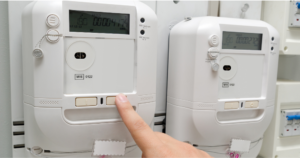
The display shows cumulative energy, usually in kWh. Many meters also cycle through instantaneous power, flow rate, supply and return temperature, and ΔT. Consumption for a billing period is the difference between two readings.
How BTU Charges Are Calculated
BTU charge = (Closing reading − Opening reading) × Rate per unit
A simplified consumption-based calculation is:
For example, suppose a meter records:
- Opening reading: 1,200 kWh
- Closing reading: 1,450 kWh
- Consumption: 250 kWh
- Rate: ₹8/kWh
Then:
250 × ₹8 = ₹2,000
So the thermal-energy component would be ₹2,000, assuming that this is the billing method and tariff applicable to that installation.
The actual bill may include additional components such as fixed charges, demand-related charges, maintenance, or other building-specific fees.
For example, an official National Payments Corporation of India (NPCI) premises tender describes air-conditioning charges based on actual consumption and calls for BTU or enthalpy metering where available
Common Reasons for High BTU Charges
Higher BTU consumption can result from several factors, including:
- Longer operating hours
- Lower temperature setpoints
- Higher cooling demand
- Increased occupancy
- Heat entering through windows or poorly insulated areas
- HVAC equipment or control issues
- Changes in chilled-water flow
Why Metered Billing Is Fairer
Fixed-allocation billing splits the building’s cooling cost by area, so a tenant who barely uses AC pays the same as a heavy user. Metered billing removes that cross-subsidy and rewards efficiency.
BTU Meter vs Electricity Meter
An electricity meter measures electrical energy. A BTU meter measures thermal energy carried by water. It needs both flow and temperature, which is why a plain flow meter cannot replace it.
| Parameter | BTU meter | Electricity meter |
| Measures | Thermal energy | Electrical energy |
| Inputs | Flow + ΔT | Voltage × current × time |
| Typical unit | kWh, BTU, GJ | kWh |
| Used in | Chilled/hot-water HVAC | Grid power supply |
BTU Meter Standards and Accuracy
For engineers specifying a thermal energy meter, the metrological standard matters as much as the measurement technology.
OIML R 75 Heat Meters is an important international reference for heat-meter requirements. OIML describes heat meters as instruments for measuring heat transferred in a heat-exchange circuit and defines key sub-assemblies including the flow sensor, temperature sensor pair and calculator.
OIML R 75 also specifies requirements around parameters such as temperature difference and flow rate.
BTU Meters in India
India’s centralised cooling market is growing, mainly in planned business districts, IT parks, hospitals and large commercial complexes. BEE’s District Cooling Roadmap identifies district cooling as a potential energy-efficient solution for India’s growing cooling demand.
GIFT City is one visible example: its district cooling system distributes chilled water through a utility network and uses monitoring and metering as part of system operation.
BTU metering can therefore be relevant in:
- District cooling projects
- IT parks
- Commercial buildings
- Hospitals
- Shopping malls
- Large residential developments
- Industrial facilities
- Centralised HVAC systems
The exact metering arrangement depends on the project’s HVAC architecture and billing requirements.
BTU charges rise and fall with how much cooling you draw, and cooling is one of the biggest electricity loads in any commercial building. A rooftop solar system can cover a large share of that daytime load, which lowers your overall energy bill. SolarSquare designs and installs rooftop solar for homes, businesses, and housing societies across India. Get a free solar consultation with SolarSquare and see how much you could save.
Frequently Asked Questions
What is a BTU meter used for in HVAC?
A BTU meter in HVAC is used to measure heating or cooling energy delivered through a hydronic system. Common applications include chilled-water systems, district cooling, centralised HVAC, and tenant-level energy billing.
What is the difference between a BTU meter and a flow meter?
A flow meter measures the amount or rate of fluid moving through a pipe. A BTU meter combines flow measurement with supply and return temperature measurements to calculate thermal energy.
How do you read a BTU meter?
Note the cumulative kWh on the display at the start and end of the period. The difference is your consumption.
Does a BTU meter measure electricity?
No. A BTU meter measures thermal energy, not electrical energy. An electricity meter measures electrical energy, normally in kilowatt-hours (kWh).
What is Delta T in a BTU meter?
Delta T is the temperature difference between the supply and return fluid. In a chilled-water system, it is generally calculated as the return temperature minus the supply temperature.