Businesses can claim 40% accelerated depreciation on solar under Section 32 of the Income Tax Act, subject to the applicable ownership, business-use, and commissioning rules. This allows an eligible business to deduct a significant portion of the solar plant’s value from its taxable income in the early years, instead of spreading the benefit over a much longer period.
For factories, hotels, hospitals, warehouses, and commercial buildings, a commercial rooftop solar system can therefore deliver savings in two ways:
- Lower monthly electricity bills
- Reduced taxable income
However, many businesses either miss this benefit or calculate it incorrectly, particularly when applying the 180-day rule or determining whether the additional 20% depreciation is available.
Electricity costs keep climbing for factories, hotels, hospitals, and commercial buildings, so the monthly bill savings from solar are easy to see. The 40% depreciation benefit is less visible, which is exactly why it gets missed.
This guide explains how accelerated depreciation for solar panels works in 2026, who actually qualifies for the full rate and who doesn’t, and how to calculate the tax savings.
What is Accelerated Depreciation on Solar Panels?
Accelerated depreciation on solar panels is a tax benefit for businesses. It allows a business to claim a higher deduction on the cost of a commercial solar plant in the early years after installation.
Normally, depreciation is spread over many years. But under accelerated depreciation for commercial and industrial solar systems, a business can claim 40% depreciation every year on the remaining value (also known as Written Down Value) of the solar plant. This is higher than the 15% rate generally allowed for regular machinery.
Written Down Value (WDV) means that depreciation is charged each year on the reducing balance of the asset rather than on its original cost.
Here is how it works:
- In Year 1, the business claims 40% depreciation on the full cost of the solar plant.
- In Year 2, it claims 40% depreciation on the value left after Year 1.
- In Year 3, it again claims 40% depreciation on the reduced value left after Year 2.
Source: Depreciation Under Income Tax Act, Income Tax Department Official Website
Because the balance shrinks each year, the deduction is largest at the start and decreases as the remaining value of the solar plant declines. This is why it is called accelerated depreciation, as the business receives a larger tax benefit in the early years rather than waiting many years.
How Much is Accelerated Depreciation on Solar Panels in India in 2026?
Indian businesses can claim 40% depreciation on the Written Down Value of a solar power system, subject to the applicable tax rules. This is the rate for almost every eligible commercial rooftop solar buyer, and it applies in full when the plant is used for 180 days or more in the year of commissioning.
A separate additional depreciation of 20% exists under a specific provision, but it is conditional and does not apply to every business. For this reason, the safe planning figure for most companies in 2026 is 40%, not 60%.
The upcoming sections explain when the extra 20% accelerated depreciation on solar systems is genuinely available and when it is not.
Section 32 of the Income Tax Act, 1961
Section 32 of the Income-tax Act, 1961, is the legal provision that allows depreciation on all business assets, including solar power systems. In the context of rooftop solar, it helps determine eligibility to claim depreciation, the applicable asset category, and the method used to calculate the deduction.
The provisions below explain how this treatment applies to solar projects in India. Together, they clarify who can claim the benefit and when the asset qualifies.
#1. Section 32: The Core Provision for Accelerated Depreciation on Solar Panels
Section 32 of the Income Tax Act, 1961, allows a business to claim depreciation on assets used for business or professional purposes. For a solar power plant, this means the business can claim accelerated depreciation only when the asset meets the basic conditions, listed below:
- Ownership: The business must own the solar plant, either fully or in part, as accelerated depreciation can be claimed only by the asset owner.
- Business use: The solar plant must be used for business or professional purposes. For example, a rooftop solar system used to power a factory, office, warehouse, hotel, hospital, or commercial building would meet this condition.
- Put to use: The system must be installed and commissioned during the relevant financial year. Buying the solar equipment is not enough on its own, because the plant has to be put to use before the claim arises.
- Capitalized in the books: The solar plant should be recorded as a fixed asset in the books of account. It should form part of the relevant block of assets and should not be treated as a regular business expense.
The depreciation rate itself comes from Rule 5 and Appendix I of the Income-tax Rules, 1962.
- Appendix I places solar power generating systems inside the block for renewable energy devices, which carries a 40% rate on the Written Down Value.
- This is what makes the solar panel depreciation rate in India so much higher than the rate for ordinary machinery.
Here’s a short illustration showing how the Written Down Value method runs over time. We’ve taken the example of a PV system, priced at Rs. 50 lakh:
- In Year 1, you depreciate 40% of Rs. 50 lakh, which is Rs. 20 lakh, leaving a closing value of Rs. 30 lakh.
- In Year 2, you depreciate 40% of Rs. 30 lakh, which is Rs. 12 lakh, leaving Rs. 18 lakh.
- In Year 3, you depreciate 40% of Rs. 18 lakh, which is Rs. 7.2 lakh, leaving Rs. 10.8 lakh.
The deduction is largest in the early years and shrinks as the balance falls. Clearly, since depreciation is not charged on the original cost every year, tax benefits are front-loaded, i.e., they’re maximum in the initial years.
Solar assets are also depreciated under the block-of-assets system. This means the business does not calculate depreciation separately for each solar panel or inverter. Instead, all assets in the same category are grouped into one block, and depreciation is calculated on the Written Down Value of that block after adjusting for additions and sales during the year.
#2. Additional Depreciation Under Section 32(1)(iia)
Section 32(1)(iia) allows an additional depreciation of 20% on new plant and machinery in certain cases. This is in addition to the normal depreciation rate.
For solar projects, this provision is important because it allows some businesses to claim a total accelerated depreciation benefit of 60%. However, this 60% figure does not apply to every rooftop solar buyer.
A business can consider this additional 20% only when the asset is new, acquired and installed by the assessee, used for the business, and the business itself must be engaged in either of two activities.
- Manufacture or production of any article or thing
- Generation, transmission, or distribution of power
The extra 20% depreciation is often presented as a standard benefit for all rooftop solar buyers. In reality, it applies only to specific types of businesses. Let’s understand this better through some examples.
- Stronger case for the extra 20%: A factory that installs rooftop solar for captive consumption, since the assessee is already engaged in manufacturing or production. A business that itself generates, transmits, or distributes power can also fall in this category.
- Needs a careful view: An office, a retail outlet, a warehouse, a corporate building, or service business using rooftop solar only to cut its own electricity bill can claim normal 40% accelerated depreciation on solar once ownership and business-use conditions are met, but it should not assume the additional 20% without a chartered accountant confirming the Section 32(1)(iia) conditions.
Who Is Eligible for Accelerated Depreciation on Solar?
The following entities can generally claim accelerated depreciation on solar panels, provided they own the asset and use the generated power for business purposes.
- Companies, both private and public limited
- LLPs and partnership firms
- Proprietorships and MSMEs
- Factories and industrial units
- Warehouses and logistics facilities
- Hotels and hospitals
- Schools and colleges that operate as businesses
- Commercial and corporate buildings
However, the benefit does not reach all solar consumers. Here’s everyone who is not eligible for accelerated depreciation on solar panels:
- A salaried individual installing residential rooftop solar cannot claim business depreciation, because there is no business income to set it against.
- A business that goes solar under an OPEX or RESCO model also cannot claim it, because the solar developer owns the plant under that structure. In that case, the developer claims the depreciation and usually passes part of the value back to the customer through a lower power tariff predecided under a solar power purchase agreement (PPA).
The 2026 Reality Check: The Concessional Tax Regime Trade-Off
For 2026, the key tax-planning question is no longer limited to whether accelerated depreciation on solar panels is available, because it is. The most critical question is whether the company can claim only 40% depreciation or also claim the additional 20% depreciation.
This is where the concessional corporate tax regime under Section 115BAA becomes important.
- Many domestic companies have moved to this regime because it offers a lower corporate tax rate of 22%, plus applicable surcharge and cess.
- For companies that qualify, this can reduce the overall tax burden.
- However, the choice is generally irrevocable. So, a company that has moved to Section 115BAA usually cannot switch back to the regular regime later.
The trade-off is that a company under Section 115BAA cannot claim additional depreciation under Section 32(1)(iia). For solar planning, this means:
- The company can still claim normal depreciation on the solar plant.
- The 40% depreciation rate on Written Down Value can still apply.
- The additional 20% depreciation is not available under Section 115BAA.
- The solar depreciation benefit should be calculated at 40%, not 60%.
From FY 2026-27, the Income-tax Act, 2025, has come into force, and it reorganizes the existing depreciation provisions. However, the core treatment for solar depreciation remains the same. The Written Down Value method, block-of-assets concept, 180-day usage rule, additional depreciation framework, and 40% rate for solar power generating systems continue in substance.
Other Tax Rules That Affect Solar Depreciation Claims
Apart from the depreciation rate, businesses also need to check how the solar asset is valued, who owns it, how it is used, and what happens if it is sold later. These rules can change the actual depreciation claim even when the 40% rate is available.
- Actual cost under section 43(1): Depreciation is calculated on the actual cost of the solar asset. For a rooftop solar project, this usually includes the cost of the solar panels, inverters, mounting structures, installation, commissioning, freight, and taxes that are not eligible for input credit. This matters because depreciation is not calculated only on the panel cost. It is calculated based on the capitalized cost of the complete solar plant, subject to applicable tax rules.
- Subsidy adjustment under explanation 10 to section 43(1): For most commercial and industrial rooftop solar projects, a direct government subsidy is generally unavailable. However, explanation 10 to Section 43(1) still matters as a cautionary rule. It says that if any part of the solar plant’s cost is covered by a subsidy, grant, or reimbursement, that portion may be deducted from the asset’s actual cost before calculating depreciation. So, depreciation is generally claimed only on the net cost borne by the business. This clause applies only when a specific scheme or support actually funds part of the project cost.
- Solar assets taken on lease: Depreciation usually follows ownership, not just physical use. This becomes important when a business uses a solar plant under a lease arrangement. In a finance lease, the lessee may be able to claim accelerated depreciation in certain situations, depending on the terms of the agreement. In an operating lease, depreciation is usually claimed by the lessor because the lessor remains the owner of the asset. Since lease structures can vary, businesses should review the contract before assuming who can claim depreciation.
- Partial business use under section 38: If the solar asset is used partly for business and partly for non-business purposes, depreciation may be restricted proportionately. For example, if a solar system powers both business premises and personal-use areas, the business may not be able to claim depreciation on the entire asset. The claim should reflect the extent of business use.
- Sale or transfer of solar assets under Section 50: If the solar plant is sold, transferred, scrapped, or removed from the business, the tax treatment follows the block-of-assets rules under Section 50. This becomes relevant when a business exits the project, sells the premises, transfers the plant, or replaces old equipment. In such cases, the sale value can affect the Written Down Value of the asset block and may lead to capital gains treatment under the tax rules.
For 2026 planning, businesses should compare these things:
| Provision | Purpose | Impact on Solar |
| Section 32 | Main depreciation section | Allows depreciation |
| Rule 5 + Appendix I | Prescribes rates | 40% on Written Down Value (WDV) |
| 180-day proviso to Section 32 | Restricts first-year claim | 20% if used under 180 days |
| Section 32(1)(iia) | Additional depreciation | Extra 20% for eligible cases |
| Section 115BAA | Concessional tax regime | Disallows additional depreciation |
| Section 43(1) | Actual cost | Determines depreciable base |
| Explanation 10 to Section 43(1) | Subsidy or grant adjustment | May reduce cost base |
| Section 38 | Partial business use | Proportionate claim |
| Section 2(11) | Block of assets | WDV concept |
| Section 50 | Sale of assets | Capital gains provisions |
How Does Accelerated Depreciation on Rooftop Solar Work in India?
Accelerated depreciation works by converting part of the solar plant’s cost into a tax deduction. Once the plant’s eligible cost is determined, the business applies the 40% depreciation rate to calculate the deduction for the year. The actual tax saving then depends on the company’s applicable tax rate.
Let’s explore how this happens step by step in the section to come.
How to Calculate Accelerated Depreciation Step by Step?
Here are the five clear steps that demonstrate how a business can calculate accelerated depreciation on solar:
- Step 1 – Determine the depreciable asset value: Start with the capital cost of the complete rooftop solar system. This may include solar modules, inverters, mounting structures, installation, commissioning, freight, and other eligible capital expenses. If the business claims input tax credit on GST, the GST amount claimed as credit is generally not included in the depreciable cost.
- Step 2 – Apply the 40% depreciation rate: Solar power generating systems are covered under the renewable energy devices block and are eligible for 40% depreciation on a Written Down Value basis. For Year 1, depreciation = project cost × 40%.
- Step 3 – Apply your effective tax rate: Multiply the Year 1 depreciation amount by the effective income tax rate applicable to the business. This shows how much tax the business can save because of the depreciation deduction. Tax saving = depreciation amount × effective tax rate.
- Step 4 – Calculate the net tax saving: The net tax saving is the reduction in income tax liability created by the depreciation claim. In other words, it is the amount of tax the business avoids paying in Year 1 because depreciation reduces its taxable income.
- Step 5 – Calculate the effective cost of the solar system: Subtract the Year 1 tax savings from the original project cost. This gives the effective cost of the solar system after considering the first-year tax benefit. Effective system cost = Total project cost − tax saving.
The whole calculation reduces to one formula.
| Tax Saving = Solar Project Cost × Depreciation Rate × Applicable Tax Rate |
Here’s a working example to make the calculation simpler to understand:
| Parameter | 100 kW Solar System | 1 MW Solar System |
| Total system cost | Rs. 45 lakh | Rs. 4.2 crore |
| Year 1 depreciation @ 40% | Rs. 18 lakh | Rs. 1.68 crore |
| Tax saving @ 25% | Rs. 4.5 lakh | Rs. 42 lakh |
| Effective cost after tax benefit | Rs. 40.5 lakh | Rs. 3.78 crore |
Please note: This example is for illustration only. The actual tax saving may vary based on the company’s tax regime, effective tax rate, GST input tax credit treatment, subsidy treatment, if any, date of commissioning, extent of business use, and eligibility under the Income Tax Act. Businesses should confirm the final depreciation claim and tax impact with their chartered accountant before using these numbers for financial planning or tax filing.
What’s the 180-Day Rule? Why Installation Date Matters?
The 180-day rule affects the amount of accelerated depreciation a business can claim in the year the solar plant is first put into use. Under this rule, the date of commissioning matters because depreciation depends on whether the asset was put to use for at least 180 days during the financial year.
- If the rooftop solar system is used for 180 days or more: The business can claim the full applicable depreciation for that year. For solar power systems, this means the full 40% depreciation can apply in Year 1.
- If the system is put to use for less than 180 days: The business can claim only 50% of the applicable depreciation for that year. For solar, this reduces the Year 1 claim from 40% to 20%.
CAPEX vs OPEX Solar: Who Gets the Tax Benefit?
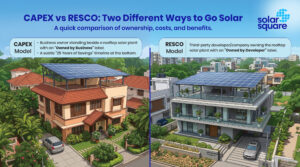
The main difference between CAPEX and OPEX/RESCO models is plant ownership, which also affects who receives the accelerated depreciation tax benefit.
- Under the CAPEX model, the business buys and owns the solar system outright. So, the business claims the depreciation once it meets the tax conditions. This is one of the main reasons profitable businesses prefer direct ownership.
- Under the OPEX or RESCO model, the developer owns the system, and the business simply buys the electricity it generates through a power purchase agreement. Here, the developer claims accelerated depreciation on the solar plant.
Can Businesses Claim GST Input Tax Credit on Solar Panels?
A GST-registered business may be able to claim ITC on a rooftop solar project if the solar plant is used for taxable business activities. When claimed, ITC reduces the GST cost and lowers the project’s actual upfront cost.
However, ITC treatment is not the same for every solar project.
It depends on how the purchase is structured, how the invoice is raised, how the EPC contract is drafted, and whether the solar system is treated as a movable plant or part of immovable property.
The GST rate may also vary depending on whether components are billed separately or supplied as part of a bundled solar power system.
This matters for depreciation as well.
- If the business claims ITC on the GST portion, that GST amount is generally not included in the depreciable cost of the solar asset.
- Depreciation is calculated on the project cost excluding the GST credit claimed.
Because GST and depreciation are linked in the project calculation, businesses should confirm two things before finalizing the numbers:
- Whether ITC is available on the specific solar installation
- How the claimed ITC affects the depreciable value of the asset
Documents Needed to Claim Solar Depreciation
To support a solar depreciation claim, the business should maintain a clear record of the project cost, ownership, commissioning date, and business use.
Key documents include:
- The tax invoice for the solar plant
- Proof of payment to the vendor or EPC contractor
- Commissioning certificate
- Fixed asset register entry
- Net metering or DISCOM approval where applicable
- Capitalisation entries in the books of account.
These records help establish that the solar plant was owned, installed, put into use, and treated as a capital asset in the correct block of assets.
Common Mistakes Businesses Make When Claiming Accelerated Depreciation on Solar
Most errors in solar depreciation claims stem from using incorrect assumptions in the project calculations. Here are the common mistakes businesses should avoid:
- Assuming depreciation is always 60%: The normal rate for solar is 40%. The additional 20% applies only in specific cases, and companies under Section 115BAA cannot claim it.
- Missing the 180-day rule: If the solar plant is put to use for less than 180 days in the financial year, the first-year depreciation claim drops from 40% to 20%.
- Counting depreciation under an OPEX or RESCO model: Depreciation can be claimed only by the owner of the solar plant. If the business does not own the asset, it should not include depreciation in its own savings calculation.
- Mixing residential and business installations: Depreciation applies to business assets used for business purposes. A residential rooftop solar system does not create a business depreciation claim.
Accelerated Depreciation on Solar Panels vs PM Surya Ghar Subsidy: Which Applies to Your Business?
Often confused, both these benefits are quite different. While accelerated depreciation is the 40% tax benefit that businesses installing rooftop solar can claim, the PM Surya Ghar Muft Bijli Yojana is the central subsidy that can only be claimed by homes and housing societies installing a grid-connected solar system.
Here’s a snapshot of the key differences between the two:
| Feature | Accelerated Depreciation on Solar Panels | PM Surya Ghar Muft Bijli Yojana |
| What is it? | Tax benefit of 40% that businesses can claim on solar | The central government’s solar subsidy scheme for housing societies and homeowners installing rooftop solar. |
| Who it is for | Businesses with taxable income | Homeowners and housing societies |
| Form of benefit | Income tax deduction | Direct subsidy transfer to lower solar installation cost |
| Legal basis | Section 32, Income Tax Act | Residential rooftop solar scheme |
| Ownership needed | Business owns the plant | Homeowner/society owns the plant |
Benefits of Accelerated Depreciation on Solar Panels for Businesses
Accelerated depreciation makes rooftop solar more cost-effective by reducing taxable income in the project’s early years. When used correctly, it can lower the effective cost of the solar plant, improve cash flow, and shorten the payback period alongside the savings from reduced electricity bills.
Let’s have a look at all the benefits in detail:
- Reduces taxable income: The biggest benefit is that depreciation lowers the business’s taxable profit. When a company claims depreciation on its solar power system, that amount is treated as an expense for tax purposes. This reduces the income on which tax is calculated.
- Improves cash flow in the early years: Solar already reduces monthly electricity bills. Accelerated depreciation adds another layer of financial benefit by reducing tax outflow. This means the business can keep more cash within the company during the early years after installation. This is useful for factories, warehouses, hotels, hospitals, schools, commercial buildings, and MSMEs with high electricity bills.
- Shortens the effective payback period: The payback period of a solar project usually depends on power savings. With accelerated depreciation, the tax benefit can reduce the effective project cost. As a result, the business may recover its investment faster than it would through electricity savings alone.
- Makes CAPEX solar more attractive: In a CAPEX model, the business owns the solar asset. Since the owner can usually claim depreciation, direct ownership is more attractive for profitable businesses. This is one reason many businesses compare CAPEX solar with OPEX or RESCO models before choosing a project structure.
- Supports long-term energy cost savings: Once the solar system starts generating solar electricity, the business saves on power bills for many years. Accelerated depreciation on solar panels further improves the financial return in the initial years, while solar generation continues to reduce operating costs over the long term.
- Helps profitable businesses use tax planning better: Accelerated depreciation is most useful for businesses with taxable profits. A profitable business can use the depreciation deduction to reduce its tax liability and improve its post-tax returns from the solar project.
- Encourages investment in clean energy: The higher depreciation rate for solar power systems encourages businesses to invest in renewable energy. It reduces the financial burden of adopting solar and supports India’s broader clean energy goals. For businesses, this creates a double benefit of lower electricity costs and a stronger sustainability profile.
Conclusion
Accelerated depreciation improves the return from rooftop solar because businesses can claim 40% of the solar plant’s cost as depreciation in the early years.
The key is to calculate the benefit correctly. Most businesses should plan around the normal 40% depreciation rate. The additional 20% depreciation is not automatic. It applies only when the business meets specific conditions, such as being in manufacturing, production, or the power sector.
A business should also check the ownership model, commissioning date, GST treatment, and documentation before estimating depreciation, tax savings, payback period, and return on investment.
When basics are handled properly, accelerated depreciation can become a reliable tax benefit that improves the overall return from rooftop solar. Want to install rooftop solar for your business but don’t know where to begin? You can book a free solar consultation call with SolarSquare.
FAQs
Can I claim depreciation if I install solar under the OPEX model?
No. Under an OPEX or RESCO model, the developer owns the plant and claims depreciation. As a customer, you just buy electricity from the developer under a power purchase agreement and benefit through a tariff that’s lower than the grid tariff.
Is GST ITC available on commercial solar panels?
GST ITC is usually available if your business is GST-registered and uses the solar plant for taxable business activities. However, the final claim depends on how the components are classified, how the EPC contract is structured, and the type of business. It is best to confirm this with a tax advisor before claiming ITC.
Is accelerated depreciation the same as a solar subsidy?
No, they are different. Accelerated depreciation is an income tax deduction claimed by a business against its taxable income. A subsidy, such as the PM Surya Ghar Muft Bijli Yojana, is a direct grant offered to lower the cost of the system and is aimed at residential buyers.
Does GST count in the depreciable value?
GST is usually not included in the depreciable value if the business claims input tax credit on it. If the GST input credit is unavailable or not claimed, the GST amount may be included in the asset cost for depreciation.
What is the difference between standard depreciation and accelerated depreciation?
Here’s a snapshot of the key differences between the two.
| Feature | Standard Depreciation | Accelerated Depreciation |
| Rate on general machinery | 15% WDV | Not applicable |
| Rate on solar system | Not applicable | 40% WDV |
| Timing of relief | Spread evenly over years | Front-loaded into early years |
| Effect on early cash flow | Smaller but steady | Larger in the first years |
Does accelerated depreciation apply to solar systems taken on lease or PPA?
It depends on legal ownership. Under a PPA, the developer owns the plant and claims the depreciation. Under a lease, a finance lease may let the lessee claim it in certain situations, while an operating lease usually leaves the claim with the lessor. The contract terms decide the outcome.
Can a business claim accelerated depreciation and the PM Surya Ghar subsidy together?
These two do not merge under any scenario. The PM Surya Ghar Muft Bijli Yojana subsidy is a residential scheme for households, while accelerated depreciation is a business benefit. A commercial installation does not qualify for the residential subsidy. So, the two are not combined on the same business project.